Back
“Mythos.1” - Class AI in Mechanical Engineering and CAD Design
AI-Driven CAD Automation, Parametric Design, and Mechanical Engineering with Claude Fable 5.1 and MecAgent

Claude Fable 5.1 & MecAgent
Introduction
Mechanical engineering is entering a major strategic shift with the emergence of “Mythos”-class language models. We are moving beyond the era of simple text-based assistance and into one characterized by the direct manipulation of complex CAD scripts, agentic workflow automation, and rigorous validation of parametric models. This transition transforms AI from a mere documentation tool into a design partner capable of interpreting geometric intent and controlling rendering and simulation engines.
This efficiency is built on a synergistic technical architecture:
Claude Fable 5.1 & Mythos 5.1 (Anthropic): State-of-the-art reasoning engines, particularly strong in large-scale contexts, software engineering, and spatial reasoning.
MecAgent: The specialized industry integration layer. It acts as an abstraction layer between the AI’s cognitive capabilities and the proprietary APIs of industrial software.
The ambition is clear: deploy autonomous automation at the heart of industry-standard platforms such as SOLIDWORKS or Autodesk Inventor, while maintaining critical human oversight. This approach ensures that execution speed never comes at the expense of the physical safety of the designs.
Claude Fable 5.1 and Mythos 5.1: The New Performance Frontier
Claude Fable 5.1 & Mythos 5.1 are the new versions of Anthropic’s latest model for the September 2026 release cycle. Technically, they are the same model, but they apply different levels of safeguards: Fable 5.1 is generally accessible, whereas Mythos 5.1 is reserved for strict trusted programs, with filters specifically tailored to the life sciences and cybersecurity.
Industrial integration has so far required companies to manage three strategic risks, which this 5.1 version directly addresses compared with the previous generation:
Cost Overhead Risk : While Fable 5 was priced at $10/$50 per million tokens — twice the price of Opus 4.8 — Fable 5.1 reduces these costs by approximately 25% for standard workloads, thanks to lower cached-input pricing. For highly agentic CAD workloads requiring a large context window, the savings reach nearly 45%.
IP Confidentiality (Data Retention) : The data-retention policy previously had to be carefully reviewed and incorporated into the company’s IP compliance matrix. The new Enterprise Frontier Safeguards (EFS) system now provides complete confidentiality equivalent to a zero-retention policy by storing data on the customer’s dedicated cloud infrastructure.
Security and False Positives : Fable 5.1 reduces cybersecurity false positives by 60%, allowing the AI to actively analyze your software architectures for vulnerabilities without unnecessarily blocking generation.
CAD-Optimized Coding Capabilities
Fable 5.1 avoids shortcuts that degrade quality over time. For the development of complex scripts, this robustness is essential. Feedback from software engineering leaders confirms that Fable 5.1 solves more complex coding problems and, most importantly, remains highly readable during extremely long, multi-step tasks.
This is a major advantage for the iterative creation of parametric CAD assemblies, where the AI must remember variables defined at the beginning of the script.
These advances are reflected in Anthropic’s new benchmarks:
Agentic coding (CursorBench 3.2.0): 73.4%
Enterprise workflows (AutomationBench): 31.4% (versus 17.1% for Fable 5)
Agentic scientific research (Terminal-Bench-Science 0.1): 52.6% (versus only 24.7% for Fable 5)
Agentic coding (Terminal-Bench 4.0): 55.8% (and 60.9% with Mythos 5.1’s adjusted filters)
Compared with Claude Opus 4.8, the model delivers notable improvements in agentic coding, spatial reasoning, and understanding of complex technical contexts — areas directly relevant to mechanical engineering and CAD applications.
However, it retains the same philosophy of behavioral robustness: the model incorporates enhanced safety measures for sensitive topics (biology, cybersecurity, and R&D involving language models), where it may adopt more cautious behavior, even at the expense of some raw performance, rather than risk providing potentially dangerous information.
This philosophy is also reflected in agentic environments such as Claude Code, where the model generally favors cautious, verifiable strategies over aggressive or difficult-to-trace modifications.
Key Published Global Performance Indicators
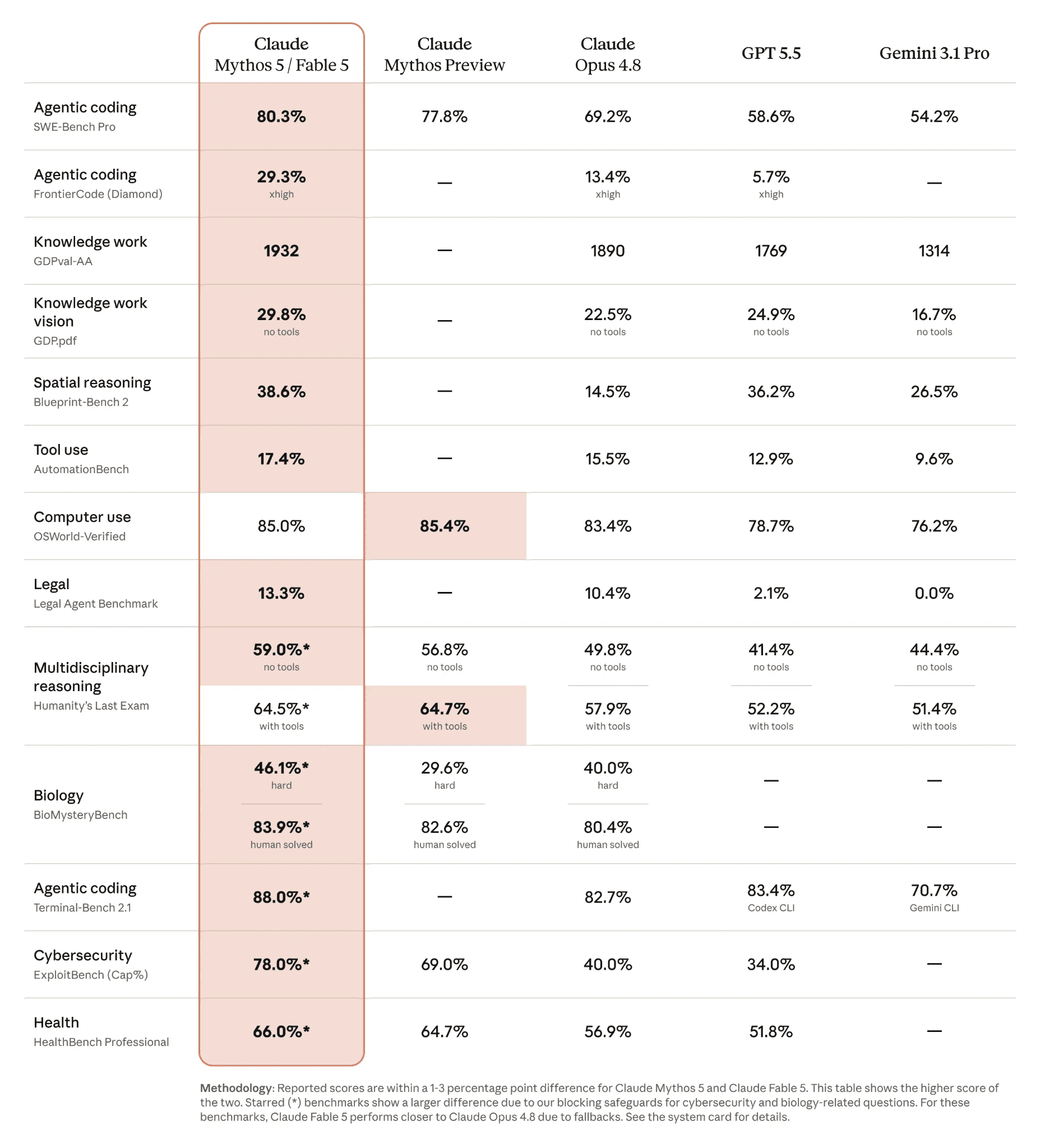
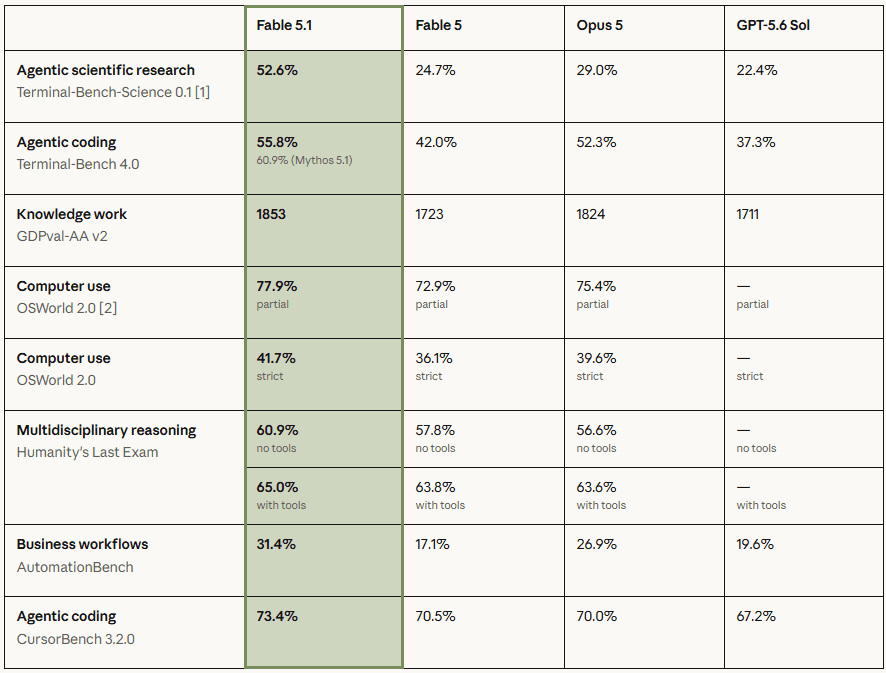
The transition from Fable 5 to Fable 5.1 shows clear progress, particularly in scientific research, complex enterprise workflows, and agentic coding, while also being accompanied by stricter benchmarks.
Direct performance evolution (Fable 5 vs. Fable 5.1):
Agentic scientific research (Terminal-Bench-Science 0.1): Score more than doubled, rising from 24.7% to 52.6%.
Enterprise workflows (AutomationBench): Major jump from 17.1% to 31.4% (+83% relative gain).
Terminal coding (Terminal-Bench 4.0): Improvement from 42.0% to 55.8% (and up to 60.9% for Mythos 5.1).
Computer use (OSWorld 2.0 – strict): Increase from 36.1% to 41.7% (and from 72.9% to 77.9% under partial evaluation).
Knowledge work (GDPval-AA v2): Increase from 1,723 to 1,853 points.
Multidisciplinary reasoning (Humanity's Last Exam): Slight increase from 57.8% to 60.9% without tools, and from 63.8% to 65.0% with tools.
Agentic coding (CursorBench 3.2.0): Increase from 70.5% to 73.4%.
Evolution of the evaluation methodology:
Stricter testing: Several metrics have been updated to newer and more demanding versions (Terminal-Bench moved from v2.1 to v4.0, OSWorld moved to v2.0, and GDPval-AA moved to v2).
New focus: The Fable 5.1 assessment places greater emphasis on agentic coding (CursorBench) and scientific research (Terminal-Bench-Science), while the highly specialized benchmarks featured in the first image (law, healthcare, biology) have been incorporated into other evaluation frameworks or dedicated programs.
However, industrial deployment requires managing three strategic risks:
Cost Management and Efficiency: Fable 5.1 reduces the overall cost by 25% on typical tasks and by up to 45% on iterative agentic workflows, thanks to lower cache read pricing. Fallback interruptions are also significantly reduced, owing to a 60% reduction in false positives from safety filters.
IP Confidentiality (Zero Retention): Data security is addressed through the Enterprise Frontier Safeguards (EFS) system, which enables companies to guarantee absolute confidentiality (zero retention) by keeping their data within their own cloud infrastructure.
The Agentic Ecosystem: The Claude Code environment remains the preferred channel for large-scale automation and script maintenance, with the Fable 5.1 model deployed there by default at the maximum effort level (High effort) to solve complex geometric problems.
Iteration Evolution Analysis: The OpenSCAD Case Study
Benchmark
Benchmark Test / Model | Opus 4.6 | Opus 4.7 | Opus 4.8 | Fable 5 | Fable 5.1 |
OpenSCAD Nema 17 (/20) | 7.5 | 12.5 | 14.5 | 16.5 | 18.75 |
OpenSCAD V8 engine Block (/20) | 5.5 | 9.0 | 12.5 | 14.5 | 17.5 |
Average Response Time | 2 min 20 s | 5 min 35 s | 6 min 45 s | 5 min 55 s | 5 min 42 |
Total Score (/40) | 13.0 | 21.5 | 27.0 | 31.0 | 36.25 |
Note on the Scoring Criteria Update: In response to the arrival of next-generation models such as Fable 5.1, we have tightened the criteria used in our benchmark. The scoring methodology has shifted from simple aesthetic validation to a more rigorous industrial audit, covering native parametric modeling, algorithmic cleanliness, and self-diagnostic modules. Previous versions of Opus have therefore been reassessed using this new scale in order to accurately reflect their technical performance and preserve a logical margin for improvement in future models.
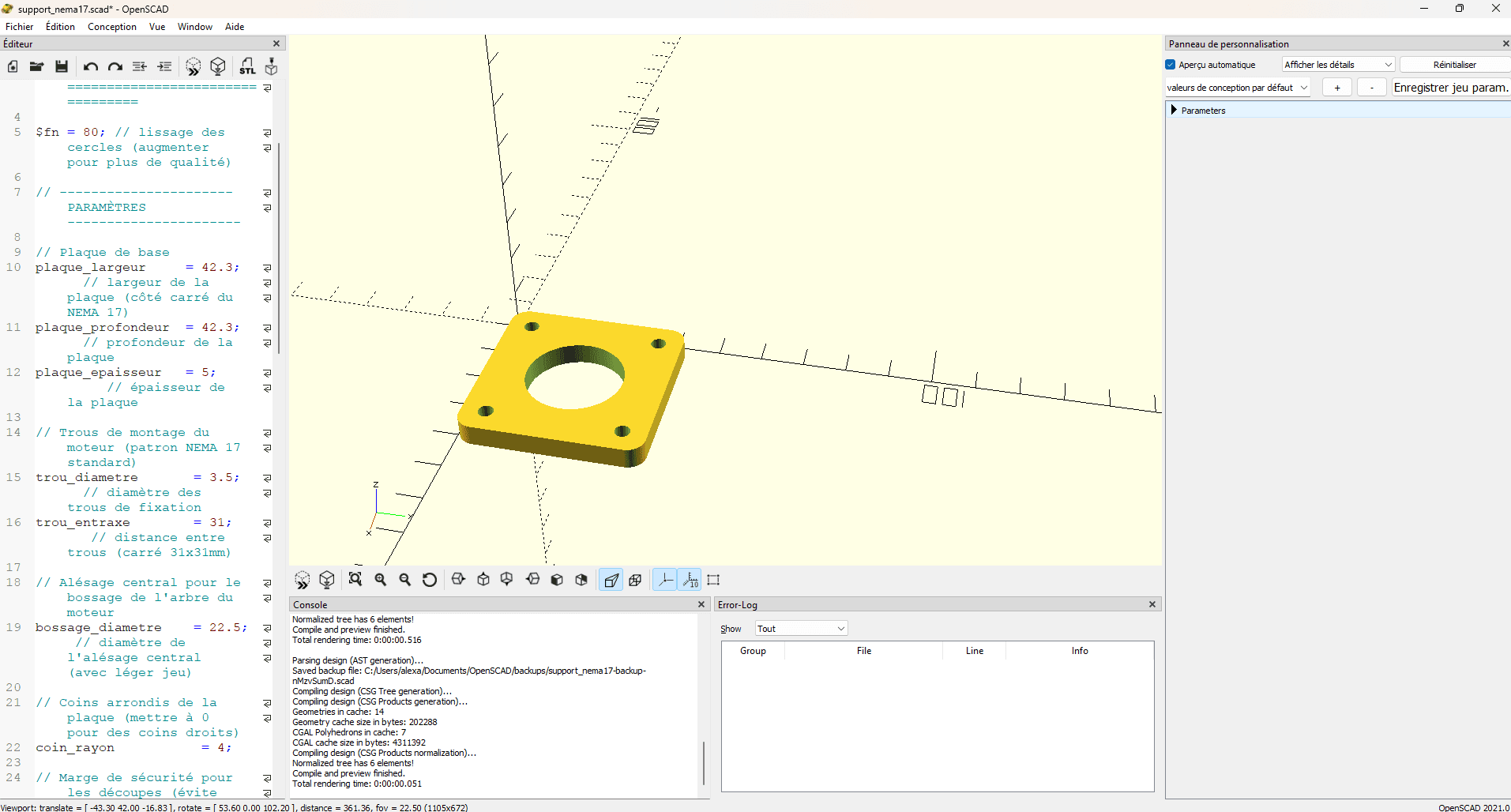
Opus 4.6: The model does very well on form, with error-free code and a clean visual on first launch. However, the robustness test reveals a lack of geometric logic: holes are placed with fixed coordinates. Changing the plate size breaks the assembly, which limits the value of a parametric tool like OpenSCAD.
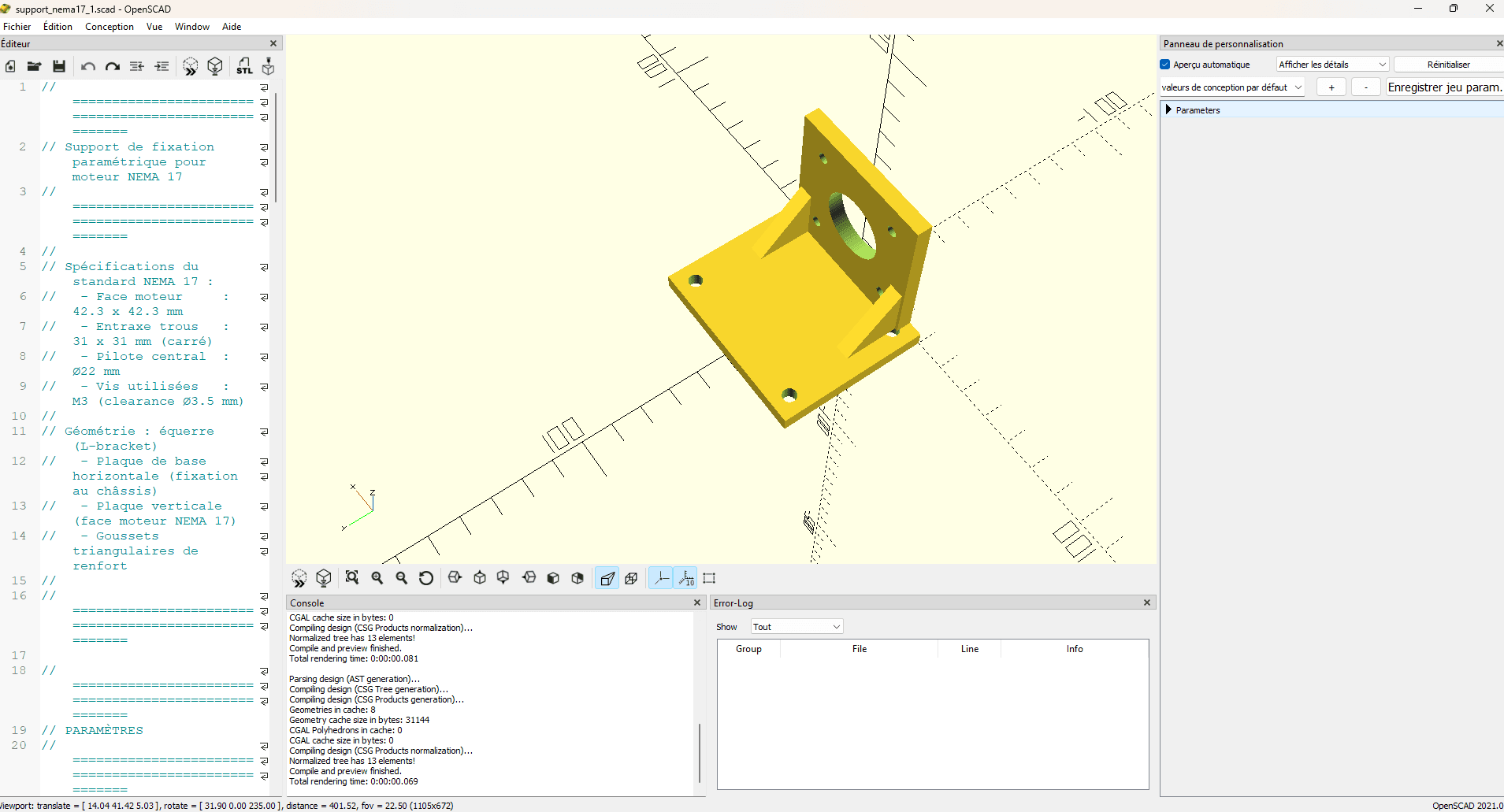
While the 4.7 model proved slightly slower at generation, the engineering quality produced is superior. Where the 4.6 model produced rigid, fragile code (requiring manual intervention), the 4.7 model successfully incorporated native geometric logic, making the object genuinely parametric and reusable.
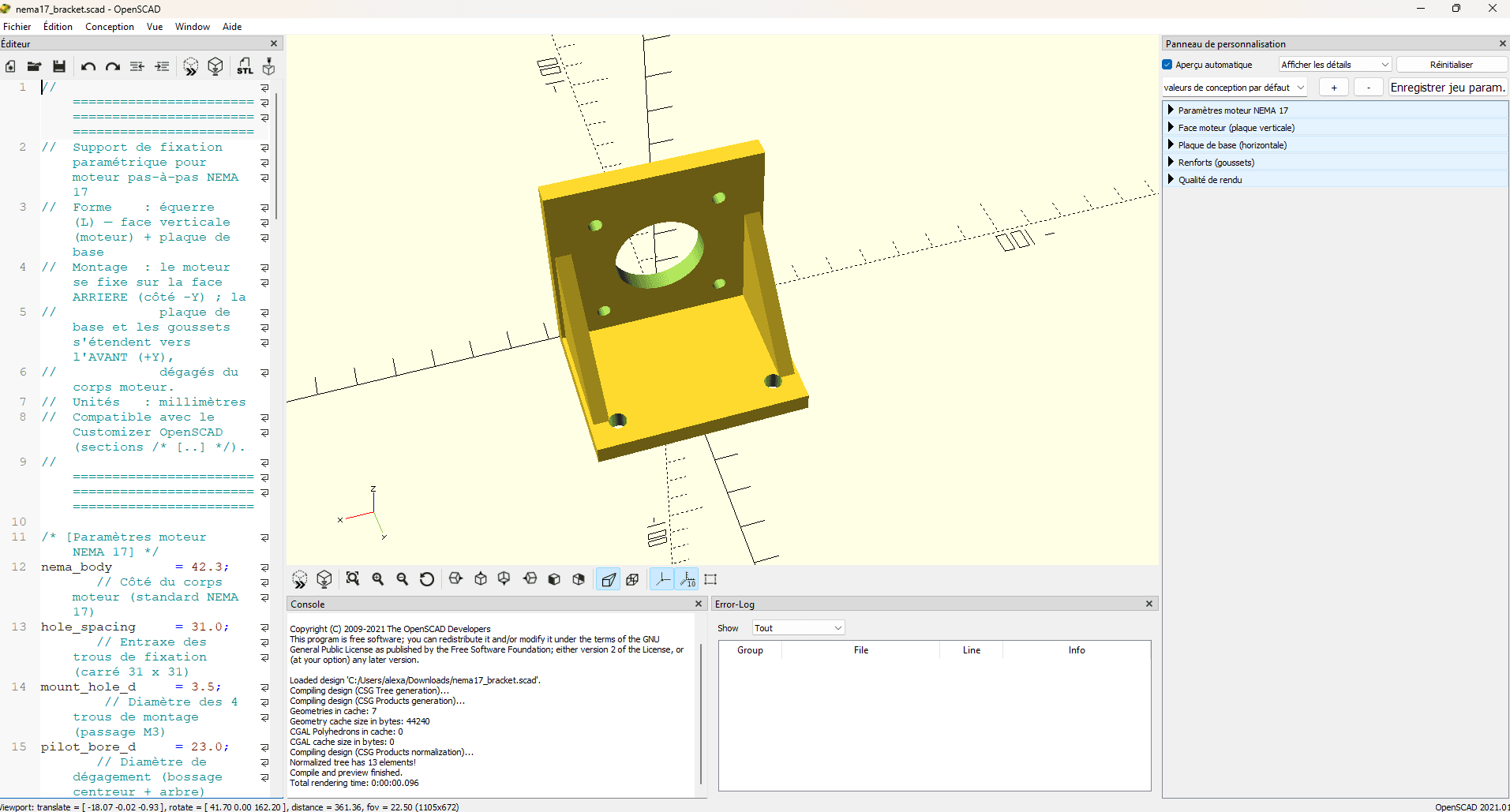
If the gain between version 4.6 and 4.7 was a matter of structural reliability, the gain between 4.7 and 4.8 is a matter of user comfort. By natively integrating OpenSCAD's "Customizer" features, the 4.8 model doesn't just deliver code: it delivers a ready-to-use user interface. The extra slowness here is simply the price of advanced thinking about the end-user experience.

Opus 4.8 crossed a comfort threshold; Fable achieves genuine industrial maturity. Where Opus 4.8 made a design error by locking in simple round drill holes for the frame, Fable incorporates true functional oblong slots via the hull() function. The code drops visual approximations in favor of a clean modular structure and a standardized overshoot (eps = 0.1). Above all, its trigonometry-based diagnostic module prevents hardware collisions with the motor body, guaranteeing a defect-free part that's directly production-ready.
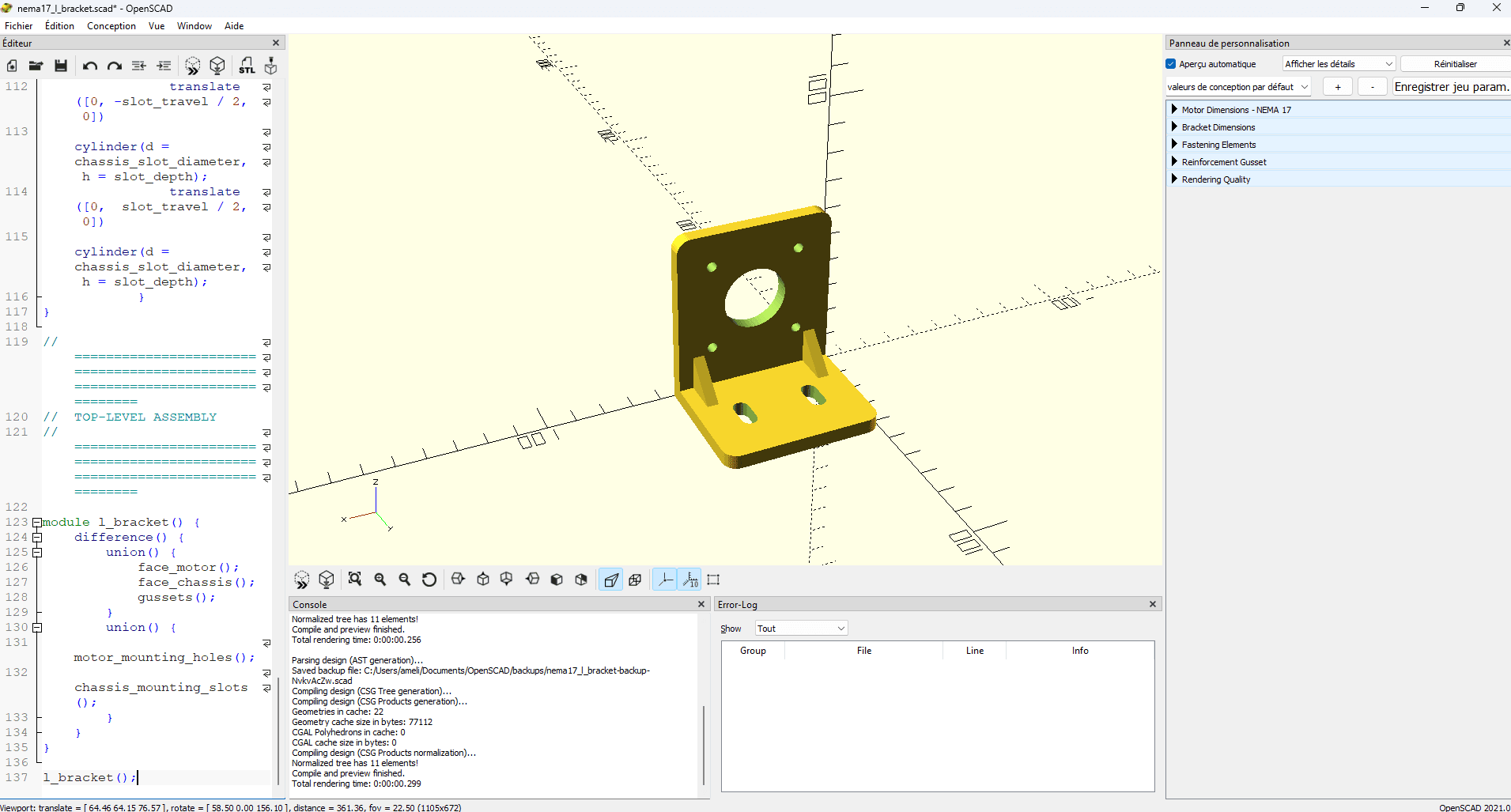
Fable 5.1 marks a clear shift toward product design. Whereas version 5 retained raw, unfinished forms, Fable 5.1 eliminates sharp edges through the introduction of a fillet radius (corner_radius) extruded from a 2D profile. The part gains greater aesthetic maturity while also reducing stress concentration.
However, this visual improvement comes at a cost: the complete removal of the diagnostic module. By sacrificing console-based self-validation in favor of more compact code, Fable 5.1 prioritizes the ergonomics of the physical object over algorithmic reliability.
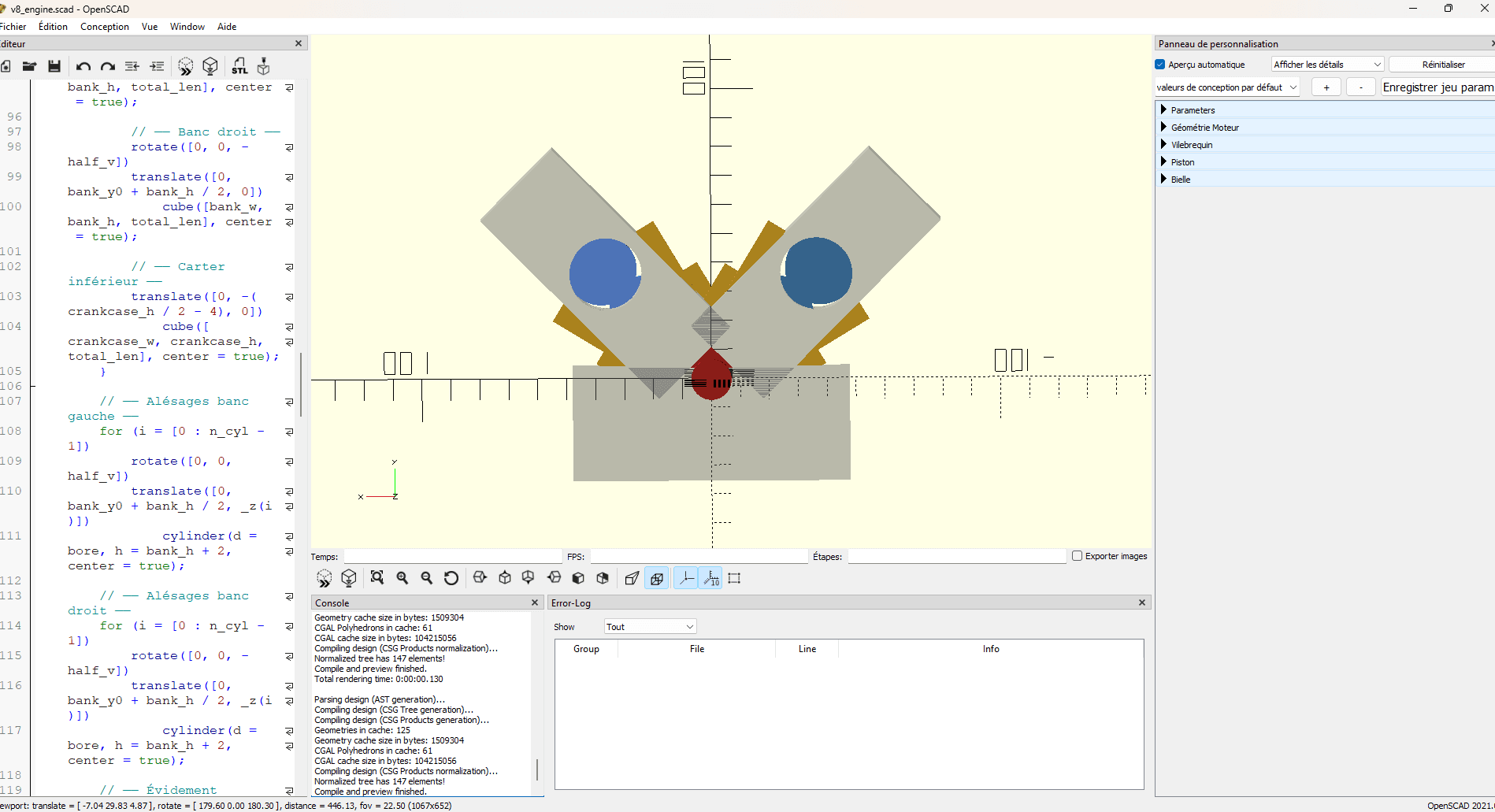
If the 4.6 model impresses at first glance with its ability to generate a complex structure, it reveals its limits as soon as rigorous mechanical validation is required.
Where we expected fluid kinematic simulation, we got a "visual mock-up": the code compiles, but the geometry doesn't obey the laws of physics. Pistons move outside their bores and connecting rods lose their anchoring. For the engineer, the result is clear: 4.6 produces correct syntax but flawed mechanical semantics. It excels at building the skeleton of a program but still fails to simulate the internal workings of a machine. It's an excellent starting point for a developer, but it requires heavy manual intervention to become a viable design tool.
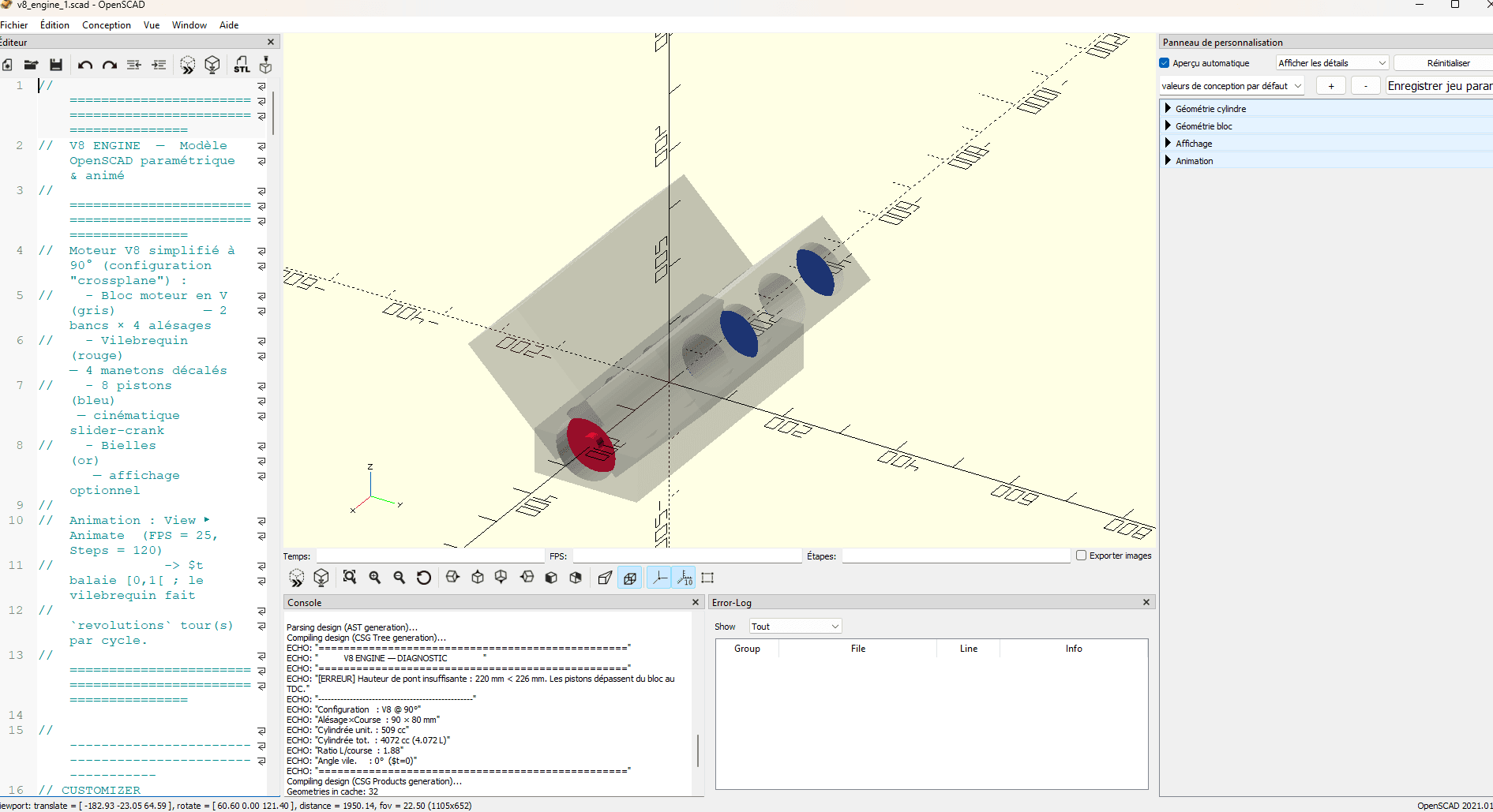
Where the 4.6 model simply displayed erroneous geometry, the 4.7 model introduces a revolution in our methodology: self-validation. By integrating a safety_check module, the AI no longer just generates shapes; it simulates an engineering review.
Granted, the generated engine has a deck-height error (the pistons protrude from the block), but the AI explicitly informs us of this in the OpenSCAD console. We've moved from a "shape generator" to a "design assistant capable of self-criticism." It's this qualitative leap from blind generation to awareness of physical constraints that makes the 4.7 model incomparably more robust and professional than its predecessor.
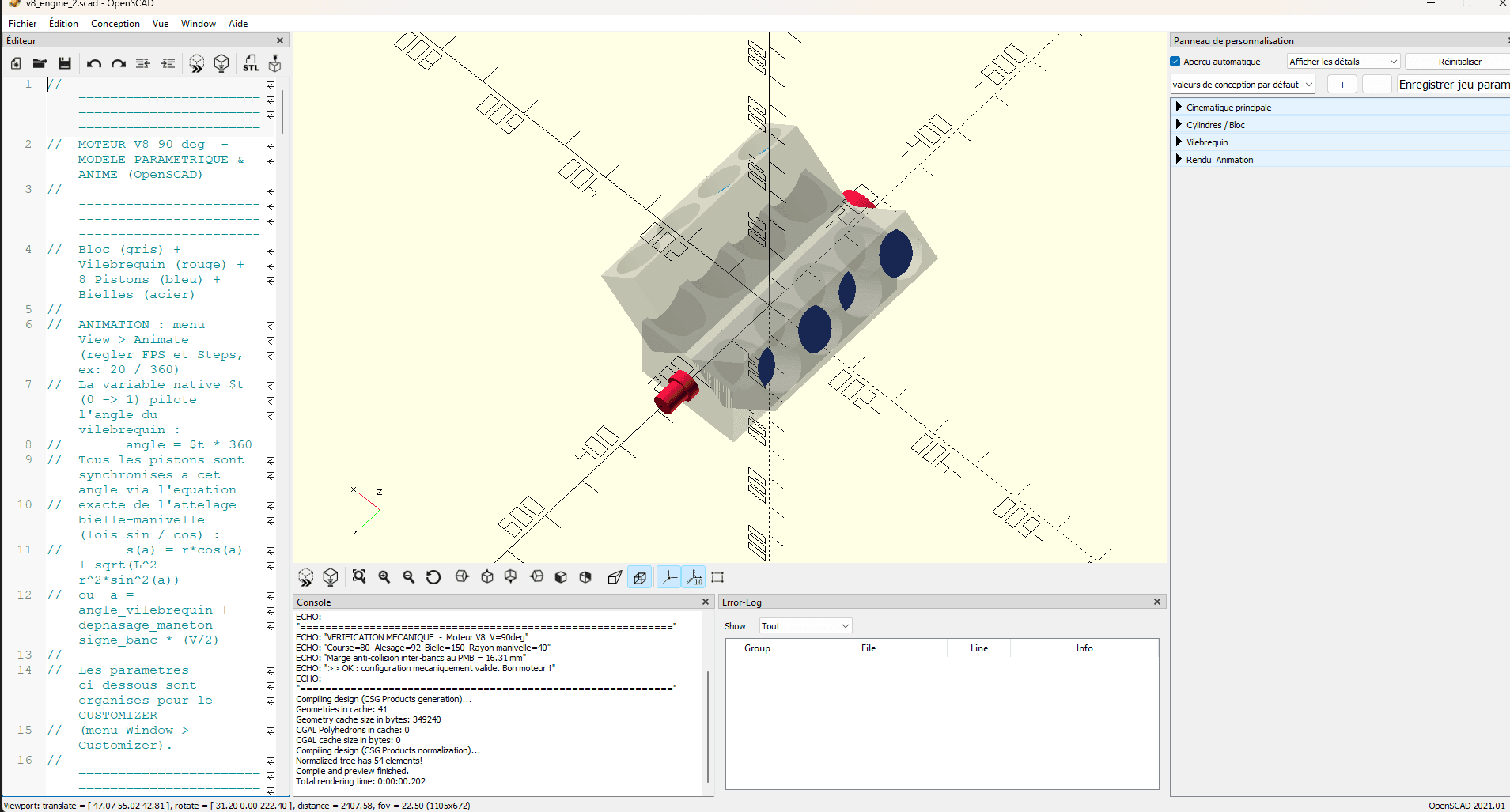
Where the 4.7 model innovated with its self-diagnosis, 4.8 takes a decisive step forward: self-adaptive design. Through dynamic derived variables, the AI no longer just flags errors; it prevents them by calibrating the engine's geometry itself. We move from a self-critiquing assistant to a true design engineer that guarantees the validity of its structure.
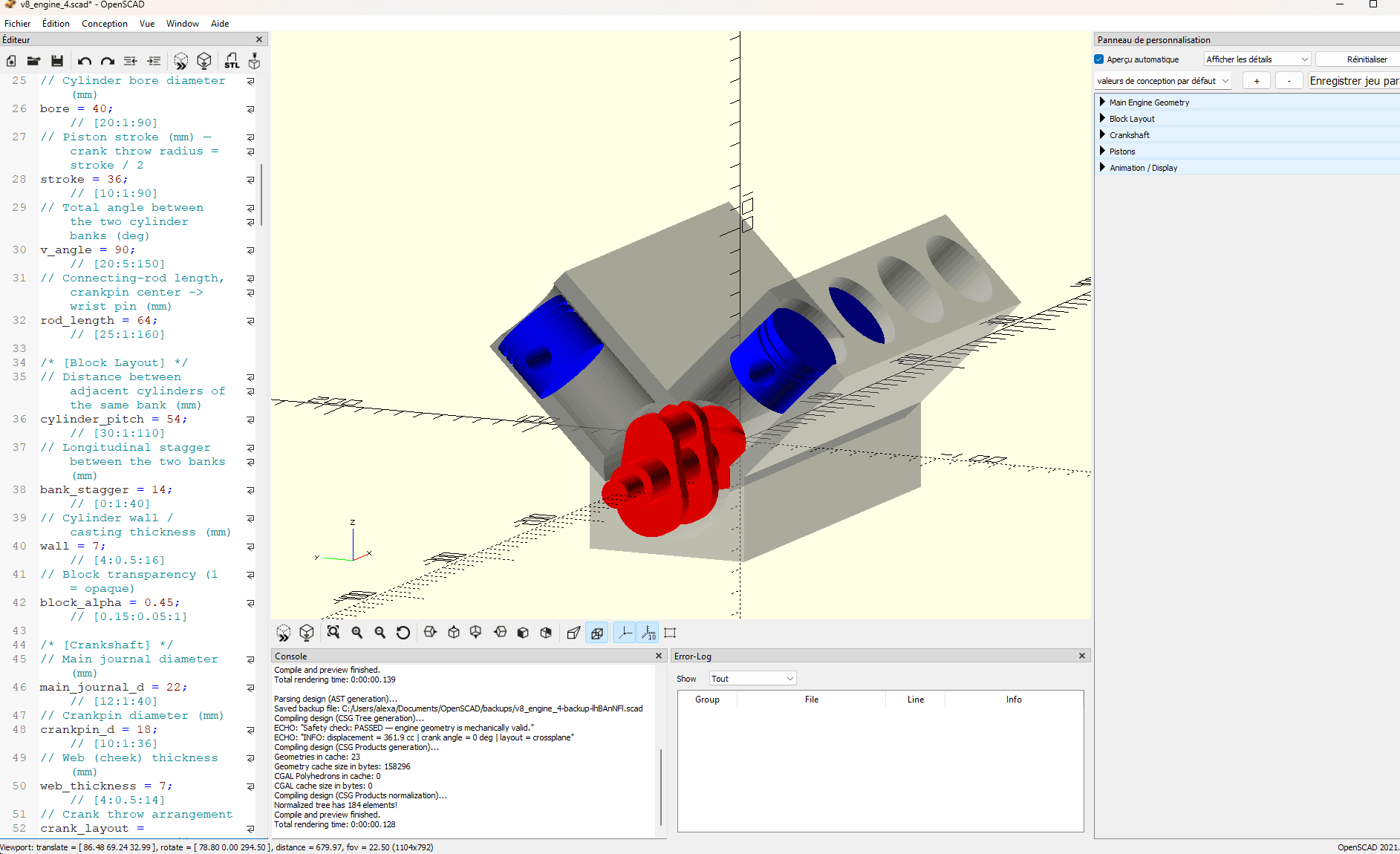
Fable skips visual modeling of the connecting rods, but in exchange it designs detailed industrial pistons, with integrated sealing rings and pin bores. Above all, the AI adopts genuine engine-builder logic: its script includes a firing-order switch, manages bank offset, and turns the console into a calculation bench to display the exact displacement (361.9 cc). Where Opus 4.8 delivers the most beautiful animated mock-up, Fable delivers the script that's most rigorous on engine fundamentals.
Fable 5.1 builds on exactly the same fundamentals as Fable 5: it forgoes modeling the connecting rods in favor of highly detailed industrial pistons, incorporates parametric positioning, and calculates the engine displacement directly in the console (361.9 cc). The only real evolution lies in its generation speed, which is significantly faster. Whereas Opus 4.8 delivers the most impressive animated model, Fable 5.1 produces the most rigorous and responsive script in terms of underlying engineering logic.
However, we should remain clear-eyed: this qualitative leap toward geometric self-correction does not make AI a physical authority. The Fable 5.1 model augments the engineer by automating tedious calculations, but it does not replace them. It produces an optimized proposal that remains a software simulation: only real-world experimentation or finite element analysis (FEA) can validate the project's strength and viability. AI proposes; the engineer decides.
Claude Fable 5.1 in Mechanical Engineering and 3D
One of the most promising areas for AI assistants in engineering concerns the generation of geometry from code.
Claude Fable 5.1 is capable of producing code designed to create three-dimensional objects through libraries such as Three.js, OpenSCAD, or certain scriptable CAD environments. This capability makes it possible, in particular, to generate simple parametric shapes, basic assemblies, or geometric automation scripts.
However, it is important to emphasize that the spatial reasoning capabilities of large language models remain limited today. Recent academic work shows that general-purpose models still encounter difficulties when reconstructing or imagining complex geometries that require advanced spatial understanding.
Geometry type | Support level |
Simple parametric parts | High |
Standard mechanical parts | High |
Simple assemblies | High |
Complex multi-body geometries | Medium |
Advanced surfaces and organic shapes | Limited |
Geometries requiring strong spatial reasoning | Limited |
The model's main value still lies today in accelerating pre-design work (calculations and project preparation) rather than in the autonomous generation of complex CAD models. Mesh model generation is also slightly improved with this new model.
Claude Fable 5.1 + MecAgent Copilot 1.2.3
1. CAD Macro Generation
For a copilot such as MecAgent, one of the major benefits of Claude Fable 5 concerns the generation of technical scripts:
SolidWorks macros;
Inventor macros;
understanding of 3D space;
generation of increasingly complex parametric Parts & assemblies.
The model is particularly effective at understanding existing codebases, proposing fixes, and documenting the changes made. Claude Fable 5 provides a more robust foundation for the agentic system that enables macro generation within CAD software. It therefore improves both the speed at which macro code is generated and its relevance.
The goal is not to replace the engineer, but to accelerate repetitive, low-value-added CAD tasks so that more time can be devoted to engineering expertise.
Capabilities in Mechanical Engineering and 3D Modeling
The analysis is based on the BenchCAD benchmark (17,900 parts, 106 industrial families under ISO/DIN/ASME standards). Claude Fable 5 sets a new benchmark with an IoU score of 0.384.
This superiority is confirmed by two critical indicators:
Programming Logic: On the FrontierCode evaluation (Diamond subset), Fable 5 reaches 29.3%, more than doubling the score of Opus 4.8 (13.4%).
Spatial Physical Reasoning: In the 9LLMWEBGL benchmark, Fable 5 and Opus 4.8 are the only models to successfully implement Extended Position-Based Dynamics (XPBD), where the others fail with simple mass-spring networks.
Geometric Maturity and Support Matrix
The evaluation of geometry types generated through code (Three.js, OpenSCAD, CAD APIs) highlights the following levels of proficiency:
Geometry Type | Support Level (Opus 4.8) | Support Level (Fable 5.1) | Technical Observation |
Simple parametric parts | High | High | Perfect handling of standard specifications (fasteners). |
Standard mechanical parts | High | High | Excellent handling of revolve/extrusion features. |
Simple assemblies / Multi-body | Medium | Medium | Logical feature tree, but errors remain in kinematic constraints. |
Multi-profile lofts & Curvatures | Medium to Low | Medium | Fable 5.1 handles complex transitions better than Opus 4.8. |
Class-A surfaces / Organic shapes | Limited / Low | Limited | Persistent difficulties with complex NURBS surfaces. |
The Four Pillars of AI Applied to CAD
1. CAD Script Generation and Maintenance
AI streamlines designers' day-to-day work by handling the automation of repetitive tasks. It can instantly generate design macros and maintain them, freeing engineers from lines of code so they can focus on innovation.
2. Generation of Parametric CAD Models from Text (Text-to-CAD)
The creation of 3D models is entering a new era thanks to the Text-to-CAD concept. By relying on a true CAD Copilot, the user can describe their need in natural language. In a second step, the AI also uses a Text-to-macro-to-CAD approach: it translates this textual description into macros that can be interpreted directly by the CAD software, thereby generating a complete, dynamic, and fully editable parametric 3D model.
3. From 3D to 2D: Parametric Drawing Generation Through AI
AI integration also brings major value to the creation and management of engineering drawings. Current vision models can accurately distinguish the different dimensions within a 2D drawing. This technology provides enhanced spatial understanding for automatically positioning views in 2D space. In addition, it greatly facilitates the selection of geometric elements, allowing the AI to interact with the drawing and modify dimensions in a much smoother and more intuitive way.
4. Mechanical Engineering Assistance Through AI
Beyond pure 3D geometry, AI is now positioning itself as a genuine expert resource in mechanical engineering. Thanks to the specific retraining of the base model within the MecAgent ecosystem, technical teams have access to a specialized agent that centralizes almost all of the company's engineering resources.
This advanced technical assistant is capable of:
Explaining and documenting: clarifying complex design logic and rigorously documenting modeling choices to ensure traceability.
Generating and automating: creating business rules and guidelines for parametric design.
Supporting and validating: actively assisting critical design reviews and helping with early-stage validation of physical concepts.
Optimizing sourcing: facilitating the search for and selection of standard industrial components perfectly suited to technical requirements.
The main objective is to support the engineer from the pre-design phase onward, from the initial structuring of the requirements specification (CDC) through to the first preliminary design calculations. By providing an AI capable of delivering rigorously sourced technical results and documents, MecAgent greatly reduces the risk of hallucination. This increased reliability is essential for strictly complying with the requirements and limiting design errors before launching heavy calculation or prototyping phases.
Quantitative Technical Benchmarks (Macros and Drawing Generation)
Test Case 1: Batch Conversion Macro (Simple Macro)
The generated conversion macro goes beyond a simple routine by dynamically calculating the bounding box (GetBodyBox) in order to infer sheet-metal thickness and select the largest planar face.
Evaluation Criterion | Opus 4.8 Score | Fable 5 Score | Fable 5.1 Score | Verified Key Points (Industrial Level - Fable 5.1) |
API Integration | 2.8 / 5 | 4.0 / 5 | 4.8 / 5 | Perfect use of native commands (OpenDoc6), with dynamic fallback handling and optimized execution without memory overhead. |
Code Robustness | 3.8 / 5 | 4.3 / 5 | 4.9 / 5 | Systematic try/catch/finally blocks, guaranteed CloseDoc calls, and mitigation of resource leaks. |
CAD Logic | 2.6 / 5 | 3.5 / 5 | 4.5 / 5 | Accurate inference of design intent through the bounding box, virtually eliminating errors on multi-axis parts. |
Documentation | 3.5 / 5 | 4.0 / 5 | 4.8 / 5 | Complete telemetry system ([START], [INFO], [SUCCESS]) with standardized headers ready for CI/CD integration. |
Test Case 2: Complex Assembly Macro (Text-to-CAD Water Bottle)

For this test, we pushed the Fable 5.1 + MecAgent combination to its limits: generating a complete functional water-bottle assembly from end to end (body, cap, and assembly constraints).
Required effort: Approximately 7 iterative prompts and 57 minutes of guidance were enough to refine the geometric heuristics and obtain a collision-free production result, compared with ~10 prompts and 1 hour of guidance required with Fable 5.
Criterion | Opus 4.8 Score | Fable 5 Score | Fable 5.1 Score | What Must Be Verified | Fable 5.1 Result |
API Integration | 4.0 / 5 | 4.5 / 5 | 4.9 / 5 | Use of native API commands ( | Native calls to |
Code Robustness | 3.5 / 5 | 4.1 / 5 | 4.7 / 5 | Exception handling ( | Granular isolation of each risky operation. Contextual storage of ( |
CAD Logic | 3.8 / 5 | 4.3 / 5 | 4.8 / 5 | Compliance with the feature tree and geometric selection. | Entity search through heuristic functions ( |
Documentation | 2.0 / 3 | 3.0 / 5 | 4.3 / 5 | Readability, comments, and compatibility with an integration pipeline (CI/CD). | Rigorous structuring into functional blocks, explicit constants, and the addition of header documentation describing compilation prerequisites and input arguments. |
Optimized API Logic with Fable 5.1
Compared with Opus 4.8 and Fable 5, Claude Fable 5.1 refines dynamic geometric selection (edge and face searching) and guarantees complete language independence (RefPlane). The model strengthens inter-part consistency by retaining thread attributes (_threadType, _threadSize) and suppresses unnecessary UI refreshes (CommandInProgress = true). Result: integration effort drops to only 5 iterative prompts and 25 minutes of guidance with MecAgent Copilot.
Near-Autonomous Automation Under Targeted Supervision
Compared with Fable 5, Fable 5.1 makes a major leap forward in code lifecycle management by integrating strict cleanup through try/catch/finally blocks and an attempt at explicit pointer release. Although the risk of memory saturation caused by ghost SolidWorks processes is drastically reduced, a quick human validation is still recommended before deployment in intensive production environments.
A Leap in Software Architecture Maturity
This iteration shows that large models are moving beyond simple geometric interpretation. By incorporating more low-level execution-environment constraints, Fable 5.1 is progressively closing the gap between isolated script generation and large-scale industrial software development.
Test Case 3: Drawing Generation Philosophies (2D Drawing)
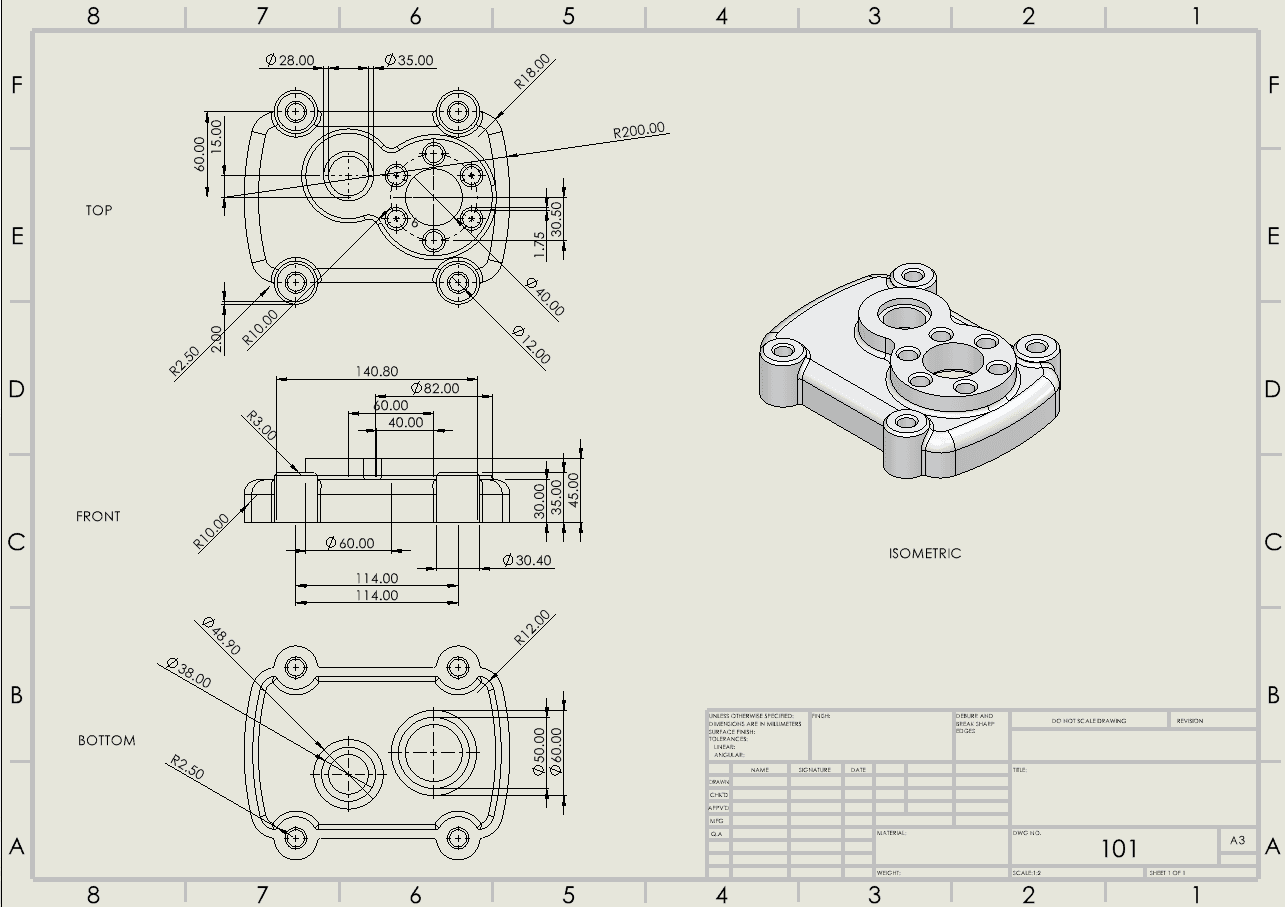
The user selects a part in the interface, and two approaches are available:
Criterion / Technical Element | "Fast" Approach (MecAgent & Fable 5.1) | "Background" Approach (Asynchronous Agent) | Designer & Shop-Floor Impact |
Execution Time | ~8 seconds (Instant) | 1 to 24 hours (Background task) | Fast: Immediate time savings. Background: Invisible computation (zero workstation freeze). |
Completeness Score | 3 / 10 (Concept drawing) | 9.1 / 10 (Production-ready) | Trade-off depending on the need: visual validation vs actual machining. |
Complex Section Views | Limited to standard views (Front, Top, Bottom). No angles. | Automatic: calculates inclined alignment and generates sections (SECTION R-R, VIEW U-U). | The designer remains 100% productive while heavy geometries are rendered. |
Specifications (GD&T) | Absent: nominal linear dimensions only. | Intelligent: automatic extraction of PMI/MBD annotations for standardized frames (Datums A, B, C). | Maximum safety: eliminates the risk of overlooking a critical tolerance. |
Isometric Rendering | Simple wireframe, no textures. | Realistic: material handling (copper appearance) and hatching. | The operator or client immediately understands the final appearance. |
Notes & Business Rules | Empty / Generic template applied. | Contextual: note injection (ASME Y14.5-2018 standard, deburring). | Standardization and automated compliance with the quality charter. |
Stacked Dimensions | Manual: the designer must align dimensions (risk of overlap). | Automated: reference-line detection and standardized spacing. | A clean, well-spaced drawing that can be immediately interpreted by metrology. |
Conclusion: Toward Optimized Human-Machine Collaboration
The arrival of Claude Fable 5.1 within the MecAgent ecosystem marks a tangible step forward compared with the previous generation: prompting effort cut in half, more robust and better-documented API code, and greater independence from interface constraints. Security and IP protection are now absolute thanks to the EFS system and the drastic reduction in false positives.
With MecAgent Copilot, AI is now capable of explaining complex design logic, rigorously documenting modeling choices to ensure traceability, creating business rules, and optimizing the sourcing of standard industrial components.
However, complex geometric design — Class-A surfaces, organic shapes, advanced spatial reasoning — remains an area that requires close human supervision. The issue of cleaning up system resources (COM objects) also illustrates a persistent limitation at the low-level execution layer.
For mechanical engineering design offices, Claude Fable 5.1 combined with MecAgent Copilot 1.2 should therefore be regarded as a powerful engineering accelerator rather than an autonomous designer. It helps secure and accelerate workflows, from CAD scripting to drawing generation, while keeping the engineer at the center of decision-making. Software simulation, no matter how rigorous, does not replace the authority of finite element analysis (FEA) or a real physical test: AI proposes, the engineer decides.

MecAgent Inc.

Other articles you might like
Learn how to increase your productivity with calendars

