
AI, OpenUSD, and NVIDIA Omniverse: How NVIDIA and MecAgent Are Shaping Collaborative Engineering
NVIDIA and Its Work in AI for Engineering
NVIDIA is a global leader in high performance computing and artificial intelligence. Originally built around GPU acceleration, NVIDIA has extended its technology into real-time simulation, physics-based rendering, and large-scale AI workflows that span robotics, digital manufacturing, autonomous systems, and industrial simulation. NVIDIA has explicitly positioned its platforms to unify physical-world data, applications, and AI at scale, addressing data silos and accelerating industrial digitalization.
NVIDIA’s AI integrations extend from generative models and simulation-ready environments to digital twin systems that enable real-world systems to be mirrored, tested, and iterated virtually. These capabilities emphasize how AI and physics-informed simulation can transform engineering data into actionable insights and predictive models.
NVIDIA Omniverse as a Collaborative Foundation
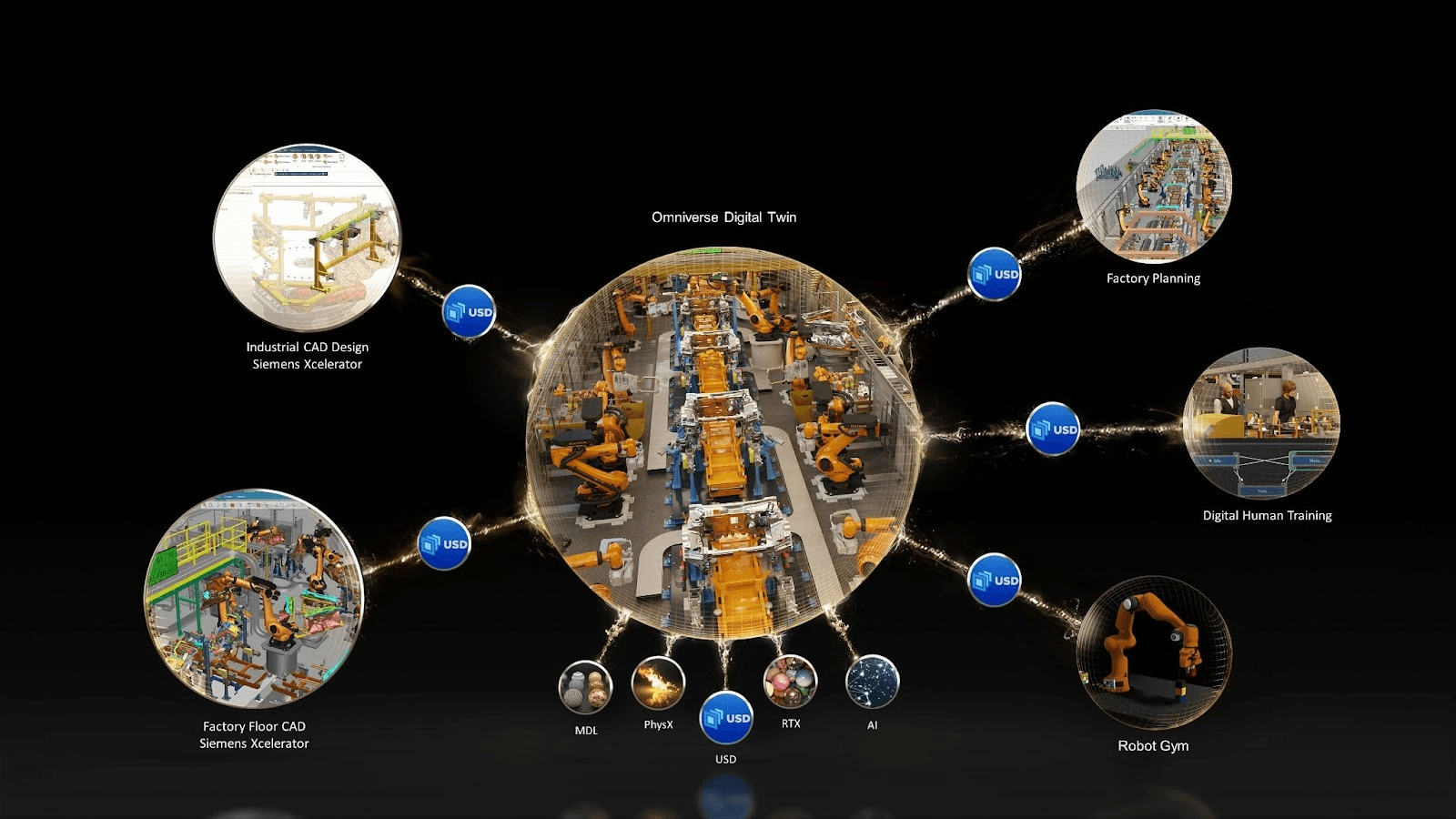
At the heart of this effort lies NVIDIA Omniverse, a real-time 3D collaboration and simulation platform built to connect tools, data, and teams. Omniverse acts as an operating system for physically accurate worlds, enabling distributed engineers, designers, and stakeholders to work together on shared 3D assets in a synchronized environment.
Unlike traditional multi-tool workflows that rely on sequential file handoffs, Omniverse provides real-time synchronization, cross-disciplinary collaboration, and support for generative AI-enabled tools and extensions. Enterprise versions use RTX rendering, modular APIs, and SDKs to power fully immersive and collaborative 3D applications across industries such as automotive, robotics, and manufacturing.
This shared environment accelerates decision making, improves design quality, and reduces integration friction by enabling teams to see the same high-fidelity representation of a product or system, regardless of which authoring tools they use.
*Source : NVIDIA – The Industrial Metaverse
OpenUSD and Scalable Interoperability
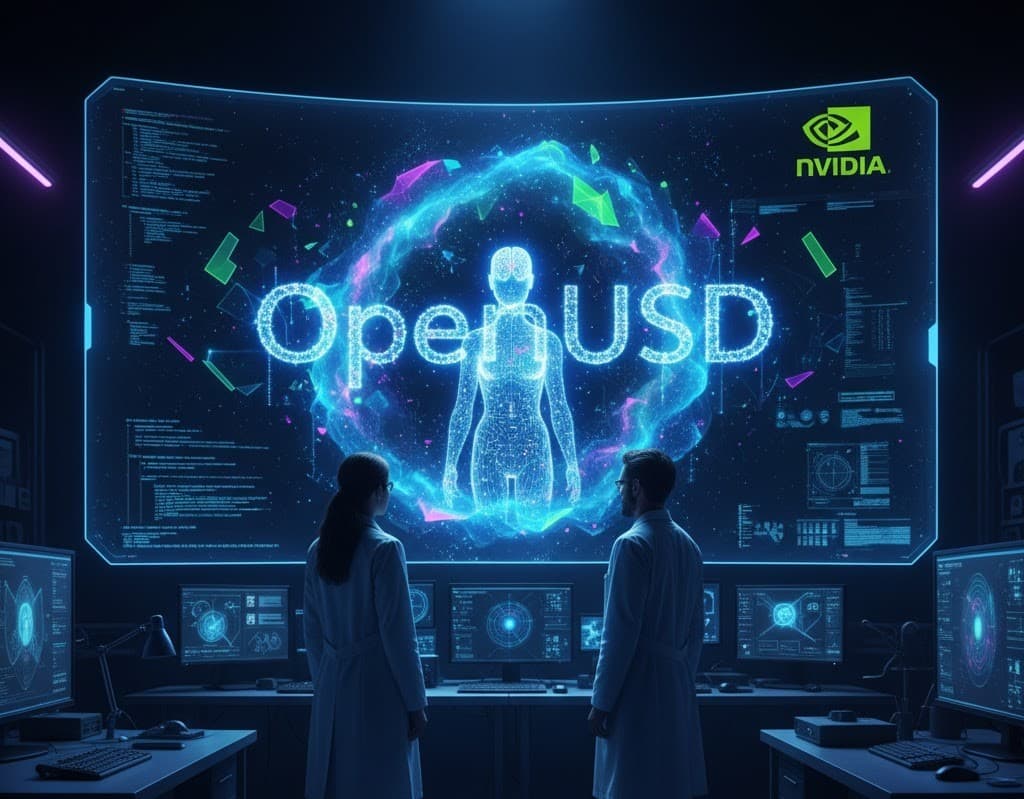
Central to Omniverse’s architecture is OpenUSD (Universal Scene Description), a vendor-agnostic, open, extensible framework for describing, composing and simulating complex 3D worlds. Originally developed at Pixar and now governed by the Alliance for OpenUSD (with founding members including Pixar, Adobe, Apple, Autodesk, and NVIDIA), OpenUSD is widely adopted as a standard for interoperable 3D content workflows.
OpenUSD enables mechanical, simulation, sensor, and visualization data from disparate systems to coexist as unified digital assets. This capability is foundational for digital twin applications, physics-accurate simulation, and real-time collaborative workflows, because it decouples the scene description from proprietary formats and toolchains.
With OpenUSD as the lingua franca of industrial 3D data, engineers can assemble large-scale models, connect real-world sensor feeds, and integrate AI-driven analytics in ways that were previously impractical due to format incompatibilities.
Why Integrating AI Automation and Text-to-3D Matters
Once NVIDIA Omniverse and OpenUSD provide a scalable, interoperable foundation for 3D collaboration and digital twins, the next frontier becomes intelligence that augments daily workflows.
Even in sophisticated environments powered by Omniverse and OpenUSD, engineers still spend substantial time on manual tasks such as data preparation, metadata management, scene structuring, and asset generation. These tasks create bottlenecks that slow down innovation and reduce productive engineering time.
Integrating AI directly into these workflows could significantly streamline operations. For example, natural language interfaces could be used to generate or modify 3D components from text prompts, aligning intent with outcomes without manual geometry edits. Similarly, AI could automate repetitive engineering tasks, such as renaming assemblies, generating consistent metadata, or creating simulation configurations automatically based on project context.
The combination of OpenUSD’s open scene description and AI-driven automation creates an environment where engineers can interact with complex systems at a higher level of abstraction. Instead of wrestling with file formats or scripting toolchains, they could write simple instructions that an intelligent system translates into structured 3D representations or simulation inputs. In this way, AI becomes the layer that connects intent to outcome, not just another tool in the pipeline.
By shifting the focus from manual CAD operations to intent-driven processes and generative automation, teams can unlock new levels of productivity, creativity, and system-level thinking in collaborative engineering environments.
MecAgent: AI CAD Automation Aligned with the NVIDIA Ecosystem
MecAgent is an AI-powered automation copilot designed to optimize engineers’ day-to-day interactions with their CAD software. Experts in code generation applied to 3D space, we transform natural language instructions into complex executable scripts, eliminating repetitive tasks that slow down design cycles.
Today, our focus is on CAD and mechanical engineering. We operate directly within design environments (such as Autodesk Inventor or SolidWorks) across 4 major pillars:
. Intelligent automation: freeing engineers from redundant workflows.
. AI-assisted creation: generating and structuring complex 3D models ready for manufacturing.
. Text-to-CAD
. CAD Copilot
Toward the future of simulation with NVIDIA
As a member of the NVIDIA Inception program, MecAgent is taking a new step forward. Our teams are now working closely with NVIDIA to help develop an AI specialized in the generation and understanding of OpenUSD.
This expertise aims to address the challenges of digital twins, industrial simulation, and AI training within a digital 3D environment.
Sources :
https://blogs.nvidia.com/blog/openusd-digital-twins-industrial-physical-ai/
https://developer.nvidia.com/omniverse
https://www.dell.com/en-us/lp/nvidia-omniverse
https://www.nvidia.com/en-us/glossary/openusd/
https://developer.nvidia.com/openusd
MecAgent Inc.
Download the Beta
Book a Demo
Download (Free)
Book a Demo
Other articles you might like
Learn how to increase your productivity with calendars
“Mythos.1” - Class AI in Mechanical Engineering and CAD Design
MecAgent Inc.
AI CAD Copilots in 2026: 7 Tools Compared for Mechanical Engineers
MecAgent Inc.
Claude Fable 5 x MecAgent 1.2.0 on CAD
MecAgent Inc.
Features
Pricing
AI CAD Community
Careers
Contact