
Anthropic's Claude for Creative Work marks a turning point in AI-driven design tools, but industrial CAD demands more than a universal protocol can offer
Introduction: When AI takes the mouse
Until very recently, artificial intelligence and 3D creation or computer aided design software coexisted without really interacting. You could ask an LLM how to create a chamfer in Autodesk Fusion, but the AI remained behind a glass wall: it advised, it described, but it did nothing. On April 28, 2026, Anthropic officially changed the game by launching Claude for Creative Work, a set of nine connectors enabling its Claude model to act directly inside professional software such as Blender, Autodesk Fusion, and Adobe Creative Cloud.
This announcement builds on an infrastructure the same company introduced in late 2024: the Model Context Protocol (MCP). Understanding this protocol, what it enables, and more importantly what it still cannot do, is essential to grasp why specialized solutions like MecAgent and its CAD Copilot represent the next logical and more ambitious step.
MCP and CAD: what are we talking about?
The Model Context Protocol: the USB C of AI
Before MCP, every integration between an AI model and third party software required custom development. Want to connect Claude to your industrial ERP? You needed a specific connector. To Slack? Another one. To your PLM system? Yet another. This approach created a jungle of incompatible integrations that were hard to maintain and impossible to reuse.
MCP solves this problem elegantly. It is an open standard, published under the MIT license, that defines a universal client server architecture: on one side, MCP Servers expose resources, tools, and functions; on the other, MCP Clients such as Claude Desktop, VS Code, or Cursor connect in a standardized way. One protocol, thousands of possible integrations.
The metaphor holds: it is the equivalent of a USB C port for physical devices. Before, each manufacturer had its own connector. After, one format is enough to plug everything in.
Launched in November 2024 by Anthropic, the protocol reached 97 million monthly installations in just 16 months, an unprecedented adoption rate in the history of AI infrastructure standards. OpenAI adopted it in early 2025, Google in early 2026. In December 2025, Anthropic transferred governance of the protocol to the Agentic AI Foundation, under the Linux Foundation, alongside AWS, Microsoft, Google, and Cloudflare. The standard no longer belongs to a single company: it belongs to the industry.
Functionality – Model Context Protocol (MCP)
| Feature | Description |
|---|---|
| Main objective | Standardize bidirectional communication so AI agents can access tools, data sources, and external services and interact with them to perform actions, not only retrieve information. |
| Architecture and operation | An open standard defining a protocol that provides a “grammar” to AI agents. It enables interaction with external systems, function calls, and structured data requests, reducing reliance on custom APIs. The AI generates structured calls, receives results (including real-time data and functions), then produces human-readable output based on these actions. |
| Use cases | AI agents perform tasks such as booking flights, updating a CRM, running code, retrieving real-time data, and enabling advanced integrations across systems. |
CAD: a demanding playground
CAD or Computer Aided Design refers to software used to model physical objects in 3D with metrological precision. Unlike artistic modeling tools like Blender, CAD software works with geometric constraints, manufacturing tolerances, parametric feature trees, and a design history logic. Changing a dimension upstream can have cascading effects across the entire model.
Major professional players include SolidWorks (Dassault Systèmes), Autodesk Inventor, CATIA, Fusion 360, and FreeCAD for open source. These tools are used in manufacturing, aerospace, automotive, medical, and precision engineering industries, sectors where a modeling error is not just an aesthetic flaw but a real risk.
This is precisely why applying AI to CAD is both the most promising and the most complex type of integration.
What Anthropic just launched: a revolution in creative workflows
The April 28, 2026 Claude for Creative Work announcement represents the most visible implementation of MCP to date. Anthropic simultaneously launched nine connectors covering the entire professional creative chain:
Adobe Creative Cloud: access to more than 50 tools
Blender: natural language interface with full Python API
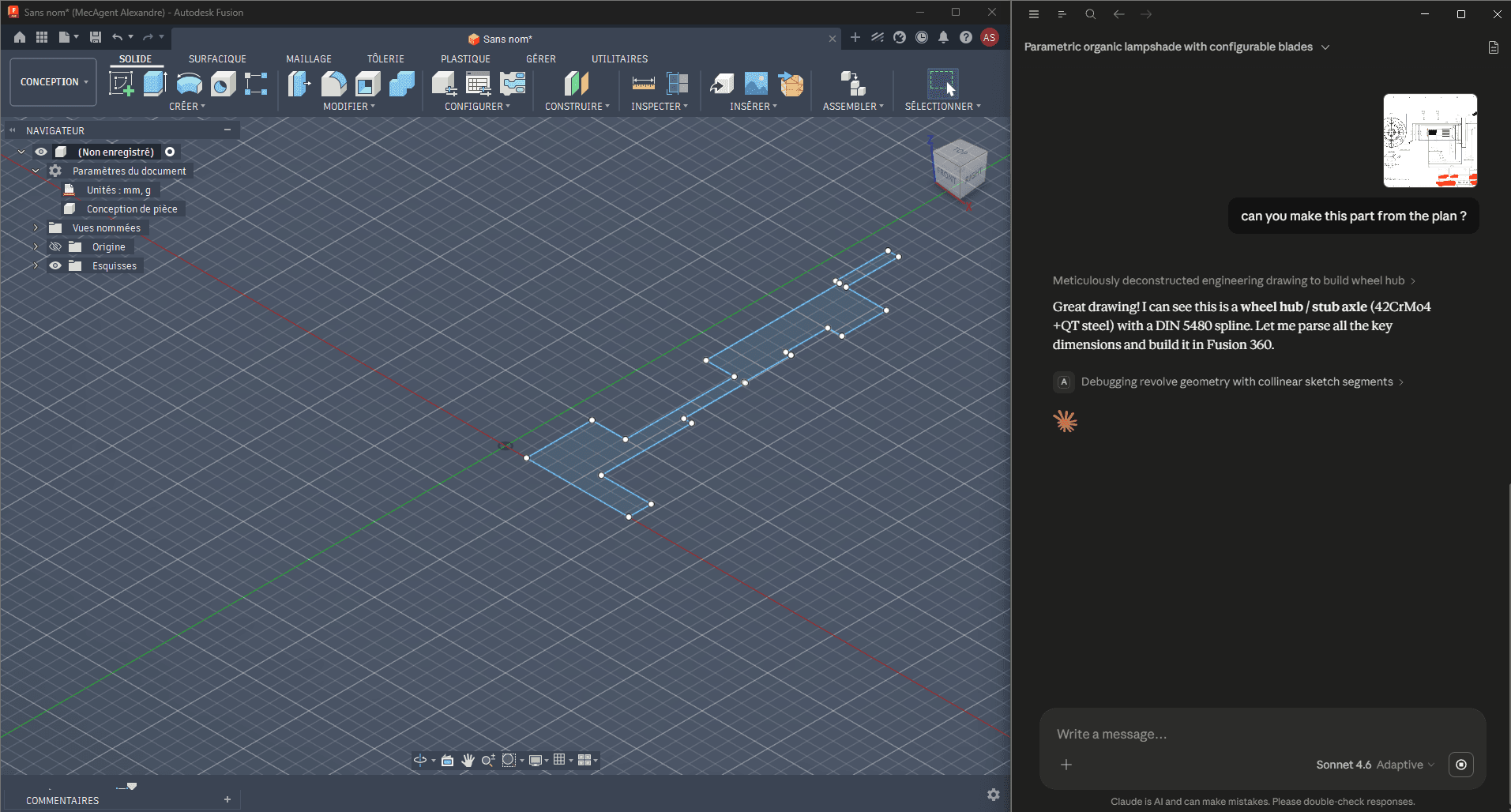
Autodesk Fusion: create and modify 3D models through conversation
Ableton Live: documentation assistance for music production
Affinity by Canva: automation of repetitive tasks
SketchUp: generate a 3D starting point from text
Splice: search for royalty free samples directly from Claude
Resolume Arena and Wire: real time control for live visual artists
What sets this wave apart from previous experiments is the nature of interaction. Before, AI generated content that had to be manually imported. Now, Claude can open files already in the pipeline, modify layers, apply effects, trim timelines, or build and debug a full 3D scene directly without friction.
For Blender, the connector exposes the full Python API. Claude can analyze a scene, write and execute scripts, and even extend the interface. For Autodesk Fusion, natural language is translated into design actions. For Adobe, the connector orchestrates multi step workflows across dozens of tools simultaneously.
Why this is a revolution
Anthropic’s strategy is clear: not replacing tools, but becoming the intelligence layer orchestrating them. This is the difference between an additional tool and a meta interface. Claude does not replace the brush, it handles the creative direction while you refine manually.
MCP limitations: what benchmarks reveal
As impressive as it is, MCP is not a magic solution. Early academic benchmarks and real world feedback allow its limitations to be precisely mapped, especially in 3D design and CAD contexts.
Context window: the core problem
MCP relies on language models with finite attention. Each interaction consumes context tokens. In complex multi step workflows such as mechanical assemblies with many nested constraints, token usage increases rapidly.
The MCP-Universe benchmark, evaluating LLMs on real tasks including 3D design, shows that even the best models (GPT-5, Grok-4, Claude Sonnet) struggle to maintain high success rates on long tasks. The MCPMark benchmark shows that realistic tasks require on average 16.2 execution steps and 17.4 tool calls, pushing models to their limits.
Tool selection problem
The more tools an MCP server exposes, the harder it becomes for the model to select the correct one. A study of 103 real MCP servers found that 89.8 percent of tool descriptions contain undeclared limitations, 89.3 percent lack clear usage guidelines, and 84.3 percent have opaque parameters.
In practice, this means the model often selects the wrong tool, uses it incorrectly, or fails to detect its limits. In Blender, this is tolerable. In CAD, where a misapplied feature can corrupt an entire design history, it becomes critical.
3D object benchmark: testing real limits
| Level | Type of task | MCP behavior |
|---|---|---|
| Simple | Create a cube, cylinder, apply basic material | Reliable |
| Intermediate | Assembly of 3–5 parts, simple geometric constraints, fillets and chamfers | Variable, requires explicit decomposition |
| Advanced | Complex assemblies (>20 parts), tolerances, parametric feature trees | Significant degradation, cascading errors |
| Expert | Complex surfaces (NURBS), topology optimization, integrated FEA simulation | Out of reach in current state |
The Blender connector itself documents its limitations: only one MCP instance at a time, complex operations must be decomposed into smaller steps, and the model operates on screenshots without real time visibility, iterating blindly between snapshots.
Trust and verification
In creative workflows, an error from Claude costs seconds of work. In engineering workflows, it can invalidate hours of design. MCP delegates verification to the human, without a native mechanism to ensure that executed actions match intent. This lack of formal feedback loop is acceptable for artistic tasks but insufficient for industrial contexts.
MecAgent and CAD Copilot: proprietary APIs as a foundation
What MCP enables and what it does not solve
MCP exposes tools through a generic protocol, but internal data models often remain inaccessible. The internal design logic or parametric history is usually out of reach.
For tools like Blender or Autodesk Fusion, this is sufficient for many creative use cases. But industrial CAD environments like SolidWorks or Inventor rely on much deeper parametric structures where every modification can cascade through the entire model.
MCP is still a key step: it allows AI to interact directly with design tools. But in industrial contexts, the challenge is not only execution, but understanding, structuring, and securing complex models.
In other words, general approaches like MCP open access. Specialized approaches aim to make this access truly usable in production.
This is where solutions like MecAgent emerge, relying on CAD software APIs to automate concrete tasks, generate macros, and execute actions from natural language instructions.
MecAgent: CAD Copilot through proprietary APIs
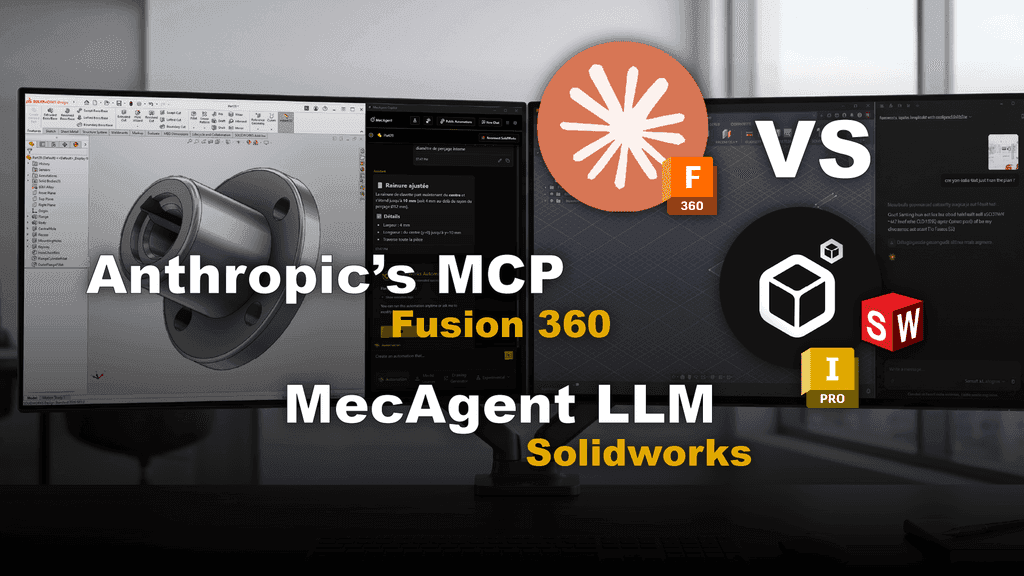
MecAgent’s architectural choice is to integrate via SolidWorks and Autodesk Inventor APIs instead of a generic protocol.
This changes everything. SolidWorks exposes a highly rich COM API, and Inventor a powerful .NET API. These APIs provide access to the full internal data model of the software.
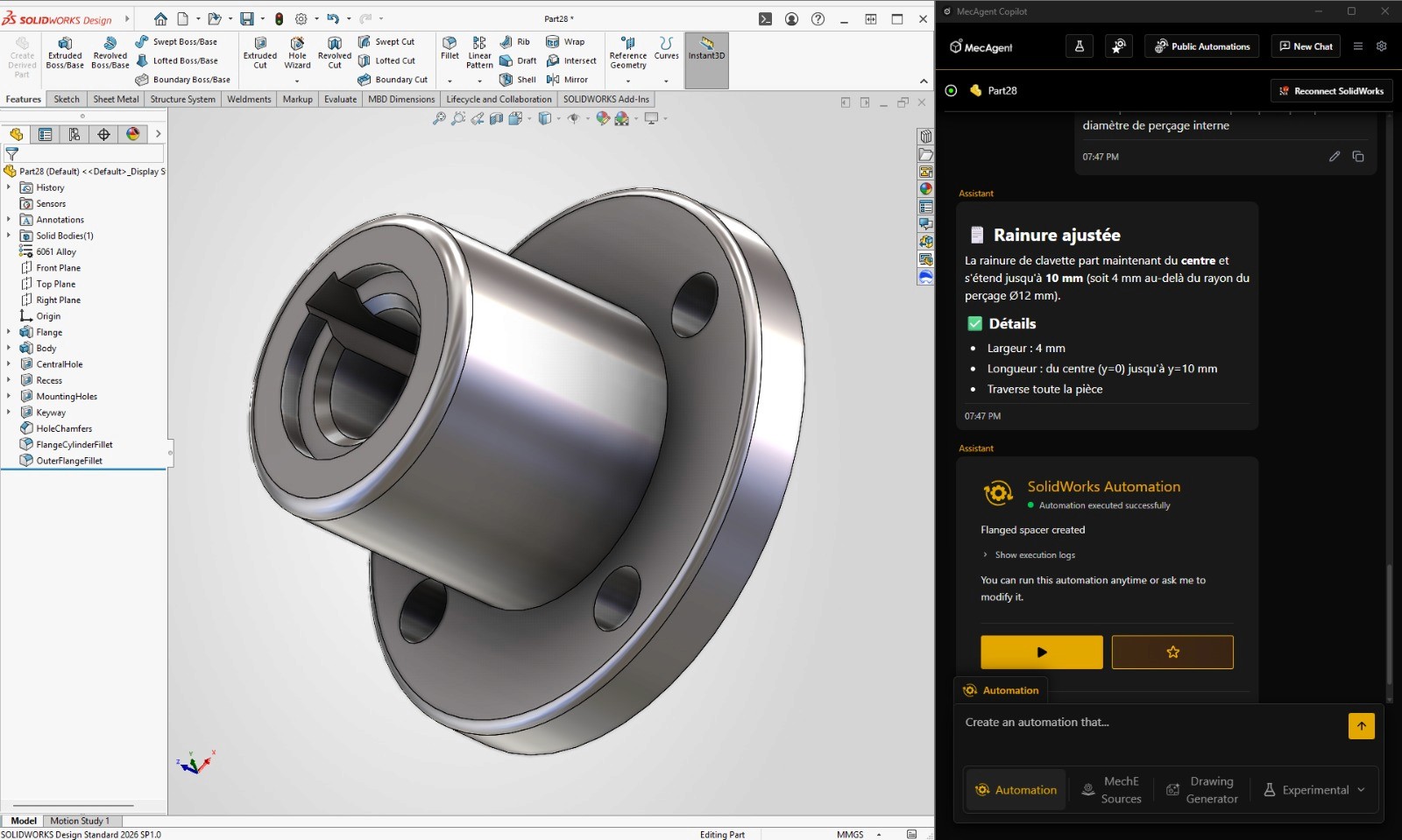
Through these APIs, MecAgent does not merely guess actions. It translates natural language requests into structured automation scripts (macros) that are executed instantly. It can create constrained sketches, modify parametric dimensions and propagate changes, manage assemblies, and generate technical drawings.
This is fundamentally different from MCP integration. MCP usually relies on exposed tools and indirect state access. With proprietary APIs, the AI directly interacts with the data model, can query it, modify it, and verify each operation before continuing. This does not remove the need for human validation, but significantly improves reliability and speed for tasks that are still largely manual today.
A domain specific vocabulary MCP cannot fully capture
The difference is not only technical depth, but also semantic richness. Mechanical engineers do not think in terms of “mesh objects” or “primitives”, but in sketches, extrusions, revolutions, fillets, mates, ISO tolerances. These concepts are native in SolidWorks and Inventor APIs.
A generic MCP connector struggles to fully express this semantics without explicit modeling. It translates natural language into generic tool calls and interprets generic outputs. A proprietary API integration can instead build a domain specific abstraction layer directly on top of native objects, enabling more precise and robust interactions.
Industrial complexity as a playground
Professional CAD is inherently complex: gear reducers, welded frames, hydraulic systems, cam mechanisms, injection molds. These involve hundreds of parts, thousands of constraints, iterative design cycles, and regulatory validation.
This is where MecAgent’s approach becomes meaningful. Where MCP reaches limits (context saturation, tool misselection, lack of formal verification), direct API access allows complexity to be handled at the source: reading real model state, modifying parameters precisely, and validating each step.
A different positioning: specialization for going further
MCP and MecAgent do not compete on the same axis. MCP is a powerful horizontal platform enabling access to many tools. MecAgent is a specialized system focused on industrial depth.
One expands accessibility across ecosystems. The other increases precision within industrial environments.
Conclusion: the next frontier of AI is mechanical
Claude for Creative Work marks a historic shift in AI integration with professional tools. MCP has proven that LLMs can interact with complex software in a standardized way.
But mechanical design is not a typical creative use case. It is constrained, standardized, verifiable, and industrially critical.
Benchmarks show that MCP reaches its limits precisely where complexity, parametric depth, and verification become essential.
This is the space where MecAgent and its CAD Copilot build something different: not an alternative to MCP, but its logical continuation into markets where precision matters more than flexibility, and where SolidWorks and Inventor are not optional tools but industry standards.
AI has entered the modeling workshop. The question is no longer whether it is useful, but how deeply it can integrate into real industrial tools. And here, specialization wins.
*Sources & References:
Anthropic (Claude for Creative Work, avril 2026)
Model Context Protocol Blog
9to5Mac, Unite.AI, lushbinary.com
Wikipedia Model Context Protocol
Benchmarks & Études arXiv :* MCP-Universe Benchmark*,* MCPMark*,* MCPToolBench++*
Sites web :* mcp-universe.github.io*,* mcpmark.ai*
MecAgent Inc.
Download the Beta
Book a Demo
Download (Free)
Book a Demo
Other articles you might like
Learn how to increase your productivity with calendars
“Mythos.1” - Class AI in Mechanical Engineering and CAD Design
MecAgent Inc.
AI CAD Copilots in 2026: 7 Tools Compared for Mechanical Engineers
MecAgent Inc.
Claude Fable 5 x MecAgent 1.2.0 on CAD
MecAgent Inc.
Features
Pricing
AI CAD Community
Careers
Contact