Back
GPT-5.5 & Claude Opus 4.7: The Silent Revolution of AI in CAD Through Copilots like MecAgent
The rapid release of GPT-5.5 and Claude Opus 4.7 marks a turning point where AI copilots like MecAgent transform CAD from a design tool into an intelligent, automated, and programmable environment.
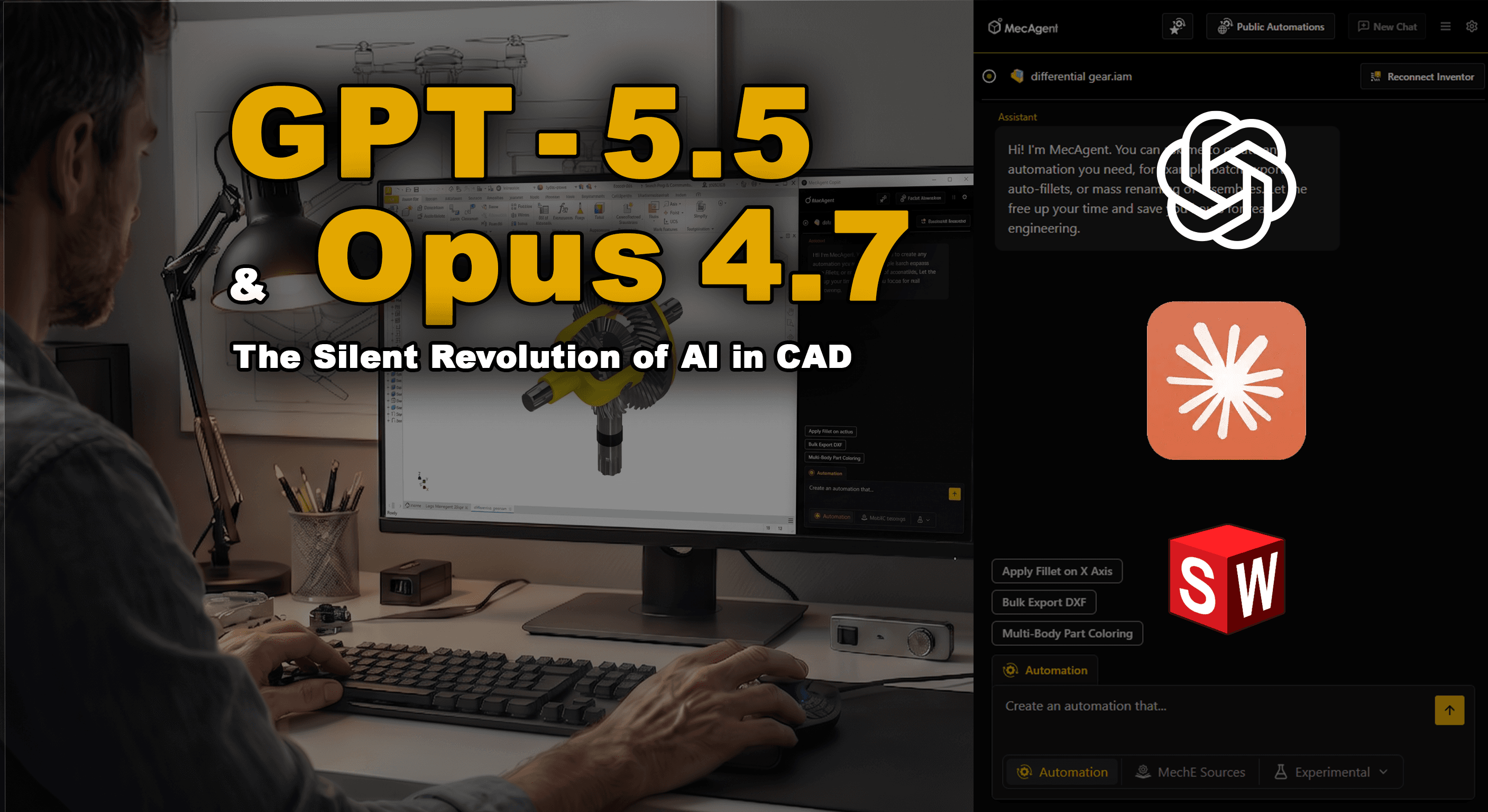
GPT-5.5 & Claude Opus 4.7: The Silent Revolution of AI in CAD Through Copilots like MecAgent
In the span of just two weeks in April 2026, OpenAI and Anthropic successively released their most powerful models to date. For mechanical engineers working daily in CAD environments, these AI releases are not just incremental updates. They are redefining what it means to design and automate three-dimensional objects inside modern CAD systems.
Something subtle yet significant happened in April 2026. On April 16, Anthropic launched Claude Opus 4.7. A week later, OpenAI responded with GPT-5.5. For the general public, these were just two more AI announcements. For engineers using SolidWorks or Autodesk Inventor, this marks a major shift in how AI integrates directly into CAD workflows.
For the first time, AI models are no longer limited to assisting with text or data. Through AI CAD copilots such as MecAgent, these systems can reason in 3D space, generate usable CAD geometries, self-correct during CAD design processes, and execute full automation pipelines inside CAD software. AI-driven CAD is no longer theoretical. It is operational.
“This generation of AI models marks significant progress in scientific and technical workflows, including CAD and engineering design.”
— Mark Chen
A Two-Way AI Race Shaping the Future of CAD
Before diving into technical details, it is important to understand the AI competition shaping the future of CAD. OpenAI and Anthropic operate in the same AI space but with different philosophies for CAD and engineering applications.
GPT-5.5 is designed as a general-purpose AI agent capable of orchestrating complex CAD workflows across multiple tools. Claude Opus 4.7 focuses on deep reasoning, making it highly relevant for CAD validation and engineering analysis tasks.
This AI competition is moving fast. GPT-5.2 in December 2025, GPT-5.4 in March 2026, GPT-5.5 in April. The pace of AI innovation directly impacts CAD tooling decisions, as each new model unlocks new CAD capabilities.
Claude Opus 4.7: AI Precision for CAD Reasoning
High-Resolution Vision for CAD Drawings
One of the key AI advancements in Claude Opus 4.7 is its ability to process high-resolution images, enabling detailed analysis of CAD drawings.
Engineers can now input full CAD assembly drawings, including dimensions and tolerances, and receive AI-driven insights without losing detail. This significantly improves CAD review workflows.
Complex CAD assemblies, manufacturing drawings, and technical documentation can now be analyzed in one pass. AI identifies constraints, risks, and optimization opportunities directly from CAD data.
Self-Correction in AI CAD Workflows
Claude Opus 4.7 introduces an advanced reasoning mode that allows the AI to self-correct before delivering results. In CAD workflows, this reduces errors when dealing with complex constraints such as tolerances, materials, and kinematics.
When integrated with MecAgent, this AI reasoning translates into real CAD actions. Engineers can generate constrained assemblies in CAD from natural language, with AI handling constraint logic and structure.
GPT-5.5: AI Automation at Scale for CAD
Text-to-CAD with AI
GPT-5.5 brings a major breakthrough in AI-powered CAD: direct text-to-CAD generation.
Through MecAgent, the AI generates scripts executed inside CAD software, creating full parametric models. This means AI does not just output geometry. It builds native CAD feature trees.
This AI-driven CAD workflow allows engineers to go from a simple description to a fully editable CAD model in seconds.
Large Context AI for Complex CAD Projects
With its massive context window, GPT-5.5 can process entire CAD project environments: specifications, standards, CAD histories, and supplier data.
This allows AI to maintain consistency across long CAD sessions, a key limitation in previous AI systems used for CAD.
End-to-End AI CAD Automation
GPT-5.5 enables full AI-driven CAD automation. Through copilots like MecAgent, engineers can automate complete CAD pipelines.
Examples include generating CAD drawings, exporting files, and applying bulk modifications across assemblies. AI becomes an execution layer inside CAD.
Benchmark Comparison: AI Models for CAD and Engineering
Test | GPT-5.5 | Claude Opus 4.7 | Winner |
Terminal-Bench 2.0 | 82.7% | 69.4% | GPT-5.5 |
SWE-Bench Pro | 58.6% | 64.3% | Claude |
OSWorld-Verified | 78.7% | 78.0% | GPT-5.5 |
FrontierMath Tier 4 | 35.4% | 22.9% | GPT-5.5 |
Source: VentureBeat / OpenAI Benchmark Report, April 23, 2026
These benchmarks reflect general AI performance, but their impact becomes most visible when applied to CAD workflows.
AI Copilots: The Missing Layer Between AI and CAD
Foundation AI models cannot directly operate CAD software. They require an execution layer.
AI CAD copilots such as MecAgent bridge this gap by translating AI outputs into CAD actions inside SolidWorks and Autodesk Inventor.
This AI-to-CAD translation layer is critical. Without it, AI remains theoretical. With it, AI becomes actionable inside CAD environments.
What AI Benchmarks Don’t Reveal About CAD
Benchmarks highlight AI performance, but real CAD usage tells a different story.
GPT-5.5 excels in AI automation and CAD execution. Claude Opus 4.7 excels in AI reasoning and CAD validation.
The real power comes from combining both AI models in CAD workflows through copilots like MecAgent.
The Future of AI in CAD with GPT-5.5, Claude Opus 4.7 and MecAgent
The transformation of CAD is driven by the convergence of AI models and CAD copilots.
By combining GPT-5.5, Claude Opus 4.7, and AI CAD copilots like MecAgent, engineers now operate in a fully AI-augmented CAD environment.
AI is turning CAD into a programmable system where natural language directly drives CAD actions.
This is not just faster CAD. It is a new paradigm where AI and CAD are deeply integrated.
The shift has already happened. GPT-5.5 and Claude Opus 4.7 are not just AI models. They are the foundation of the next generation of CAD, brought to life through AI copilots like MecAgent.

MecAgent Inc.

Other articles you might like
Learn how to increase your productivity with calendars


