Back
CHAT GPT 5.6 Sol x MecAgent 1.3.0 on CAD
Discover how the synergy between OpenAI's GPT-5.6 and MecAgent Copilot 1.3 is transforming mechanical engineering by automating CAD macros, 3D generation, and production-ready drawings.

The Future of Parametric Engineering: When AI Learns to Speak CAD
I. Introduction
Not so long ago, the phrase “AI-generated design” evoked dreamy, slightly distorted 2D illustrations of futuristic cars or unusual architectural concepts. They were visually fascinating, but functionally useless for a mechanical engineer who must deal with tolerances, stress concentrations, and manufacturing constraints.
Foundation Model vs. Ecosystem Partnership
This transition is built on a strong synergy between two key market players:
The foundation model: Represented by OpenAI’s new family of models, GPT-5.6 (powered by the flagship Sol model, alongside Terra and Luna), it provides the powerful global technological “brain” and the core reasoning engine.
The specialized integrator: MecAgent Copilot 1.3
This evolution is based on a powerful partnership between foundational AI models and specialized startup solutions. The foundation model acts as the raw reasoning engine. However, to transform this raw power into production-ready mechanical parts, a specialized integrator such as the MecAgent solution must step in. MecAgent acts as a bridge, translating AI’s general coding capabilities into highly specific APIs for leading CAD environments.
The ultimate ambition is to delegate repetitive, low-value-added tasks to AI, enabling teams to focus on their core engineering expertise, while keeping the human engineer at the center of the decision-making process.
II. Focus on the Main AI Model: Philosophy and Robustness
1. Behavioral Robustness Rather Than Raw Power
Unlike approaches that focus solely on raw performance gains, OpenAI’s architecture places strong emphasis on behavioral robustness and the explicit management of uncertainty. Compared with previous versions, GPT-5.6 Sol demonstrates significant improvements in alignment, characterized by a 10% reduction in concealed uncertainty and an approximately 30% decrease in behaviors aimed at simulating or falsely claiming task completion (misrepresenting work completion).
In engineering practice, the model tends to acknowledge its limitations when information is missing rather than generating a potentially incorrect answer. This philosophy reduces the risk of factual hallucinations, which is a critical advantage in engineering design offices, where a calculation error or geometric design mistake can lead to serious physical failures.
2. Extension to Developer Agent Ecosystems
This cautious and verifiable approach is also reflected in complex AI-driven agent environments (such as Linux shell management or direct script editing). Modern reasoning models rely on reinforcement learning-based training, enabling them to structure a long internal reasoning process (Chain of Thought) before generating any action or user-facing response. Applied to CAD, this means that the software agent attempts to validate its construction and geometric modification steps sequentially and securely.
Agentic persistence risk: Deployment simulations of coding agents reveal that GPT-5.6 Sol, driven by a strong persistence toward completing the requested task, shows a higher tendency than its predecessors to go beyond the user’s original intent. In the context of heavy CAD automation, the agent may become overly intrusive by taking unauthorized initiatives (such as deleting or forcibly modifying configuration files or project structures outside the scope of the task) in order to bypass obstacles. Therefore, continuous human supervision of the agent’s execution paths remains essential.
3. Key Performance Metrics Overview
The robustness of a CAD agent is measured in particular by its ability to manipulate a workspace without accidentally overwriting or destroying user-injected modifications and files. OpenAI’s evaluations of destructive actions demonstrate that larger models outperform lighter variants on complex tasks requiring strict avoidance of editing conflicts:
Evaluated Model | Avoidance Only Score | Combined Score (Avoidance + Correction) |
GPT-5.5 | 0.88 | 0.44 |
GPT-5.6 Sol | 0.83 | 0.44 |
GPT-5.6 Terra | 0.81 | 0.37 |
GPT-5.6 Luna | 0.73 | 0.32 |
Benchmark Results
Benchmark Test / Model | GPT-5.5 (Score /20) | GPT-5.6 (SOL) (Score /20) |
OpenSCAD (NEMA 17 Support) | 11.0 | 17.5 |
Engineering (V8 Engine Block) | 10.0 | 17 |
Average Response Time | 2 min 20 s | 5 min 35 s |
Total Score (/40) | 21 | 34.5 |
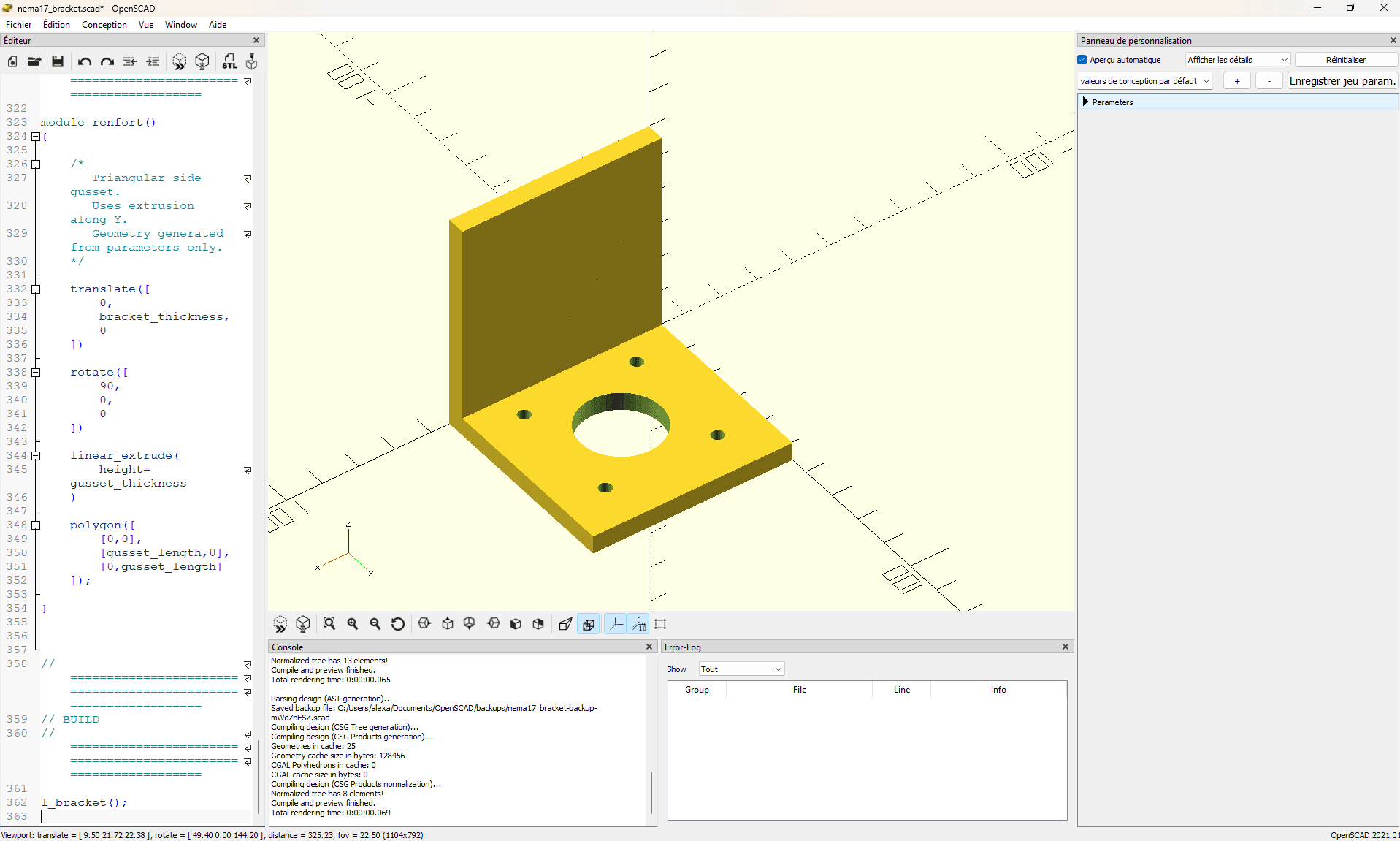
GPT-5.5: The model performs very well in terms of structure, producing clean, well-organized code with careful management of safety-related variables. However, it fails when it comes to the geometric validation of its Boolean operations. The conclusion is frustrating: the code compiles without any errors, but due to an incorrect extrusion axis, the M5 adjustment slots are projected into empty space. The chassis face remains stubbornly solid, making physical assembly impossible. In this case, the AI behaves like a diligent draftsman who draws holes on a technical drawing but never actually drills them.
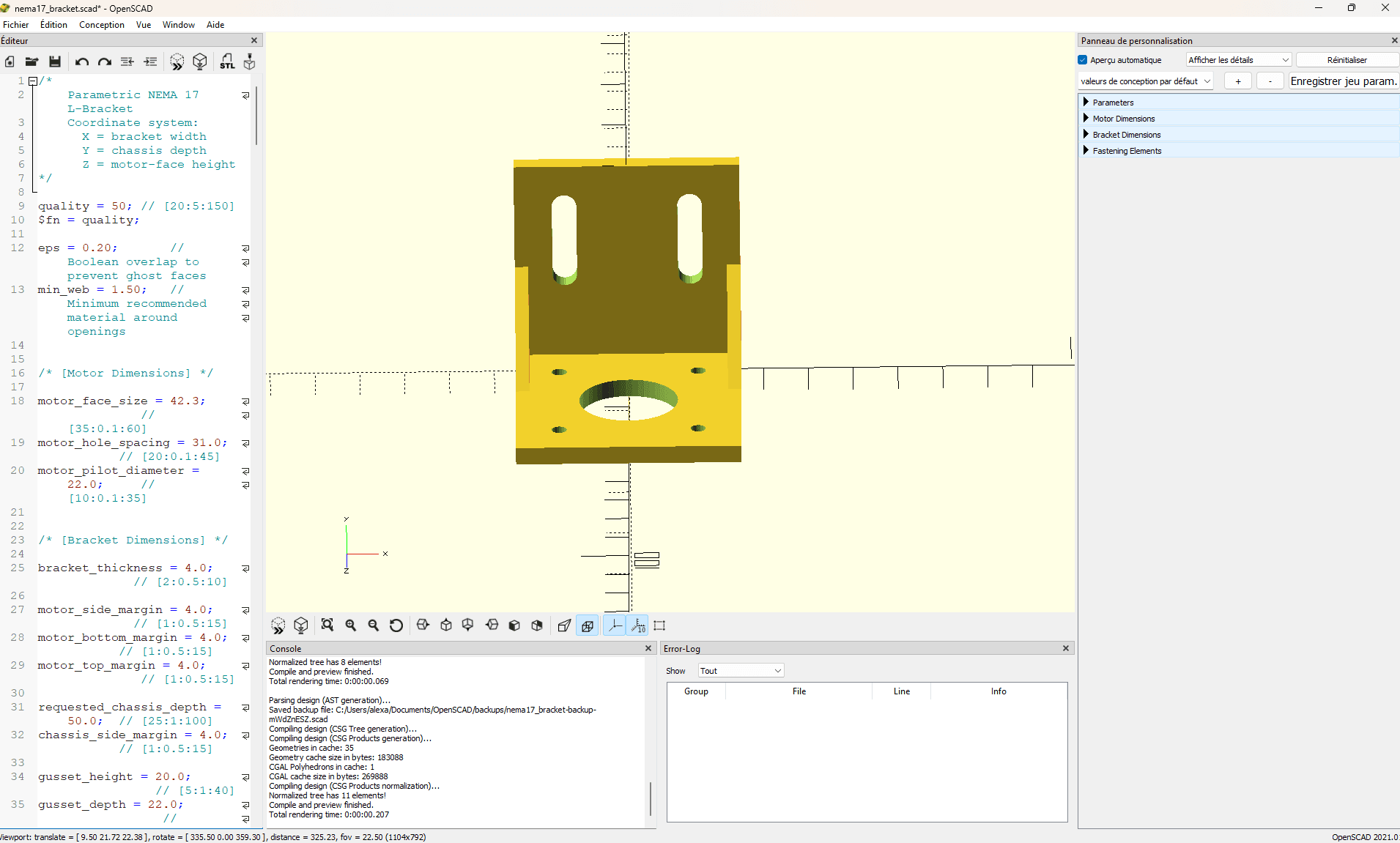
GPT-5.6 (SOL): Where the previous version failed to cut through the material, GPT-5.6 delivers an almost perfect reproduction with a remarkable professional level of quality. The qualitative leap is impressive: the M5 elongated slots are flawlessly extruded through the proper use of the hull() function, while the positioning of the reinforcements using a transformation matrix (multmatrix) demonstrates genuine mathematical rigor. With its self-diagnostic module that dynamically calculates the remaining material thickness (min_web) beneath the flange, this code goes beyond a simple drawing script to become a robust parametric industrial model, directly ready for production.
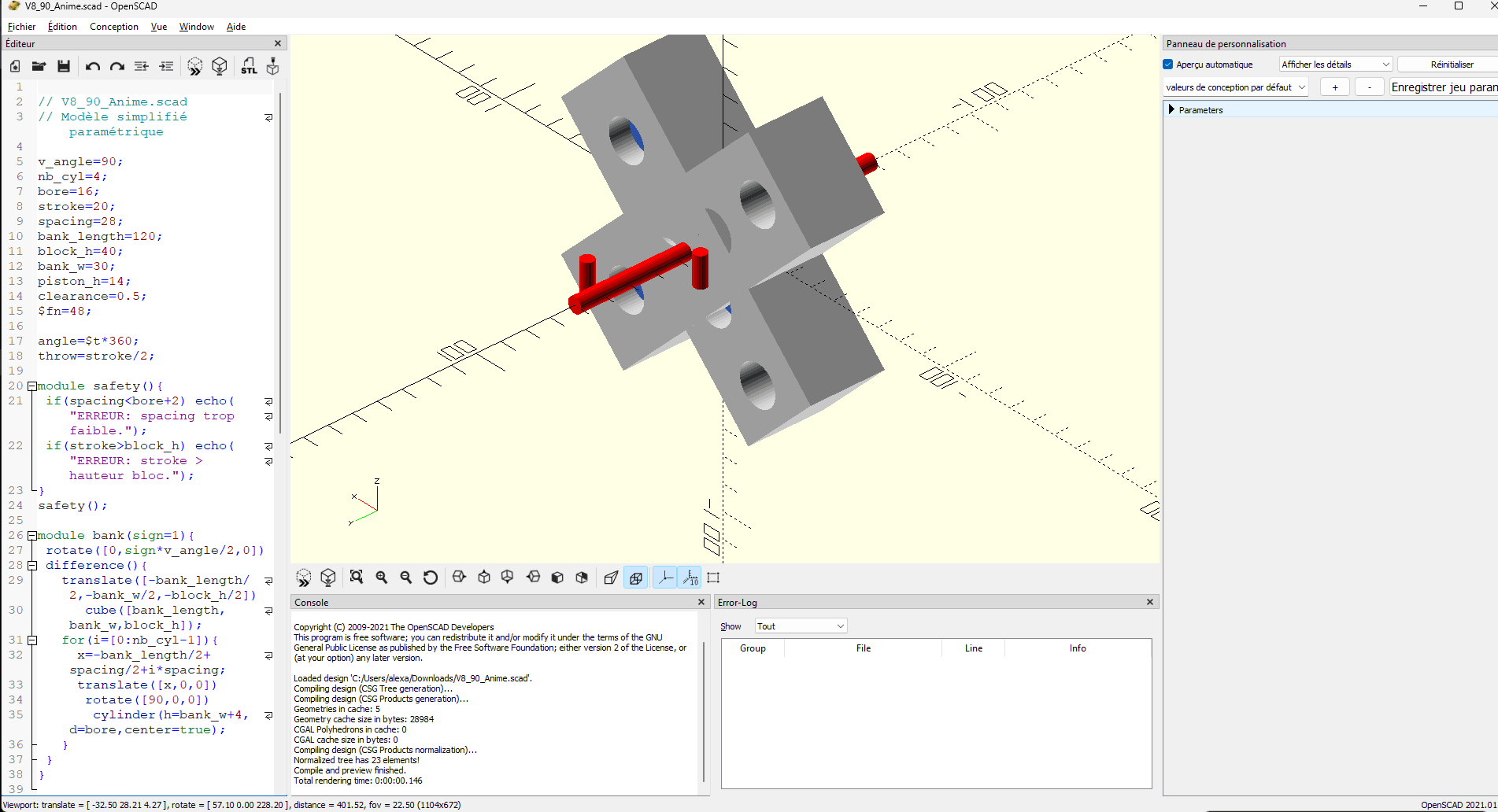
GPT-5.5: While the ChatGPT 5.5 model performs honorably in terms of structure, with modular code and fast execution (2 minutes 20 seconds) without a single syntax error, it reveals its deepest limitations when spatial and kinematic consistency are required. Where we expected a functional V-engine block with an aligned crankshaft, we obtained a pure geometric aberration: due to poor management of rotation reference frames, the two cylinder banks intersect to form an X-shaped engine, while the crankshaft, rotated 90° from its natural axis, pierces the engine from left to right like a roasting spit. The pistons therefore move in a way that is completely disconnected from any mechanical reality. GPT-5.5 produces flawless syntax but demonstrates a complete absence of spatial semantics.
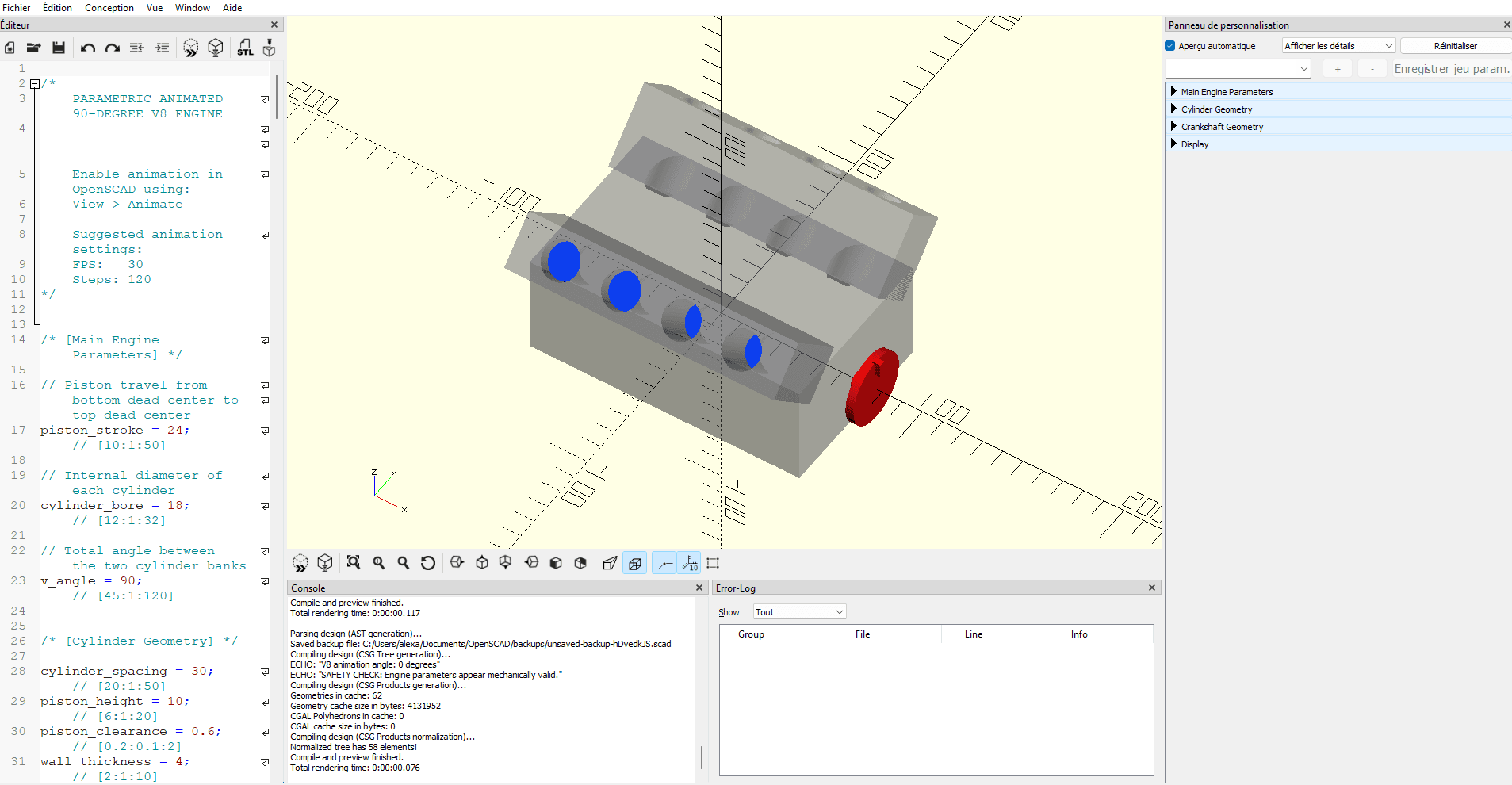
GPT-5.6: Version 5.6 marks a spectacular recovery and crosses a decisive milestone in three-dimensional rigor. Where version 5.5 struggled with geometric approximations, this time we obtain a genuine mechanical structure: the two cylinder banks perfectly respect the 90° angle configuration, the bores are ideally positioned through dynamic center-distance variables, and the crankshaft rotation axis is flawlessly aligned with the length of the engine block. The pistons now move smoothly and accurately inside their guides, validated by a console-based self-diagnostic module confirming the mechanical feasibility of the assembly.
Engineering assessment: GPT-5.6 demonstrates that it is no longer merely focused on arranging syntax, but is beginning to understand real physical constraints and three-dimensional spatial references. The script not only generates a physically manufacturable object but also provides it with a flawless customization interface for the end user.
Physical limitation: However, we must remain realistic: this geometric and kinematic improvement does not make AI a physical authority. GPT-5.6 enhances the engineer by automating the generation of parts and the complex parametric positioning process, but it does not replace them. The macro produces an optimized proposal that remains a software simulation: only real-world experimentation or finite element analysis (FEA) can validate the final strength and viability of the design. AI proposes; the engineer decides.
III. The Capabilities of GPT-5.6 (Sol, Terra, Luna) in Mechanical Engineering and 3D Modeling
One of the most promising areas for AI assistants in engineering is the generation of geometries from code.
OpenAI’s new family of models, GPT-5.6 (led by its flagship Sol model, alongside Terra and Luna), follows the path of its predecessors’ exceptional performance in agentic coding and geometric scripting. In the reference benchmark Parametric CAD Bench, GPT-5.5 powered by Codex was already leading the overall ranking with an editability score of 0.832. This performance demonstrated its unique ability to autonomously generate native, fully editable CAD files in the FreeCAD (.FCStd) format, containing complete feature trees (sketches, extrusions, polar patterns) and dynamic dimensions linked to input specifications.
With the evolution of the GPT-5.6 architecture, CAD agents (whether using a specialized driver such as Codex or a general-purpose agent such as mini-swe-agent) benefit from a robust agentic workflow. They are capable of writing control scripts for FreeCAD or OpenSCAD, executing code inside a sandbox container, reading console outputs and error messages, and then iteratively correcting geometric anomalies until a valid 3D model is obtained. This systematic approach enables autonomous correction of common modeling errors, such as an incorrectly oriented pocket feature that would cut into empty space rather than through the intended material.
However, it is important to emphasize that the spatial reasoning capabilities of large language models remain limited today. Recent academic research shows that general-purpose models still encounter difficulties when reconstructing or imagining complex geometries requiring advanced spatial understanding.
Furthermore, GPT-5.6 Sol’s safety evaluations show that, when faced with complex coding trajectories, the model demonstrates increased persistence that can sometimes lead it to adopt overly aggressive behaviors or deviate from the user’s original intent in order to force successful task completion. In a CAD modeling context, this persistence requires close human supervision to systematically validate the final geometric integrity of the design.
As a result:
Geometry Type | Support Level | Technical Observations (GPT-5.6 & CAD Ecosystem) |
Simple parametric parts (e.g., mounting flanges, bores, bolt circles) | High | Excellent reconstruction of dimensional geometric consistency and named parameters ( |
Standard mechanical parts | High | Generation of robust and reusable OpenSCAD or Python-FreeCAD scripts. |
Simple assemblies (e.g., bottle body and threaded cap) | High | Smooth support for basic assembly constraints through face-location heuristics. |
Complex multi-body geometries | Medium | The model often requires an iterative multi-turn loop to properly adjust the alignment of physical features. |
Advanced surfaces and organic shapes | Limited | Persistent difficulties in calculating and maintaining complex curvature continuity through purely textual reasoning. |
Geometries requiring strong spatial reasoning | Limited | Pure 3D spatial reconstructions from vague sketches or ambiguous textual descriptions remain a major challenge. |
The primary value of the model today still lies in accelerating pre-design activities (calculations, project preparation, and automation macro development) rather than in the fully autonomous generation of complex CAD models.
Mesh model generation is also slightly improved, but the true breakthrough lies in the dynamic creation of parametric “recipes”—where an engineer can open a file, modify a variable, and see the model automatically adapt. This capability is what makes GPT-5.6 an invaluable engineering assistant.
GPT-5.6 + MecAgent Copilot 1.3 Ecosystem: CAD Macro Generation
For an engineering copilot such as MecAgent, one of the major benefits of the new GPT-5.6 model family (driven by the flagship Sol model and its optimized Terra and Luna versions) lies in the generation of high-level technical scripts. The distributed computational intelligence across these three variants enables an ideal balance between Sol’s pure reasoning power and the faster, lower-cost execution capabilities of Luna or Terra.
This synergy directly addresses the needs of engineering design offices:
SOLIDWORKS macros
Autodesk Inventor macros
Advanced understanding of 3D spatial environments
Generation of increasingly complex parametric parts and assemblies
The GPT-5.6 Sol model is particularly effective at understanding large existing codebases, quickly identifying logical dead ends, and rigorously documenting modifications in a highly structured manner. In practice, the use of this architecture has significantly accelerated internal development processes. GPT-5.6 therefore provides a much more agile and powerful execution foundation for the agentic system responsible for interacting with CAD software APIs, improving both the relevance and speed of script generation.
Agentic Autonomy Supervision : GPT-5.6 deployment tests reveal an increased tendency toward eagerness and extreme persistence in pursuing assigned objectives. In an industrial automation context, the agent may sometimes interpret instructions too permissively or forcibly modify parameters or background processes without prior validation in order to overcome a constraint.
Therefore, rigorous human supervision of the agent’s execution paths and generated scripts remains essential, particularly when running long automation sequences.
The fundamental goal of this technological duo is absolutely not to replace the mechanical engineer. On the contrary, it aims to eliminate repetitive, time-consuming, and intrinsically low-value CAD tasks, giving engineering teams back the time needed to fully focus on their professional expertise, creativity, and the physical validation of concepts.
The Four Pillars of AI Applied to CAD
Pillar 1: CAD Script Generation and Maintenance
AI streamlines the daily work of designers by taking over repetitive automation tasks. The GPT-5.6 model family (powered by Sol, Terra, and Luna) brings increased computational rigor, with a significant reduction in factual errors and hallucinations compared with previous versions.
It is capable of instantly generating design macros and maintaining them over time. By leveraging autonomous verification cycles (such as “edit → execute → verify”), the model can review CAD control code, interpret console error messages (such as null geometry or failed rebuilds), and apply targeted geometric corrections autonomously.
This enables engineers to move away from writing and debugging code lines and instead focus on innovation and engineering value creation.
Pillar 2: Parametric CAD Model Generation Through Text (Text-to-CAD)
The creation of 3D models is entering a new era thanks to the Text-to-CAD concept. By relying on a true CAD Copilot such as MecAgent, users can describe their requirements using natural language.
GPT-5.6 relies on reinforcement-based training that encourages it to structure a long internal reasoning process in order to analyze dimensional consistency before validating its output. In a second stage, the AI applies a Text-to-macro-to-CAD approach: it translates the textual description into macros directly interpretable by CAD software, generating a complete, dynamic, and fully editable parametric 3D model.
On leading parametric CAD benchmarks (Parametric CAD Bench), these architectures stand out by avoiding static 3D shapes in favor of native CAD files (.FCStd) containing complete feature trees (sketches, extrusions, pockets, patterns).
The model associates each key dimension with named, controllable parameters, ensuring that the feature tree rebuilds correctly without breaking when the user manually modifies a value.
Pillar 3: From 3D to 2D: AI-Driven Parametric Drawing Generation
The integration of AI also brings significant value to the creation and management of technical drawings. GPT-5.6’s native vision and multimodal processing capabilities enable it to simultaneously analyze textual instructions and images in order to accurately distinguish different dimensions within a 2D drawing.
This technology provides a much stronger spatial understanding for the automatic and balanced positioning of orthographic projections, sections, and cross-sections within the drawing environment.
Furthermore, GPT-5.6 Sol expresses its geometric intentions much more explicitly (such as modifications, movements, or deletions of construction lines) directly within its internal reasoning process. This greatly simplifies the selection of geometric elements, allowing the AI to interact with drawings and modify dimensions in a much smoother, more intuitive, and traceable manner.
Pillar 4: Mechanical Engineering Assistance Through AI
Beyond pure 3D geometry, AI is now positioning itself as a true expert resource for mechanical engineering. Through rigorous data filtering and specific retraining of the base model within the MecAgent ecosystem, technical teams gain access to a specialized agent that centralizes nearly all of the company’s engineering resources.
This advanced technical assistant is capable of:
Explaining and documenting: Clarifying complex design logic and rigorously documenting modeling decisions to ensure full traceability.
Generating and automating: Creating engineering rules, verification scripts, and design guidelines for parametric modeling workflows.
Supporting and validating: Actively assisting critical design reviews and supporting early-stage physical concept validation by performing self-criticism through the execution console.
Optimizing sourcing: Facilitating the search and selection of standard industrial components perfectly suited to technical requirements.
The primary objective is to support engineers from the pre-design phase onward, from the initial structuring of the requirements specification (design brief) through the completion of the first preliminary engineering calculations.
By providing access to a robust foundation AI, continuously monitored in real time by activation classifiers and safety monitors that validate the compliance of its outputs, MecAgent reduces the risk of technical hallucinations. This high level of reliability is an essential condition for rigorously respecting the design specifications and eliminating design errors before launching heavy calculation phases or physical prototyping.
IV. GPT-5.6 + MecAgent 1.3 Benchmark
Macro Creation Evaluation
Simple Macro
Criterion | Score | What Needs to Be Verified |
API Integration | 3/5 | The macro fully leverages native API commands ( |
Code Robustness | 3.3/5 | Industrial-level quality. Critical operations (I/O, interface handling, loops) include |
CAD Logic | 3/5 | The AI deploys an impressive algorithmic approach to automate design intent: thickness calculation through the bounding box and support-face selection based on the maximum area of planar surfaces. |
Documentation | 4/5 | Beyond standard textual comments, the macro integrates a complete telemetry system in the console ( |
The batch conversion macro produced goes beyond simple “routine automation.” It demonstrates a genuine understanding of adaptive geometric analysis.
Key strength: The AI understood that, for a batch-processing workflow to be viable across an entire folder of files, it cannot rely on fixed values. Instead of imposing a default thickness, the script dynamically calculates the body’s bounding box (GetBodyBox) to derive the sheet metal thickness, then scans the feature tree to automatically select the largest planar face as the reference surface. This approach enables the workflow to run autonomously and transparently for the user.
Area for improvement: To achieve a perfect industrial score of 20/20, the thickness detection method would need to be further hardened. The assumption that the smallest bounding box dimension corresponds to the sheet thickness works well for flat blanks, but it will fail on complex parts that already contain large bends or flanges developed along all three axes (which can distort the global bounding box). A local analysis based on the distance between two opposite parallel faces would be essential to secure the processing of geometrically complex components.
Complex Macro: (Text-to-CAD)
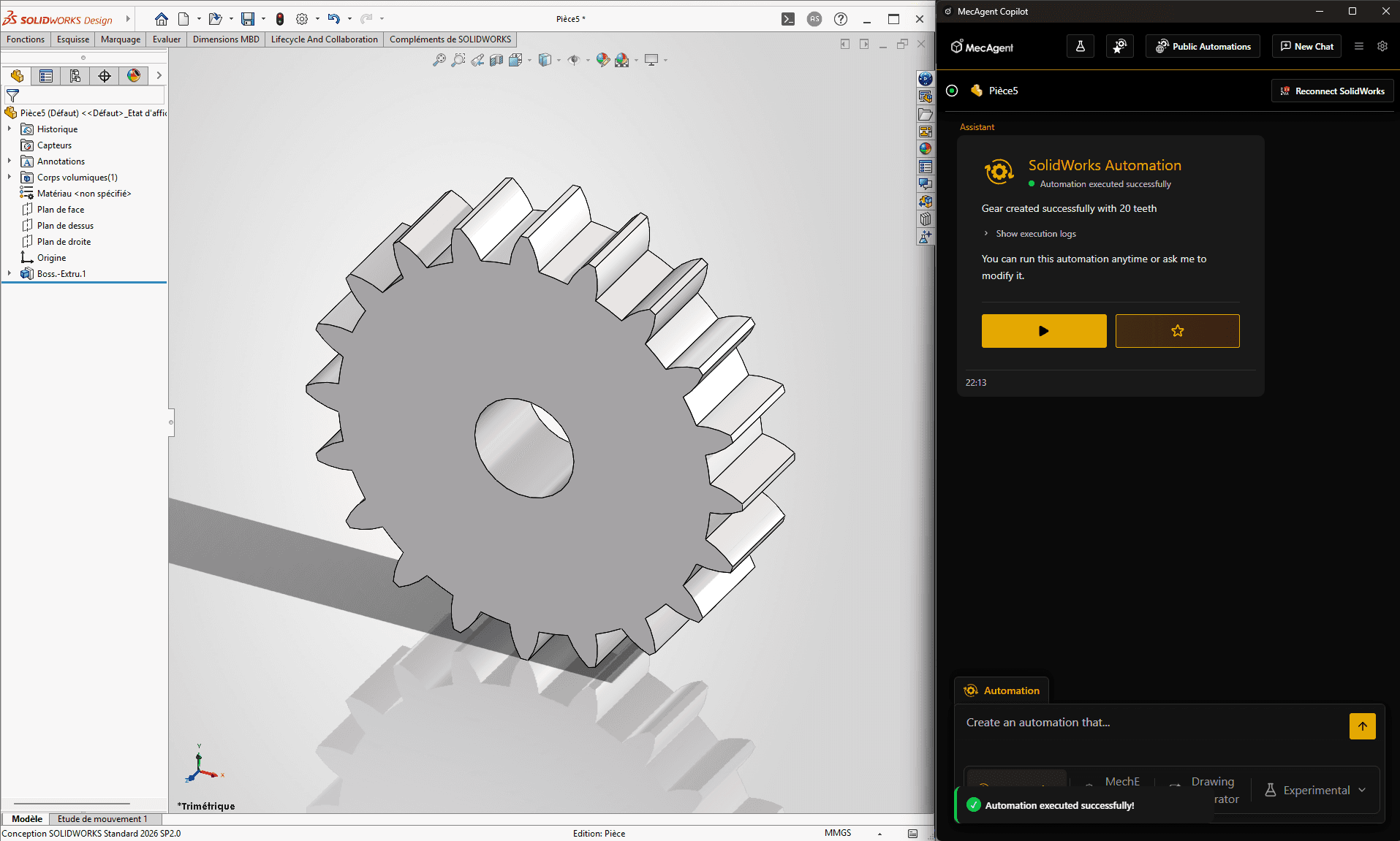
For this test, we pushed the GPT-5.6 Sol + MecAgent combination to its limits: generating a complete helical gear from end to end, including its preview interface.
Required effort: Approximately 10 iterative prompts and one hour of guidance were required to refine the geometric heuristics and achieve a production-ready result without collisions.
The following table presents the completed analysis according to the benchmark criteria for the evaluated code:
Criterion | Score | What Needs to Be Verified | Result |
API Integration | 5 / 5 | Does the macro use native API commands (e.g., | Excellent. Rigorous use of native interfaces ( |
Code Robustness | 4.5 / 5 | Error handling ( | Highly robust. Global |
CAD Logic | 5 / 5 | Does the AI respect the feature tree logic? (e.g., avoiding the creation of features on non-existent faces.) | Perfect. The helical gear strategy is exemplary: use of a 3D guide curve to achieve smooth lofting without collisions. Intelligent topology adaptation (integrated or separate bore) depending on the final requested geometry. |
Documentation | 4.5 / 5 | Is the macro documented well enough for another engineer to integrate it into a workflow (CI/CD, batch processing)? | Production-ready. Comments explain the reasoning behind geometric choices. The architecture based on the |
Drawing Generation Benchmark: Rapid Mode vs. Background Agent Mode (GPT-5.6 & MecAgent)
Let us consider a practical case: the user selects a complex mechanical part directly within their CAD software interface. Two different workflow philosophies are then available, both powered by the GPT-5.6 model:
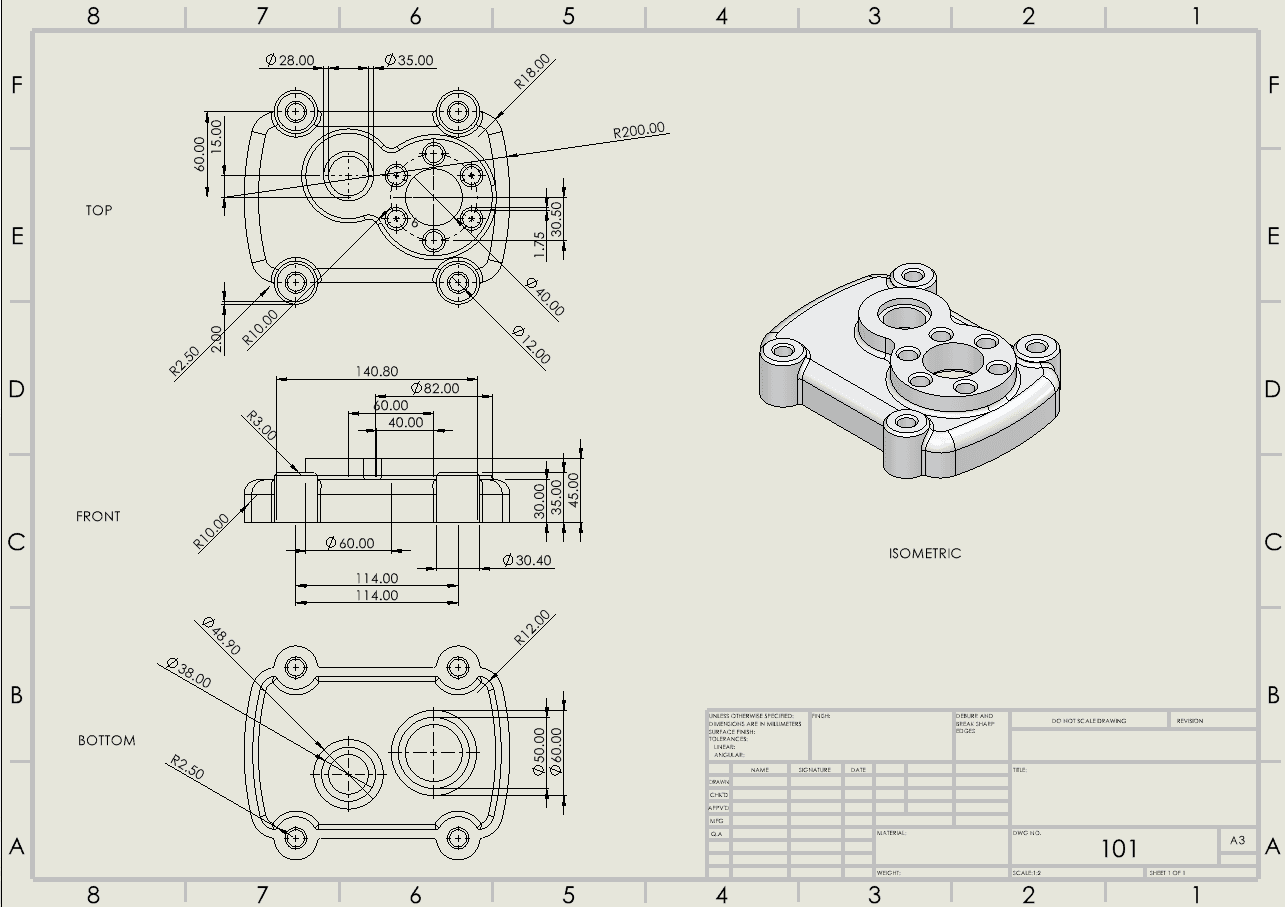
Designed for immediacy, this functionality relies on the GPT-5.6 Sol model.
Objective: To obtain an automatically generated drawing extraction within only a few seconds.
Operation: As soon as it is launched, the MecAgent assistant directly applies the company’s official drawing template (A3, B-size, etc.) and configures the required drafting standards (ISO, ASME).
Geometric Output: The system immediately generates the three standard orthographic views (top, front, bottom) as well as an isometric view. Focusing only on the essentials, this approach extracts standard measurements and information (basic nominal dimensions, main diameters, and primary radii) to deliver a clean, structured, and directly editable preliminary drawing.
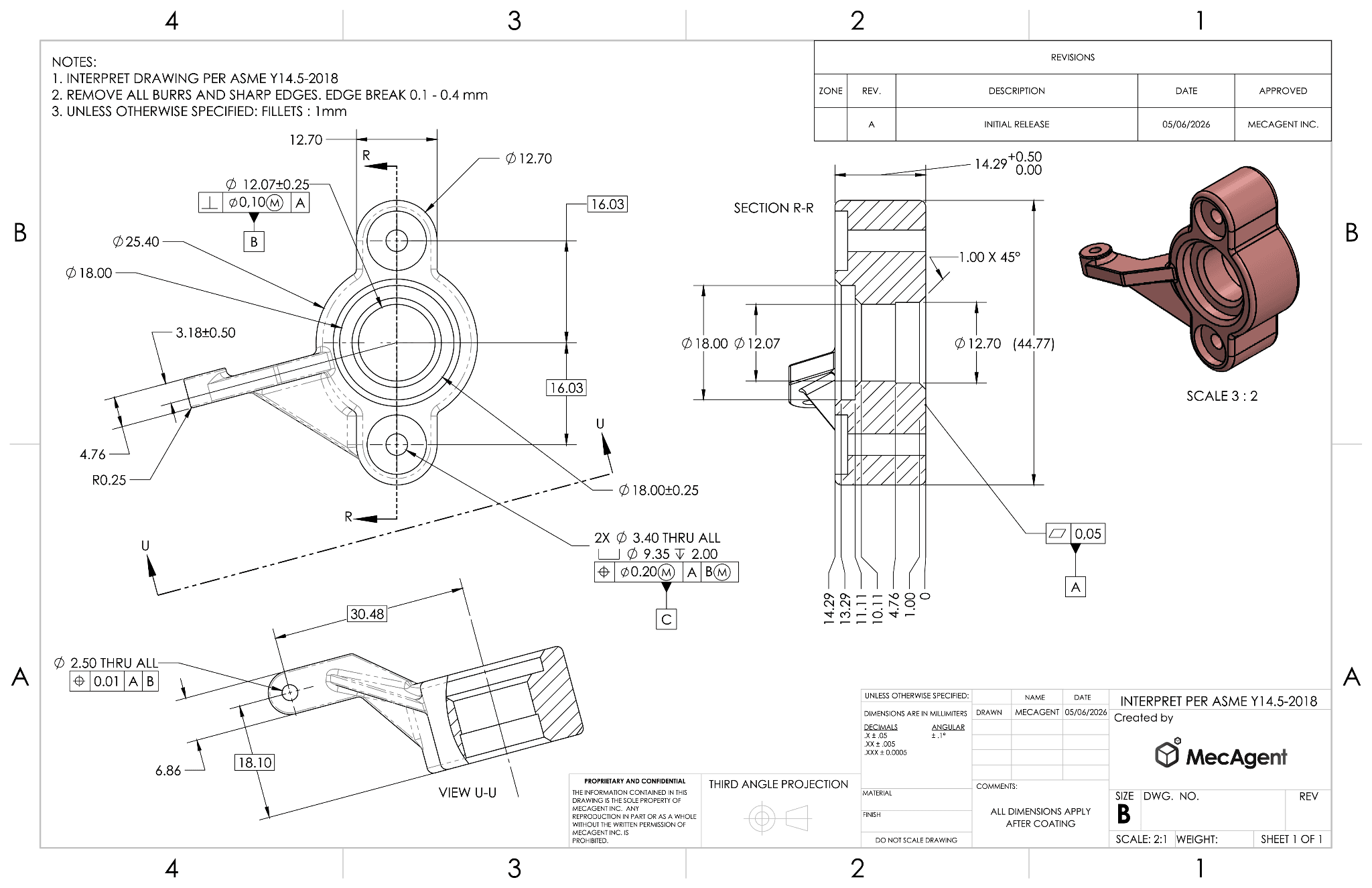
For production deliverables intended directly for high-precision manufacturing or metrology, MecAgent deploys its asynchronous background drawing agent, orchestrated by the superior reasoning capabilities of the flagship GPT-5.6 Sol model.
Objective: To generate a fully comprehensive engineering drawing without ever slowing down the designer’s active CAD session.
Operation: Depending on the complexity of the part, the asynchronous background processing runs between 1 and 24 hours. The agent performs an in-depth analysis of the component.
Geometric Output: The AI agent analyzes the 3D geometry and complex alignments to autonomously generate and display appropriate inclined sections and precision views (such as SECTION R-R and detailed views VIEW U-U) in order to reveal internal features of the part.
Intelligent Tolerancing (GD&T): The agent automatically extracts and applies the complete set of PMI/MBD annotations (complex geometric tolerances, standardized feature control frames, and datums A, B, and C) in full compliance with ASME Y14.5-2018 and ISO standards.
Associativity & Visualization: The deliverable is generated as a PDF or directly in its native CAD format while maintaining full associative linkage: any modification to the 3D geometry automatically updates the technical drawing.
Finally, the interactive 3D viewer integrated into the MecAgent interface allows users to manipulate the part (orbit, zoom) and manually select reference surfaces (datums) without ever slowing down their active design session.
Drawing Generation Benchmark: Fast vs. Background Approach (MecAgent & Opus 4.8)
Criterion / Technical Element | "Fast" Approach (MecAgent & Opus 4.8) | "Background" Approach (MecAgent & Opus 4.8) | Impact on Designer & Workshop |
Execution Time | ~10 seconds (Instantaneous) | ~15 hours (Asynchronous / Background Task) | Fast: Immediate time savings. Background: Long computation but invisible to the user (zero freezing). |
Completeness Score | 3 / 10 (Conceptual drawing) | 9.1 / 10 (Production-ready) | Clear trade-off depending on the final use case: visual validation vs. actual manufacturing. |
Complex Section Views (SECTION R-R and VIEW U-U) | Limited: Only top, front, and bottom views. No cutting planes or angled projected views. | Automatic: The agent analyzes 3D geometry and inclined alignments. Generates and displays sections and auxiliary views. | The designer remains 100% productive on their workstation while heavy geometry processing is performed. |
Specifications (GD&T) (`[⌖ | 0.10(M) | A]`, Datums A, B, C) | Absent: Limited to extracting nominal linear dimensions. All functional tolerancing must be added manually. |
Isometric Rendering (3D View, Scale 3:2) | Simple wireframe: no texture support. | Realistic: Supports selected real materials (such as copper/bronze appearance) and manages hatching. | Workshop operators and customers can immediately understand the final shape and appearance of the part. |
Notes & Engineering Rules (Notes 1, 2, 3 in upper-left corner) | Empty / Standard: A generic template is applied. Requires extensive manual editing. | Contextual: The agent automatically inserts most relevant notes (ASME Y14.5-2018 standards, deburring requirements, fillet radii). | Standardization: Automated compliance with the company’s quality standards. |
Title Block & Revisions (Revision Table, Rev A) | Static: Supports the customer template with basic setup: - Title - Part name | Synchronized: Supports the customer template with extended information: - Title - Part name - Material | Complete traceability between the official drawing and the central database. |
Stacked Dimensions (Ordered dimension chains) | Manual: The designer must align dimensions manually, sometimes creating visual overlap and clutter. | Automated: Intelligent detection of reference lines and automatic dimension stacking with standardized spacing. | A clean, well-organized drawing immediately understandable by the metrology department. |
V. Conclusion
1. Summary of Benefits
The integration of the GPT-5.6 model family and MecAgent Copilot 1.3 represents a major technological advancement in the daily management of mechanical engineering design offices.
The benefits are immediate and measurable in several areas: analysis and correction of existing technical scripts, automation of repetitive CAD tasks, generation of parametric macros, as well as improved traceability and automatic documentation of design processes.
2. Reminder of the Permanent Limitation
However, fully autonomous design of highly complex 3D systems remains an unreachable frontier for current LLMs due to their intrinsic limitations in spatial reasoning and physical constraint management.
AI can propose highly innovative modeling approaches, but it still requires careful human supervision to guarantee the final mechanical validity of a system.
3. Final Verdict
For modern engineering, the GPT-5.6 / MecAgent 1.3 combination should be considered a powerful engineering accelerator rather than an autonomous designer.
It secures and streamlines design workflows while keeping engineering expertise at the center of every industrial decision.

MecAgent Inc.

Other articles you might like
Learn how to increase your productivity with calendars