
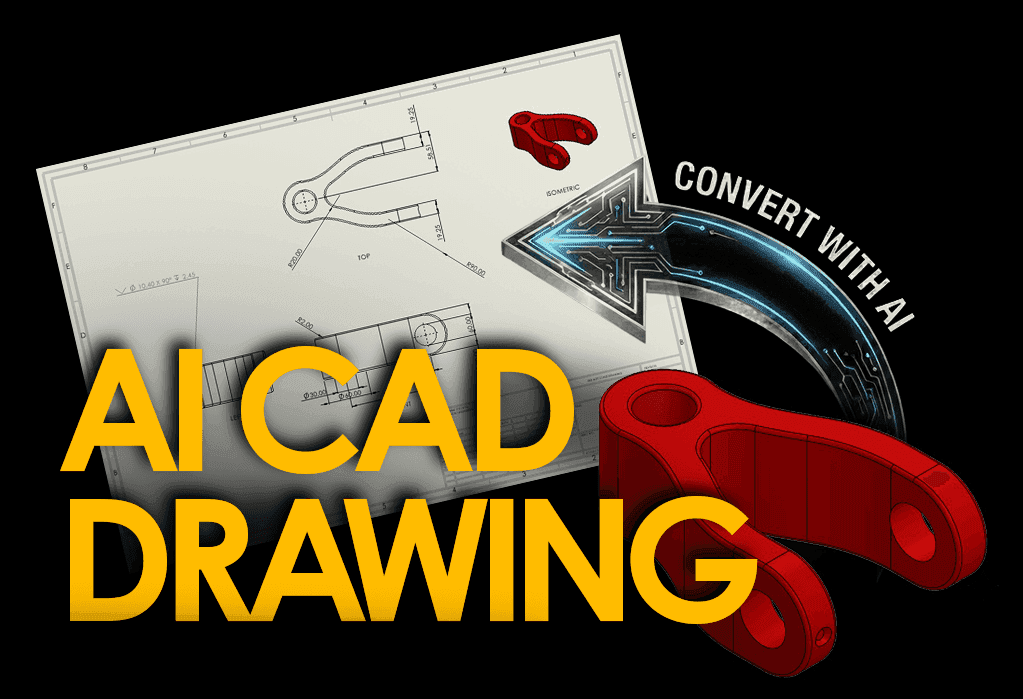
How AI is revolutionizing the way technical drawings are created, accelerating workflows and empowering CAD designers.
The Evolution of Technical Drawings: From Manual Drafting to AI-Driven Drawing Generation
For decades, technical drawings have been a fundamental pillar of mechanical engineering. Long before the advent of 3D modeling, a part only truly existed industrially once it was clearly represented on a drawing: standardized views, sections, dimensions, and tolerances formed the common language between design, manufacturing, and inspection.
Within this value chain, drawings have always occupied a central position. They serve as the transition between 3D CAD design and manufacturing, and still today remain a contractual reference in many industrial environments.
With the arrival of artificial intelligence in CAD, driven by MecAgent, the role of technical drawings has begun to fundamentally evolve. What was once a final deliverable is progressively becoming an automated, intelligent process natively integrated into the design workflow, ensuring a smooth continuity between the 3D model and manufacturing.
From Manual Drafting to Parametric 3D: The Birth of Digital Drawings
Originally, industrial drawings were created entirely by hand. They relied on deep knowledge of projections, graphical conventions, and standards. Any design change often required redrawing large portions, or even the entire drawing, from scratch. The process was rigorous, but slow and highly dependent on individual expertise.
The first 2D CAD tools digitized this practice, delivering significant gains in productivity and readability. However, drawings remained central: geometry was still represented as graphical entities, with no embedded engineering intelligence.
The arrival of parametric 3D CAD marked a major paradigm shift. The 3D model became the complete definition of the part, integrating geometry, relationships, and functional parameters. Drawings are now generated from the model, with automatically projected views and dimensions linked to design parameters.
However, in practice, the entire drawing creation process remains largely manual: CAD designers still have to manually place views, organize projections, create section and detail views, position dimensions, manage bills of materials (BOM), apply tolerances, and finalize the title block. The drawing thus becomes a derived representation of the model, ensuring consistency and traceability between design and manufacturing, but at the cost of a significant manual effort.
Why Drawings Remain a Critical Bottleneck
Despite these advances, drawing creation remains one of the most demanding stages of the mechanical design process. Selecting relevant views, organizing the layout, placing dimensions, creating detail views, and finalizing the title block all require time, rigor, and expertise.
In complex or highly iterative projects, this step still represents a major bottleneck between 3D design and manufacturing. And despite more than 20 years of CAD software evolution, no solution has truly automated drawing creation in an effective way.
In practice, CAD designers have continued to do almost everything manually.
AI Drawing Generation: An AI Feature of the MecAgent CAD Copilot
AI Drawing Generation is an AI-powered feature developed by MecAgent, designed with a simple and concrete goal: dramatically accelerate the creation of drawings from 3D CAD models.
Before the introduction of this feature, drawing creation was still a manual and tedious task. CAD designers had to manually place primary views, organize projections, create detail views, position dimensions, fill in the title block, and structure the entire drawing. A repetitive, time-consuming, yet unavoidable process.
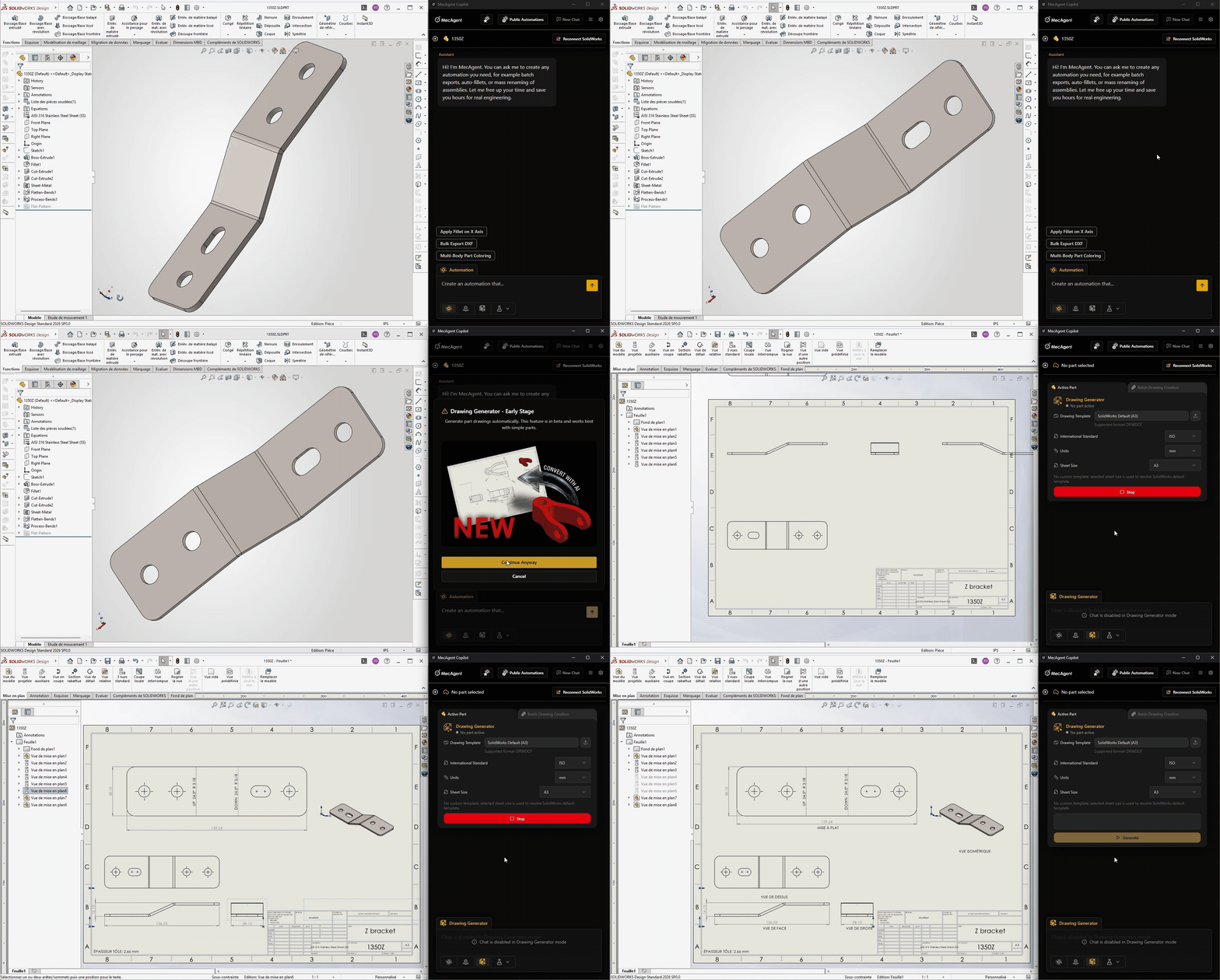
Drawing Generation automates exactly these operations. Starting from the 3D model, the tool:
automatically places relevant views,
generates and organizes detail views,
positions main dimensions,
fills in the title block,
structures the drawing in a clear and usable way.
The goal is not to eliminate human involvement, but to refocus the CAD designer’s role on high-value tasks.
With this approach, engineers can concentrate on:
tolerancing (GD&T),
functional decisions,
and final adjustments before validation and manufacturing.
Integrated into the MecAgent AI CAD Copilot, the AI Drawing Generation feature transforms drawing creation from a fully manual task into a fast, assisted, and fluid process, significantly reducing execution time while improving overall design productivity.
The Final Challenge: Automating GD&T
To fully automate drawing creation, one final step remains: GD&T (Geometric Dimensioning & Tolerancing).
This is the most complex phase, as it requires understanding each part’s real role within its assembly context, identifying functional surfaces, and translating those functions into relevant tolerancing requirements.
At MecAgent, several major technical barriers have already been overcome. Ongoing R&D efforts aim to allow AI to assist with this final step as well, ultimately enabling full automation of the drawing process.
It is an ambitious challenge, but a critical one, to fully unlock the potential of AI-assisted mechanical engineering.
Conclusion
The history of mechanical drawings reflects a continuous evolution: from manual drafting to 2D CAD, then to parametric 3D modeling, and today to the arrival of AI in CAD.
Drawings remain a central industrial artifact, a critical link between 3D design and manufacturing. But the way they are produced is changing fundamentally. With the AI Drawing Generation feature developed by MecAgent, drawings are no longer a bottleneck: they become a faster, assisted process focused on human expertise.
This transition shifts the engineer’s role from execution to supervision and decision-making, a key evolution to meet the demands of modern mechanical engineering
MecAgent Inc.
Download the Beta
Book a Demo
Download (Free)
Book a Demo
Other articles you might like
Learn how to increase your productivity with calendars
“Mythos.1” - Class AI in Mechanical Engineering and CAD Design
MecAgent Inc.
AI CAD Copilots in 2026: 7 Tools Compared for Mechanical Engineers
MecAgent Inc.
Claude Fable 5 x MecAgent 1.2.0 on CAD
MecAgent Inc.
Features
Pricing
AI CAD Community
Careers
Contact