

Pultrusion
Fibers pulled through resin and a heated die, nonstop
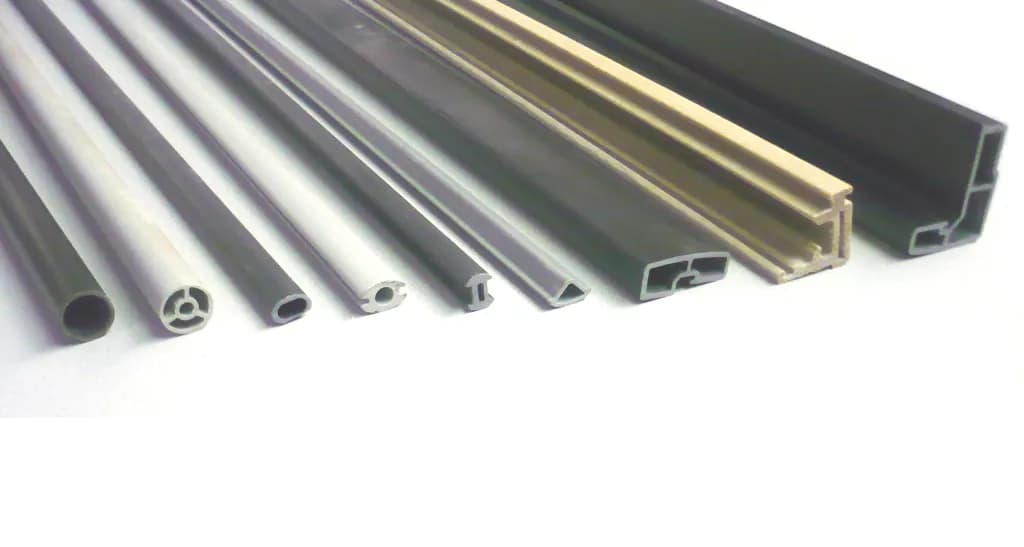
Pultrusion pulls continuous fibers through a resin bath and then a hot die, where the resin hardens around them. Out comes an endless rod, tube or beam with the same cross-section all along, cut to length on the fly. Fiberglass ladder rails, walkway grating and cable trays are made this way.
How it works
Feed the fibers. Rovings (untwisted bundles of continuous fiber) unwind from a creel, a rack of spools. Mats or woven tapes are often added so the profile is also strong across its width.
Soak them in resin. The fibers run through an open resin bath, or the resin is injected straight into the die. Polyester, vinyl ester and epoxy are common choices.
Gather the shape. Guide plates called preformers squeeze out extra resin and bring the wet fibers close to the final cross-section.
Cure in the heated die. A steel die, typically about 0.5–1.5 m long, gives the exact shape. Heat of roughly 100–200 °C makes the resin harden before the profile leaves the die.
Pull continuously. Caterpillar belts, or two clamps that take turns, grip the cured profile and pull the whole line. This pulling is what gives the process its name (pull plus extrusion).
Cut to length. A flying saw, one that travels along with the profile while it cuts, chops pieces to length without stopping the line.
Key facts
- Materials
- Mostly glass fiber, also carbon or basalt; polyester, vinyl ester, epoxy or polyurethane resin
- Typical parts
- Rods, tubes, I-beams, channels, angles, flat bars, ladder rails, grating bars, cable trays
- Part size
- Cross-sections from a few millimeters to roughly 1 m wide; any length, cut as needed
- Precision
- Cross-section typically within about ±0.2–0.5 mm, depending on size
- Surface finish
- Smooth and resin-rich; often covered by a surface veil (a thin fiber tissue) for weather resistance
- Batch size it suits
- Long runs of one profile, often kilometers
- Tooling and machine cost
- Dies: roughly $5,000 to over $100,000 each; complete lines: about $100,000 to over $1 million
- Speed
- Typically about 0.2–3 m per minute, around the clock
Strengths and limits
Strengths
- Continuous and automated: low cost per meter, little waste
- Very strong and stiff along its length, often 60–70 % fiber by weight
- Glass-fiber profiles don't rust, are light and don't conduct electricity
- Any length in one piece, cut on the fly
Limits
- Only straight profiles with one constant cross-section
- Much weaker across the width unless mats or fabrics are added
- Every new cross-section needs its own die, and changeovers take time
- Cured thermoset profiles are hard to recycle
Where it's used
- ConstructionWalkway grating, handrails, window and door frame profiles, fiber rebar
- ElectricalCable trays, ladder side rails, insulating rods and poles
- InfrastructureFootbridges, bridge decks, cooling-tower structures
- EnergyCarbon strips for wind-turbine blade spars, utility poles
- Everyday itemsTent poles, tool handles, plant stakes
How to recognize it
- A long piece with exactly the same cross-section everywhere, with saw-cut ends.
- Fine lengthwise fiber streaks at the surface, sometimes under a thin tissue-like veil.
- At a cut end, a dense mass of fiber dots: the rovings seen end-on.
- Classic look: yellow, gray or green fiberglass grating, ladder rails and handrails.
Compare with
Watch it
Strongwell MC · The idea of pultrusion, from a major profile maker
Strongwell MC · Each station: fiber creel, resin bath, heated die, puller and saw
Liberty Pultrusions · A factory tour of real pultrusion lines
Strongwell MC · Pultruded bars assembled into walkway grating
See real photos
- Wikipedia: Pultrusion — overview with a diagram of the line and photos of profiles
- Wikimedia Commons photo search
Remember
- Pultrusion pulls fibers through resin and a hot die, without stopping.
- It makes endless straight profiles with one constant cross-section.
- The result is very strong lengthwise, rust-free and cheap per meter.
More in Composites
All 100 processes
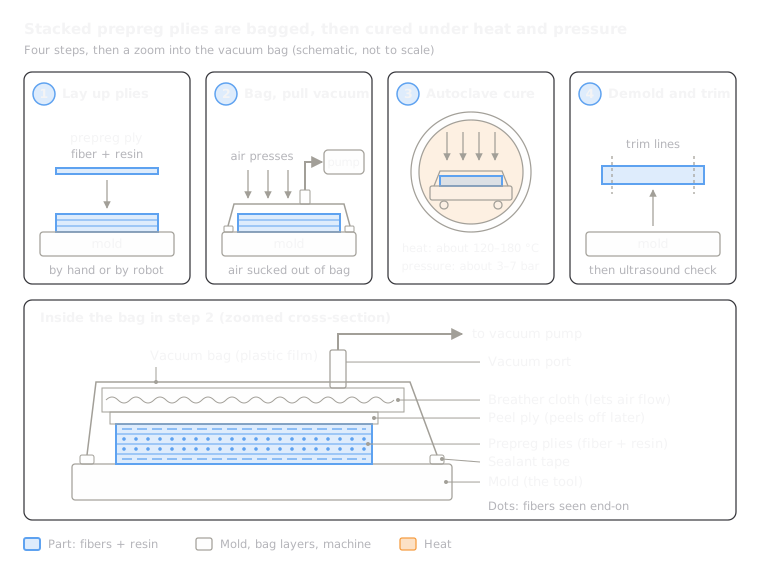 10.1Layup and autoclave curingPrepreg plies stacked on a mold, vacuum-bagged and cured under heat and pressureOpen the lesson
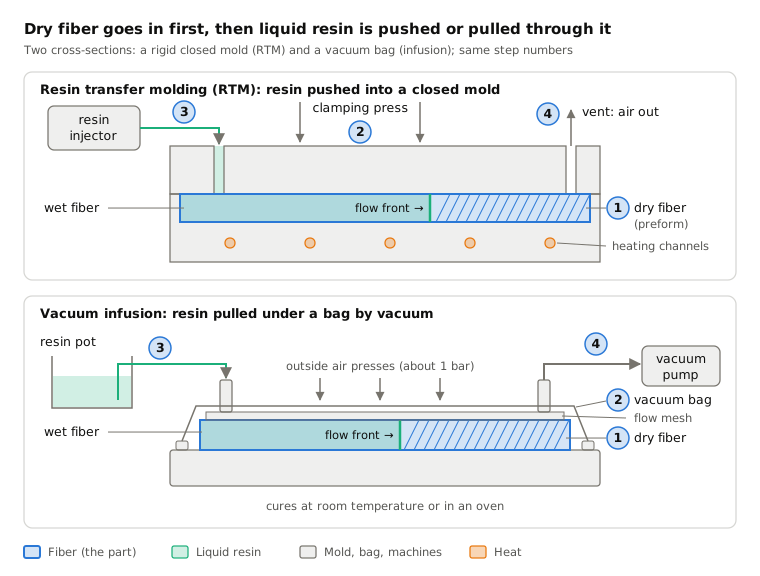
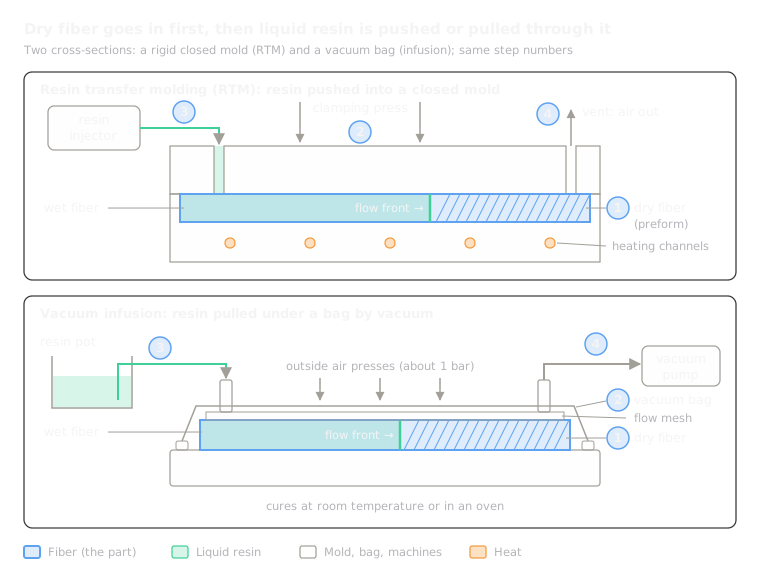 10.2Resin transfer molding and infusionDry fiber in a mold; liquid resin pushed in (RTM) or pulled in by vacuum (infusion)Open the lesson
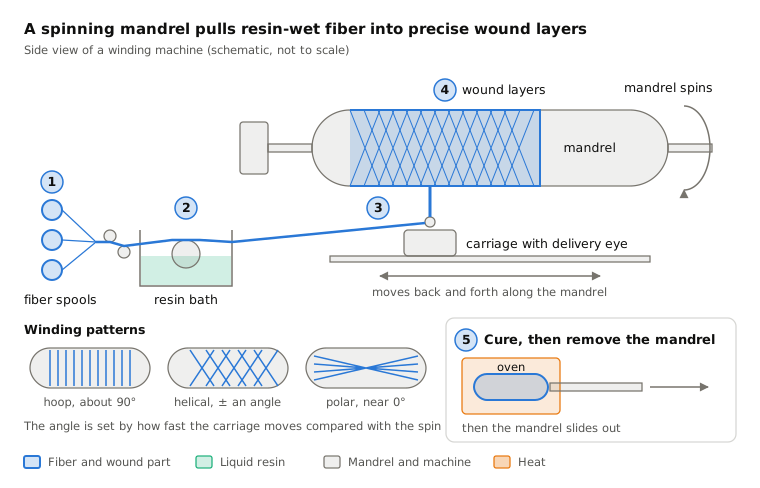
 10.4Filament windingResin-wet fiber wound onto a spinning mandrelOpen the lesson
Try it
Put AI to work in your CAD.
Model parts, generate drawings and automate the repetitive work inside your CAD software.