

Extrusion (aluminum profiles and plastic pipes)
Push metal or plastic through a shaped die
Extrusion pushes material through a shaped opening (a die), like toothpaste from a tube, giving a long piece with that cross-section. Window frames and heat sinks are extruded aluminum; water pipes and cable insulation are extruded plastic. Once you have the die, you can make the shape in any length.
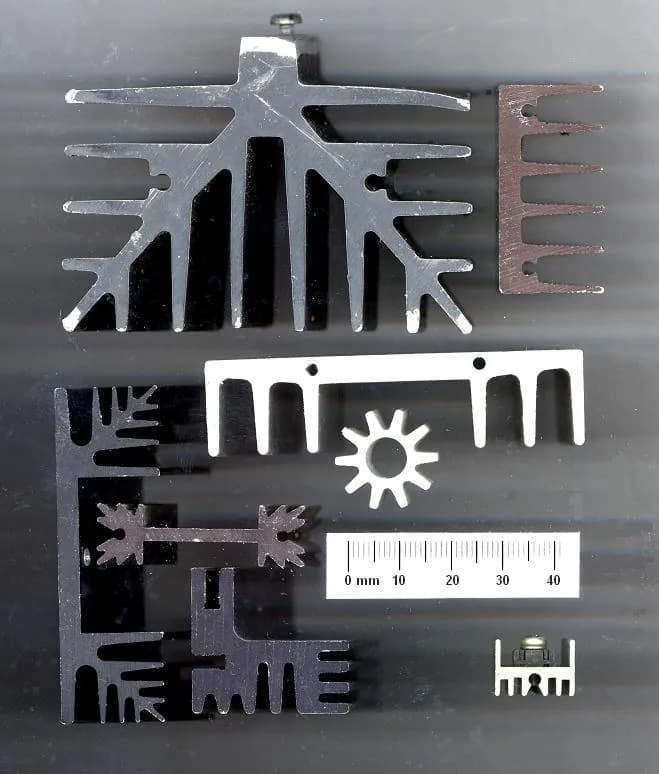
How it works
Heat the billet. A billet (a short, thick log of aluminum) is heated to about 450–500 °C. It stays solid and does not glow, but it becomes soft enough to flow under pressure.
Push with the ram. The billet is loaded into a heated container. A hydraulic ram pushes it with a force of hundreds to thousands of tonnes.
Squeeze through the die. The metal flows through the die (a thick steel disk with a shaped hole). It comes out as a profile (a long piece with a constant cross-section). For hollow shapes, the metal splits around a central core inside the die and joins up again.
Cool, stretch and cut. A puller guides the hot profile along a table while air or water cools it. It is then stretched straight, cut to length, and often heat-treated or anodized (given a protective oxide layer).
Plastic pipe: melt with a screw. Plastic pellets fall from a hopper into a heated barrel. A turning screw (an auger, like in a meat grinder) melts them by heat and friction, and pushes the melt forward without stopping.
Form the tube. The melt flows through a ring-shaped gap in the die, around a central pin that forms the hole of the pipe.
Cool, pull and cut. The soft pipe passes through a water tank that sets its final size. A puller draws it along at a steady speed, and a saw cuts it to length.
Key facts
- Materials
- Aluminum alloys (by far the most common metal), copper, brass, magnesium; plastics such as PVC, polyethylene and polypropylene
- Typical parts
- Window and door frames, heat sinks, rails and tubes, water pipes, cable insulation, plastic trims and seals
- Part size
- Aluminum profiles from about a centimeter to tens of centimeters across, cut to lengths of several meters; plastic pipes from a few millimeters to over a meter in diameter
- Precision
- Aluminum: about ±0.1–0.3 mm on small sections. Plastic pipe: typically a few tenths of a millimeter
- Surface finish
- Smooth, with faint lengthwise die lines; aluminum is often anodized or painted
- Batch size it suits
- From short runs (dies are cheap) to plastic lines running nonstop around the clock
- Tooling and machine cost
- Aluminum dies: often a few hundred to a few thousand dollars. Presses and complete lines: hundreds of thousands to millions
- Speed
- Aluminum: a whole billet pressed in a few minutes. Plastic: continuous, typically meters per minute
Strengths and limits
Strengths
- Complex cross-sections in one pass, hollow ones included
- Cheap dies make even short runs of a custom profile affordable
- Continuous and fast, with little waste (scrap ends are recycled)
- Good surface, ready for anodizing or painting
Limits
- Only constant cross-sections; holes or features across the length must be machined later
- Very thin walls and sharp corners are hard to achieve
- Long profiles can twist or bow and must be stretched straight
- Hard metals such as steel need very high forces and wear dies quickly
Where it's used
- ConstructionWindow and door frames, curtain-wall sections, railings, PVC drain pipes
- ElectronicsHeat sinks, equipment housings, LED strip profiles
- TransportTrain and bus body sections, roof rails, bumper beams
- Plumbing and utilitiesWater and gas pipes, cable conduits, cable insulation
- Consumer goodsCurtain rails, ladder rails, garden hoses
- Food (same principle)Pasta, breakfast cereals, snacks
How to recognize it
- The cross-section is exactly the same along the whole length; a cut end shows the full profile.
- Fine straight lines running lengthwise (die lines), easiest to see on bare aluminum under a light.
- Saw-cut ends, with holes and notches added later by machining.
- On plastic pipes, printed text repeating along the length, added as the pipe leaves the line.
Compare with
Watch it
Hydro · The whole aluminum route, explained step by step
corematerials · A simple cut-away of ram, billet and die
Hydro · A real press turning a billet into a profile
Machine GPM · A plastic pipe line: extruder, cooling tank, puller and saw
See real photos
- Wikipedia: Extrusion — diagrams of direct and indirect extrusion, photos of profiles and dies
- Wikimedia Commons photo search
Remember
- Extrusion pushes material through a shaped die; the product keeps that cross-section for any length.
- Aluminum is pushed by a ram one billet at a time; plastic is melted and pushed nonstop by a screw.
- Cheap dies make custom profiles affordable, even in small runs.
More in Bulk forming
All 100 processes
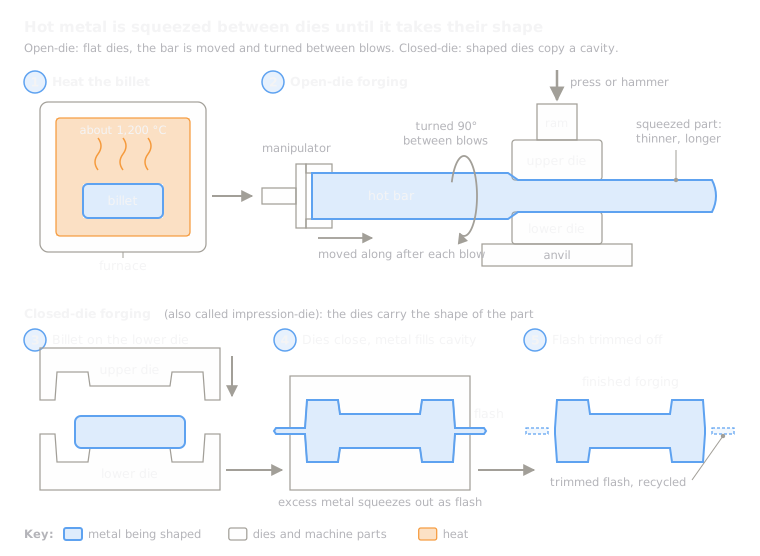 3.1ShortForging (open-die and closed-die)Squeeze hot metal between flat or shaped diesOpen the lesson
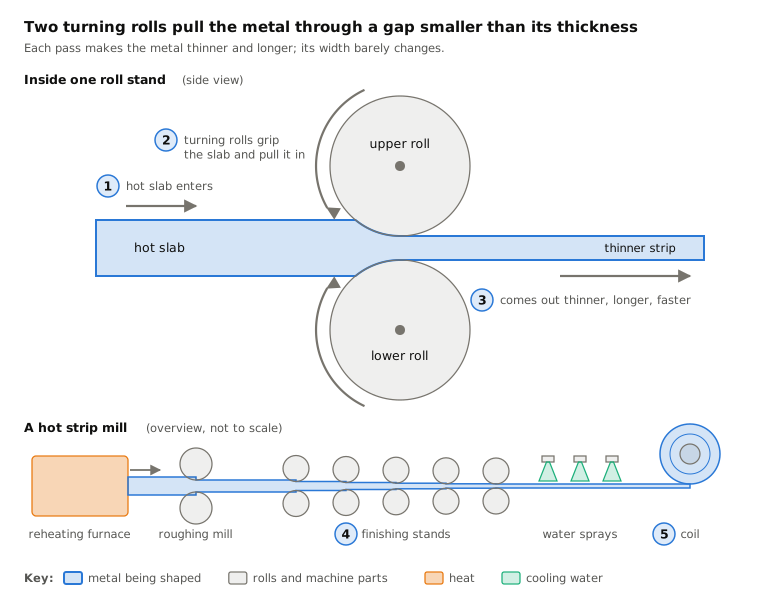
 3.2RollingPull metal through the gap between turning rollsOpen the lesson
 3.4Wire drawingPull a rod through ever-smaller diesOpen the lesson
 3.5Cold headingCut wire into blanks and punch a head, coldOpen the lesson
 3.6Thread rolling and tappingPress a thread onto a blank, or cut or press one in a holeOpen the lesson
Try it
Put AI to work in your CAD.
Model parts, generate drawings and automate the repetitive work inside your CAD software.