

Cold heading
Cut wire into blanks and punch a head, cold
Cold heading cuts a short piece of wire and hammers one end into a head, at room temperature, in a fraction of a second. Almost every screw, bolt, nail and rivet you own was made this way. It wastes almost no metal and is one of the fastest ways to make a solid part.
How it works
Cut a blank. Drawn wire (lesson 3.4) is fed off a coil, straightened and pushed through a feed tube. A cutter shears off a blank (a short slug) of exactly the right length.
Upset with the first blow. Transfer fingers place the blank in a die (a hardened block with a hole). A punch strikes its end and upsets it (squashes it shorter and fatter) into a rough cone.
Form the head. At the next station a heading punch flattens the cone into the final head. A pin on the punch presses in the recess, for example a cross or hex socket for the screwdriver.
Eject. An ejector pin pushes the finished blank out of the die. A screw blank then goes to thread rolling (lesson 3.6), and often to heat treatment and plating.
Key facts
- Materials
- Low- and medium-carbon steels, alloy steels, stainless steel, aluminum, copper and brass
- Typical parts
- Screws, bolts, rivets, nails, pins, ball blanks, spark-plug bodies, small shafts
- Part size
- Typically from about 1 mm to about 30 mm in diameter, and up to a few hundred millimeters long
- Precision
- Typically about ±0.05–0.1 mm on diameters; heads slightly looser
- Surface finish
- Smooth, slightly shiny formed surfaces, no tool marks from cutting
- Batch size it suits
- Very large: tens of thousands to millions of identical parts
- Tooling and machine cost
- Die and punch sets: thousands of dollars. Multi-station headers: hundreds of thousands to millions
- Speed
- Small parts: often a few hundred per minute; large bolts: tens per minute
Strengths and limits
Strengths
- Extremely fast and cheap per part
- Almost no waste: no chips, nearly all the wire becomes product
- Cold working makes the metal stronger, and the grain follows the head
- Very repeatable parts from automatic machines
Limits
- Tooling and setup only pay off in very large batches
- Limited to fairly compact, round shapes made from wire
- The metal must be ductile enough not to crack when squashed cold
- Tight features (fine threads, precise bores) need extra steps
Where it's used
- FastenersWood and machine screws, bolts, rivets, nails
- AutomotiveWheel bolts, engine bolts, ball-joint studs, valve parts
- ElectronicsTiny screws for phones and laptops, contact pins
- ConstructionAnchor bolts, structural bolts, nails
- BearingsSteel ball blanks before grinding
How to recognize it
- A head that flows smoothly into the shank, with no seam or weld line.
- A slightly rough or flattened tip on the far end, where the wire was sheared.
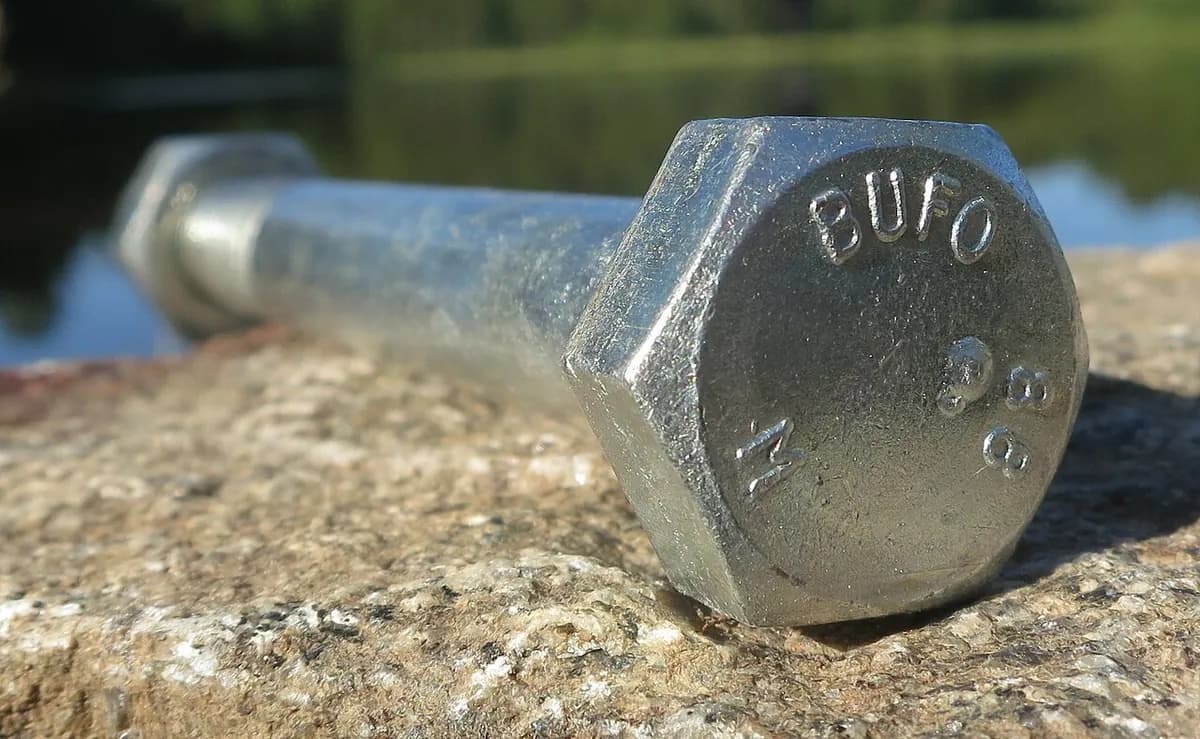
- Letters or numbers raised or stamped on the head, pressed in by the punch (bolt grade and maker marks).
- Identical parts by the thousand, typically sold in bulk boxes.
Compare with
Watch it
Corey @ SmithReps · A one-minute overview of how screws are headed
Nedschroef Machinery · How a multi-station former shapes a part blow by blow
Arjaan Buijk · A simulation of the metal flowing at each station
INFASCO · A bolt factory, from wire coil to finished bolt
See real photos
- Wikipedia: Cold heading — principle, header types and grain flow
- Wikimedia Commons photo search
Remember
- Cold heading cuts wire into blanks and punches a head on them, cold, in a few blows.
- Several stations in one machine shape each part step by step, hundreds of times a minute.
- It makes almost every screw, bolt and rivet, with almost no waste.
More in Bulk forming
All 100 processes
 3.1ShortForging (open-die and closed-die)Squeeze hot metal between flat or shaped diesOpen the lesson
 3.2RollingPull metal through the gap between turning rollsOpen the lesson
 3.3Extrusion (aluminum profiles and plastic pipes)Push metal or plastic through a shaped dieOpen the lesson
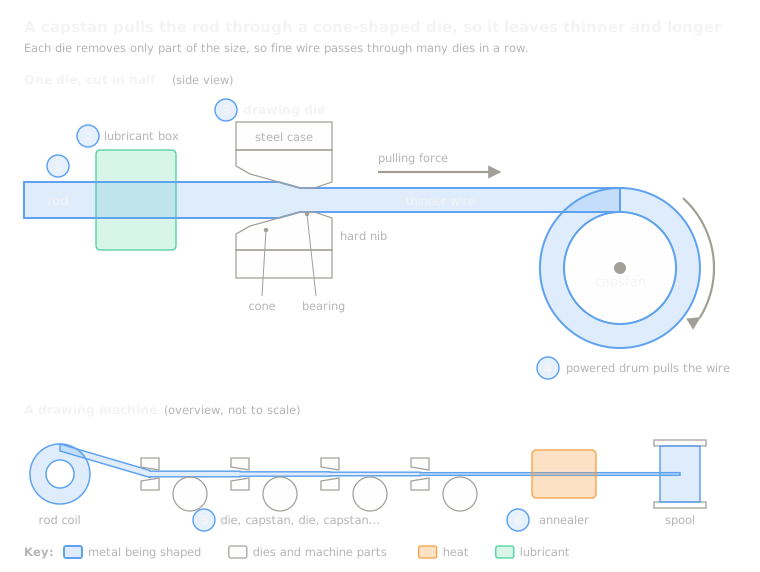 3.4Wire drawingPull a rod through ever-smaller diesOpen the lesson
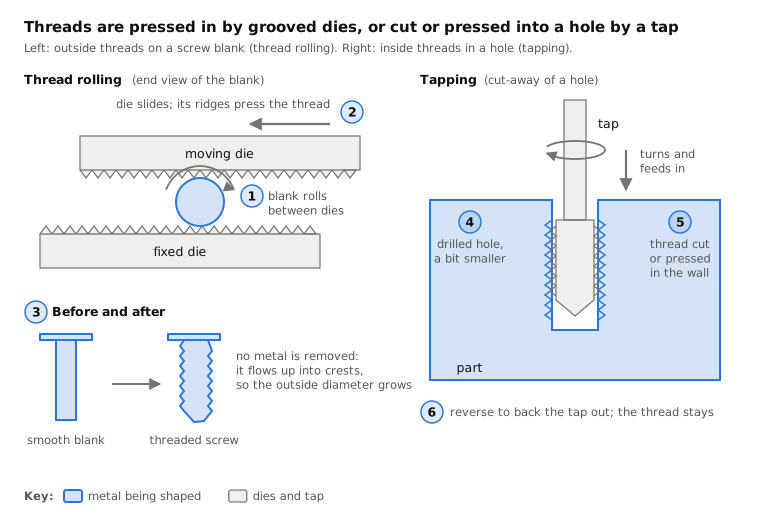
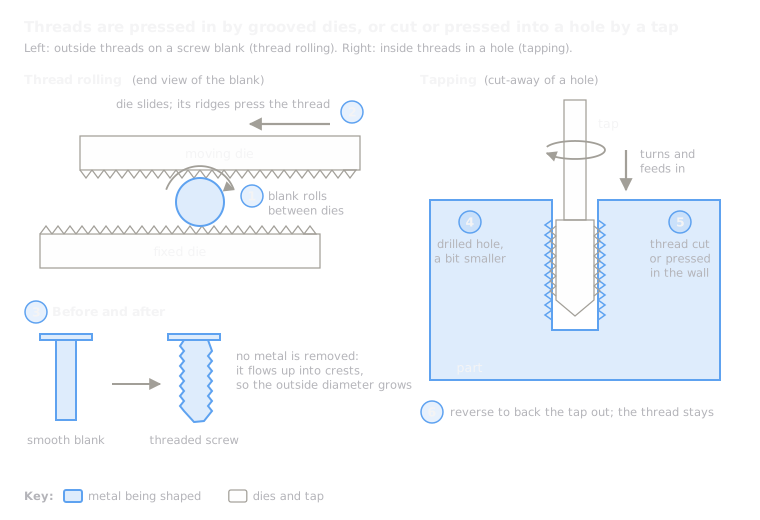 3.6Thread rolling and tappingPress a thread onto a blank, or cut or press one in a holeOpen the lesson
Try it
Put AI to work in your CAD.
Model parts, generate drawings and automate the repetitive work inside your CAD software.