

Bulk forming
Bulk forming shapes a solid piece of metal by squeezing, hammering, pushing or pulling it, without melting it and without cutting chips away. The metal flows like very stiff clay into a new shape, so almost none of it is wasted. These six processes make most of the bars, sheets, wires, crankshafts and screws in the world.
The big idea
Metal is not as rigid as it looks. Push hard enough and it flows plastically (it changes shape for good, without breaking), much like modeling clay under your thumb. Every process here applies that push in a different way: blows between dies, turning rolls, a ram behind a die, or a pull through a hole. Heating the metal makes it flow more easily; working it cold makes it stronger and more precise.
The 6 processes in this chapter
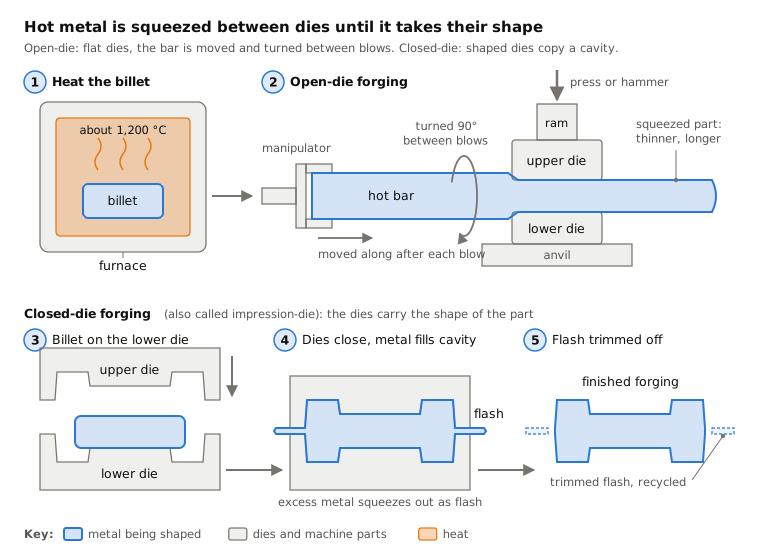
 3.1ShortForging (open-die and closed-die)Squeeze hot metal between flat or shaped diesOpen the lesson
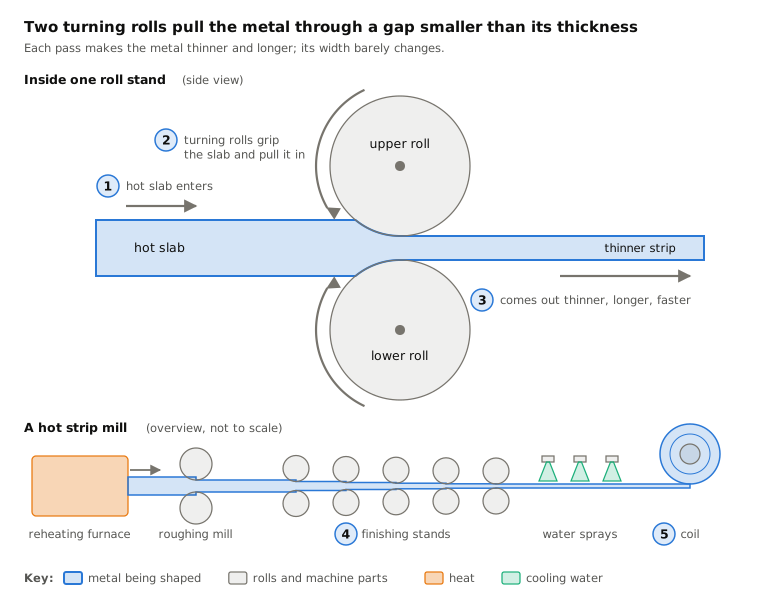
 3.2RollingPull metal through the gap between turning rollsOpen the lesson
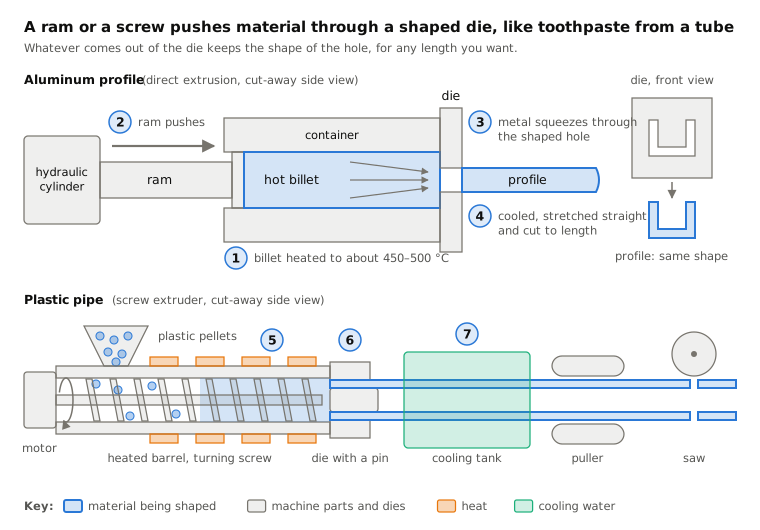
 3.3Extrusion (aluminum profiles and plastic pipes)Push metal or plastic through a shaped dieOpen the lesson
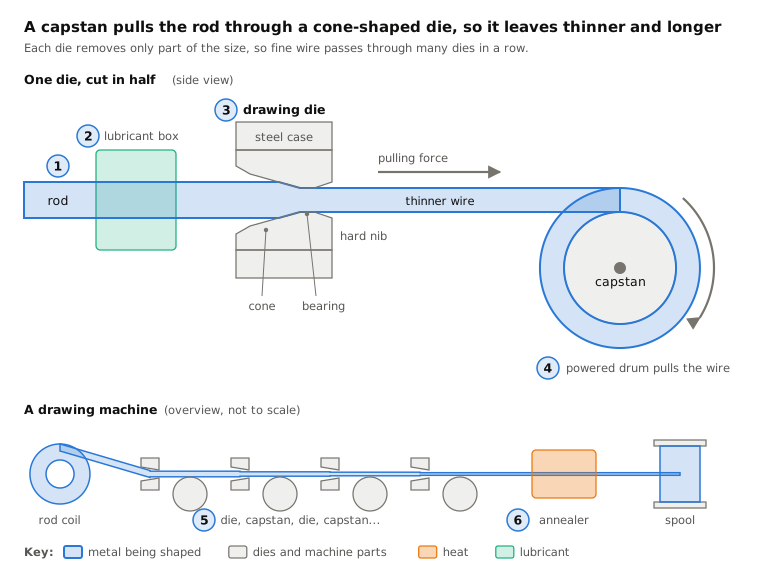
 3.4Wire drawingPull a rod through ever-smaller diesOpen the lesson
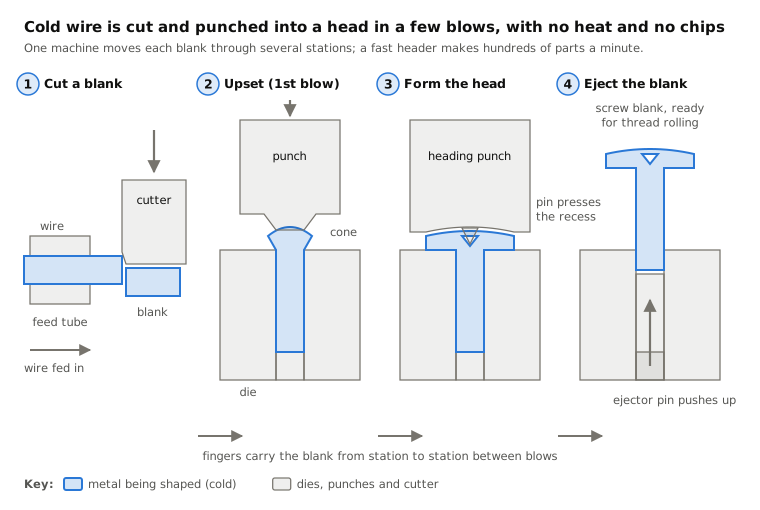
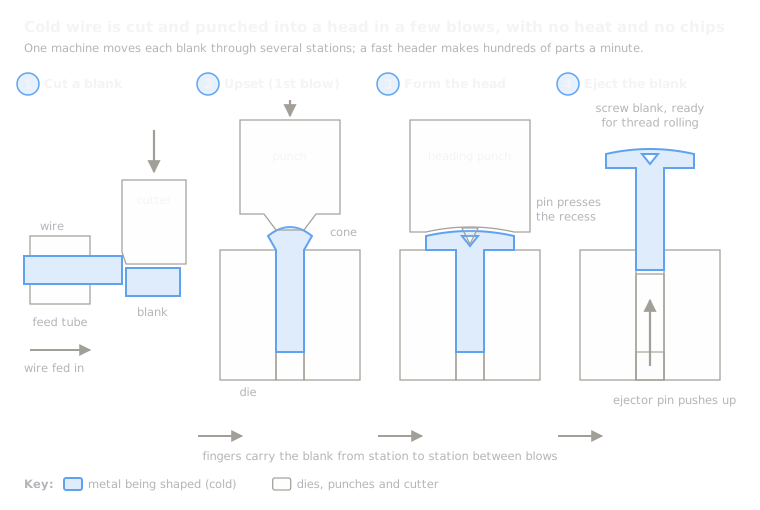 3.5Cold headingCut wire into blanks and punch a head, coldOpen the lesson
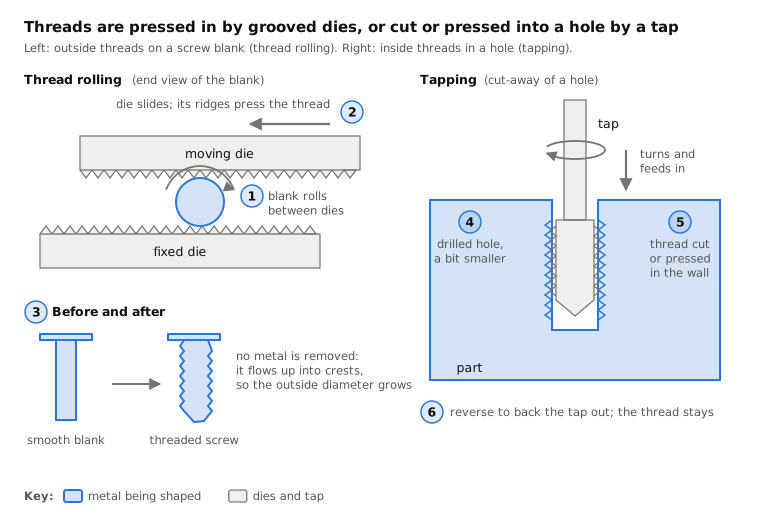
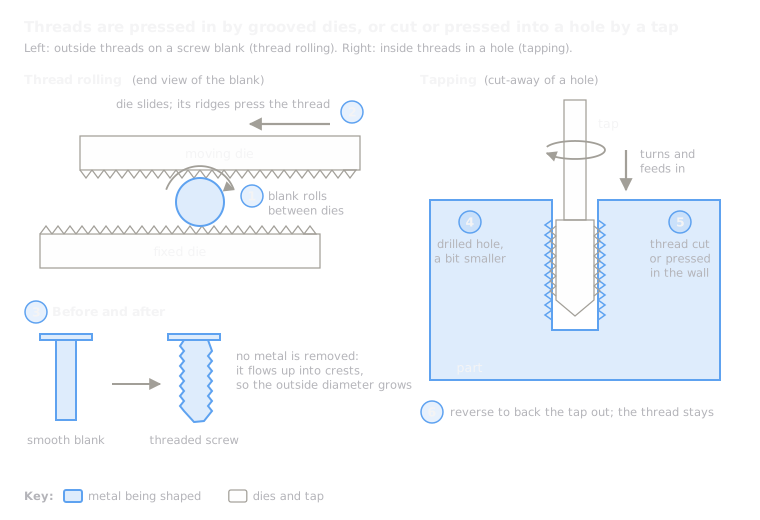 3.6Thread rolling and tappingPress a thread onto a blank, or cut or press one in a holeOpen the lesson
Side by side
| Process | In one line | Best for | Batch size | Precision |
|---|---|---|---|---|
| 3.1Forging (open-die and closed-die) | Squeeze hot metal between flat or shaped dies | Strong, tough parts: crankshafts, tools, aircraft fittings | One-offs (open die) to millions (closed die) | About ±0.5 mm, then machined |
| 3.2Rolling | Pull metal through the gap between turning rolls | Sheet, plate, foil, beams and rails | Millions of tonnes a year | About ±0.1 mm hot, ±0.01–0.05 mm cold |
| 3.3Extrusion (aluminum profiles and plastic pipes) | Push metal or plastic through a shaped die | Window frames, heat sinks, pipes | Short runs to nonstop lines | About ±0.1–0.3 mm |
| 3.4Wire drawing | Pull a rod through ever-smaller dies | Wire for cables, springs and screws | Very high volume | About ±0.01–0.05 mm |
| 3.5Cold heading | Cut wire into blanks and punch a head, cold | Screws, bolts, rivets, nails | Tens of thousands to millions | About ±0.05–0.1 mm |
| 3.6Thread rolling and tapping | Press a thread onto a blank, or cut or press one in a hole | Screws, bolts and threaded holes | One hole to millions of screws | A few hundredths of a millimeter |
The last three lessons tell one story: how a screw is made from wire. Rod is drawn into precise wire (3.4), cut and headed into a blank (3.5), then given its thread by rolling (3.6).
How to choose within this family
- Need a part that must not break under load, like a crankshaft or a hook? Choose forging.
- Need long, flat or simple products by the tonne? Choose rolling.
- Need a long piece with a complex but constant cross-section, even in small runs? Choose extrusion.
- Need thin, round, precise wire? Choose wire drawing.
- Need small headed parts such as screws by the million? Choose cold heading, then thread rolling.
Key words
- Plastic deformation
- a permanent change of shape without cracking, the basis of all bulk forming.
- Hot working
- forming metal above the temperature where it softens and re-forms its grains; easier flow, rougher finish.
- Cold working
- forming at room temperature; more force needed, but stronger and more precise parts.
- Work hardening
- metal becomes harder and less ductile each time it is deformed cold.
- Annealing
- heating metal to soften it again after cold working.
- Die
- a hardened steel or carbide tool whose shape is copied onto the workpiece.
- Billet
- a solid starting block or log of metal, cut to length before forming.
- Grain flow
- the fiber-like pattern of the metal's crystals, which follows the shape in formed parts and makes them tough.
Try it
Put AI to work in your CAD.
Model parts, generate drawings and automate the repetitive work inside your CAD software.