

Sheet and tube forming
Sheet and tube forming turns thin flat sheet or tube into 3D shapes without removing any material. Every process in this chapter bends or stretches the metal past its elastic limit, so it keeps the new shape; they differ in what does the pushing: a press and die, a spinning roller, a fluid, a gas, a magnetic pulse, an explosion or a laser.
The big idea
Think of folding and stretching a sheet of kitchen foil over a bowl. Metal sheet behaves the same way, only it needs far more force. The thickness stays roughly the same, so a light, strong shell or tube comes out of a flat blank with little waste. The choice of process depends mostly on how deep and complex the shape is, how many parts you need, and how much you can spend on tooling.
The 10 processes in this chapter
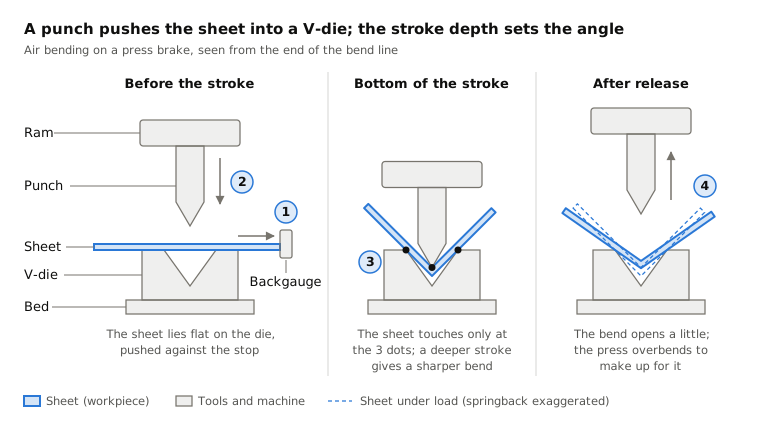
 4.1Sheet metal bendingA press brake folds sheet along straight linesOpen the lesson
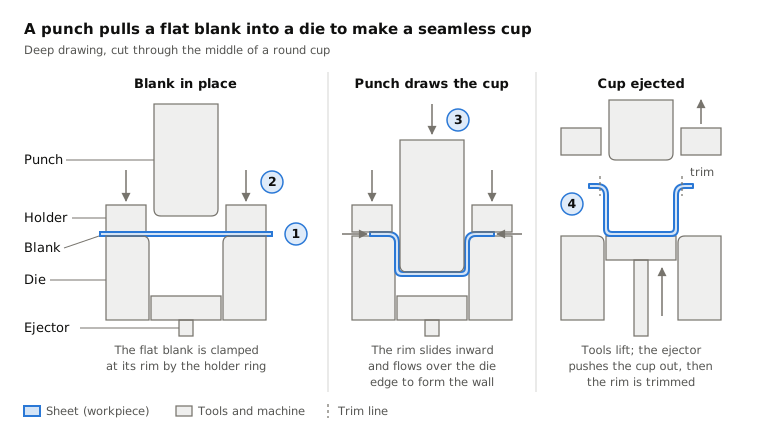
 4.2ShortStamping and deep drawingMatched dies cut and press sheet into shape, often in a secondOpen the lesson
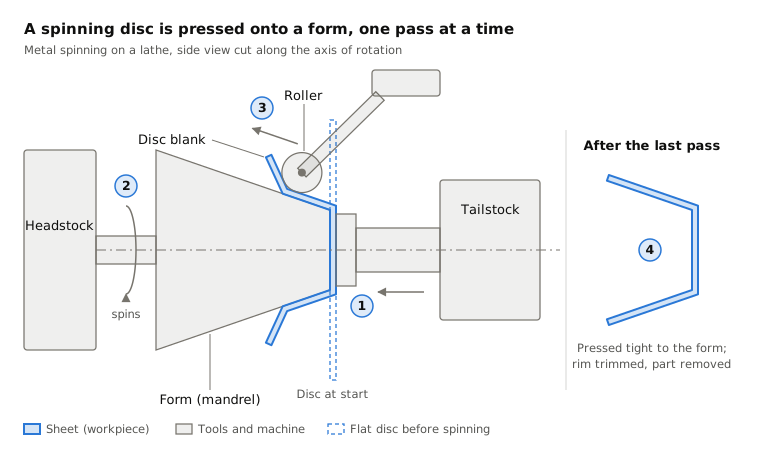
 4.3Metal spinningA roller presses a spinning disc over a formOpen the lesson
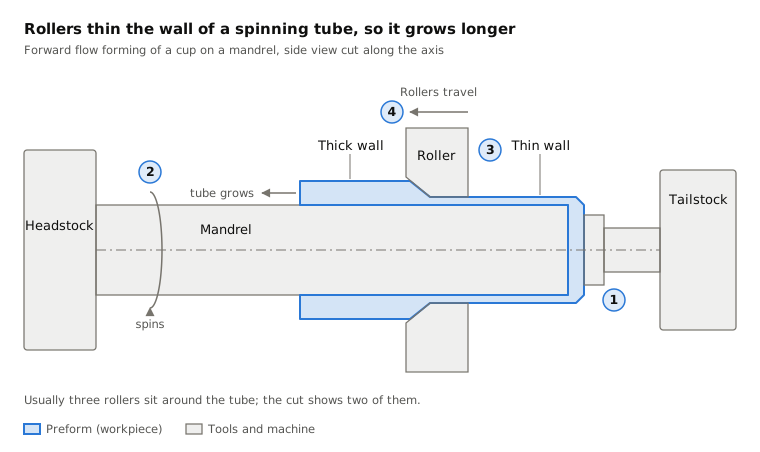
 4.4Flow formingRollers stretch a spinning tube thinner and longer over a mandrelOpen the lesson
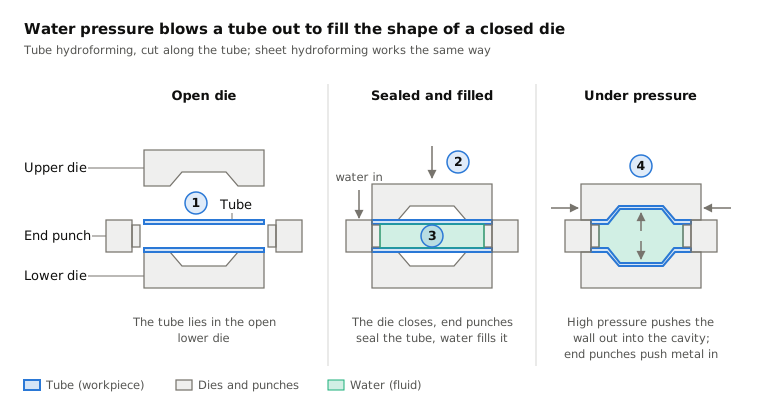
 4.5HydroformingFluid pressure pushes tube or sheet into a dieOpen the lesson
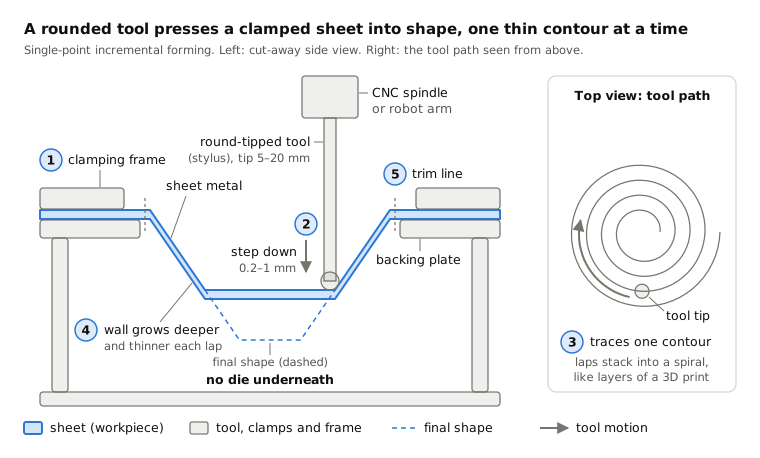
 4.6Incremental sheet formingA round tool traces contours into clamped sheet, with no dieOpen the lesson
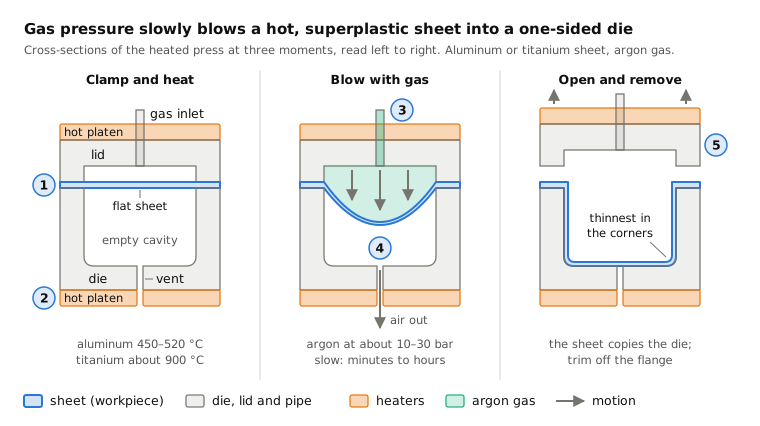
 4.7Superplastic formingHot gas blows a superplastic sheet into one dieOpen the lesson
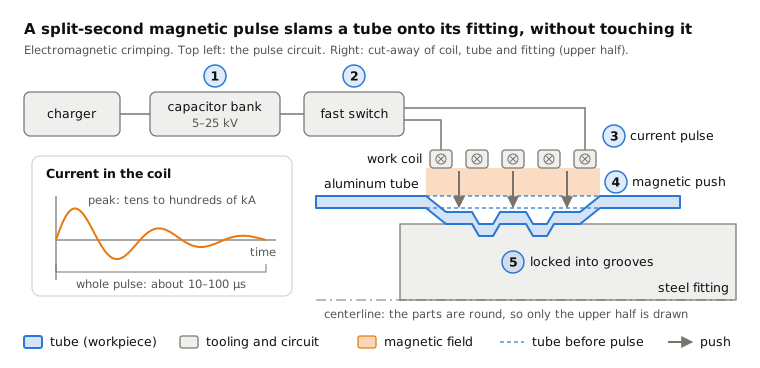
 4.8Electromagnetic formingA magnetic pulse throws metal onto a fitting, without contactOpen the lesson
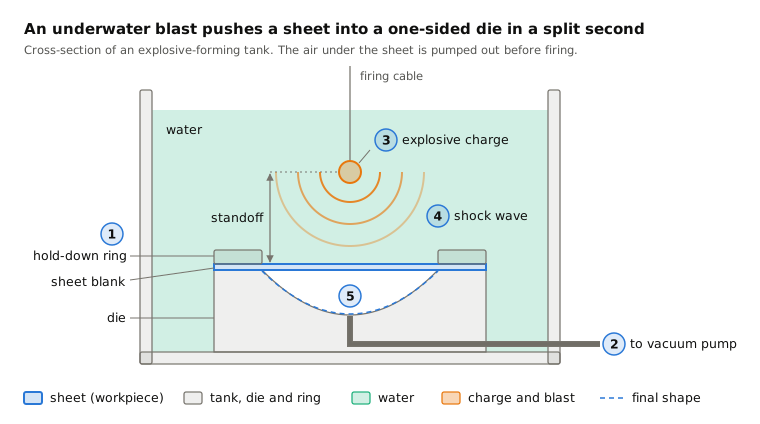
 4.9Explosive formingAn underwater blast pushes sheet into one dieOpen the lesson
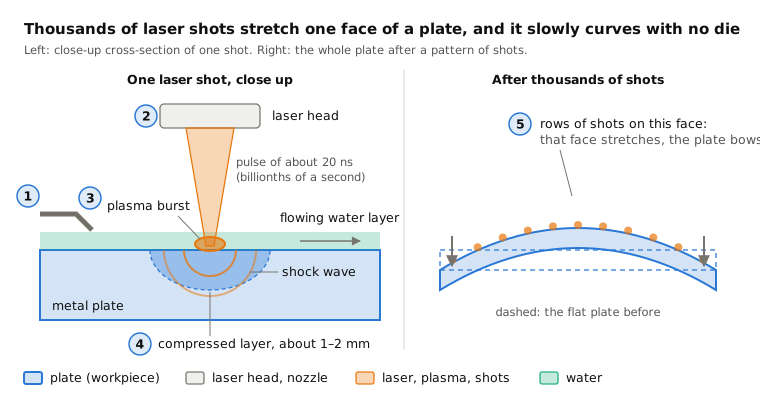
 4.10Laser peen formingLaser shots stretch one face so a plate curvesOpen the lesson
Side by side
| Process | In one line | Best for | Batch size | Precision |
|---|---|---|---|---|
| 4.1Sheet metal bending | A press brake folds sheet along straight lines | Brackets, boxes, enclosures | One-offs to mass production | About ±0.1–0.5 mm, angles about ±0.5° |
| 4.2Stamping and deep drawing | Matched dies cut and press sheet into shape, often in a second | Car panels, cans, sinks | Mass production | About ±0.05–0.2 mm |
| 4.3Metal spinning | A roller presses a spinning disc over a form | Round parts: lamp shades, domes, cookware | One-offs to medium series | About ±0.1–0.5 mm |
| 4.4Flow forming | Rollers stretch a spinning tube thinner and longer over a mandrel | Precise thin-walled tubes and cylinders | Medium to high series | About ±0.05–0.1 mm |
| 4.5Hydroforming | Fluid pressure pushes tube or sheet into a die | Car frame tubes, exhaust parts, complex panels | Medium to high series | About ±0.1–0.3 mm |
| 4.6Incremental sheet forming | A round tool traces contours into clamped sheet, with no die | Prototypes and custom parts | One-offs to a few hundred | About ±0.5–1 mm |
| 4.7Superplastic forming | Hot gas blows a superplastic sheet into one die | Deep, complex aerospace and car panels | Hundreds to a few thousand a year | A few tenths of a mm |
| 4.8Electromagnetic forming | A magnetic pulse throws metal onto a fitting, without contact | Crimped tubes and joints, aluminum and copper | Medium to high series | Often about ±0.1 mm |
| 4.9Explosive forming | An underwater blast pushes sheet into one die | Very large domes and panels | Prototypes, very small series | Good fit to die; trimmed after |
| 4.10Laser peen forming | Laser shots stretch one face so a plate curves | Gently curved thick aerospace panels, straightening | Small series | A few tenths of a mm after correction |
Precision figures are typical orders of magnitude; each lesson gives details.
How to choose within this family
- Simple folds in sheet: bending; many identical parts: stamping and deep drawing.
- Round parts: spinning for a few, flow forming for precise thin walls, stamping for huge numbers.
- Tubes with complex shapes: hydroforming; tubes joined to fittings: electromagnetic forming.
- Few parts and no die budget: incremental sheet forming, or laser peen forming for gentle curves in thick plate.
- Deep, complex or very large parts in small numbers: superplastic forming, or explosive forming for the biggest and toughest.
Key words
- Blank
- the flat piece of sheet that a part is formed from.
- Die
- a hardened, shaped tool that gives the part its form.
- Springback
- the small elastic return of metal toward its old shape after forming.
- Flange
- the flat rim around a formed part, often trimmed off.
- Mandrel
- a shaped form that the metal is pressed onto or over.
- Formability
- how far a metal can stretch before it thins too much or cracks.
- Residual stress
- stress locked inside the metal after forming.
Try it
Put AI to work in your CAD.
Model parts, generate drawings and automate the repetitive work inside your CAD software.