

Hydroforming
Fluid pressure pushes tube or sheet into a die
Hydroforming uses high-pressure fluid, usually water, instead of a solid punch to push metal into the shape of a die. A tube is blown out like a balloon inside a closed die, or a sheet is pressed against a single die half. Car frame rails, aluminum bicycle frames and saxophone tubes are made this way, light and stiff in one piece.
How it works
Load. A tube, often pre-bent to the rough path of the part, goes into the lower half of a split die (a two-part steel mold).
Close and seal. A press closes the upper die and holds it shut with great force. End punches (plugs pushed in from each side) seal both tube ends.
Fill. Water, usually with additives against rust, fills the tube through one punch and drives the air out.
Pressurize and feed. The pressure rises, up to a few thousand bar, and the wall bulges out until it fills the cavity. Meanwhile the end punches push the tube ends inward, feeding in metal so the wall does not thin too much; then the pressure drops and the die opens.
Sheet hydroforming works the same way with a flat sheet: fluid, often behind a rubber membrane, presses the sheet onto one solid die half.
Key facts
- Materials
- Ductile steels, including high-strength grades, stainless steel, aluminum, brass and copper, as tubes or sheets
- Typical parts
- Car frame rails, engine cradles and exhaust parts, bicycle frame tubes, pipe T-joints; sheet panels and dishes
- Part size
- Tubes up to a few meters long, such as car frame rails; sheet-formed satellite dishes up to about 6 m across
- Precision
- Typically within a few tenths of a millimeter, because the part is pressed against a solid die
- Surface finish
- The outside copies the die; no tool marks on the inside
- Batch size it suits
- Mostly high volume (cars, bikes); sheet versions also suit small batches
- Tooling and machine cost
- Dies cost tens to hundreds of thousands of dollars; a large press with its high-pressure system is typically a multi-million-dollar investment
- Speed
- Typically from about 20 seconds to a minute per part, slower than stamping
Strengths and limits
Strengths
- Complex hollow shapes in one piece, replacing welded assemblies
- Lighter, stiffer parts with fewer welds
- Even wall thickness and extra strength from work hardening
- Sheet hydroforming needs only one solid die half
Limits
- Longer cycle times than stamping
- High-pressure equipment and dies are expensive
- The tube bursts if it is stretched too far, so expansion is limited
- Tubes often need bending and pre-forming first
Where it's used
- AutomotiveFrame rails, engine cradles, roof rails, exhaust parts
- Bicycles and mobilityAluminum bike frame tubes, wheelchair frames
- MusicThe brass body tube of some saxophones
- Oil and gasLarge T-shaped pipe joints
- Aerospace and lightingSheet panels, satellite antennas, lighting housings
How to recognize it
- Hollow parts whose cross-section changes along their length, from round to square to oval, with no extra seams.
- One-piece frame members where you would expect several stamped halves welded together.
- Smooth bulges and crisp shaped profiles on aluminum bike tubes.
Compare with
Watch it
Tooling U-SME · A training explainer of the whole process
Car Addict Garage · Why car frames are hydroformed
ANDRITZ Schuler · Real hydroforming presses at work in a factory
Jones Metal Products · The sheet version: fluid cell forming
See real photos
- Wikipedia: Hydroforming — sheet and tube versions, with car, bike and instrument examples
- Wikimedia Commons photo search
Remember
- Fluid pressure, not a solid punch, pushes the metal into the die.
- End punches feed metal in so the wall does not burst.
- It makes light, one-piece hollow parts, mostly for cars and bikes.
More in Sheet and tube forming
All 100 processes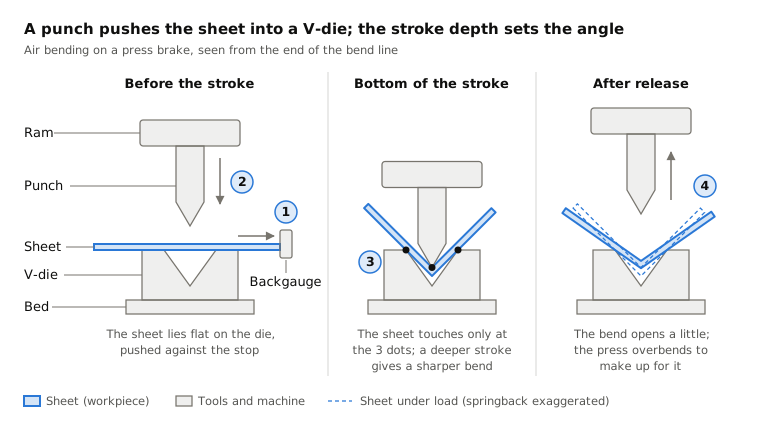
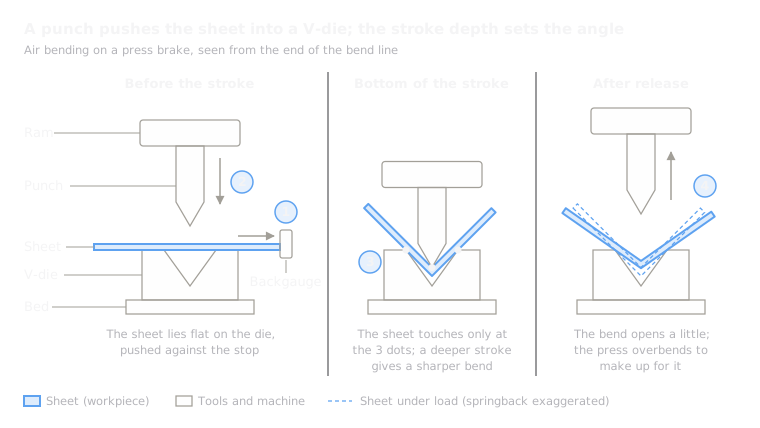 4.1Sheet metal bendingA press brake folds sheet along straight linesOpen the lesson
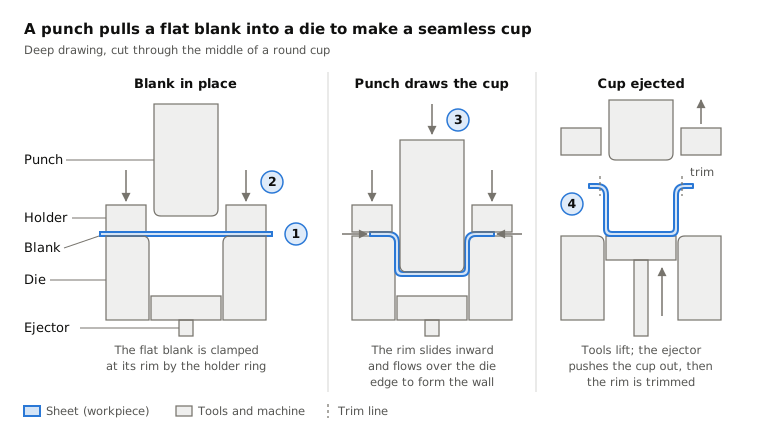
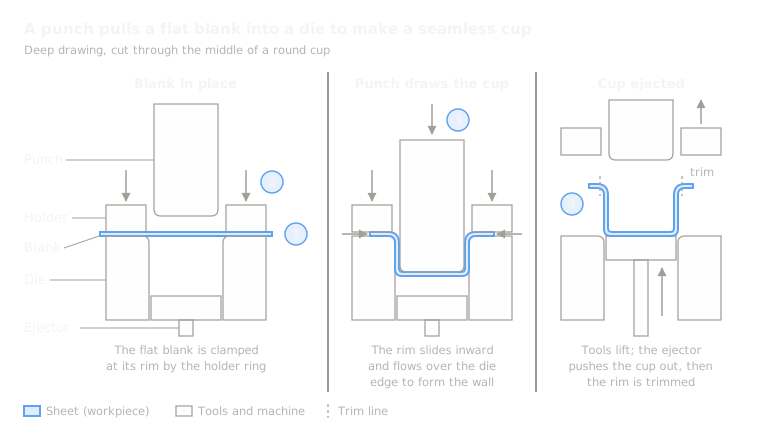 4.2ShortStamping and deep drawingMatched dies cut and press sheet into shape, often in a secondOpen the lesson
 4.3Metal spinningA roller presses a spinning disc over a formOpen the lesson
 4.4Flow formingRollers stretch a spinning tube thinner and longer over a mandrelOpen the lesson
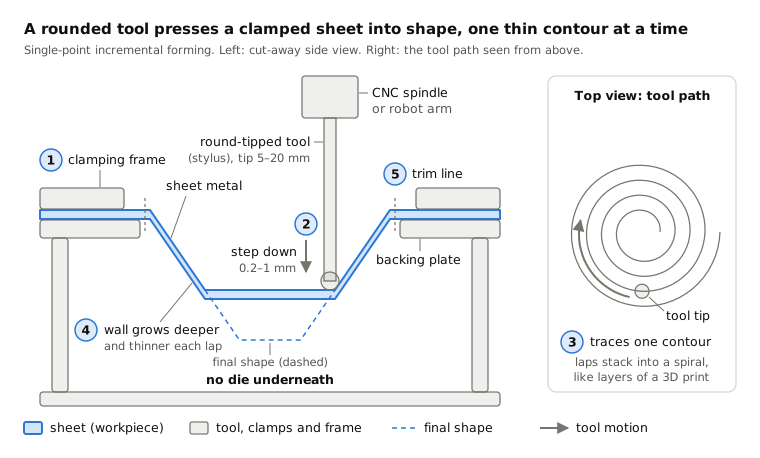
 4.6Incremental sheet formingA round tool traces contours into clamped sheet, with no dieOpen the lesson
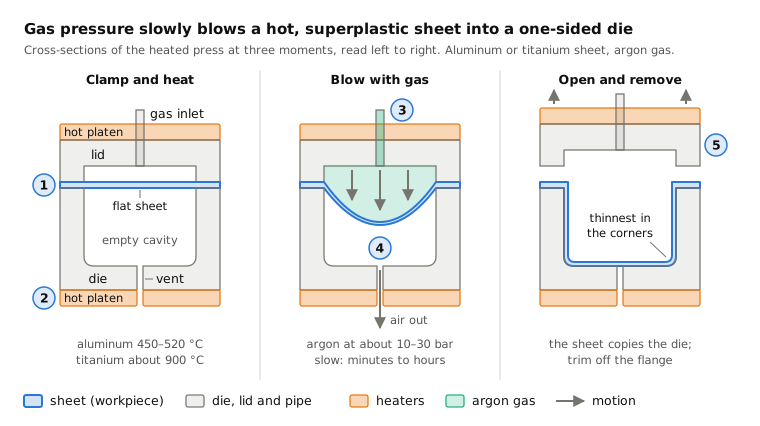
 4.7Superplastic formingHot gas blows a superplastic sheet into one dieOpen the lesson
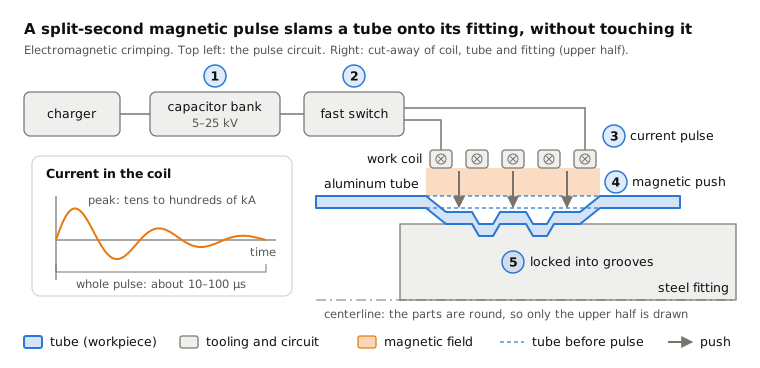
 4.8Electromagnetic formingA magnetic pulse throws metal onto a fitting, without contactOpen the lesson
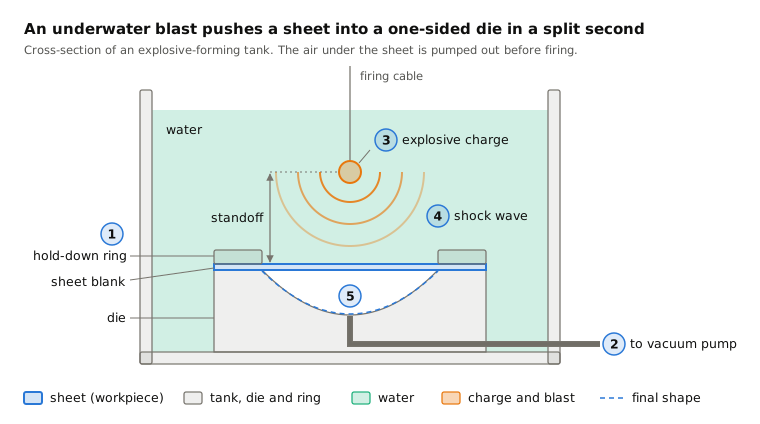
 4.9Explosive formingAn underwater blast pushes sheet into one dieOpen the lesson
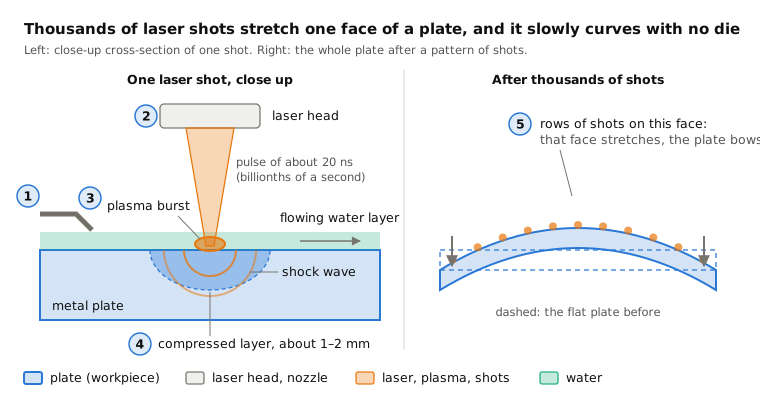
 4.10Laser peen formingLaser shots stretch one face so a plate curvesOpen the lesson
Try it
Put AI to work in your CAD.
Model parts, generate drawings and automate the repetitive work inside your CAD software.