

Explosive forming
An underwater blast pushes sheet into one die
Explosive forming uses a small explosive charge fired under water to push a metal sheet into a one-sided die. The water carries the blast as a pressure wave, like a giant invisible hammer that hits the whole sheet at once. It shapes very large or very tough parts, such as rocket domes, without a press big enough to do the job.
How it works
Clamp the blank. A flat sheet (the blank) is clamped over a die by a hold-down ring (a heavy ring bolted around its edge). The die can be steel, ductile iron, concrete or even fiberglass for low pressures.
Pump out the air. A vacuum pump removes the air between sheet and die. Trapped air would cushion the sheet and stop it from filling the die.
Place the charge. The setup is lowered into a water tank or pool. A licensed blasting team hangs a measured explosive charge at a set standoff (distance) above the sheet.
Fire. The detonation sends a shock wave (a sudden, very high pressure front) through the water. Water does not compress much, so it passes the pressure to the sheet very efficiently.
The sheet hits the die. In about a millisecond the sheet slams into the die and copies its shape. The part is lifted out, checked, and usually trimmed; large parts may need several shots.
Key facts
- Materials
- Steels, stainless steels, titanium, aluminum and nickel alloys, often hard-to-form grades
- Typical parts
- Large domes and dished heads, cones, rocket and tank parts, complex panels
- Part size
- Up to several meters across, set by the pool rather than by a press
- Precision
- Good fit to the die, but springback and thickness vary; parts are often checked and trimmed afterward
- Surface finish
- Smooth die-side surface; no marks from a punch because there is none
- Batch size it suits
- Prototypes and very small series of large parts
- Tooling and machine cost
- Low compared with a press of the same power: no press, only a die, a tank and explosives handling
- Speed
- The forming itself takes about a millisecond; setting up each shot takes hours
Strengths and limits
Strengths
- Huge forces without a huge press
- Very large parts in one piece
- Cheap one-sided dies
- High speed lets tough metals stretch further
Limits
- Explosives need licenses, a remote site and strict safety
- Slow setup: few shots per day
- Hard to automate, so poor for mass production
- Springback and thickness are less predictable than in a press
Where it's used
- Aerospace and spaceRocket tank domes, engine parts, aircraft skin sections
- Pressure vesselsLarge dished heads and end caps for tanks
- Architecture and artSculptures and decorative panels formed against molds
- Research and prototypesOne-off parts in metals too strong for available presses
How to recognize it
- Very large single-piece domes or panels with no weld seams across them.
- Smooth, gently curved shapes that copy a one-sided die.
- Usually found on rockets, tanks or art pieces rather than everyday products.
Compare with
Watch it
ONE POINT ACADEMY · A beginner explainer: charge, water tank, die and vacuum
Design Otherwise · How the process works and how it was used in history
GESPASA · A real industrial blast forming a large steel sphere
San Diego Air and Space Museum Archives · Archive film of aerospace parts made with high-energy forming
See real photos
- Wikipedia: Explosive forming — principle, history and die materials; few photos
- Wikimedia Commons photo search
Remember
- Water carries the blast to the sheet; a vacuum lets the sheet fill the die.
- Only one die is needed, and no press, so very large parts become possible.
- It suits rare, big, tough parts, not mass production.
More in Sheet and tube forming
All 100 processes
 4.1Sheet metal bendingA press brake folds sheet along straight linesOpen the lesson
 4.2ShortStamping and deep drawingMatched dies cut and press sheet into shape, often in a secondOpen the lesson
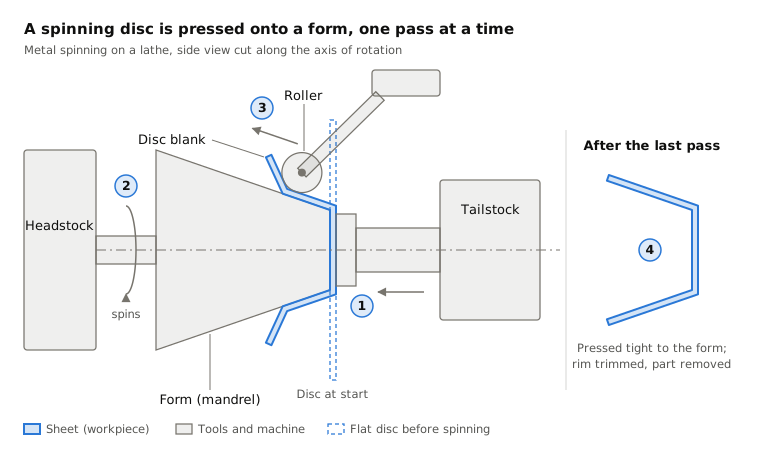
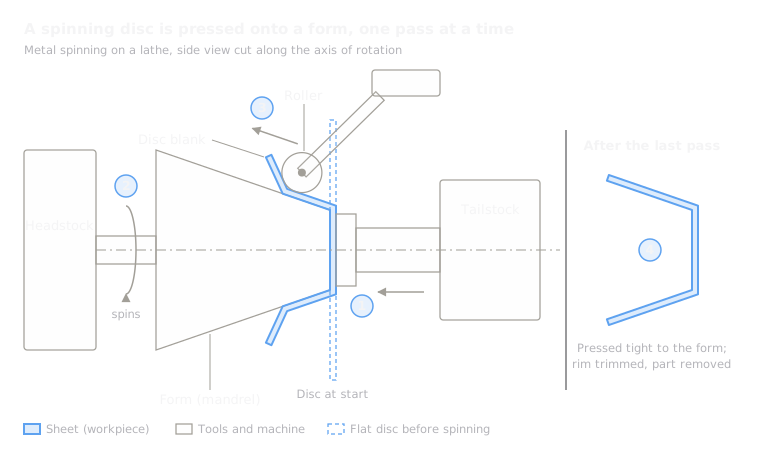 4.3Metal spinningA roller presses a spinning disc over a formOpen the lesson
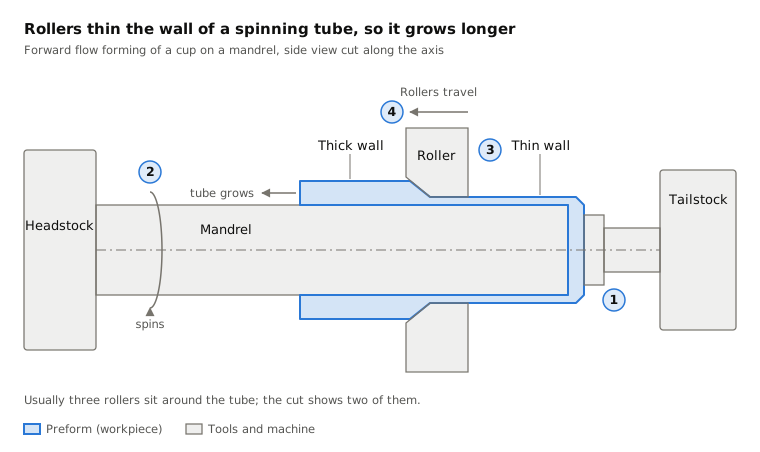
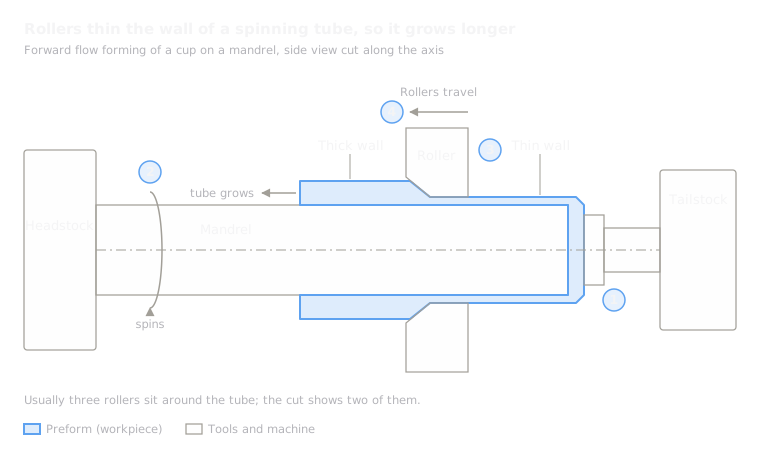 4.4Flow formingRollers stretch a spinning tube thinner and longer over a mandrelOpen the lesson
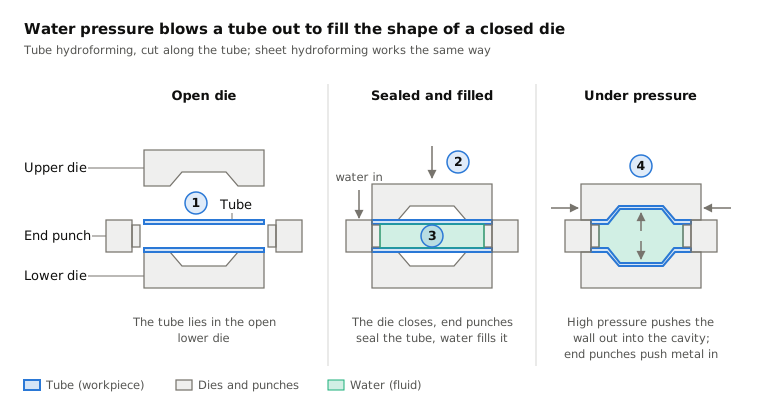
 4.5HydroformingFluid pressure pushes tube or sheet into a dieOpen the lesson
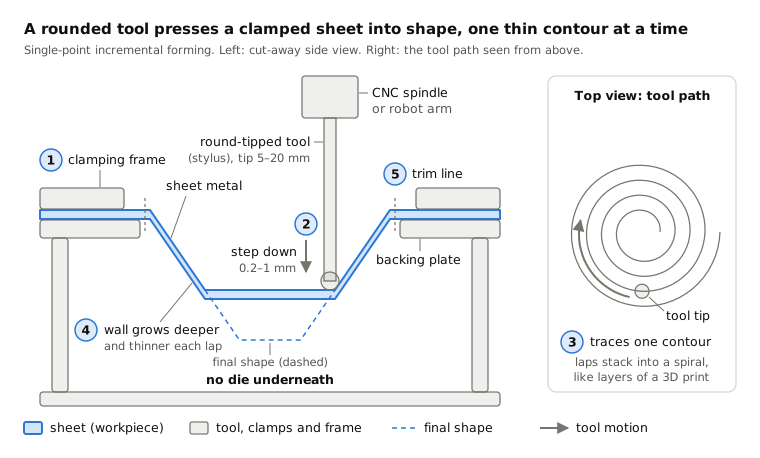
 4.6Incremental sheet formingA round tool traces contours into clamped sheet, with no dieOpen the lesson
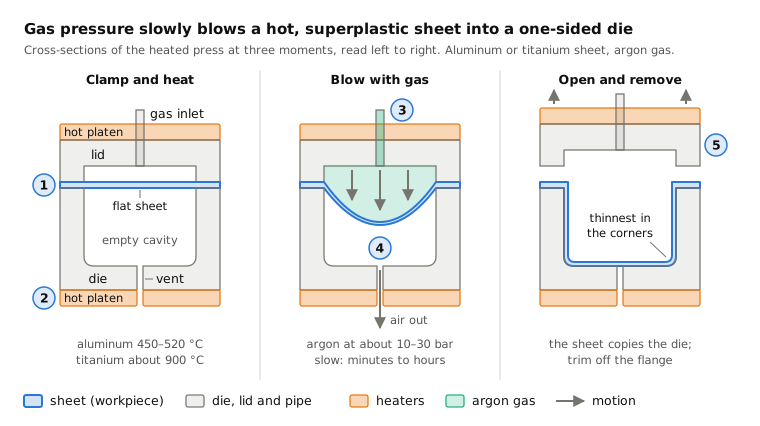
 4.7Superplastic formingHot gas blows a superplastic sheet into one dieOpen the lesson
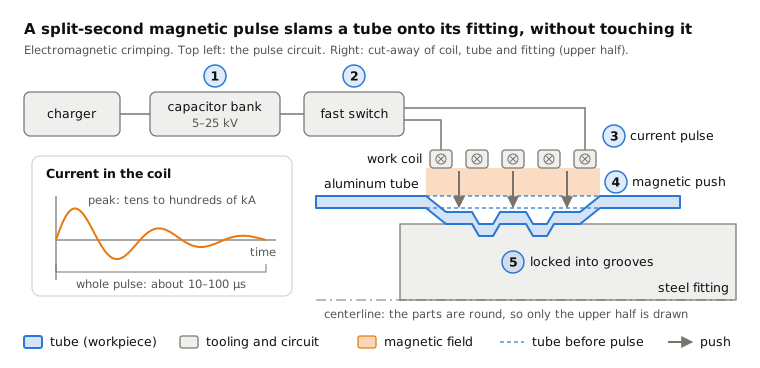
 4.8Electromagnetic formingA magnetic pulse throws metal onto a fitting, without contactOpen the lesson
 4.10Laser peen formingLaser shots stretch one face so a plate curvesOpen the lesson
Try it
Put AI to work in your CAD.
Model parts, generate drawings and automate the repetitive work inside your CAD software.