

Flow forming
Rollers stretch a spinning tube thinner and longer over a mandrel
Flow forming squeezes the wall of a spinning tube or cup against a mandrel with rollers, making it thinner and longer. Many lightweight car wheels are made this way, along with gas cylinders and rocket motor cases. It gives precise, seamless tubes whose metal gets stronger as it is squeezed.
How it works
Load and clamp. A short, thick preform (a starting part, usually a machined, forged or cast cup or tube) slides onto a hardened steel mandrel. The tailstock clamps it in place.
Spin. The headstock spins the mandrel and the preform together.
Squeeze. Usually three rollers, spaced evenly around the part, press the wall onto the mandrel. The wall gets thinner, often by more than half in total.
Travel and flow. The rollers move along the axis, and the squeezed metal can only go lengthwise, so the tube grows longer. Finally the tube is pulled off the mandrel and trimmed to length.
In this forward version, the metal flows the same way the rollers travel. In backward flow forming, the tube is pushed against a stop and the metal flows the opposite way, which suits long open tubes.
Key facts
- Materials
- Steel and stainless steel, aluminum, titanium and nickel alloys; ductile grades work best
- Typical parts
- Wheel rims, gas cylinders, rocket motor cases, drive-train drums, precision tubes
- Part size
- Diameters from a few centimeters to about a meter or more
- Precision
- Wall thickness and diameter to about ±0.05 mm in precision work
- Surface finish
- Very smooth bore that copies the polished mandrel; fine roller marks outside
- Batch size it suits
- Medium to high volume (wheels, cylinders); also small runs of high-value parts
- Tooling and machine cost
- Each inner diameter needs its own mandrel; machines typically cost hundreds of thousands of dollars or more
- Speed
- Typically one to a few minutes per part
Strengths and limits
Strengths
- Seamless tubes with very even, precise walls
- Metal gets stronger as it is squeezed
- Little waste: metal is moved, not cut away
- Flow-formed wheels are lighter than plain cast ones
Limits
- Only round parts
- Costly machine, plus a mandrel for each inner diameter
- Needs a preform made by another process first
- Hard alloys may need heating or annealing between passes
Where it's used
- AutomotiveWheel rims, clutch and transmission drums, drive-train parts
- Energy and gasGas cylinders and pressure vessels
- Aerospace and defenseRocket motor cases, missile bodies, shafts
- IndustryPrecision hydraulic cylinder tubes
How to recognize it
- Long, seamless tubes or wheel barrels with thin, very even walls.
- A mirror-smooth bore and fine spiral roller marks on the outside.
- Aftermarket wheels sold as flow formed or rotary forged: the cast center stays thick while the barrel is thin.
Compare with
Watch it
BBS of America, Inc. · How a wheel maker flow forms a rim, explained and shown
Leifeld Metal Spinning · A tube stretched on a mandrel as the rollers travel
WF Maschinenbau · Real footage of a wheel rim machine at work
Leifeld Metal Spinning · Flow forming automotive drive parts in production
See real photos
- Wikipedia: Shear forming — covers flow forming; mostly text, so use Commons for photos
- Wikipedia: Metal spinning — the parent family, with photos of spinning lathes and parts
- Wikimedia Commons photo search
Remember
- Rollers squeeze a spinning tube onto a mandrel: the wall thins and the tube grows longer.
- The result is a seamless, precise tube whose metal is stronger than before.
- It needs a thick preform first and makes round parts only.
More in Sheet and tube forming
All 100 processes
 4.1Sheet metal bendingA press brake folds sheet along straight linesOpen the lesson
 4.2ShortStamping and deep drawingMatched dies cut and press sheet into shape, often in a secondOpen the lesson
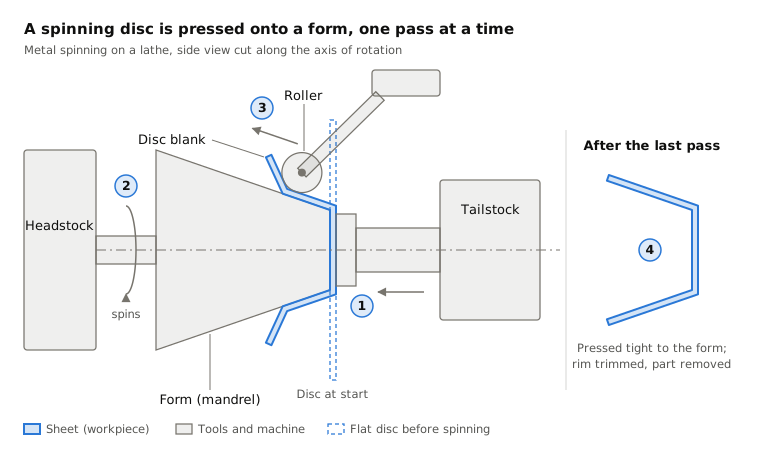
 4.3Metal spinningA roller presses a spinning disc over a formOpen the lesson
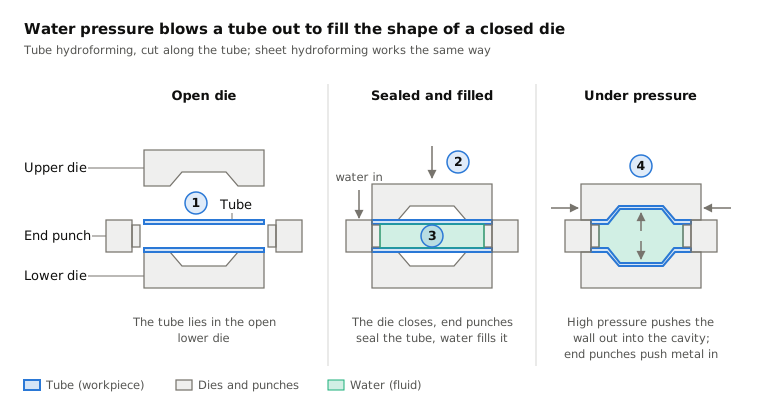
 4.5HydroformingFluid pressure pushes tube or sheet into a dieOpen the lesson
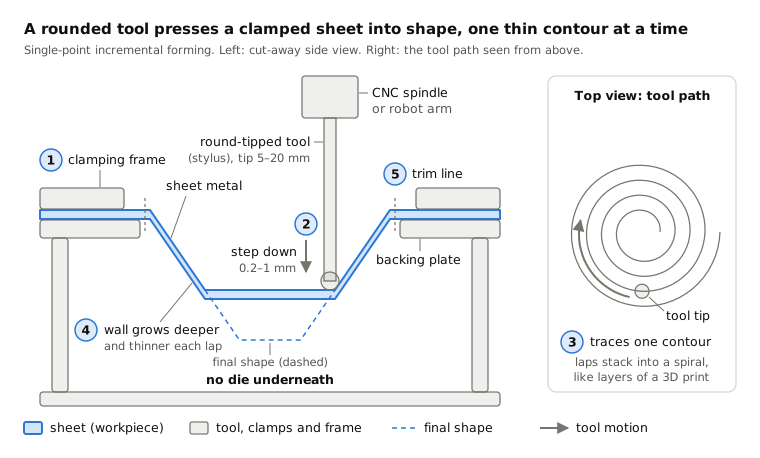
 4.6Incremental sheet formingA round tool traces contours into clamped sheet, with no dieOpen the lesson
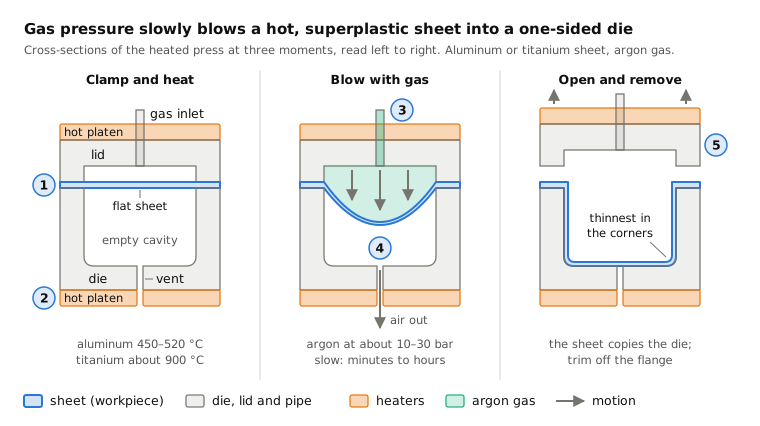
 4.7Superplastic formingHot gas blows a superplastic sheet into one dieOpen the lesson
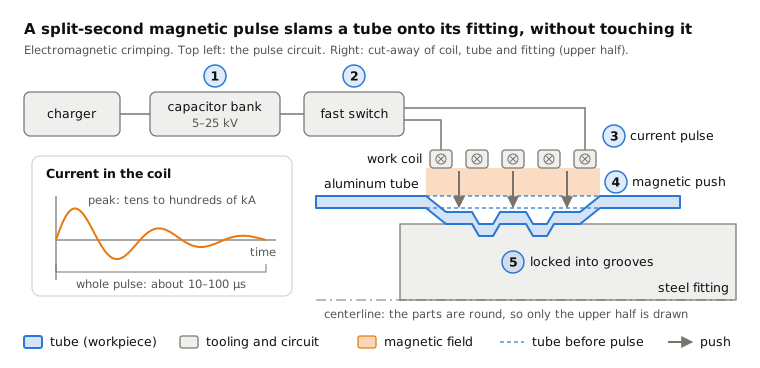
 4.8Electromagnetic formingA magnetic pulse throws metal onto a fitting, without contactOpen the lesson
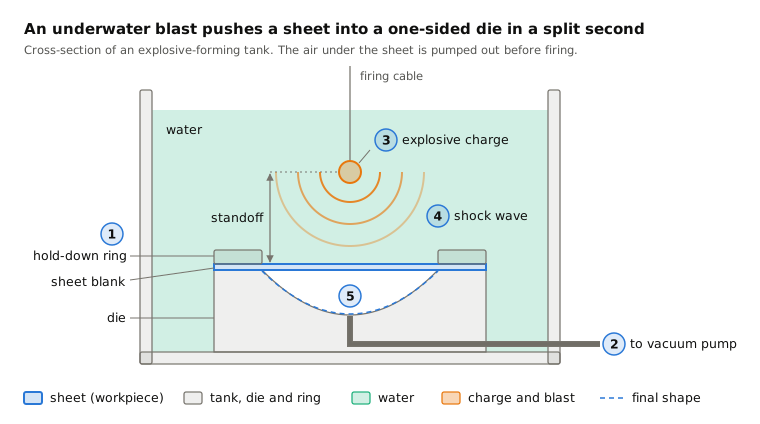
 4.9Explosive formingAn underwater blast pushes sheet into one dieOpen the lesson
 4.10Laser peen formingLaser shots stretch one face so a plate curvesOpen the lesson
Try it
Put AI to work in your CAD.
Model parts, generate drawings and automate the repetitive work inside your CAD software.