

Stamping and deep drawing
Matched dies cut and press sheet into shape, often in a second
Stamping shapes sheet metal between matched dies in a press, one part per stroke. Deep drawing is the stamping operation that pulls a flat blank into a die to make a seamless hollow part. Drink cans, kitchen sinks, battery cans and car body panels are all drawn this way.
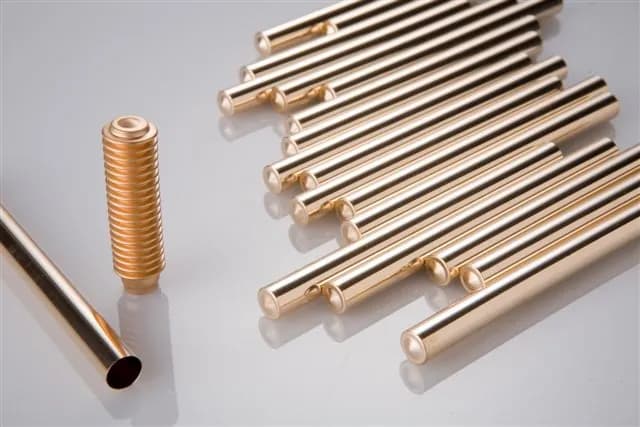
Stamping and deep drawing in a minute, by MecMade
How it works
Load the blank. A flat blank (a piece cut from sheet, here a disc) is placed on the die, a block with a hole whose edge is rounded. That rounded edge is called the die radius.
Clamp the rim. The blank holder, a ring around the punch, presses the rim with a controlled force. Too little force and the rim wrinkles; too much and the wall tears.
Draw. The punch pushes the center down into the hole. The rim slides inward under the holder and bends over the die radius to become the wall.
Eject and trim. The punch and holder lift, an ejector pushes the cup out, and the uneven rim is trimmed. Deeper parts are drawn again in later stages (redraws), each narrower and deeper.
In high-volume stamping, a progressive die does several operations at stations along a coil strip: cutting, piercing (punching holes), bending and drawing. The strip moves one station per stroke, so a finished part drops out every stroke.
Key facts
- Materials
- Ductile sheet: low-carbon and stainless steel, aluminum, copper, brass; typically about 0.2 to 6 mm thick
- Typical parts
- Cans, cups, sinks, cookware, fuel tanks, car body panels, battery cans, brackets
- Part size
- From shells a few millimeters across to car body side panels a few meters long
- Precision
- About ±0.1 mm on small parts; looser on large panels
- Surface finish
- Smooth, close to the sheet's own finish; good enough for painted car panels
- Batch size it suits
- High volume: thousands to millions of parts, because the dies only pay off at scale
- Tooling and machine cost
- Dies from about $10,000 for small simple parts to over $1 million for a set of car body dies; presses from about $100,000 to many millions for a car-panel line
- Speed
- One part per stroke: large car panels about 10 to 15 per minute; small parts in progressive dies tens to hundreds per minute
Strengths and limits
Strengths
- Very fast and cheap per part at high volume
- Seamless, leak-tight hollow parts with no welds
- Strong, light parts; the metal hardens as it is worked
- Very repeatable from part to part
Limits
- Dies are expensive and take weeks to months to build and tune
- Depth per stage is limited: the blank can be only about twice the punch diameter
- Defects to control: wrinkles in the rim, tears near the punch corner, a wavy rim
- A design change means new or reworked dies
Where it's used
- AutomotiveDoors, hoods, roofs, fenders, fuel tanks, oil pans
- PackagingDrink and food cans, aerosol cans, bottle caps
- Kitchen and appliancesSinks, pots, pans, appliance housings
- Electronics and batteriesCylindrical battery cans, connector shells, shielding cans
- DefenseCartridge cases
How to recognize it
- Seamless hollow shapes, such as cans, cups and sinks, with no weld line.
- Rounded inside and outside corners at the bottom, copied from the punch and die radii.
- A clean, trimmed rim at the opening, often rolled or folded over.
- Faint vertical scratch lines on the outer wall, where the metal slid over the die.
Compare with
Watch it
Toledo Metal Spinning · A beginner overview of deep draw stamping
Hubert Stüken GmbH & Co. KG · How a part is drawn in several stages, explained by a manufacturer
Gut Metallumformung AG · Real deep drawing of a cup in a press
ANDRITZ Schuler · A car body press line with robots moving panels between dies
See real photos
- Wikipedia: Deep drawing — process diagrams and a deep-draw line
- Wikipedia: Stamping (metalworking) — overview of stamping operations
- Wikimedia Commons photo search
Remember
- Matched dies shape sheet in one press stroke; deep drawing pulls a flat blank into a seamless cup.
- The blank holder stops the rim from wrinkling as it slides inward.
- Dies are costly, so stamping pays off at high volume.
More in Sheet and tube forming
All 100 processes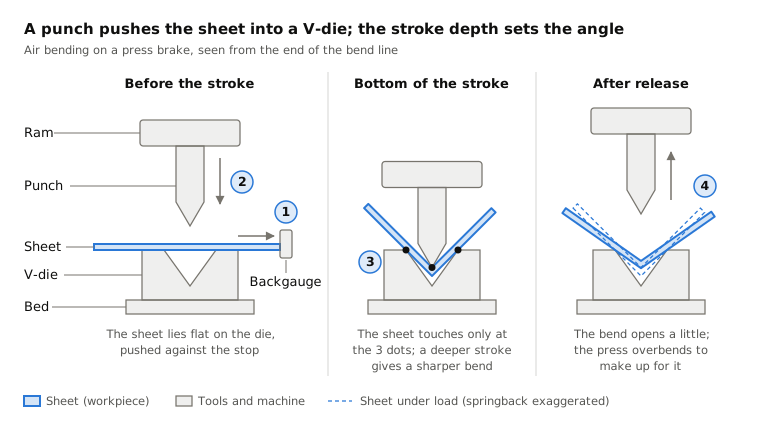
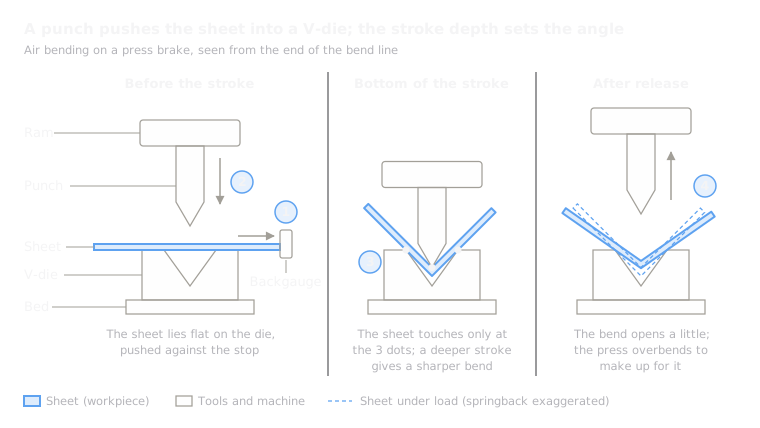 4.1Sheet metal bendingA press brake folds sheet along straight linesOpen the lesson
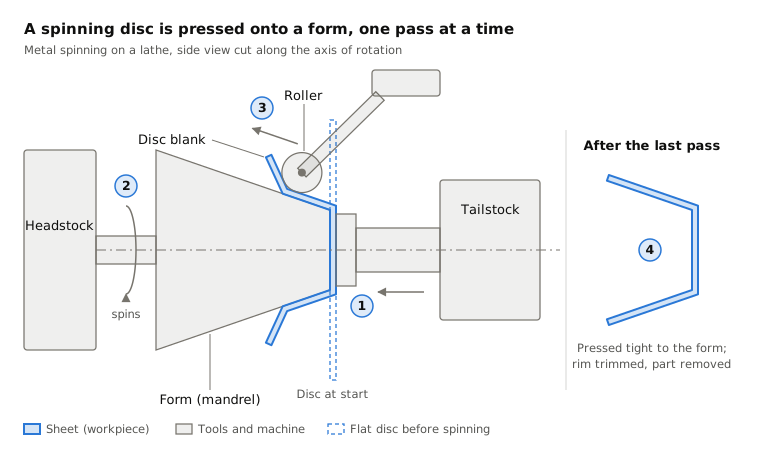
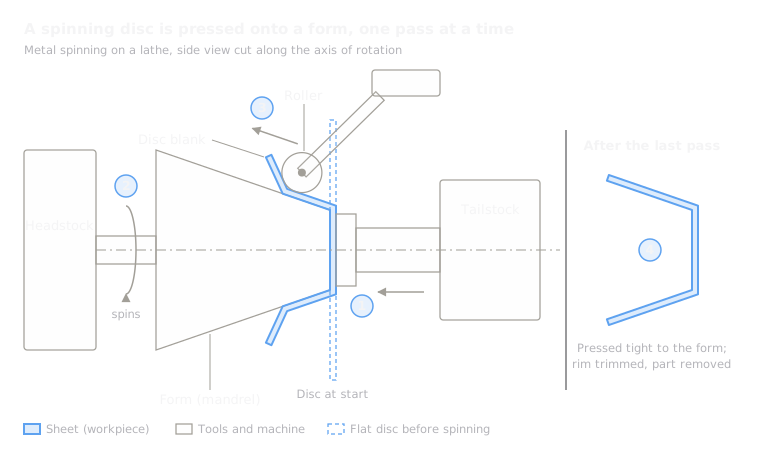 4.3Metal spinningA roller presses a spinning disc over a formOpen the lesson
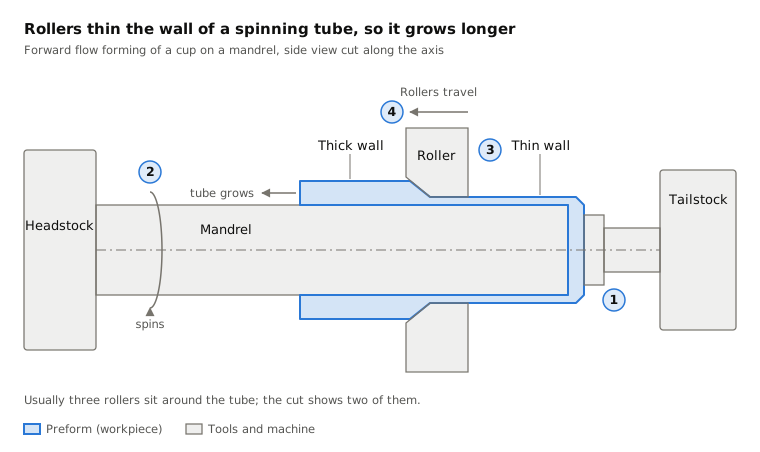
 4.4Flow formingRollers stretch a spinning tube thinner and longer over a mandrelOpen the lesson
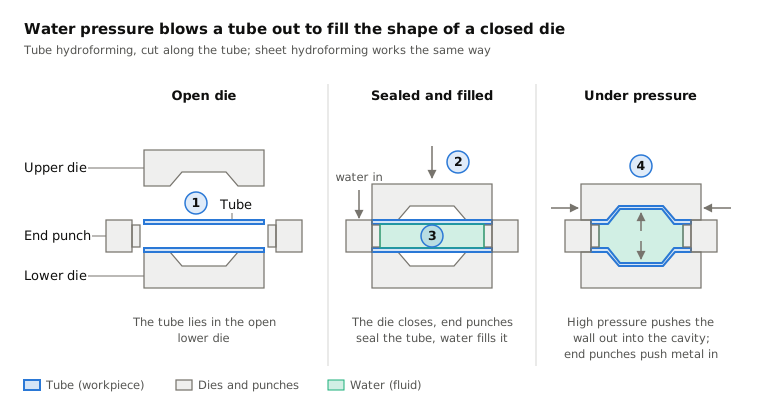
 4.5HydroformingFluid pressure pushes tube or sheet into a dieOpen the lesson
 4.6Incremental sheet formingA round tool traces contours into clamped sheet, with no dieOpen the lesson
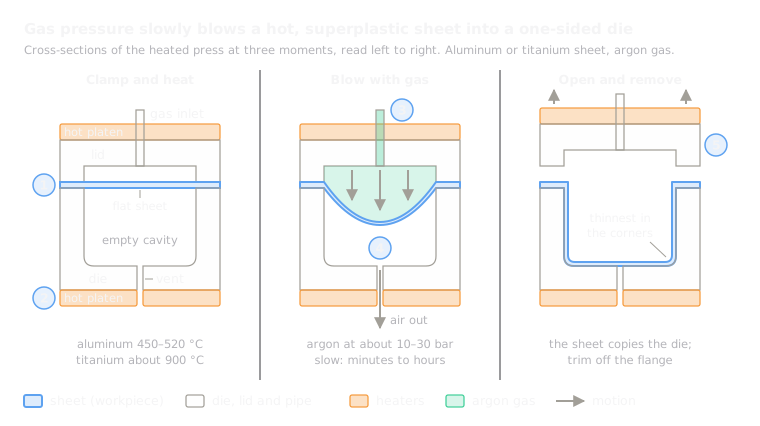 4.7Superplastic formingHot gas blows a superplastic sheet into one dieOpen the lesson
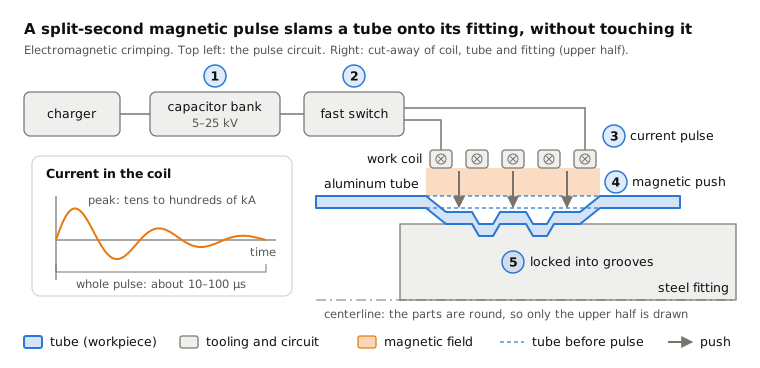
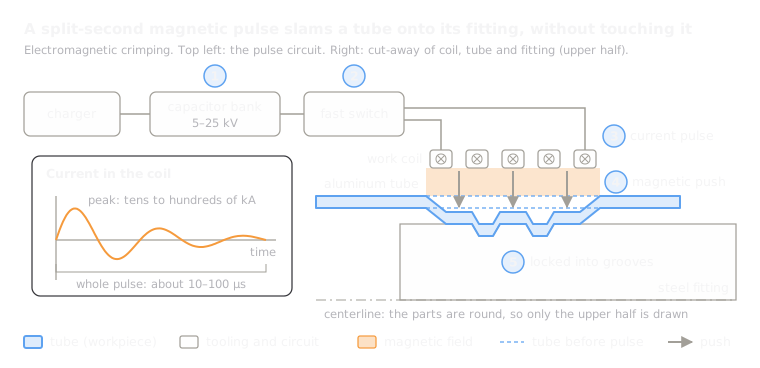 4.8Electromagnetic formingA magnetic pulse throws metal onto a fitting, without contactOpen the lesson
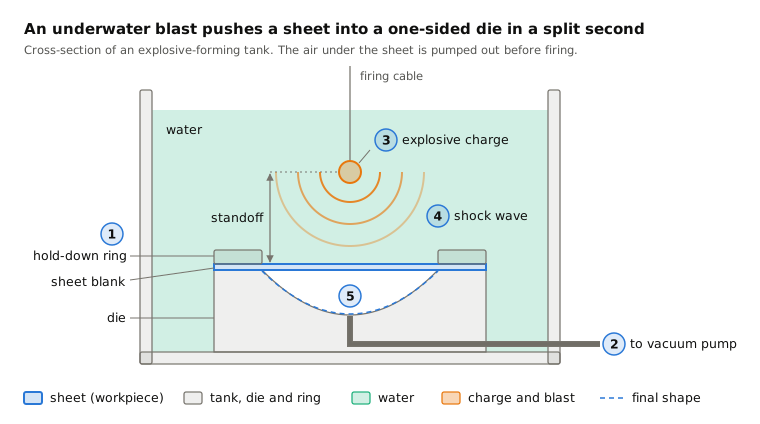
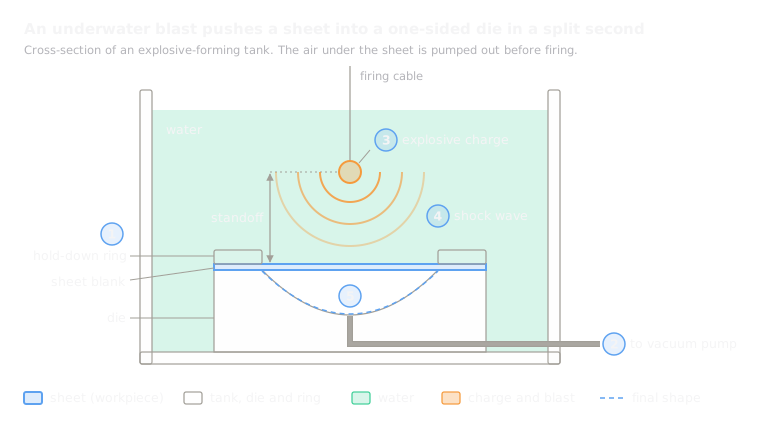 4.9Explosive formingAn underwater blast pushes sheet into one dieOpen the lesson
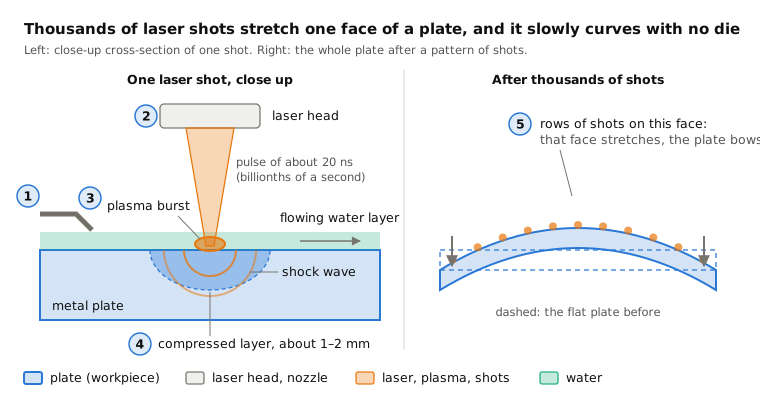
 4.10Laser peen formingLaser shots stretch one face so a plate curvesOpen the lesson
Try it
Put AI to work in your CAD.
Model parts, generate drawings and automate the repetitive work inside your CAD software.