

Superplastic forming
Hot gas blows a superplastic sheet into one die
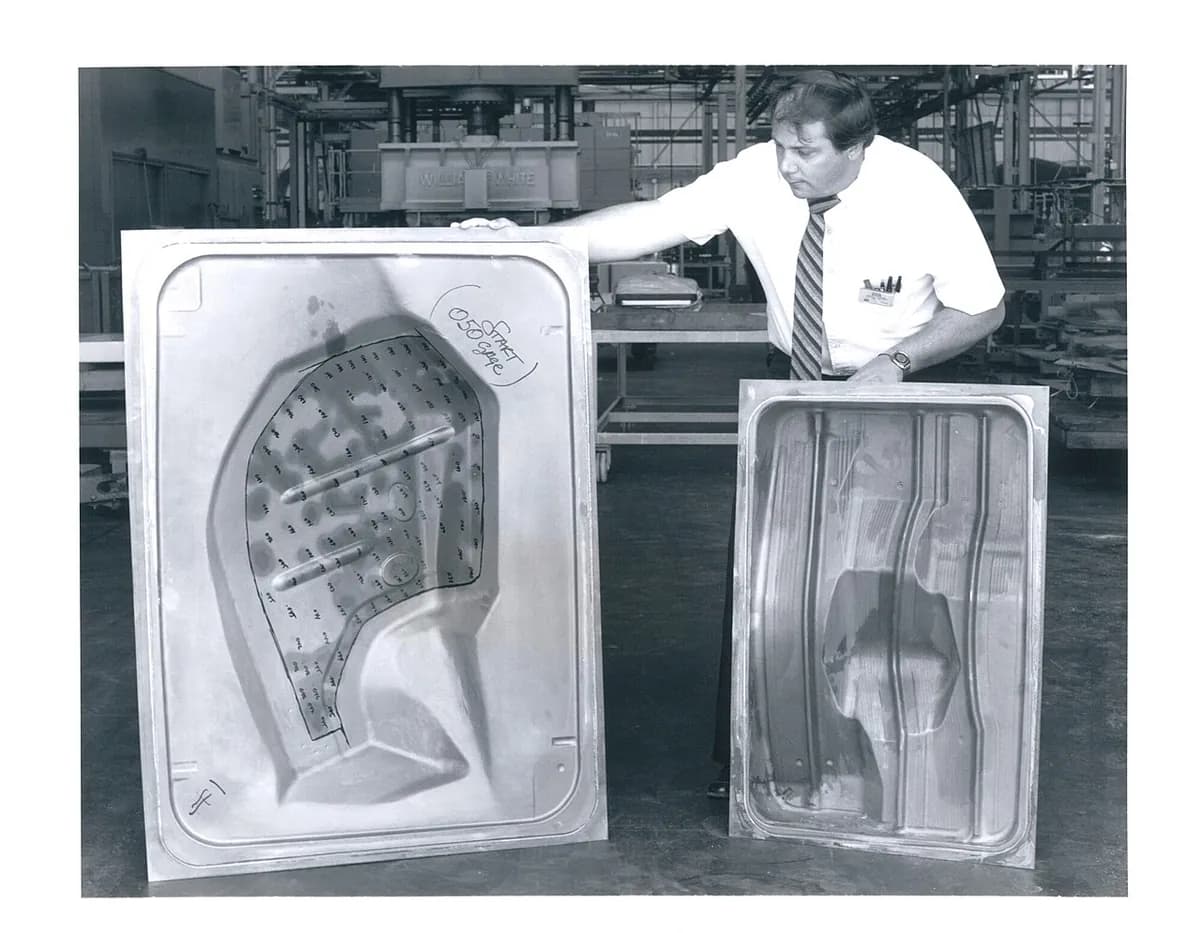
Superplastic forming (SPF) heats a special fine-grained sheet until it can stretch to several times its length, like warm bubble gum. Gas pressure then blows it slowly into a one-sided die (a shaped steel mold). It turns one sheet into deep, complex panels, such as aircraft doors and sports-car bodywork, that would otherwise need many pieces.
How it works
Clamp the sheet. A flat sheet of superplastic alloy is laid over a die with a cavity (the hollow shape of the part). A sealed lid presses on its edge, making a gas-tight seal.
Heat everything. Heated platens (hot press plates) bring die and sheet to forming temperature: about 450–520 °C for aluminum 5083, about 900 °C for titanium Ti-6Al-4V.
Blow in gas. Argon (an inert gas that keeps hot metal from reacting with air) flows in above the sheet at low pressure, typically about 10–30 bar.
Let it stretch slowly. The sheet bulges like a soap bubble while the air below escapes through vents. Pressure rises gradually, so the metal stretches slowly, over minutes to hours, without tearing. Its tiny grains (the crystals that make up a metal) slide past each other, allowing stretches of several hundred percent.
Fill the die, then open. The sheet meets the cavity walls and reaches the corners last, so the corners end up thinnest. The press opens, the hot part is lifted out, and its flange (the clamped rim) is trimmed off.
Key facts
- Materials
- Fine-grained superplastic alloys: titanium Ti-6Al-4V, aluminum 5083 and some aluminum-lithium alloys, some stainless steels
- Typical parts
- Aircraft doors, access panels and ducts, low-volume car body panels, hollow stiffened structures
- Part size
- From small brackets to panels a few meters long
- Precision
- Close to the die shape, typically a few tenths of a millimeter on the die side, with almost no springback (elastic bounce-back)
- Surface finish
- Smooth on the die side; titanium needs cleaning to remove a hard, oxygen-rich surface skin
- Batch size it suits
- Small to medium series: hundreds to a few thousand parts a year
- Tooling and machine cost
- One die only, in heat-resistant steel or ceramic, cheaper than matched stamping dies; the heated press is a large investment
- Speed
- Slow: roughly 15 minutes to a few hours per part, faster for aluminum than for titanium
Strengths and limits
Strengths
- Deep, complex shapes in one piece, replacing assemblies of many parts
- Only one die needed, so tooling costs less
- Almost no springback, so shapes are accurate
- With diffusion bonding (sheets fused under heat and pressure), makes hollow stiffened structures
Limits
- Slow cycles: minutes to hours per part
- Needs special fine-grained, more expensive alloys
- Uneven thickness: corners and deep pockets thin out
- Hot, energy-hungry process; titanium needs protective gas and surface cleaning
Where it's used
- Aircraft structuresTitanium and aluminum doors, access panels and ducts
- Jet enginesHollow titanium fan blades, made by combining SPF with diffusion bonding
- AutomotiveAluminum body panels for low-volume sports and luxury cars
- ArchitectureCurved aluminum facade and cladding panels
How to recognize it
- Deep, smooth, soft-edged shapes made from one sheet, with no welds or seams.
- One crisp, smooth side (the die side); the other side shows softer, rounded details.
- Thickness that varies: thinner in corners and deep pockets, visible on a cut edge.
- Draws deeper than an ordinary press could manage, always with generous radii.
Compare with
Watch it
superformusa · The core method: gas blows the hot sheet into a female die cavity
superformusa · A variant: the sheet is first blown into a bubble, then shaped over a male tool
superformuk · Real car body panels coming out of production
David Kirkham · Shop-floor footage of a formed part leaving the hot press
See real photos
- Wikipedia: Superplastic forming — principle, temperatures and aircraft examples; mostly text
- Wikipedia: Superplasticity — the materials science behind the extreme stretch
- Wikimedia Commons photo search
Remember
- Superplastic alloys stretch several hundred percent when hot and pulled slowly.
- Gas pressure pushes the sheet into one single-sided die, so tooling stays simple.
- Ideal for deep, complex one-piece panels; the price is slow cycles and thin corners.
More in Sheet and tube forming
All 100 processes
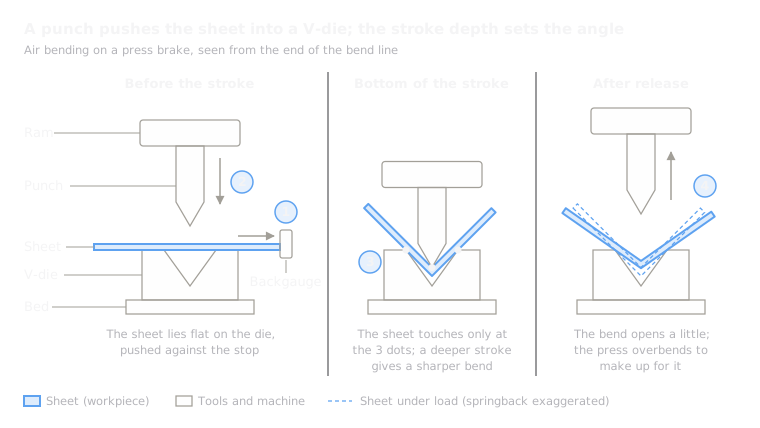 4.1Sheet metal bendingA press brake folds sheet along straight linesOpen the lesson
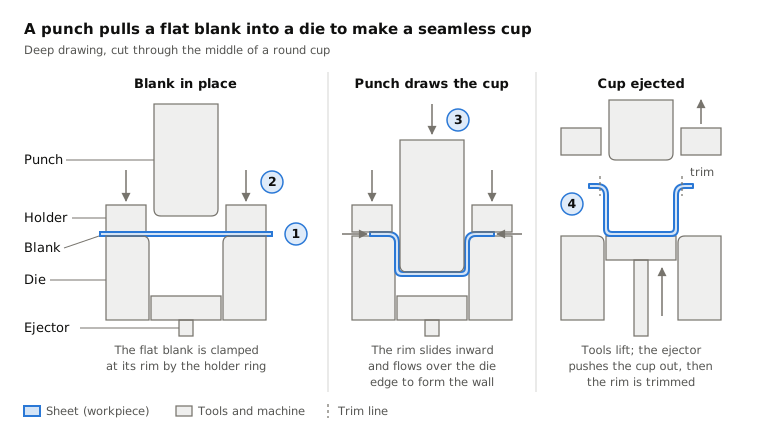
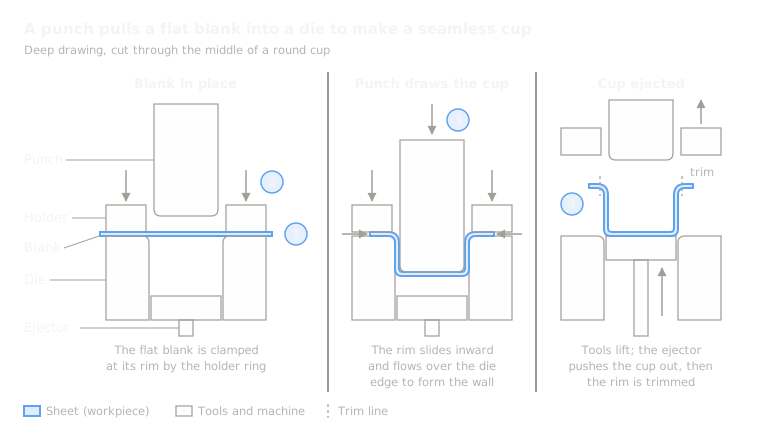 4.2ShortStamping and deep drawingMatched dies cut and press sheet into shape, often in a secondOpen the lesson
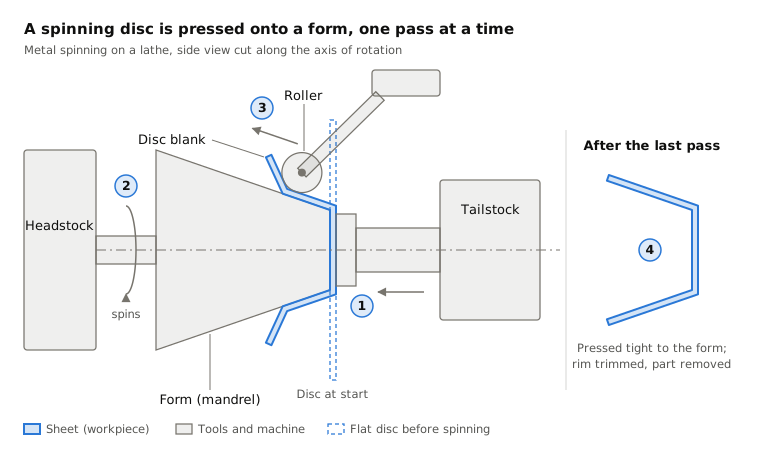
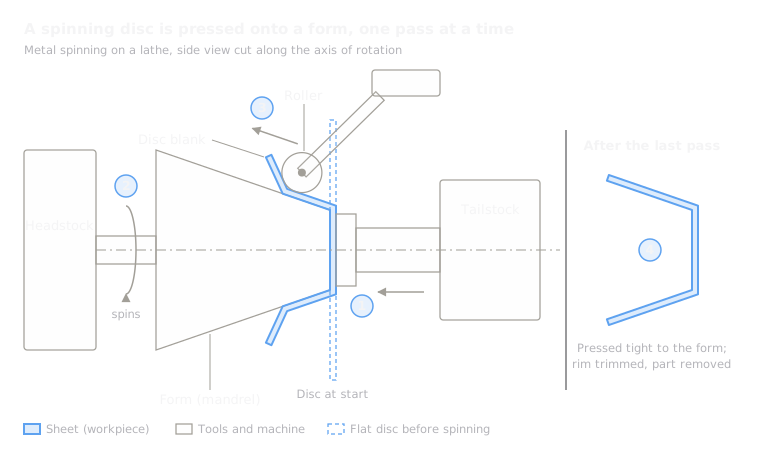 4.3Metal spinningA roller presses a spinning disc over a formOpen the lesson
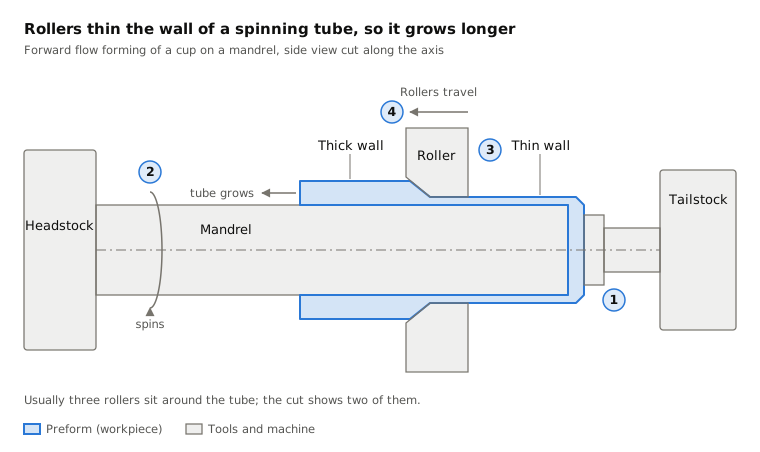
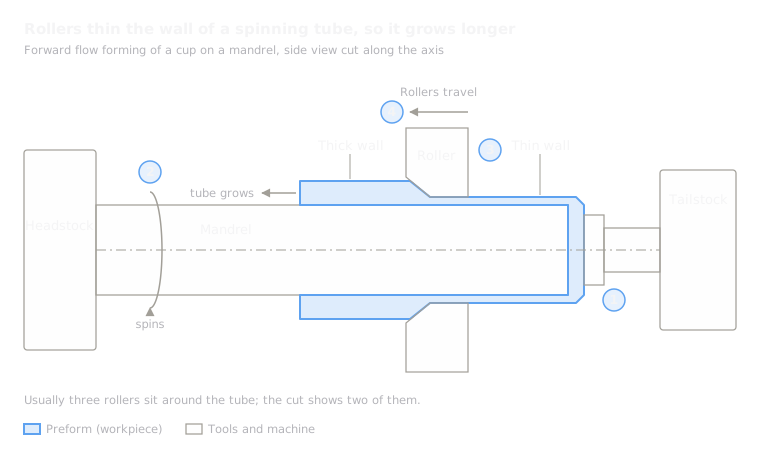 4.4Flow formingRollers stretch a spinning tube thinner and longer over a mandrelOpen the lesson
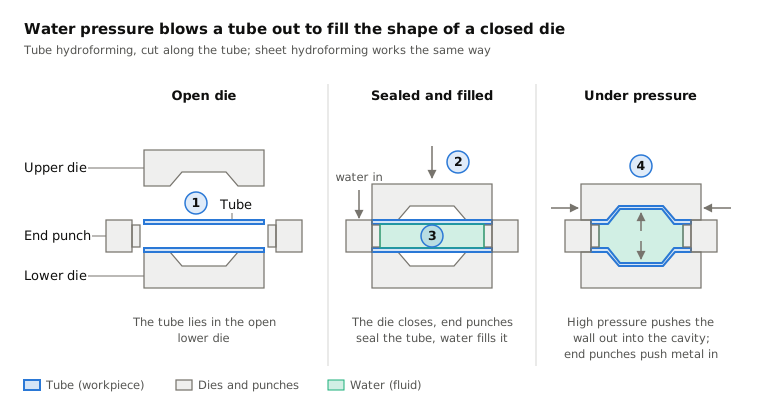
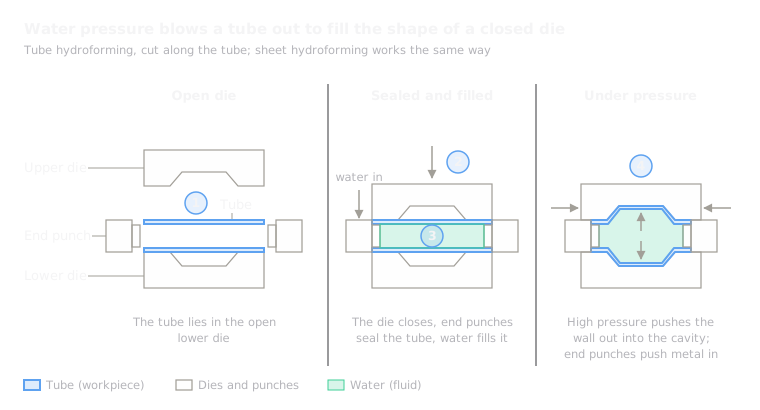 4.5HydroformingFluid pressure pushes tube or sheet into a dieOpen the lesson
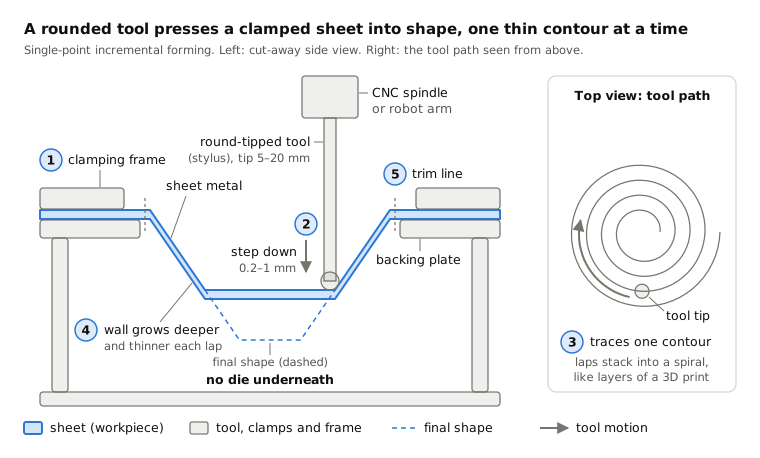
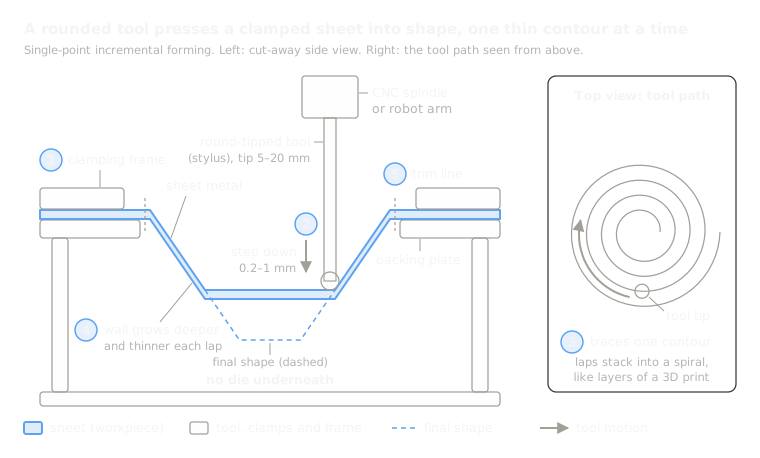 4.6Incremental sheet formingA round tool traces contours into clamped sheet, with no dieOpen the lesson
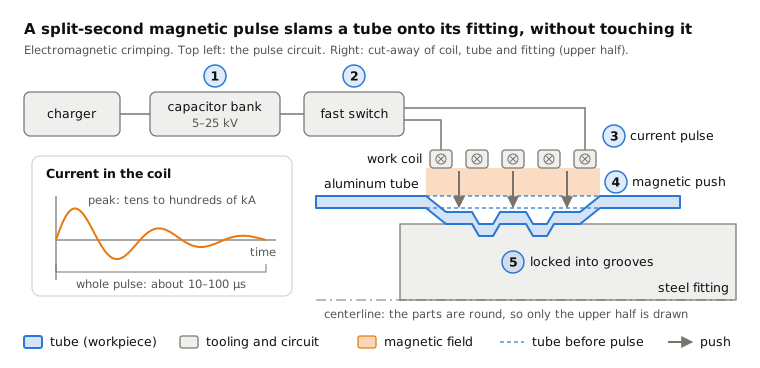
 4.8Electromagnetic formingA magnetic pulse throws metal onto a fitting, without contactOpen the lesson
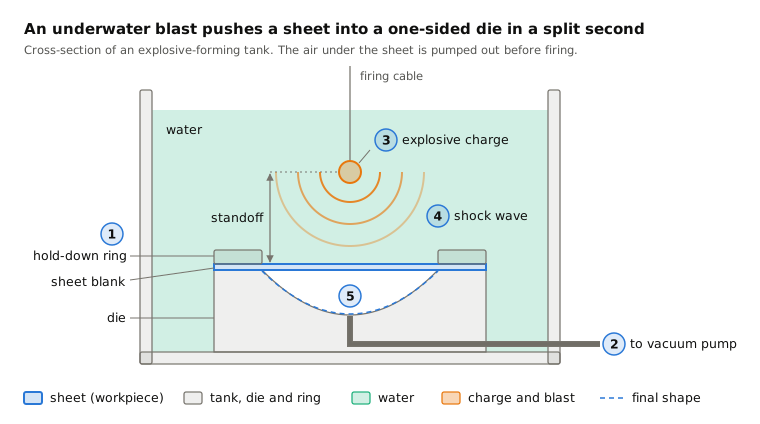
 4.9Explosive formingAn underwater blast pushes sheet into one dieOpen the lesson
 4.10Laser peen formingLaser shots stretch one face so a plate curvesOpen the lesson
Try it
Put AI to work in your CAD.
Model parts, generate drawings and automate the repetitive work inside your CAD software.