

Thermoforming
Heated sheet sucked onto a mold
Thermoforming heats a flat plastic sheet until it goes soft, then pulls it over or into a mold with vacuum or air pressure. Yogurt cups, blister packs, takeaway lids and fridge door liners are made this way. Molds are simple and cheap, so it suits both short runs and huge packaging volumes.
How it works
Clamp and heat. A frame clamps the edges of a plastic sheet. Radiant heaters (hot panels that heat by infrared radiation) warm it until it turns soft and rubbery, but not liquid.
Sag and raise. The soft sheet sags under its own weight. The mold rises into it, or the sheet is lowered onto the mold.
Vacuum. A pump sucks the air out through small holes in the mold. Atmospheric pressure then presses the sheet tightly against the mold surface. In pressure forming, compressed air also pushes from above for sharper detail.
Cool, release, trim. The plastic cools against the mold in seconds to a minute and becomes rigid. The part is lifted off, and the excess sheet around it is trimmed away with a knife, press or router (a spinning cutter).
For thin packaging, the sheet comes off a roll and runs through the machine continuously; heavy parts such as bathtubs use thick cut sheets, one at a time.
Key facts
- Materials
- Sheets of thermoplastics: polystyrene, PET, polypropylene, ABS, PVC, acrylic, polycarbonate
- Typical parts
- Food cups and trays, blister packs, lids, fridge liners, bathtubs, truck panels, machine covers
- Part size
- From small blisters a few centimeters across to parts several meters long
- Precision
- Typically about ±0.5 mm or looser; only the side touching the mold is accurate
- Surface finish
- One side copies the mold; the other side is the sheet's own surface
- Batch size it suits
- From a few parts (prototypes, displays) to millions of packaging items
- Tooling and machine cost
- Molds from a few hundred dollars (wood, resin) to tens of thousands (water-cooled aluminum); machines from a few thousand to over a million dollars for packaging lines
- Speed
- Heavy parts a few minutes per cycle; packaging lines many cycles per minute, each forming dozens of cups
Strengths and limits
Strengths
- Cheap, quick-to-make molds
- Very large parts are possible
- Fast and cheap for thin packaging
- Good for short runs and prototypes
Limits
- Walls thin out where the sheet stretches most, such as deep corners
- Only shell-like parts with one open side
- Trimming wastes sheet, though scrap is usually reground
- No ribs, bosses or holes in one step, unlike injection molding
Where it's used
- Food packagingYogurt cups, meat trays, clamshells, drink lids
- Retail packagingBlister packs, tool and toy displays
- AppliancesRefrigerator door and cabinet liners
- TransportTruck and tractor panels, aircraft interior panels
- Home and medicalBathtubs, shower trays, medical device trays
How to recognize it
- A thin shell of even-looking plastic with a flat rim (the flange) where it was trimmed.
- One side sharp and detailed, the other side softly rounded copies of the same shape.
- Thinner, sometimes whitened walls at deep corners where the sheet stretched most.
- Tiny bumps or dots on the surface from the vacuum holes in the mold.
Compare with
Watch it
Formech · A short, clear explainer from a machine maker
The Invention Laboratory · Close-ups of each step on a real part
Factories · Industrial thermoforming in a factory
Angel-Thermoforming Machine (Yiyou&Hongyouxing) · A high-speed line forming and stacking cups from a roll
See real photos
- Wikipedia: Thermoforming — thin and heavy gauge, vacuum, pressure and plug assist, with mold examples
- Wikimedia Commons photo search
Remember
- Heat a sheet, pull it onto a mold with vacuum, cool, trim.
- Cheap molds make it good for big parts and short runs; packaging lines make it fast.
- Expect thin corners, one accurate side and a trimmed rim.
More in Molding plastics and rubber
All 100 processes
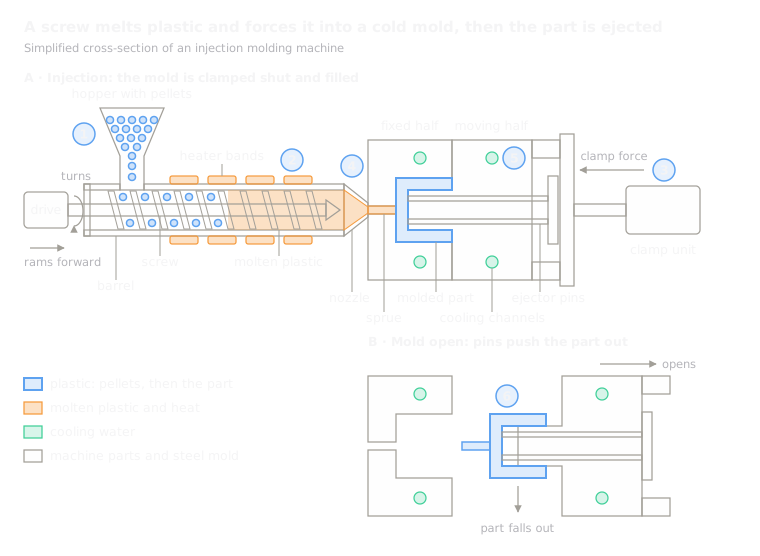 2.1ShortInjection moldingMelt forced into a closed steel moldOpen the lesson
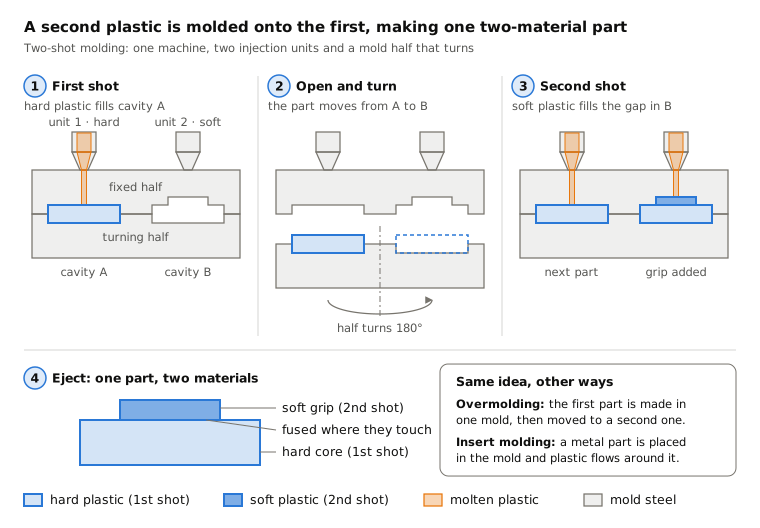
 2.2Overmolding and two-shot moldingA second plastic molded onto the firstOpen the lesson
 2.3Blow molding (extrusion and injection blow molding)Hot tube or preform inflated in a moldOpen the lesson
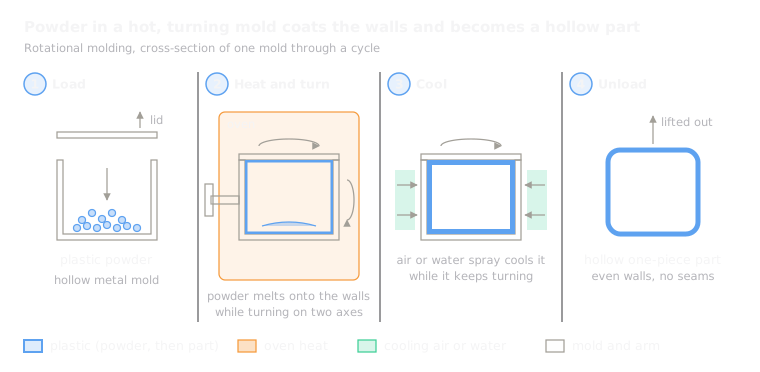 2.5Rotational moldingPowder coats a hot, turning moldOpen the lesson
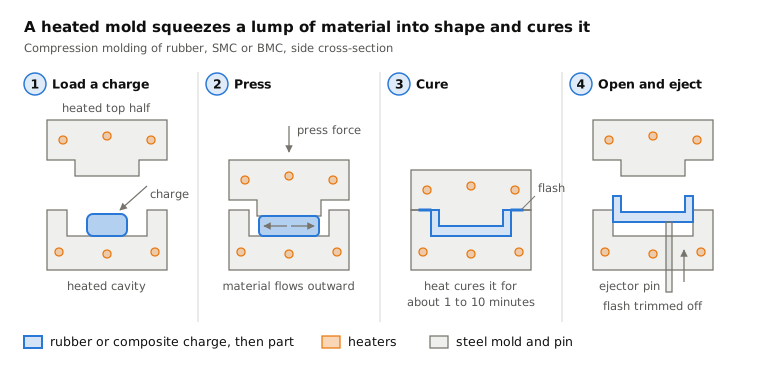
 2.6Compression molding (SMC, BMC, rubber)A charge pressed and cured in a hot moldOpen the lesson
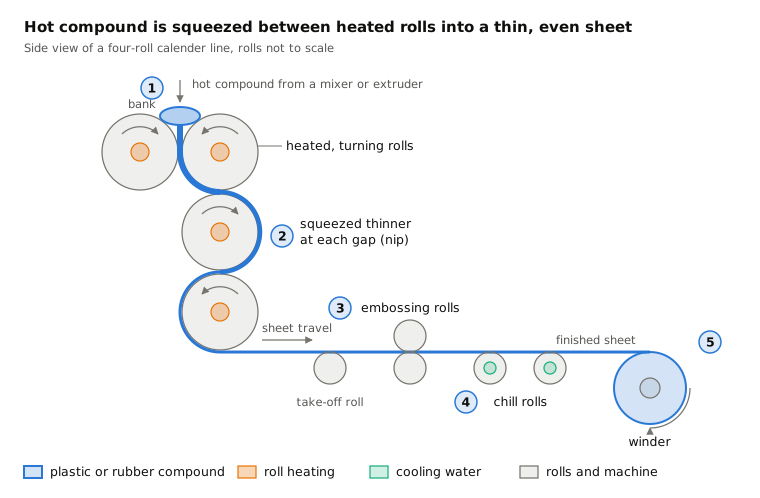
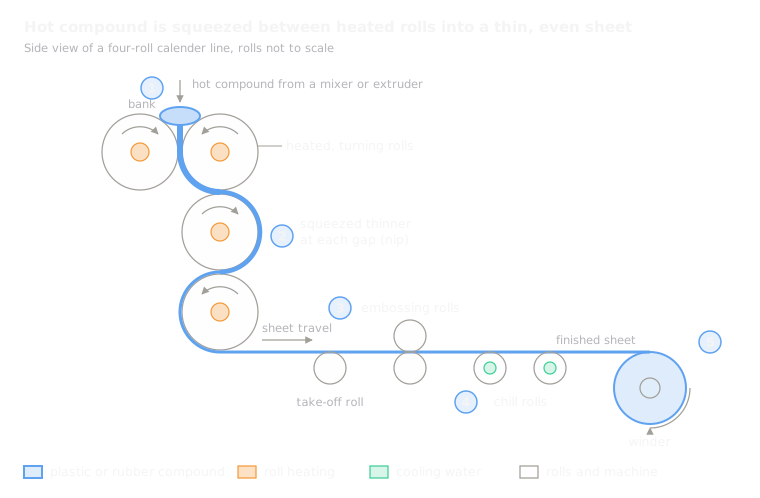 2.7CalenderingCompound squeezed into sheet between rollsOpen the lesson
Try it
Put AI to work in your CAD.
Model parts, generate drawings and automate the repetitive work inside your CAD software.