

Overmolding and two-shot molding
A second plastic molded onto the first
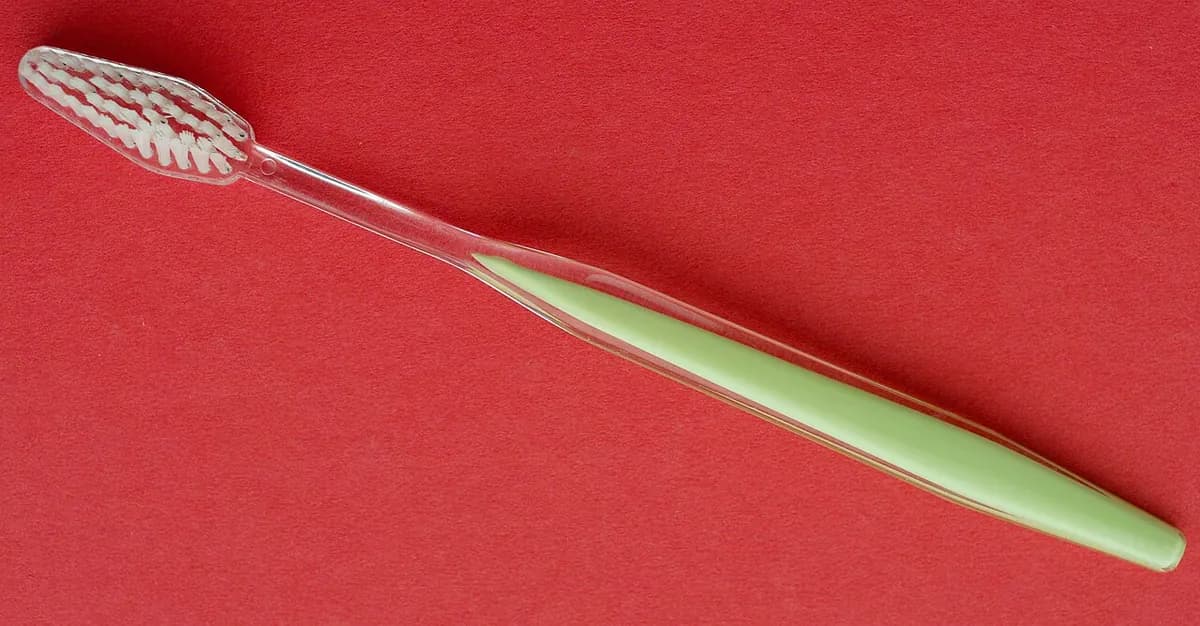
Overmolding molds a second plastic onto a first one, so a single part comes out made of two materials. The soft rubbery grip on a toothbrush or a cordless drill is made this way. It replaces glue and assembly, and the two layers do not peel apart in normal use.
How it works
First shot. One injection unit fills cavity A with a hard plastic. This makes the rigid base part, called the substrate.
Open and turn. The mold opens and the half holding the substrate turns 180°. The substrate now faces cavity B, which has extra room where the grip will go.
Second shot. The mold closes and a second injection unit fills that extra room with a soft plastic, often TPE (thermoplastic elastomer, a rubbery plastic that can be melted). The hot melt fuses with the surface of the substrate. At the same moment, cavity A molds the next substrate.
Eject. The mold opens and the finished part is pushed out. From then on, every cycle delivers one complete two-material part.
The bond comes from the two plastics melting together, which only works for compatible pairs. Otherwise designers add holes or grooves so the soft material locks on mechanically.
Two variants use the same idea. Overmolding in two molds works the same way, but a robot or an operator moves the substrate from the first mold to the second. Insert molding places a metal part (a threaded insert, a blade, electrical contacts) in the mold instead of a first shot.
Key facts
- Materials
- Hard plastics (polypropylene, ABS, polycarbonate, nylon) paired with soft TPE or silicone; or two colors of the same plastic; inserts are often brass or steel
- Typical parts
- Toothbrush handles, power tool grips, two-color buttons and keys, housings with built-in seals
- Part size
- Mostly small to medium, from a few grams to a few kilograms
- Precision
- Like injection molding: typically about ±0.05 to ±0.1 mm on the hard part; the soft layer is looser
- Surface finish
- As molded, glossy or textured; soft areas feel grippy
- Batch size it suits
- Two-shot: tens of thousands to millions; two molds or hand loading: also smaller runs
- Tooling and machine cost
- Higher than for one material: a more complex mold, often tens of thousands of dollars or more, and a machine with two injection units and a turning platen
- Speed
- One finished part per cycle, typically about 20–60 s
Strengths and limits
Strengths
- One finished part, no glue or assembly
- Strong, sealed joints between hard and soft areas
- Soft-touch grips, seals and crisp two-color looks
- Fast and consistent at high volume
Limits
- Molds and machines cost more than for one-material parts
- The two plastics must be compatible to bond, which limits the pairs
- More to tune: two materials, two temperatures, different shrinkage
- Two-shot only pays off at high volume; two-mold overmolding is slower per part
Where it's used
- Personal careToothbrushes, razor handles
- ToolsPower tool housings, screwdriver and plier handles
- AutomotiveTwo-color buttons and knobs, tail-light lenses, seals molded onto housings
- ElectronicsPhone cases with soft bumpers, waterproof housings with molded-in seals, cable strain reliefs
- MedicalDevice housings and instrument handles with soft grips
How to recognize it
- A soft, rubbery zone that cannot be peeled off, with a crisp edge against the hard plastic.
- Two colors meeting at a perfectly sharp boundary, with no glue line or gap.
- Small holes or slots in the hard part filled with the soft material (mechanical locks).
- Gate marks in both materials, one for each shot.
Compare with
Watch it
Star Rapid · Insert molding, overmolding and two-shot molding compared for beginners
SIMTEC Silicone Parts, Inc. · Two-step overmolding versus one-machine two-shot molding
Injection Molding Skills & More · A two-shot cycle, step by step
Injection mold maker · Real footage of a hard polycarbonate part getting a soft TPE layer
See real photos
- Wikipedia: Multi-material injection molding — multi-shot molding and overmolding, with toothbrush and power tool examples
- Wikipedia: Injection moulding — sections on overmolding and insert molding, with mold photos
- Wikimedia Commons photo search
Remember
- A second plastic is molded onto the first: one part, two materials, no glue.
- The layers hold by fusing or by mechanical locks, so material pairs matter.
- Two-shot does it in one machine; overmolding uses two molds; insert molding starts from metal.
More in Molding plastics and rubber
All 100 processes
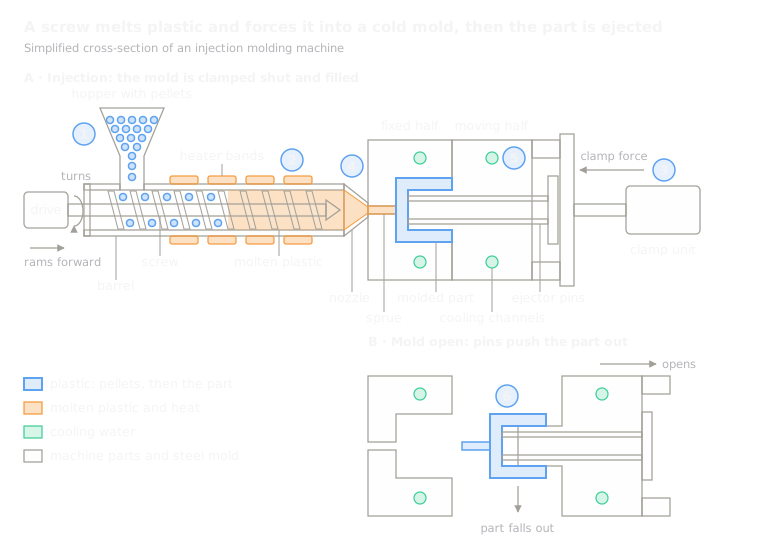 2.1ShortInjection moldingMelt forced into a closed steel moldOpen the lesson
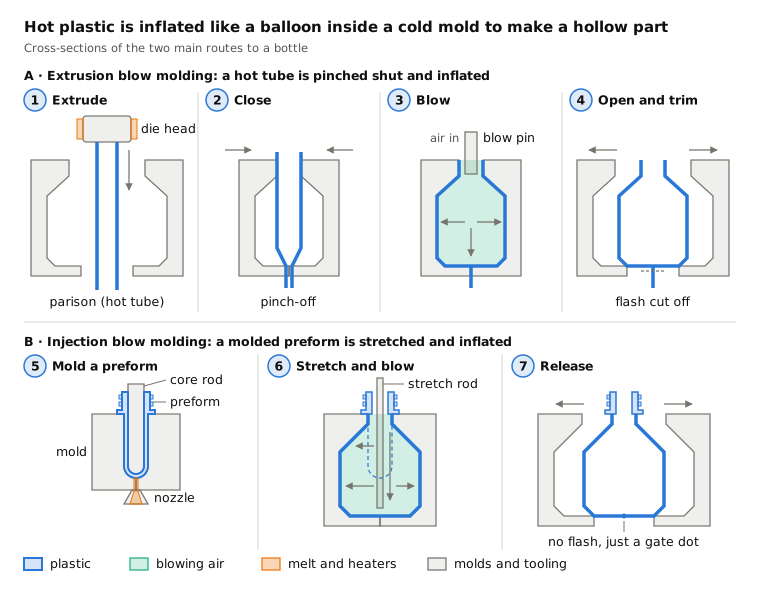
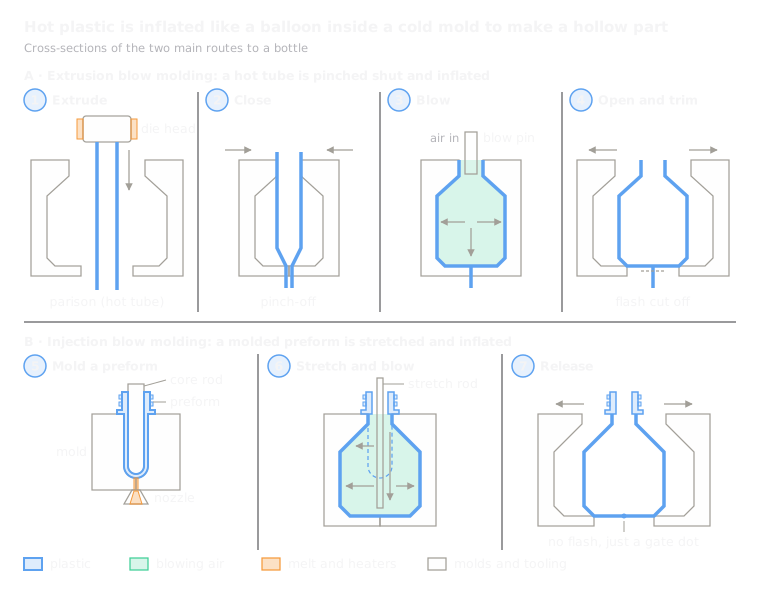 2.3Blow molding (extrusion and injection blow molding)Hot tube or preform inflated in a moldOpen the lesson
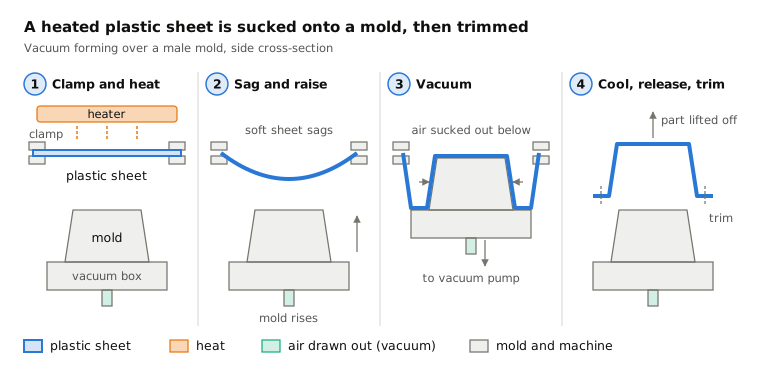
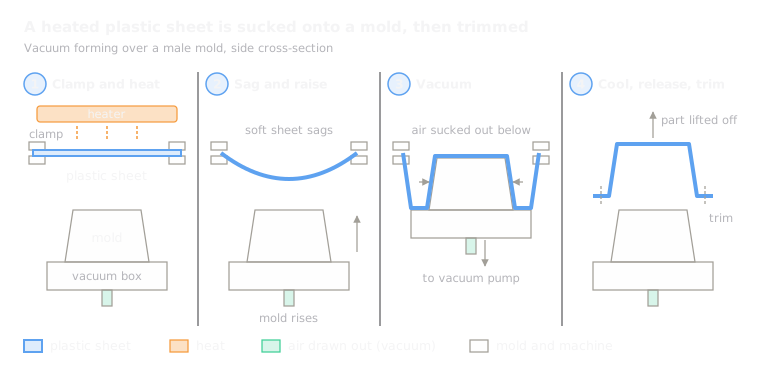 2.4ThermoformingHeated sheet sucked onto a moldOpen the lesson
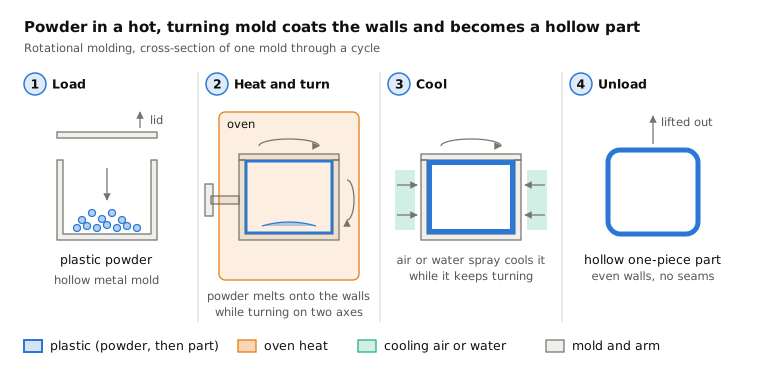
 2.5Rotational moldingPowder coats a hot, turning moldOpen the lesson
 2.6Compression molding (SMC, BMC, rubber)A charge pressed and cured in a hot moldOpen the lesson
 2.7CalenderingCompound squeezed into sheet between rollsOpen the lesson
Try it
Put AI to work in your CAD.
Model parts, generate drawings and automate the repetitive work inside your CAD software.