

Molding plastics and rubber
Plastics and rubbers are shaped while they are soft, then made to hold that shape. Every process in this chapter softens the material with heat, forces it against a mold or between rolls, then sets it by cooling (thermoplastics) or by a chemical cure (rubbers and thermosets). Together they make most of the plastic and rubber objects you touch every day.
The big idea
Think of baking cookies with a cutter versus a waffle iron: the dough is the same, but how you press it decides the shape. Here the "dough" is a polymer (a material made of very long chain molecules), and the processes differ in how they push it into shape: injected under high pressure, inflated with air, sucked onto a mold, tumbled in a turning mold, squeezed in a press, or flattened between rolls. Continuous profiles, pipes and films pushed through a die are also central to plastics; they are taught in lesson 3.3 Extrusion.
The 7 processes in this chapter
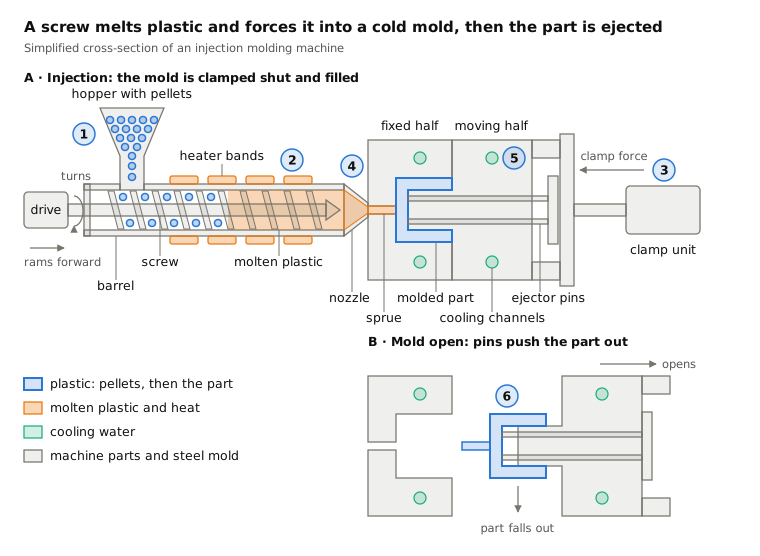
 2.1ShortInjection moldingMelt forced into a closed steel moldOpen the lesson
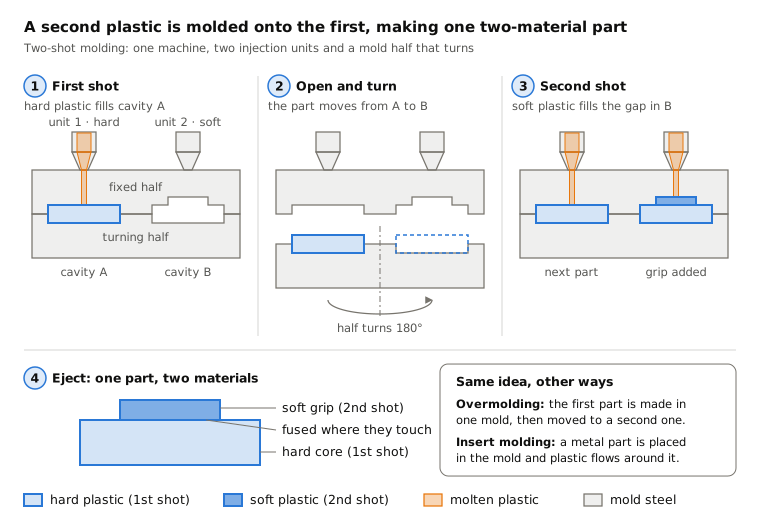
 2.2Overmolding and two-shot moldingA second plastic molded onto the firstOpen the lesson
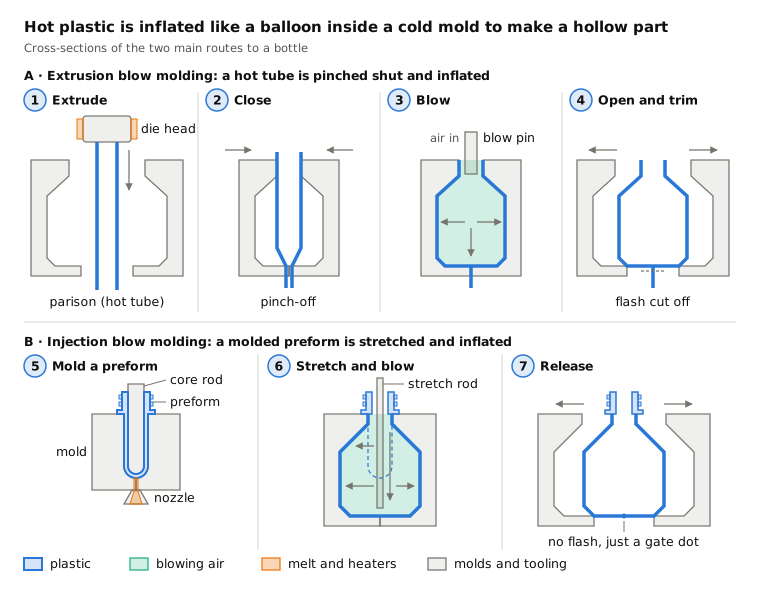
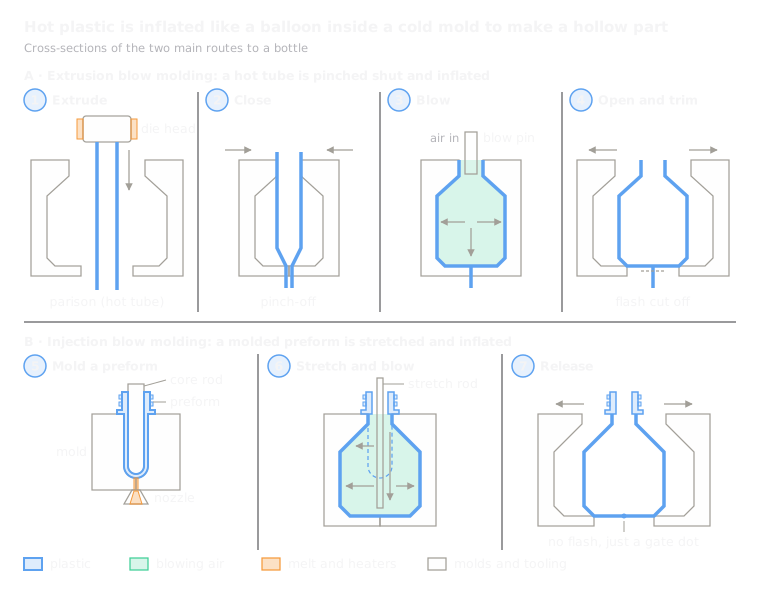 2.3Blow molding (extrusion and injection blow molding)Hot tube or preform inflated in a moldOpen the lesson
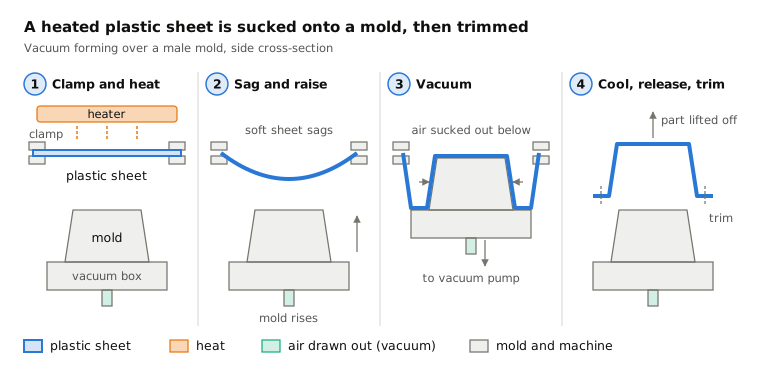
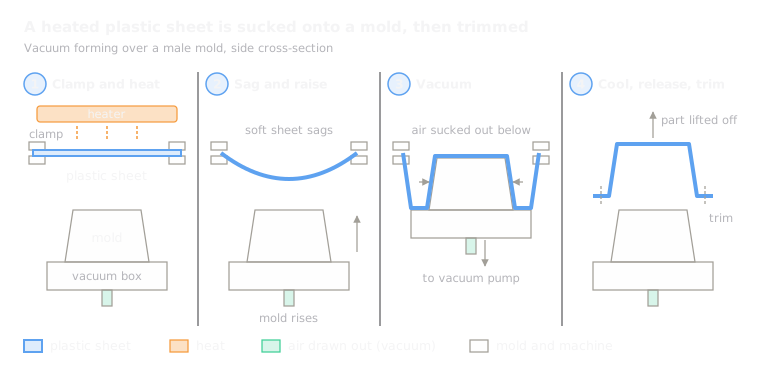 2.4ThermoformingHeated sheet sucked onto a moldOpen the lesson
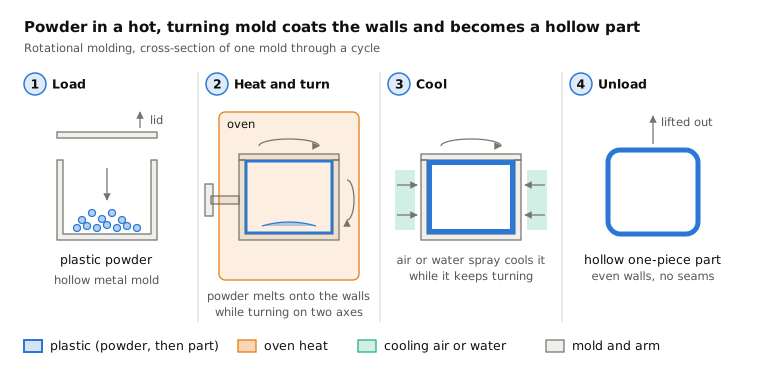
 2.5Rotational moldingPowder coats a hot, turning moldOpen the lesson
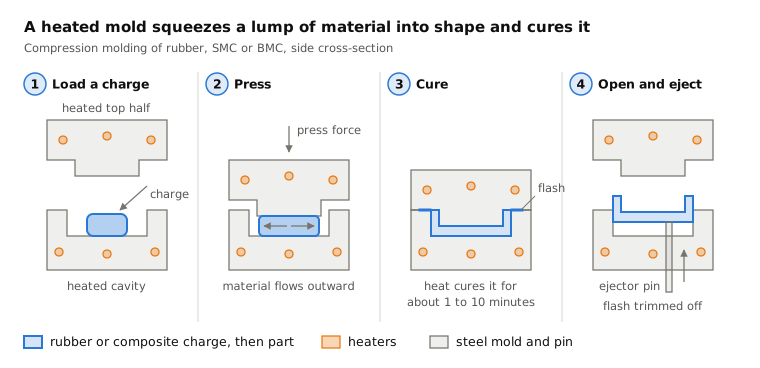
 2.6Compression molding (SMC, BMC, rubber)A charge pressed and cured in a hot moldOpen the lesson
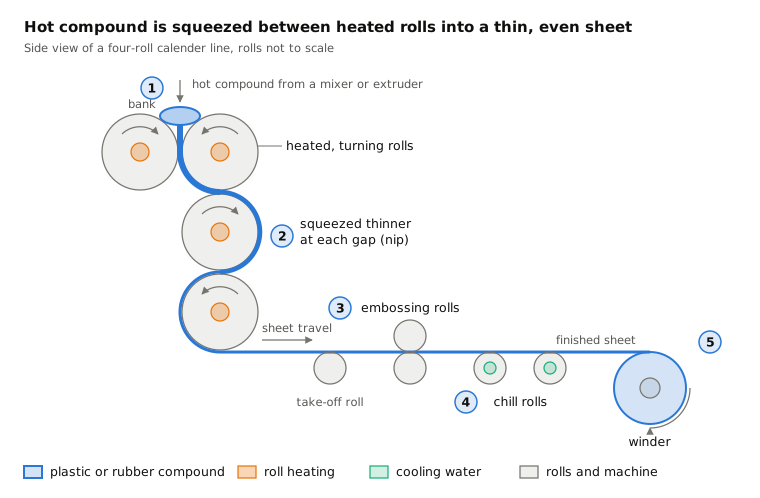
 2.7CalenderingCompound squeezed into sheet between rollsOpen the lesson
Side by side
| Process | In one line | Best for | Batch size | Precision |
|---|---|---|---|---|
| 2.1Injection molding | Melt forced into a closed steel mold | Complex solid parts | Thousands to millions | About ±0.05–0.1 mm |
| 2.2Overmolding and two-shot molding | A second plastic molded onto the first | Soft grips, seals, two-color parts | Tens of thousands to millions | Like injection molding |
| 2.3Blow molding (extrusion and injection blow molding) | Hot tube or preform inflated in a mold | Bottles, tanks, hollow parts | Tens of thousands to millions | About ±0.3–0.5 mm |
| 2.4Thermoforming | Heated sheet sucked onto a mold | Trays, cups, liners, large panels | A few to millions | About ±0.5 mm |
| 2.5Rotational molding | Powder coats a hot, turning mold | Large hollow parts: tanks, kayaks | Tens to thousands | About ±1 mm |
| 2.6Compression molding (SMC, BMC, rubber) | A charge pressed and cured in a hot mold | Rubber seals, composite panels | Hundreds to hundreds of thousands | About ±0.1–0.3 mm |
| 2.7Calendering | Compound squeezed into sheet between rolls | Vinyl film, flooring, rubber sheet | Very long runs | Very even thickness |
How to choose within this family
- Solid, detailed part in large numbers: injection molding; add overmolding when it needs a soft grip or a second color.
- Hollow part: blow molding for bottles and mid-size containers at high volume; rotational molding for very large or low-volume hollow parts.
- Thin open shell or big panel, or a short run: thermoforming, because its molds are cheap.
- Rubber or fiber-reinforced thermoset: compression molding, since these materials set by curing, not cooling.
- Flat sheet or film by the kilometer: calendering for PVC and rubber; extrusion (lesson 3.3) for most other plastics.
Key words
- Polymer
- a material made of very long chain molecules, such as plastics and rubbers.
- Thermoplastic
- a plastic that softens when heated and hardens when cooled, again and again.
- Thermoset
- a material that sets permanently by a chemical reaction and cannot be remelted.
- Curing (vulcanizing for rubber)
- the chemical cross-linking that sets a thermoset or rubber.
- Mold cavity
- the hollow inside a mold that has the shape of the part.
- Parting line
- the line on a part where the mold halves met.
- Flash
- a thin film of excess material squeezed out at the parting line, usually trimmed off.
- Draft
- a slight taper on part walls so the part can slide out of the mold.
Try it
Put AI to work in your CAD.
Model parts, generate drawings and automate the repetitive work inside your CAD software.