

Casting
Casting makes a part by melting metal, pouring or pushing it into a hollow the shape of the part, and letting it freeze. Every process in this chapter shares that principle; they differ in what the mold is made of, whether it is used once or thousands of times, and what drives the metal in: gravity, pressure or spin.
The big idea
Casting is like making ice cubes: liquid takes the shape of its container, then hardens. The hard part is the container. A sand or ceramic mold is cheap and broken after one use, so it suits large or complex parts in small numbers. A steel mold is expensive but lasts for thousands of parts, so it suits mass production. Everything else, from risers to spinning molds to slow-freezing furnaces, deals with the same two problems: filling the mold completely, and stopping holes as the metal shrinks while it cools.
The 8 processes in this chapter
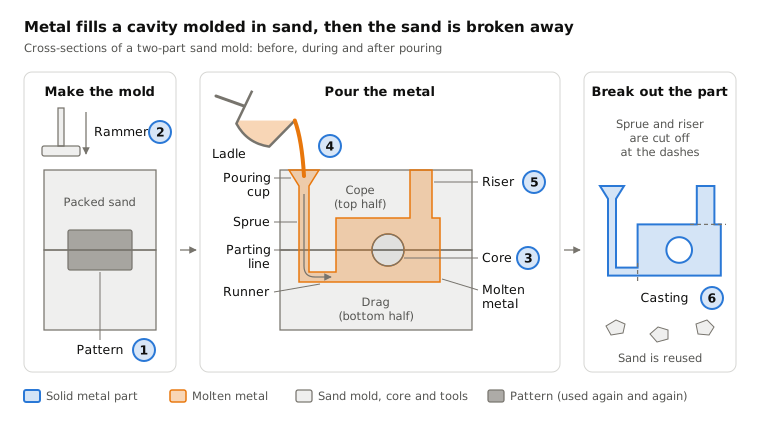
 1.1ShortSand castingMetal poured into a cavity packed in sand; the sand is broken awayOpen the lesson
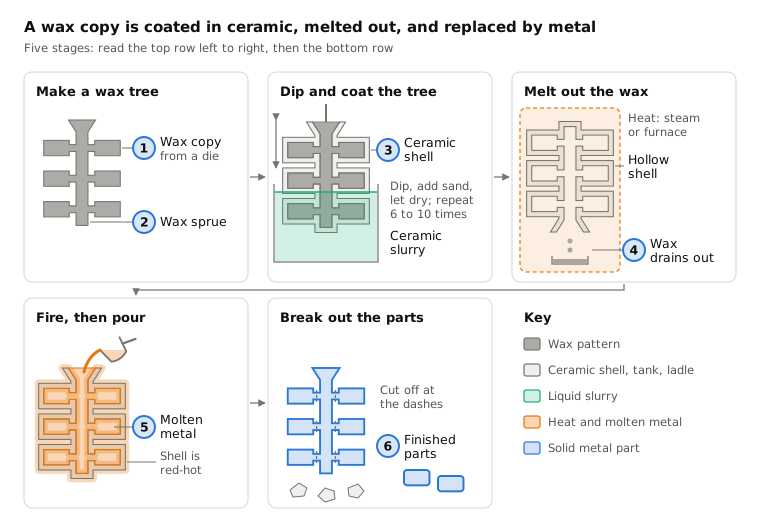
 1.2Investment casting (lost wax)Wax copy coated in ceramic, melted out, then filled with metalOpen the lesson
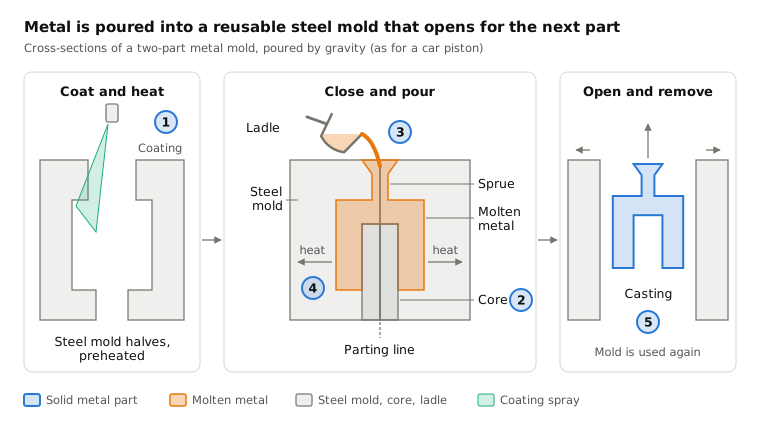
 1.3Permanent mold castingMetal poured by gravity into a reusable steel moldOpen the lesson
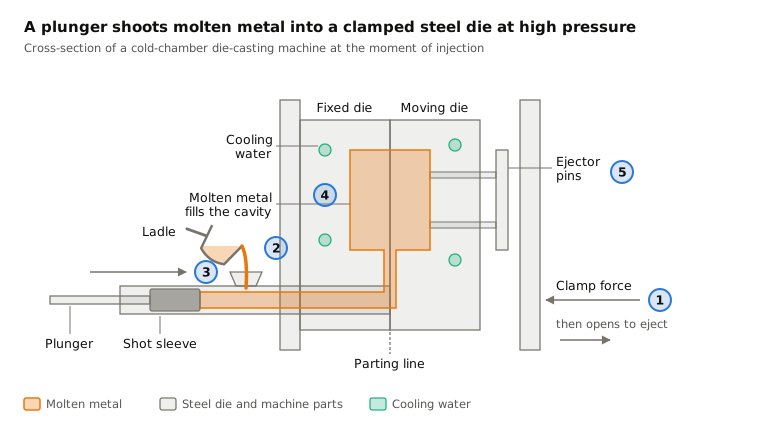
 1.4Die castingMetal shot into a steel die at high pressureOpen the lesson
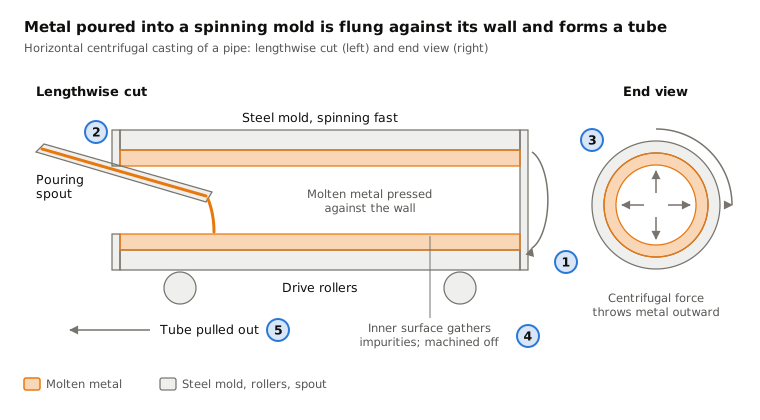
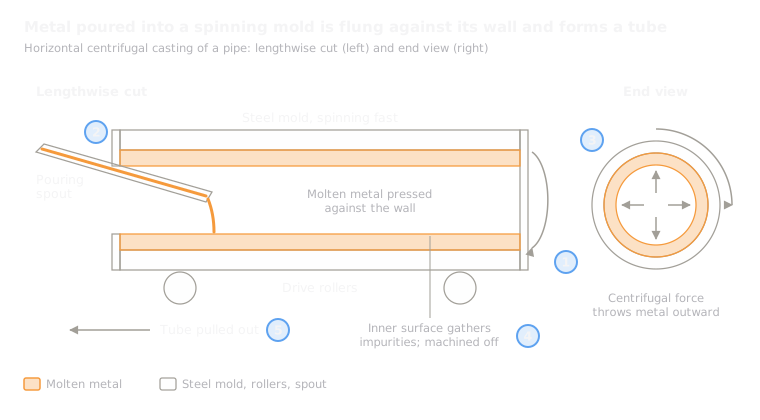 1.5Centrifugal castingMetal flung against the wall of a spinning moldOpen the lesson
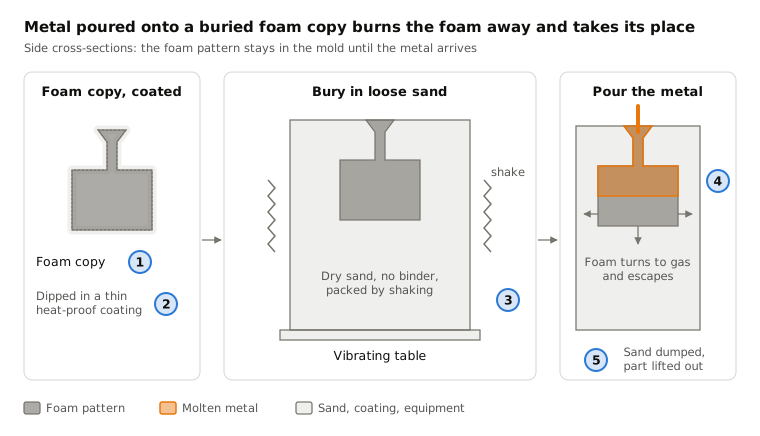
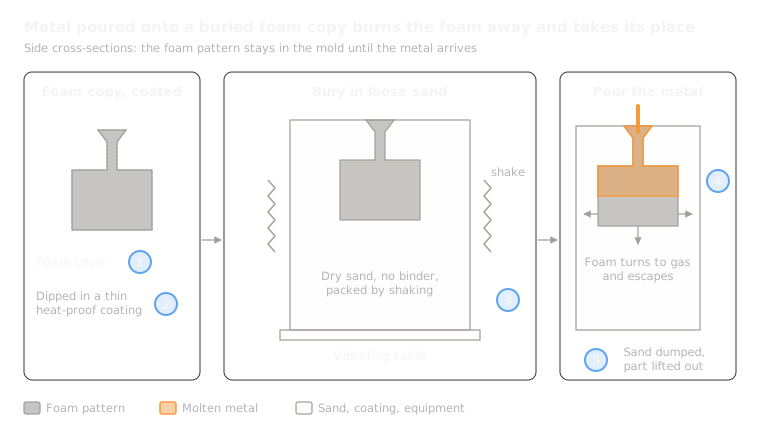 1.6Lost foam castingMetal poured onto a foam copy buried in loose sandOpen the lesson
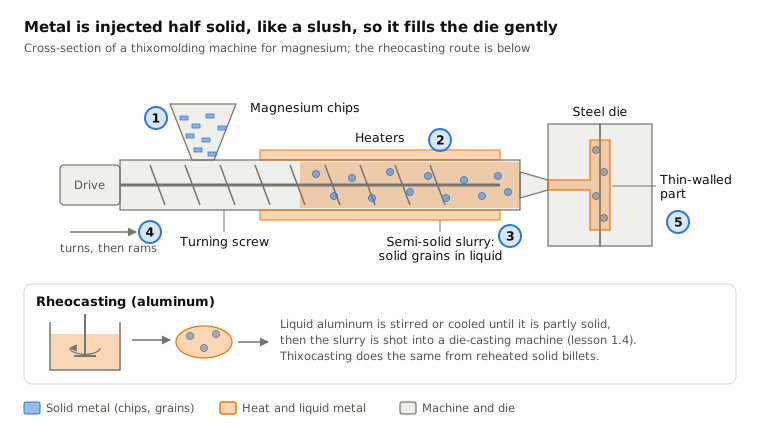
 1.7Semi-solid casting (thixomolding and rheocasting)A half-solid metal slush injected into a steel dieOpen the lesson
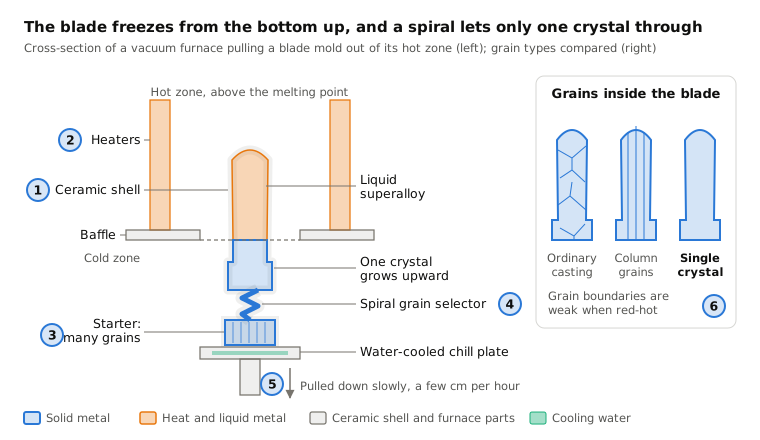
 1.8Single-crystal casting (turbine blades)Slow freezing from one end grows the part as one crystalOpen the lesson
Side by side
| Process | In one line | Best for | Batch size | Precision |
|---|---|---|---|---|
| 1.1Sand casting | Metal poured into a cavity packed in sand; the sand is broken away | Large or rough parts in any metal | 1 to millions | About ±0.5 to ±2 mm |
| 1.2Investment casting (lost wax) | Wax copy coated in ceramic, melted out, then filled with metal | Small, detailed parts in tough alloys | Hundreds to hundreds of thousands | About ±0.1 to ±0.25 mm |
| 1.3Permanent mold casting | Metal poured by gravity into a reusable steel mold | Aluminum parts such as pistons and wheels | Thousands to hundreds of thousands | About ±0.3 to ±0.5 mm |
| 1.4Die casting | Metal shot into a steel die at high pressure | Thin-walled aluminum, zinc and magnesium parts | Tens of thousands to millions | About ±0.05 to ±0.2 mm |
| 1.5Centrifugal casting | Metal flung against the wall of a spinning mold | Pipes, rings and liners | 1 to millions | About ±0.5 to ±2 mm outside |
| 1.6Lost foam casting | Metal poured onto a foam copy buried in loose sand | Complex one-piece parts like engine blocks | One-offs to high volume | About ±0.3 to ±0.5 mm |
| 1.7Semi-solid casting (thixomolding and rheocasting) | A half-solid metal slush injected into a steel die | Dense, thin magnesium and aluminum housings | Tens of thousands to millions | About ±0.05 to ±0.2 mm |
| 1.8Single-crystal casting (turbine blades) | Slow freezing from one end grows the part as one crystal | Jet-engine and gas-turbine blades | Thousands a year | About ±0.1 mm |
How to choose within this family
- Few parts, big parts, or steel and iron: sand casting, the cheapest and most flexible mold.
- Fine detail or high-melting alloys in small parts: investment casting; single-crystal casting when the part must survive red-hot service.
- Thousands of aluminum parts: permanent mold casting if walls are thick and tooling must stay affordable; die casting when volumes are high and walls thin.
- Round, hollow parts: centrifugal casting, which needs no core for the bore.
- Complex inner passages or dense, pore-free thin walls: lost foam casting for the first, semi-solid casting for the second.
Key words
- Mold
- the hollow container the metal fills; called a die when it is steel and reusable.
- Pattern
- a copy of the part used to shape the mold; it is reused in sand casting, used up in investment and lost foam casting.
- Core
- an insert placed in the mold to form a hole or inner passage.
- Parting line
- the seam where two mold halves meet, often visible on the part.
- Sprue, runner and gate
- the channels that carry metal into the cavity.
- Riser
- an extra reservoir of metal that feeds the part as it shrinks.
- Shrinkage
- metal gets smaller as it cools and freezes, which can leave holes inside.
- Grain
- a single crystal inside the metal; most castings contain millions.
Try it
Put AI to work in your CAD.
Model parts, generate drawings and automate the repetitive work inside your CAD software.