

Semi-solid casting (thixomolding and rheocasting)
A half-solid metal slush injected into a steel die
Semi-solid casting injects metal that is neither fully liquid nor solid, but a slush of tiny solid grains in liquid. That slush flows smoothly into a steel die, traps little air and shrinks less, so parts come out denser than ordinary die castings. Magnesium laptop and camera bodies and some aluminum car parts are made this way.
How it works
Feed solid chips. Thixomolding starts with small magnesium chips, not molten metal. They fall from a hopper into a heated barrel, under a blanket of argon gas to stop them burning.
Heat and stir into a slush. Heaters and the turning screw warm and shear the chips until they are partly melted, typically around 5 to 60 percent solid. Shearing breaks the solid into round grains, so the slush flows like a thick paste.
Gather a shot. The screw carries the slush forward and a measured amount collects at the front of the barrel.
Inject. The screw rams forward like a plunger and pushes the slush through the nozzle into a closed steel die. Because it is thick and partly solid, it fills smoothly instead of splashing.
Cool and eject. The part freezes in seconds, the die opens and ejector pins push it out, as in die casting.
Rheocasting reaches the same slush from the other side: liquid aluminum is stirred or cooled until it is partly solid, then cast in a die-casting machine. Thixocasting reheats solid aluminum billets to the same mushy state.
Key facts
- Materials
- Thixomolding: magnesium alloys. Rheocasting and thixocasting: mainly aluminum alloys
- Typical parts
- Laptop, camera and phone housings, power-tool bodies, car brackets, steering parts, telecom housings
- Part size
- From a few grams to several kilograms
- Precision
- About ±0.05 to ±0.2 mm, similar to die casting
- Surface finish
- Smooth: Ra (average roughness) about 1 to 2 µm
- Batch size it suits
- Tens of thousands to millions of parts
- Tooling and machine cost
- Similar to die casting: dies from tens of thousands of dollars, machines from hundreds of thousands
- Speed
- Roughly 20 seconds to a minute or two per shot
Strengths and limits
Strengths
- Few pores, so parts can be heat-treated and are stronger than die castings
- Less shrinkage, so tighter tolerances and thinner walls
- Lower process temperature, so dies last longer
- Thixomolding avoids handling a pot of molten magnesium
Limits
- Process control is harder: the solid fraction must stay just right
- Fewer suppliers and less know-how than ordinary die casting
- Machines and special feedstock (chips, billets) cost more
- Mostly limited to magnesium and aluminum alloys
Where it's used
- ElectronicsLaptop, camera and phone housings in magnesium
- AutomotiveBrackets, steering-wheel frames, suspension and engine-mount parts
- TelecomHousings and heat sinks for radio units
- Tools and sportsPower-tool housings, bicycle and archery parts
How to recognize it
- Very thin, even walls on a light metal housing, often magnesium (feels lighter than aluminum).
- A smooth surface, usually painted, with small ejector-pin marks like a die casting.
- On a cut section, almost no pores; under a microscope, round grains instead of tree-like crystals.
- From the outside it is hard to tell from die casting: check the maker's data.
Compare with
Watch it
North American Die Casting Association · An industry overview of semi-solid processes, with diagrams
The Limiting Factor · A long explainer of thixomolding and why magnesium suits it
Daseon Industry Group Ltd. · A thixomolding machine in operation
Comptech AB · A rheocasting cell producing aluminum parts
See real photos
- Wikipedia: Semi-solid metal casting — thixocasting, rheocasting and thixomolding explained; text only, so use the search below for pictures
- Wikimedia Commons photo search
Remember
- The metal goes in as a slush, partly solid and partly liquid.
- Slush fills the die calmly, so parts have fewer pores than die castings.
- Thixomolding uses magnesium chips and a screw; rheocasting stirs liquid aluminum.
More in Casting
All 100 processes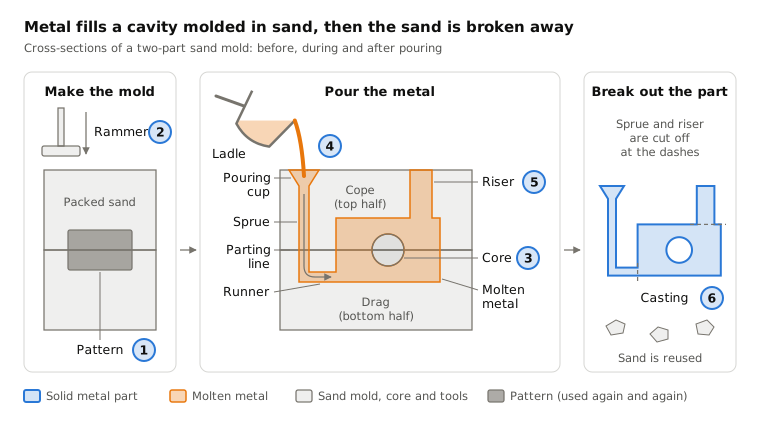
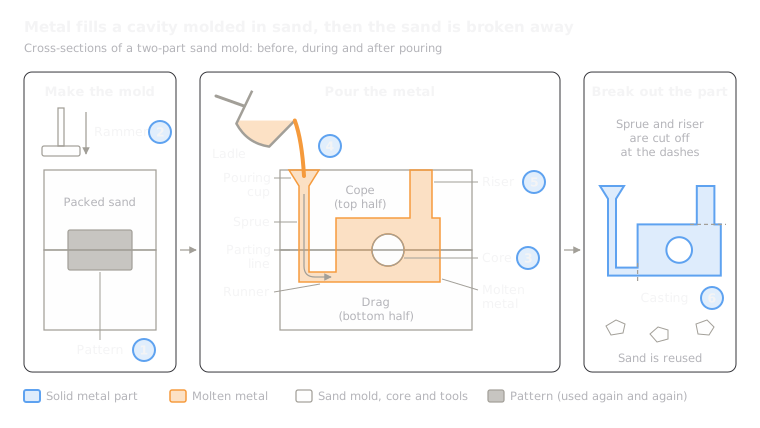 1.1ShortSand castingMetal poured into a cavity packed in sand; the sand is broken awayOpen the lesson
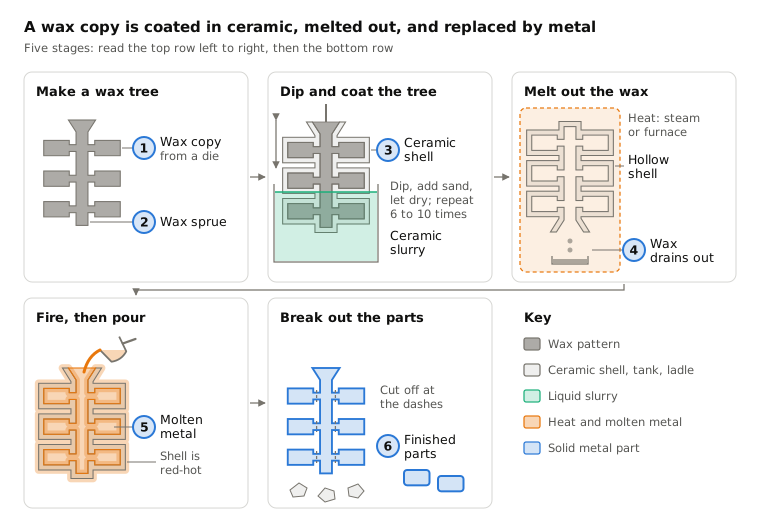
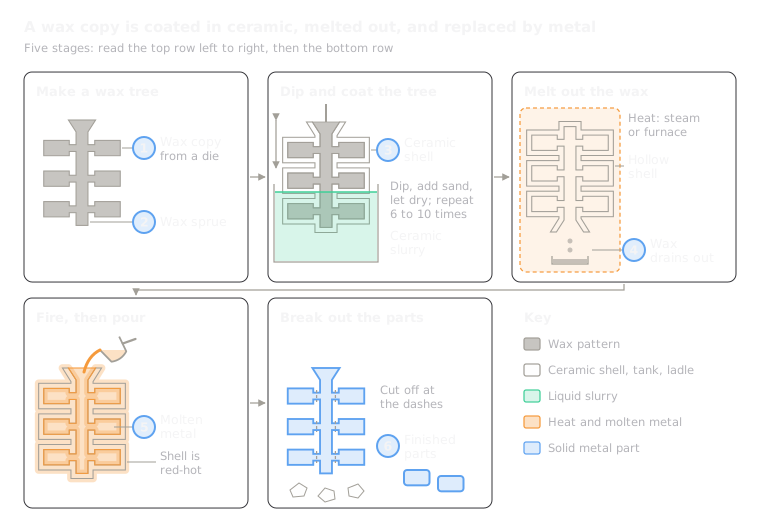 1.2Investment casting (lost wax)Wax copy coated in ceramic, melted out, then filled with metalOpen the lesson
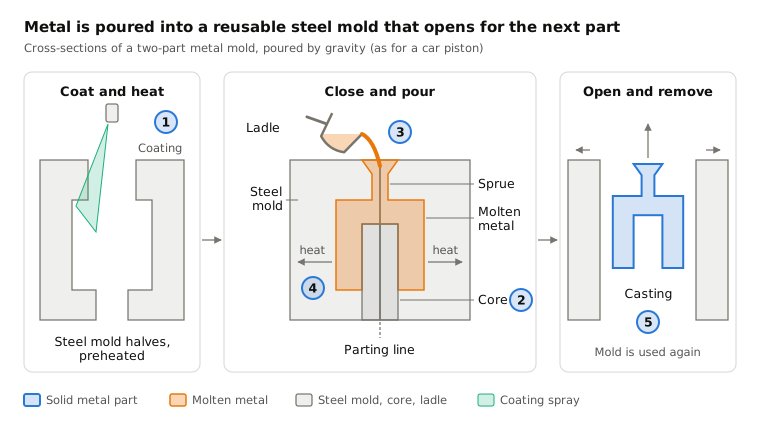
 1.3Permanent mold castingMetal poured by gravity into a reusable steel moldOpen the lesson
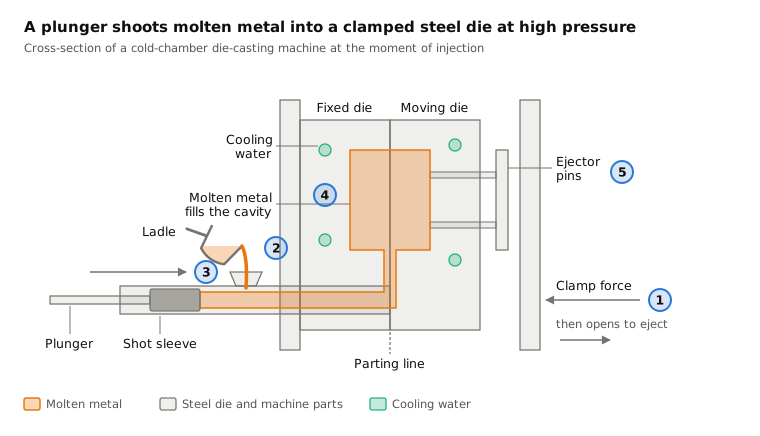
 1.4Die castingMetal shot into a steel die at high pressureOpen the lesson
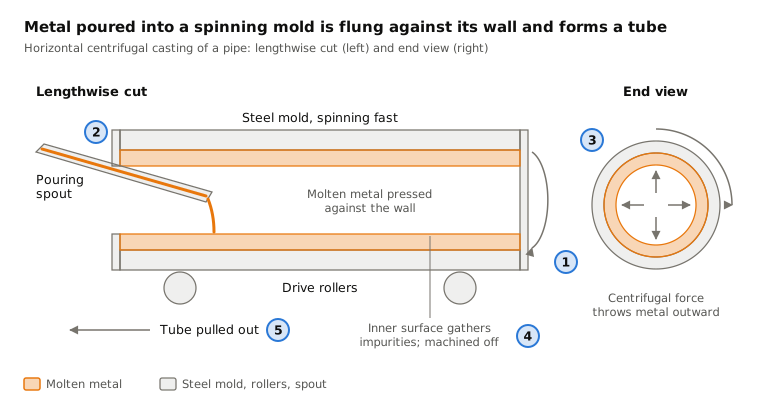
 1.5Centrifugal castingMetal flung against the wall of a spinning moldOpen the lesson
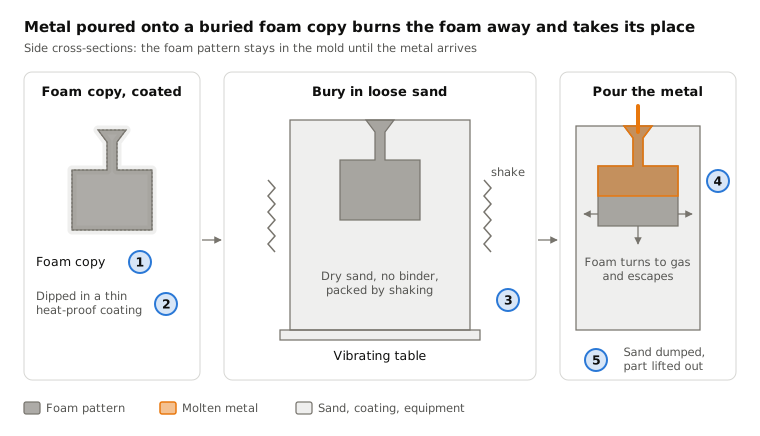
 1.6Lost foam castingMetal poured onto a foam copy buried in loose sandOpen the lesson
 1.8Single-crystal casting (turbine blades)Slow freezing from one end grows the part as one crystalOpen the lesson
Try it
Put AI to work in your CAD.
Model parts, generate drawings and automate the repetitive work inside your CAD software.