

Investment casting (lost wax)
Wax copy coated in ceramic, melted out, then filled with metal
Investment casting, also called lost-wax casting, copies a part in wax, coats the wax in ceramic, melts the wax out and pours metal into the hollow shell. Jet-engine turbine blades, golf club heads and hip implants are made this way. You get near-finished parts with fine detail, in almost any alloy.
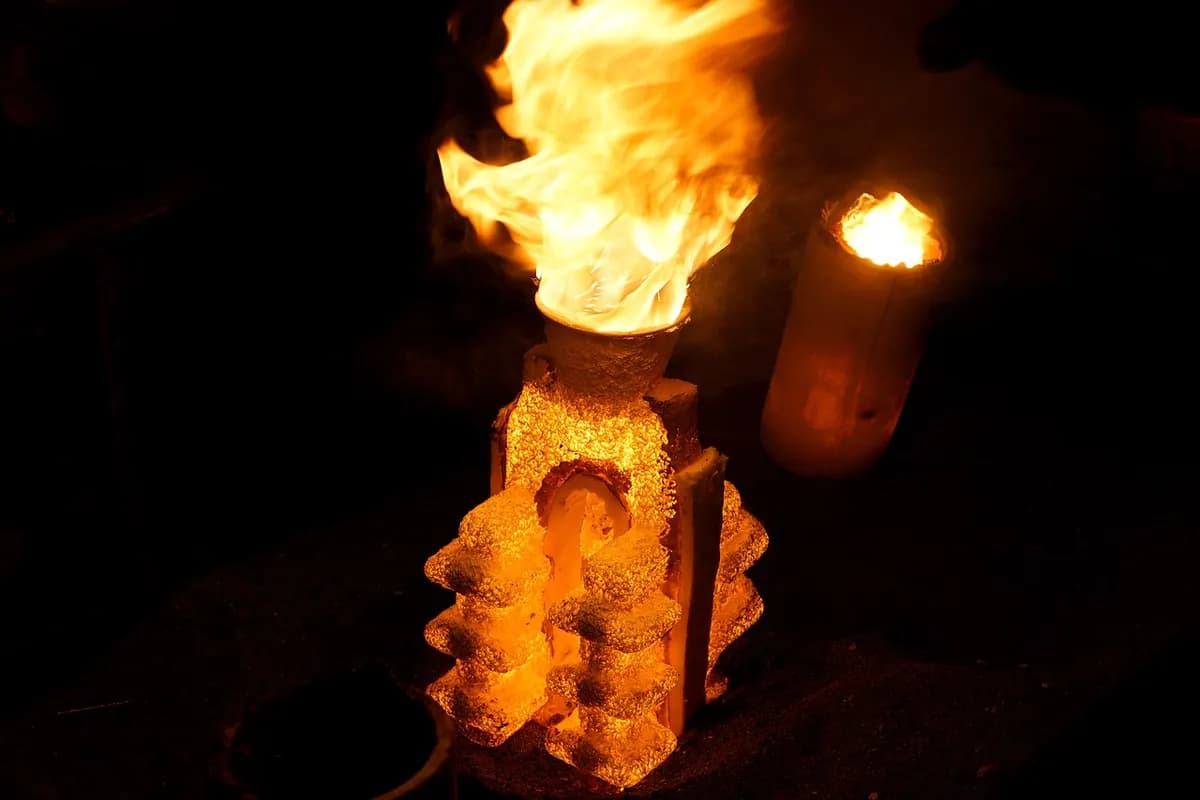
How it works
Make wax copies. Wax is injected into a metal die (a reusable mold) to make a pattern, an exact wax copy of the part. Every casting needs its own pattern.
Build a tree. Many patterns are glued onto a central wax sprue (feeding channel), forming a "tree" that can hold from a few to dozens of parts.
Coat it in ceramic. The tree is dipped in a ceramic slurry (a creamy mix of fine ceramic powder and liquid binder), sprinkled with fine sand and dried. This is repeated about 6 to 10 times, until the shell is several millimeters thick.
Melt out the wax. The shell is turned upside down and heated, usually in a steam autoclave (a pressurized steam oven) or a hot furnace. The wax runs out, often to be reused, leaving a hollow one-piece mold.
Fire, then pour. The shell is fired, often at around 1000 °C, to make it strong and burn off the last wax. Metal is poured in while the shell is still hot, so thin sections fill before the metal freezes.
Break out the parts. After cooling, the shell is knocked off by hammering, vibration or water jets. The parts are cut from the tree, and the gate stubs (where each part joined the tree) are ground smooth.
Key facts
- Materials
- Steels and stainless steels, nickel and cobalt superalloys, titanium, aluminum, copper alloys, gold and silver
- Typical parts
- Turbine blades, golf club heads, hip and knee implants, pump impellers, firearm and lock parts, jewelry
- Part size
- Usually a few grams to a few kilograms; specialist foundries go beyond 100 kg
- Precision
- About ±0.1 to ±0.25 mm on small features, roughly ±0.5% of a dimension
- Surface finish
- Smooth: Ra (average roughness) about 1.5 to 3 µm
- Batch size it suits
- Hundreds to hundreds of thousands of parts a year; also one-offs in art and jewelry
- Tooling and machine cost
- Wax-injection dies cost a few thousand to tens of thousands of dollars; 3D-printed patterns skip the die for prototypes
- Speed
- Days to weeks per batch, mostly spent waiting for shell coats to dry; many trees are processed in parallel
Strengths and limits
Strengths
- Very fine detail and smooth surfaces, often with little machining
- Works with high-melting alloys such as superalloys and stainless steel
- Complex shapes in one piece, with little or no seam
- Little waste: sprues and runners are remelted
Limits
- More steps and labor, so each part costs more than a sand casting
- Parts are mostly small; large ones become difficult and expensive
- A new wax pattern and a new shell are used up for every part
- Long lead time, from days to weeks
Where it's used
- AerospaceTurbine blades and vanes, structural brackets, fuel-system parts
- MedicalHip and knee implants, surgical instruments
- SportsGolf club heads
- AutomotiveTurbocharger wheels, rocker arms, small valve parts
- IndustrialPump impellers, valve bodies, levers and brackets
- Art and jewelryBronze sculptures, rings, dental crowns and bridges
How to recognize it
- Crisp detail, sharp lettering and a smooth, slightly satin surface, even in hidden corners.
- No mold seam, or only a very faint line left by the wax die.
- A small flat, ground spot where the part was cut from the tree (the gate mark).
- A complex shape made in one piece that would otherwise need several machined parts.
Compare with
Watch it
RAPID DIRECT · An animated, step-by-step explanation of the whole process
Paul Hamler · The full process done by hand, from wax to metal
SIMIS · Robots dipping wax trees in slurry and sand to build shells
Dean Group International Ltd · A real foundry: trees, pouring and knocking off the shell
See real photos
- Wikipedia: Investment casting — a shell for a turbocharger rotor, the inside of a shell, and the finished part
- Wikimedia Commons photo search
Remember
- Every part needs a fresh wax copy and a fresh ceramic shell.
- Melting the wax out leaves a seamless one-piece mold, so detail is excellent.
- Precise and smooth, but slower and costlier per part than sand casting.
More in Casting
All 100 processes
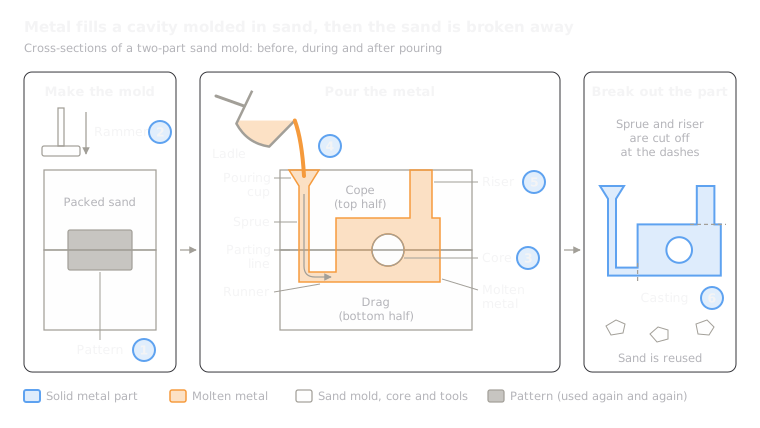 1.1ShortSand castingMetal poured into a cavity packed in sand; the sand is broken awayOpen the lesson
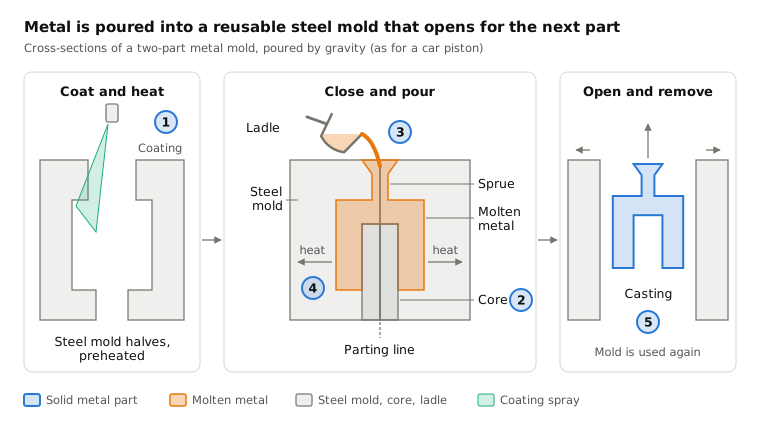
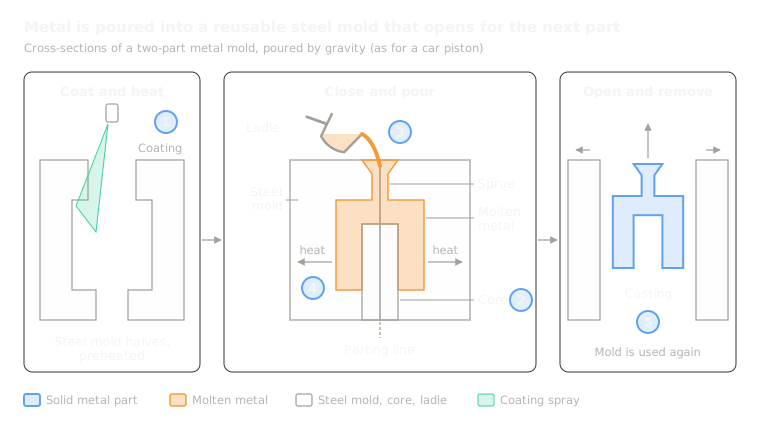 1.3Permanent mold castingMetal poured by gravity into a reusable steel moldOpen the lesson
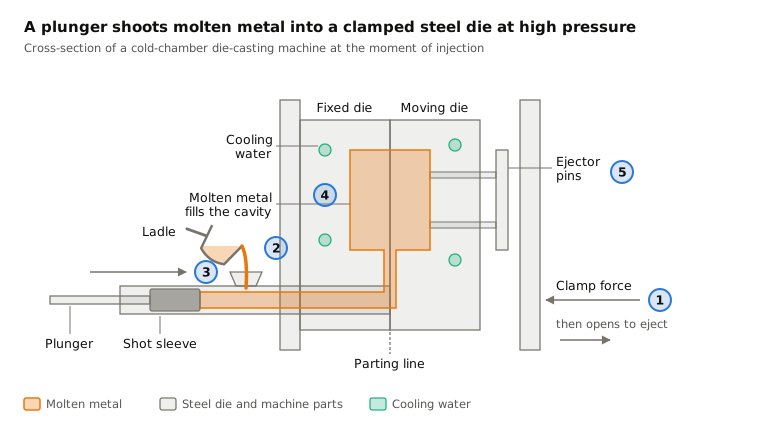
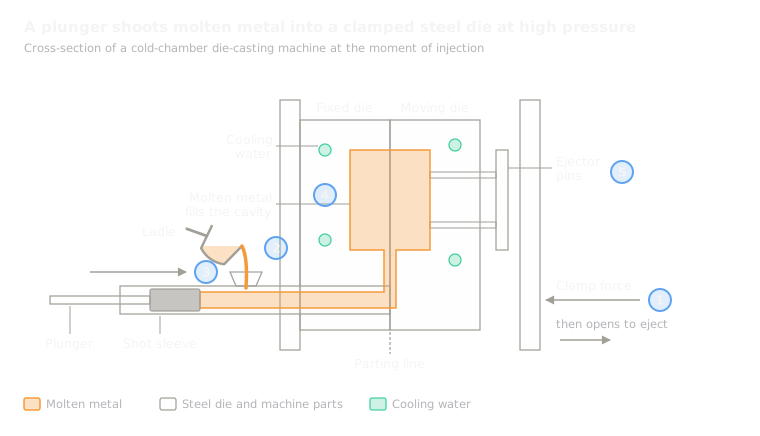 1.4Die castingMetal shot into a steel die at high pressureOpen the lesson
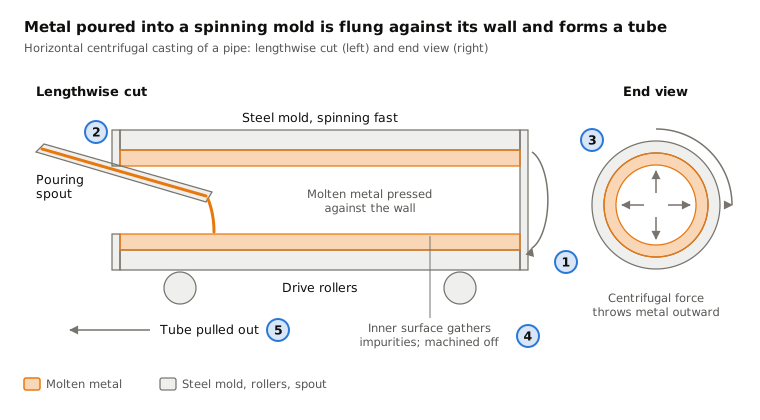
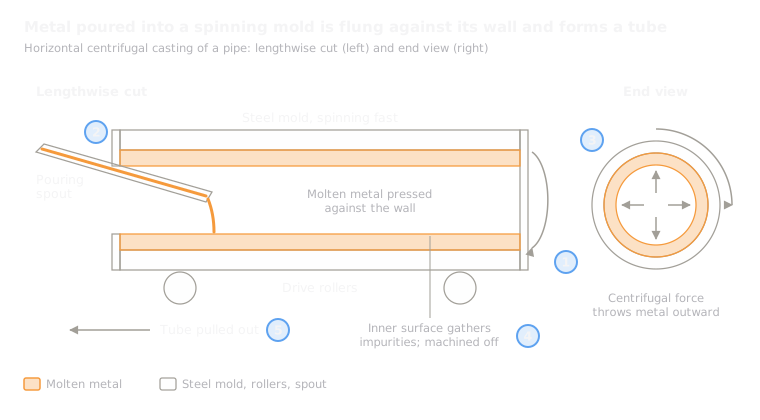 1.5Centrifugal castingMetal flung against the wall of a spinning moldOpen the lesson
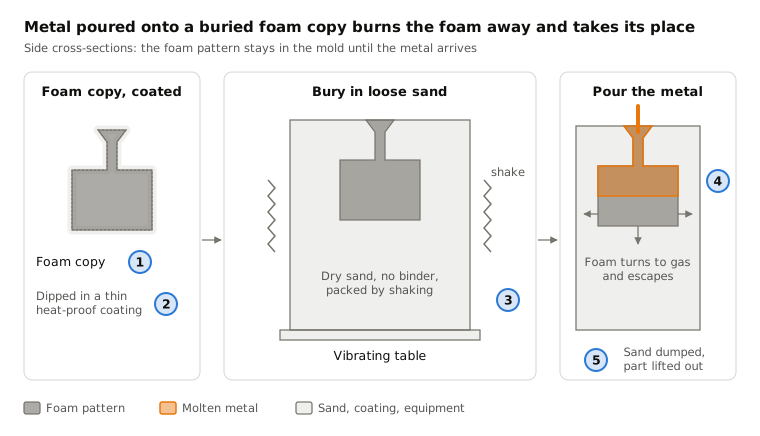
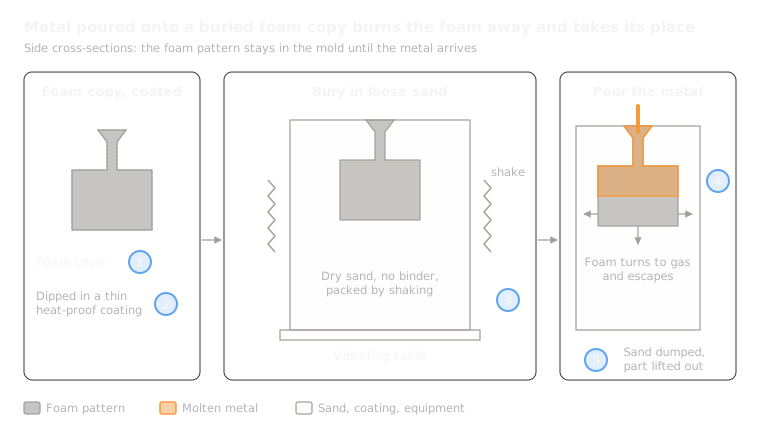 1.6Lost foam castingMetal poured onto a foam copy buried in loose sandOpen the lesson
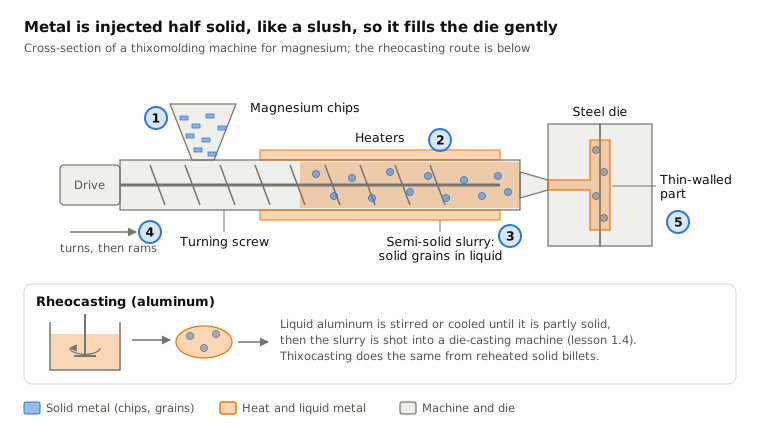
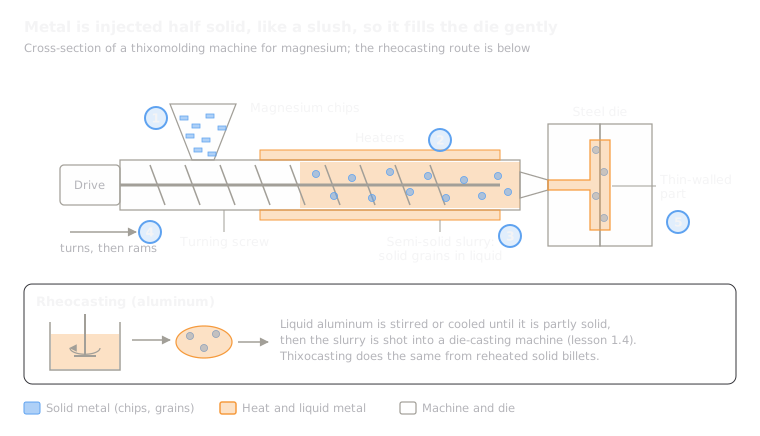 1.7Semi-solid casting (thixomolding and rheocasting)A half-solid metal slush injected into a steel dieOpen the lesson
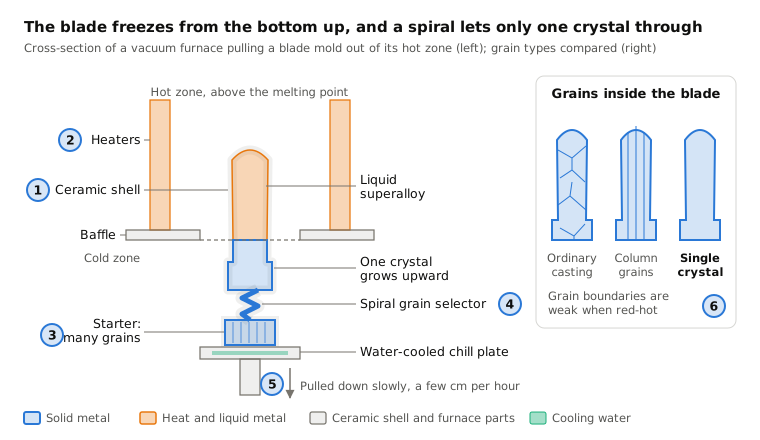
 1.8Single-crystal casting (turbine blades)Slow freezing from one end grows the part as one crystalOpen the lesson
Try it
Put AI to work in your CAD.
Model parts, generate drawings and automate the repetitive work inside your CAD software.