

Sand casting
Metal poured into a cavity packed in sand; the sand is broken away
Sand casting makes a metal part by pouring molten metal into a hollow shaped in packed sand. Engine blocks, manhole covers and pump housings are typical examples. It is one of the oldest casting methods and still the most widely used, because the mold is cheap and almost any size is possible.
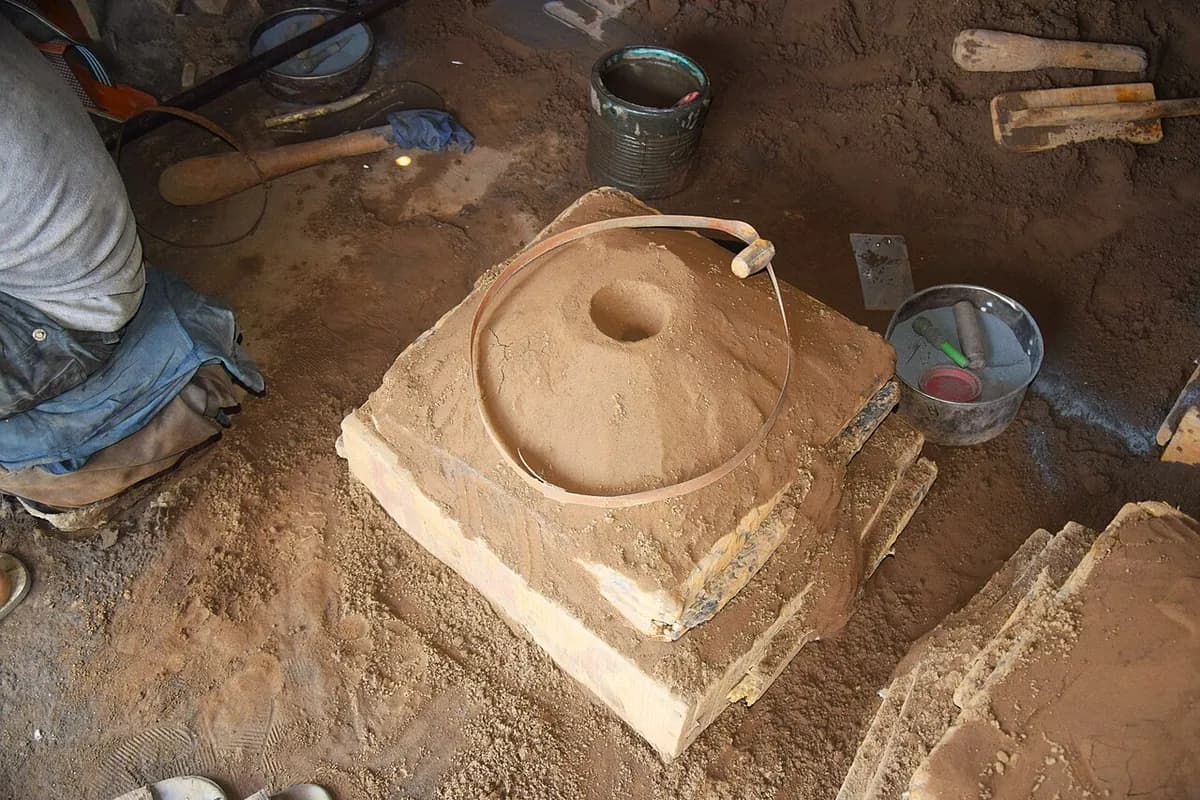
Sand casting in a minute, by MecMade
How it works
Make a pattern. A pattern is a full-size copy of the part in wood, plastic or metal. It is made slightly oversize, because metal shrinks as it cools.
Pack sand around it. The pattern sits in a two-part box called a flask. Sand mixed with clay and water (green sand) or with a resin binder is rammed (pressed hard) around it until it holds its shape.
Remove the pattern, set the core, close the mold. The upper half (the cope) is lifted off the lower half (the drag) and the pattern is drawn out, leaving a cavity. A core (a hardened sand insert) goes in to form an inner hole, channels are cut, and the halves are closed again. The seam where they meet is the parting line.
Pour. Molten metal is poured from a ladle into the pouring cup. It runs down the sprue (vertical channel), along the runner (horizontal channel) and fills the cavity.
Let it solidify. Cooling takes minutes for small parts and hours, even days, for very large ones. A riser (an extra reservoir of metal) keeps feeding the part as it shrinks, so the shrinkage hole forms in the riser instead of the part.
Break out and finish. The sand is shaken off and recycled. The sprue and risers are cut off, the surface is cleaned, often by shot blasting (blasting with small steel balls), and key faces are machined.
Key facts
- Materials
- Almost any metal that can be melted: gray and ductile iron, steel, aluminum, bronze, brass, magnesium
- Typical parts
- Engine blocks, cylinder heads, pump and valve bodies, gearbox housings, manhole covers, machine bases
- Part size
- From a few centimeters to several meters across; from grams to more than 100 tonnes
- Precision
- Typically about ±0.5 to ±2 mm, more on large parts
- Surface finish
- Rough and grainy: Ra (average roughness) roughly 6 to 25 µm
- Batch size it suits
- One-offs and prototypes (hand molding) up to millions of parts (automated molding lines)
- Tooling and machine cost
- Patterns from a few hundred to tens of thousands of dollars; automated molding lines cost millions
- Speed
- Hours per mold by hand; automated lines make up to several hundred molds per hour. Cooling adds minutes to hours
Strengths and limits
Strengths
- Works with almost any metal, including high-melting iron and steel
- Parts from palm-size to many tonnes
- Cheap tooling, so one-offs and prototypes are affordable
- Cores make complex internal passages possible
Limits
- Rough surface and loose tolerances, so key faces need machining
- A new mold must be made for every part
- Gas holes (porosity) and trapped sand grains can cause defects
- Thin walls are hard to fill; about 3 to 5 mm is a practical minimum
Where it's used
- AutomotiveCast-iron engine blocks, cylinder heads, brake drums, differential housings
- Pumps and valvesPump casings, valve bodies, impellers
- Heavy machineryMachine-tool beds, gearbox housings, mining and construction equipment
- Energy and marineWind-turbine hubs, turbine casings, ship propellers
- City infrastructureManhole covers, drain grates, pipe fittings
- Home goodsCast-iron skillets, wood-stove parts, bells
How to recognize it
- A grainy, matte surface, like fine sandpaper, on every area that was not machined.
- A thin seam or small step running around the part: the parting line, where cope and drag met.
- Flat, ground-down patches where the sprue, runners and risers were cut away.
- Shiny machined faces (bolt flanges, bores) right next to rough cast surfaces.
Compare with
Watch it
dharmesh barodiya · Every step, from pattern to finished casting, in a teaching workshop
mrpete222 · How a green-sand mold is rammed by hand in a cope and drag
General Foundry Service · What an industrial green-sand foundry and its pouring look like
DISA · How an automated line makes and pours molds for mass production
See real photos
- Wikipedia: Sand casting — photos of molds, flasks, cores and castings, plus a process diagram
- Wikipedia: DISAMATIC — the automated machine that makes vertically split sand molds
- Wikimedia Commons photo search
Remember
- A reusable pattern shapes the cavity; the sand mold is destroyed after each pour.
- The sprue, runners and risers bring metal in and feed it, then are cut off.
- Cheap and flexible for any size, but rough and only moderately precise.
More in Casting
All 100 processes
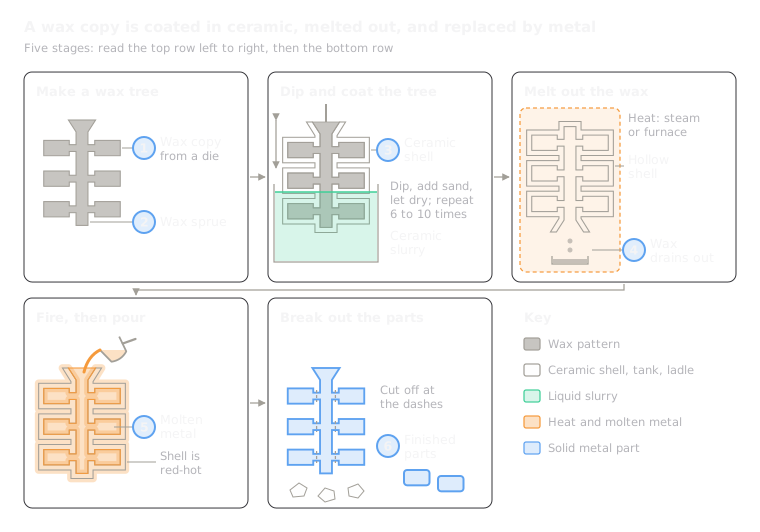 1.2Investment casting (lost wax)Wax copy coated in ceramic, melted out, then filled with metalOpen the lesson
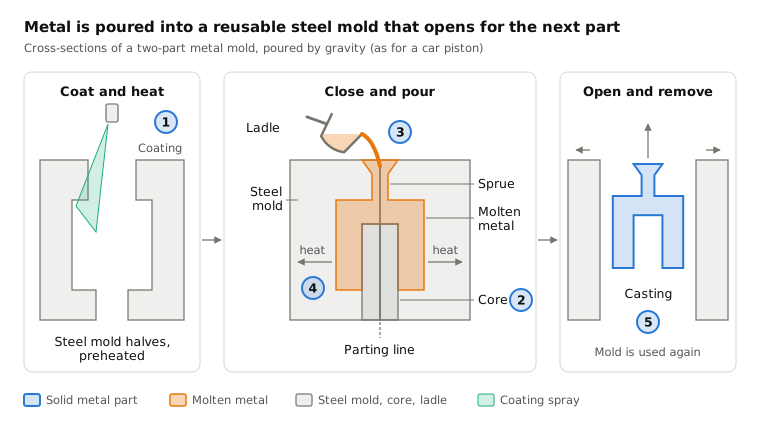
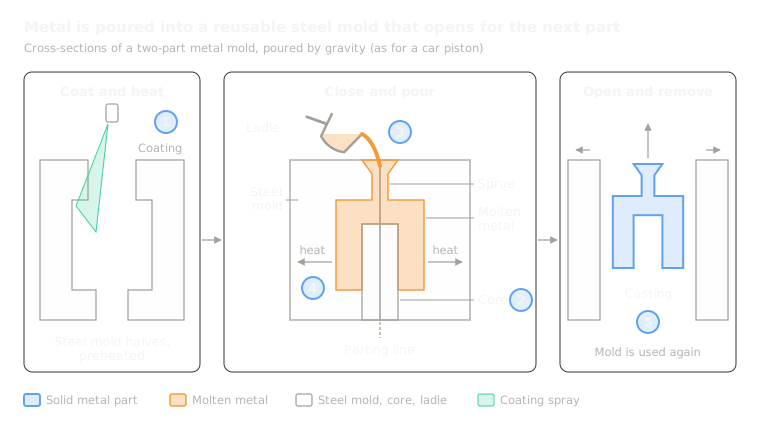 1.3Permanent mold castingMetal poured by gravity into a reusable steel moldOpen the lesson
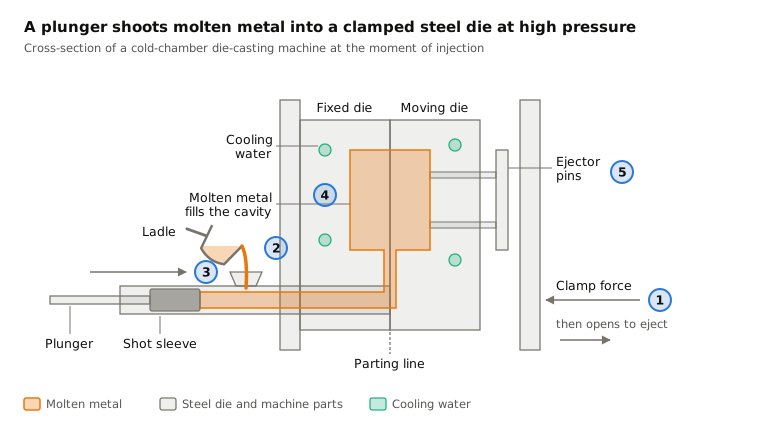
 1.4Die castingMetal shot into a steel die at high pressureOpen the lesson
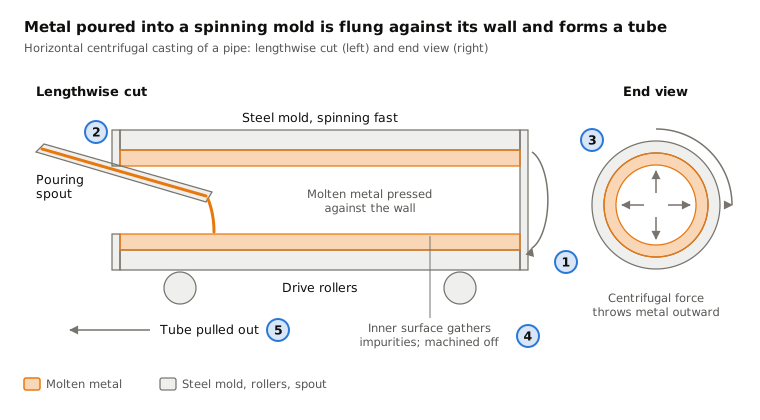
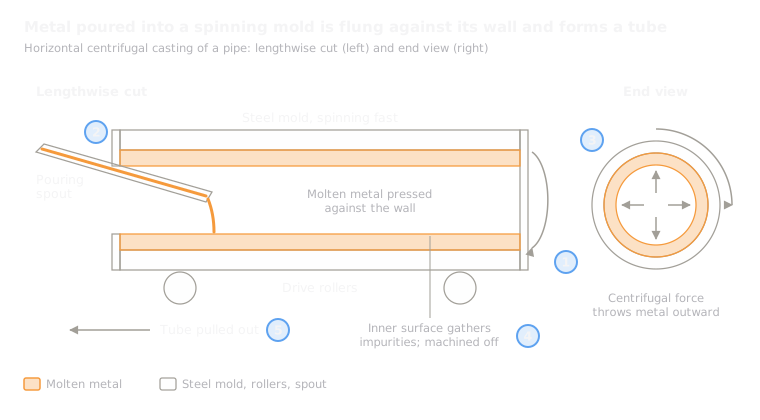 1.5Centrifugal castingMetal flung against the wall of a spinning moldOpen the lesson
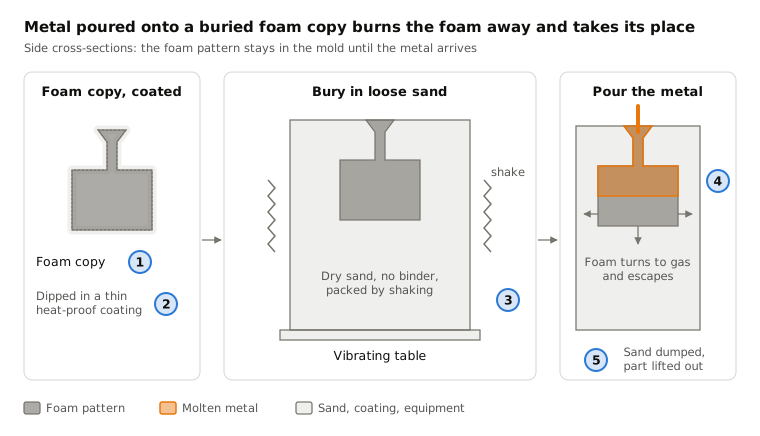
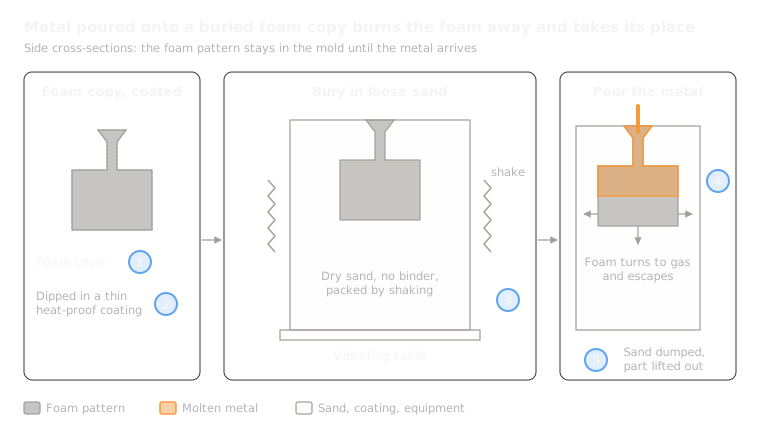 1.6Lost foam castingMetal poured onto a foam copy buried in loose sandOpen the lesson
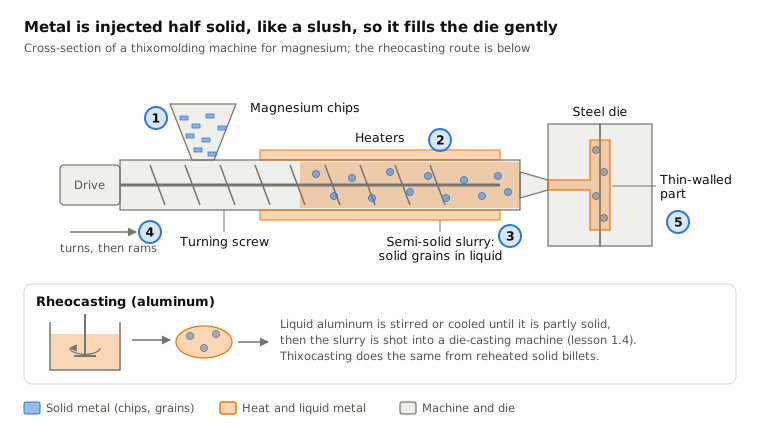
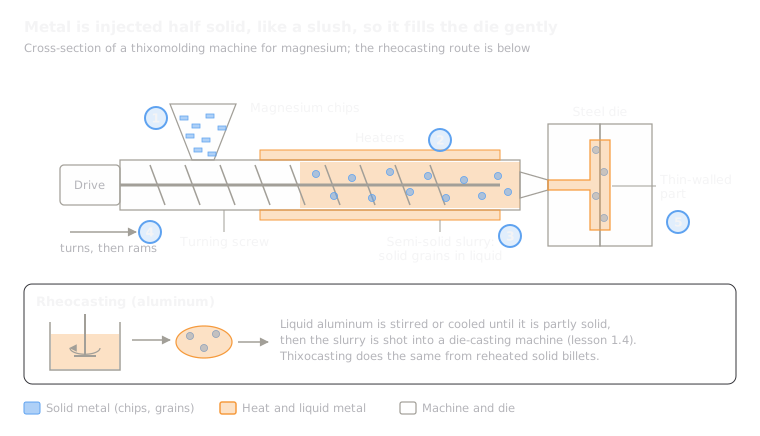 1.7Semi-solid casting (thixomolding and rheocasting)A half-solid metal slush injected into a steel dieOpen the lesson
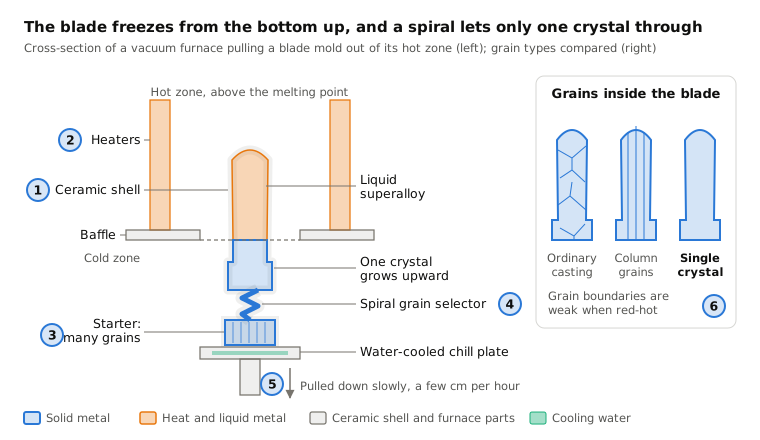
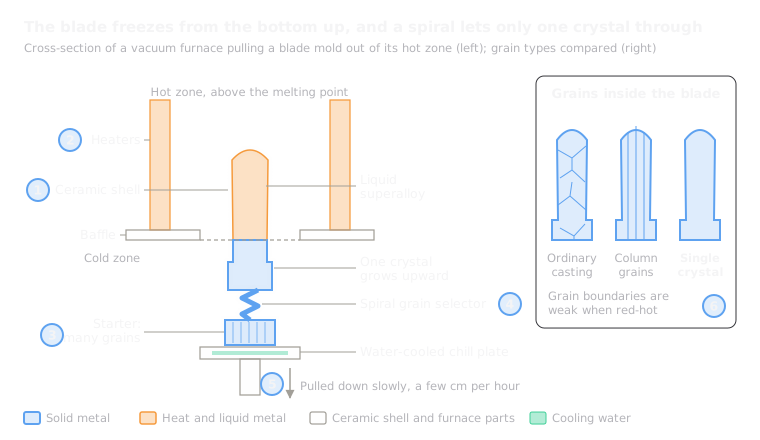 1.8Single-crystal casting (turbine blades)Slow freezing from one end grows the part as one crystalOpen the lesson
Try it
Put AI to work in your CAD.
Model parts, generate drawings and automate the repetitive work inside your CAD software.