

Lost foam casting
Metal poured onto a foam copy buried in loose sand
Lost foam casting buries a foam copy of the part in loose sand and pours metal straight onto it. The hot metal vaporizes the foam and takes its exact place. Engine blocks, cylinder heads and outboard-motor parts are made this way, often with complex inner passages that would need many cores in sand casting.
How it works
Make a foam copy. The pattern is molded from expanded polystyrene beads, the same light foam as a disposable cup, or cut by hand for one-offs. Foam sprues are glued on, and complex parts can be glued together from several foam slices.
Coat it. The foam is dipped in a thin refractory (heat-resistant) coating and dried. The coating keeps sand out but lets gas through.
Bury it in loose sand. The coated foam goes into a flask, and dry sand with no binder is poured around it. Shaking the flask on a vibrating table packs the sand into every hollow.
Pour. Molten metal is poured onto the foam sprue. The foam melts and turns to gas just ahead of the metal, and the gas escapes through the coating into the sand.
Dump the sand. After cooling, the flask is tipped out; the loose sand runs away and is reused. The casting is lifted out and its sprue is cut off.
Key facts
- Materials
- Mostly aluminum alloys and cast iron; also some steel and copper alloys
- Typical parts
- Engine blocks and cylinder heads, intake manifolds, outboard-motor housings, pump and valve bodies, art pieces
- Part size
- From under 1 kg to several hundred kilograms
- Precision
- About ±0.3 to ±0.5 mm on a 100 mm feature
- Surface finish
- Ra (average roughness) about 2.5 to 25 µm, often showing a faint foam-bead texture
- Batch size it suits
- High volume with molded foam; one-offs with hand-cut foam
- Tooling and machine cost
- Aluminum molds for the foam cost tens of thousands of dollars; automated lines cost millions
- Speed
- Cooling takes minutes to an hour; automated lines fill a flask every minute or so
Strengths and limits
Strengths
- Complex shapes and inner passages without cores
- No parting line, so no flash
- Loose sand with no binder is easy to reuse
- Several parts can be combined into one casting
Limits
- A new foam pattern is burned up for every part
- Fragile foam patterns are easy to damage
- Foam residue can cause defects such as folds or carbon marks
- Molding foam patterns needs costly tooling for volume production
Where it's used
- AutomotiveEngine blocks, cylinder heads, crankshafts, manifolds
- MarineOutboard-motor blocks and housings
- Pumps and valvesPump housings, valve bodies, pipe fittings
- MachineryGearbox housings, brackets
- Art and prototypingOne-off sculptures and parts from hand-carved foam
How to recognize it
- A faint pattern of small round dimples on the surface, left by the foam beads.
- No parting line seam anywhere on the part.
- Glue lines where foam slices were joined, sometimes visible as thin ridges.
- Complex inner passages in one piece, with no core-print holes.
Compare with
Watch it
Heinrichs Made · A beginner walkthrough: carving foam, burying it in sand, pouring, the result
Brian J · A small-shop pour from foam pattern to finished part
FATA Aluminum · An industrial plant making engine blocks by lost foam
Завод АКС, ЛВМ и ЛГМ технология литья · An automated line: flasks, sand compaction and pouring
See real photos
- Wikipedia: Lost-foam casting — process overview and history; few photos, so use the search below
- Wikimedia Commons photo search
Remember
- The foam pattern is never removed: the metal burns it away.
- Loose, unbonded sand and no parting line make the mold simple.
- Great for complex one-piece parts such as engine blocks.
More in Casting
All 100 processes
 1.1ShortSand castingMetal poured into a cavity packed in sand; the sand is broken awayOpen the lesson
 1.2Investment casting (lost wax)Wax copy coated in ceramic, melted out, then filled with metalOpen the lesson
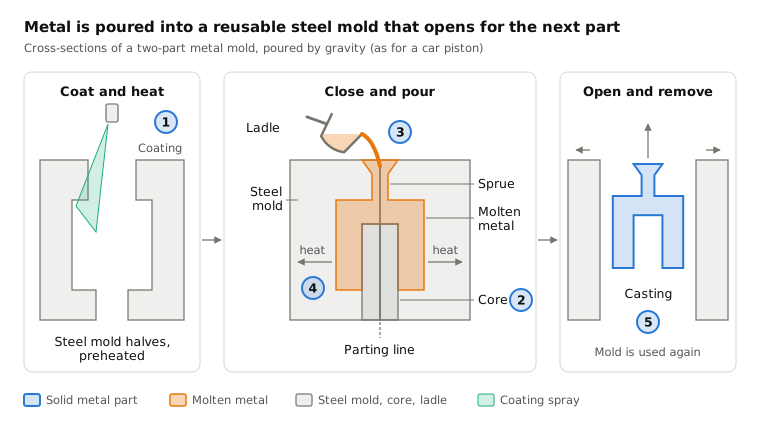
 1.3Permanent mold castingMetal poured by gravity into a reusable steel moldOpen the lesson
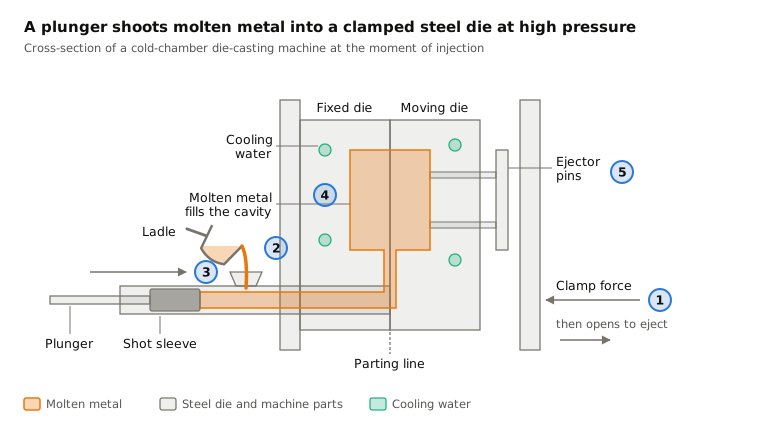
 1.4Die castingMetal shot into a steel die at high pressureOpen the lesson
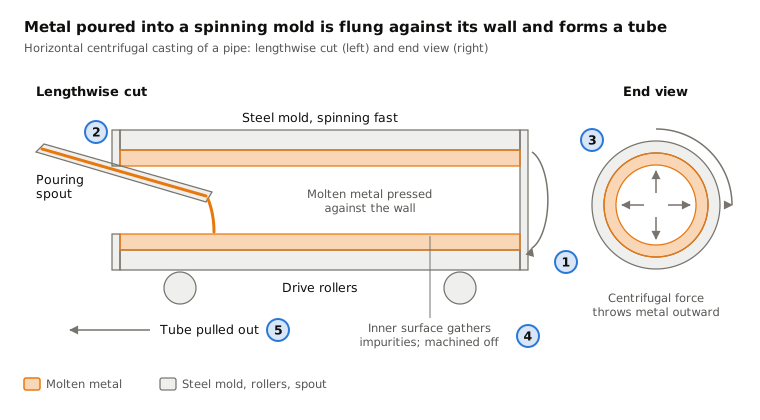
 1.5Centrifugal castingMetal flung against the wall of a spinning moldOpen the lesson
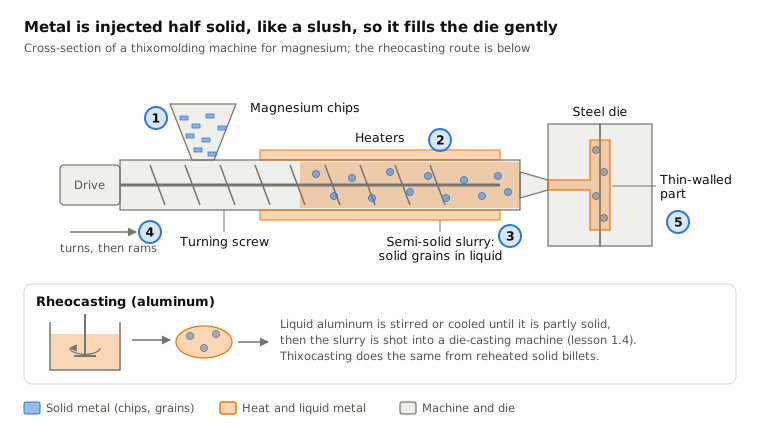
 1.7Semi-solid casting (thixomolding and rheocasting)A half-solid metal slush injected into a steel dieOpen the lesson
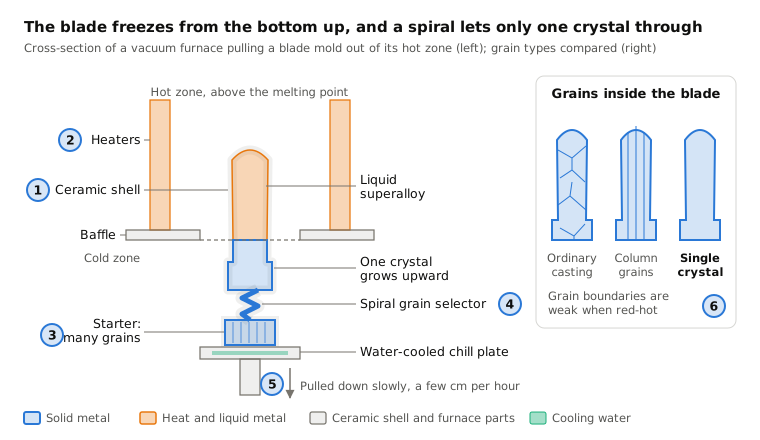
 1.8Single-crystal casting (turbine blades)Slow freezing from one end grows the part as one crystalOpen the lesson
Try it
Put AI to work in your CAD.
Model parts, generate drawings and automate the repetitive work inside your CAD software.