

Single-crystal casting (turbine blades)
Slow freezing from one end grows the part as one crystal
Single-crystal casting makes a metal part that is one continuous crystal, with no grain boundaries (the seams between crystals) at all. It is used for the hottest turbine blades in jet engines and power-plant gas turbines. Those blades spin red-hot for thousands of hours, and grain boundaries are where they would creep (slowly stretch) and crack.
How it works
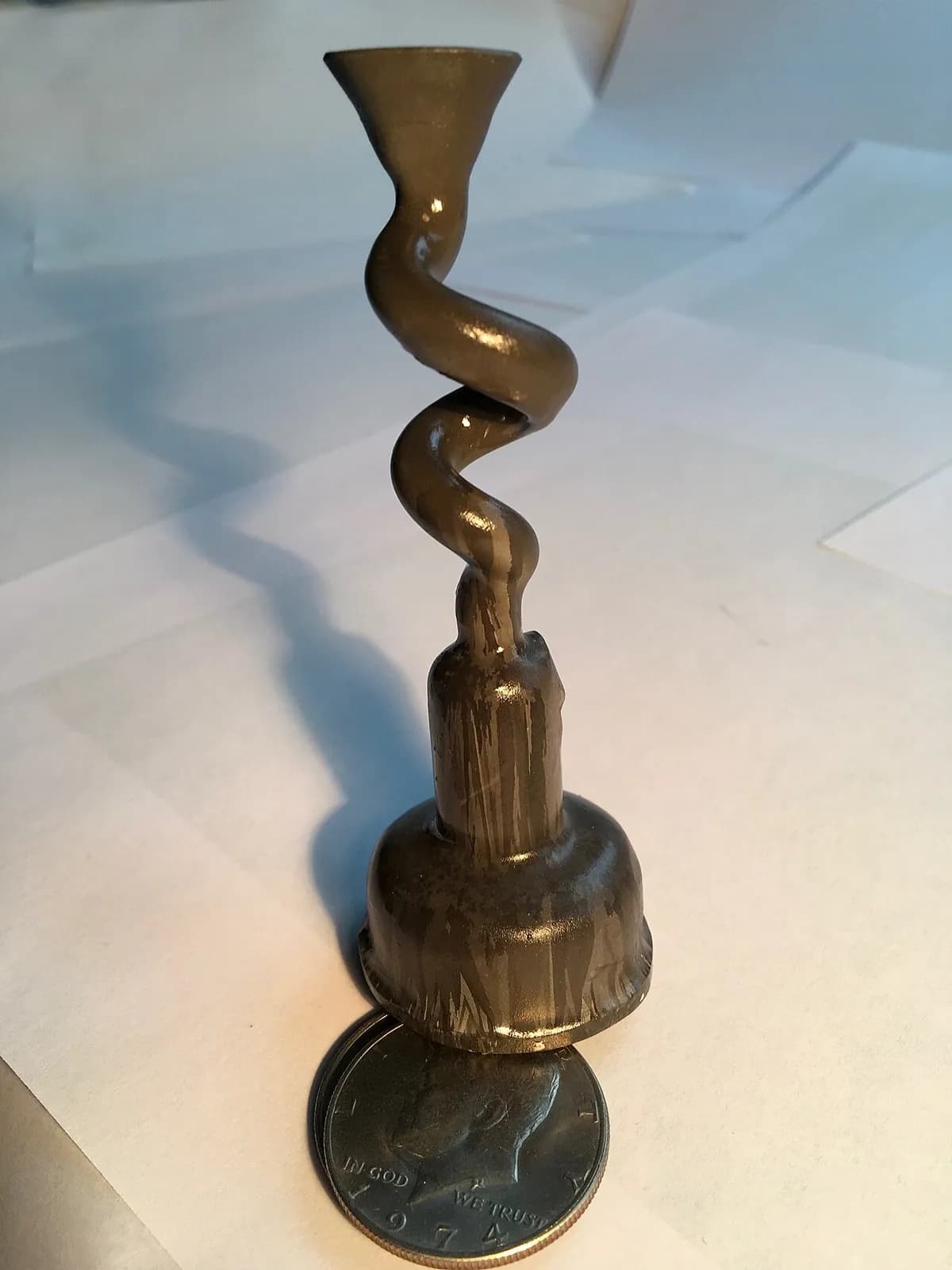
Make a ceramic mold. As in investment casting (lesson 1.2), a wax blade is coated in ceramic and melted out. A ceramic core inside forms the blade's cooling channels, and a spiral passage, the grain selector, is added under the blade.
Pour into a hot mold. The mold sits on a chill plate inside a vacuum furnace, so the nickel superalloy cannot react with air. The mold is heated above the metal's melting point, around 1500 °C, and the metal is poured in.
Start freezing from below. The water-cooled chill plate freezes the metal at the bottom first. Many small crystals start in the starter block, all growing upward.
Let one crystal through. The spiral grain selector is too twisted for most crystals to follow; only one, usually, makes it out of the top. A seed crystal can be used instead to set its direction.
Withdraw slowly. The mold is lowered out of the hot zone through a baffle, typically a few centimeters per hour. The freezing front stays flat at the baffle and the single crystal grows up through the whole blade.
Remove the shell and inspect. The ceramic is broken off and the core dissolved. Each blade is etched and checked, with X-rays and crystal orientation measurement, to confirm it is one crystal.
Key facts
- Materials
- Nickel-based superalloys (heat-resistant alloys of nickel with chromium, cobalt, aluminum, rhenium and others)
- Typical parts
- High-pressure turbine blades and vanes in jet engines and gas turbines
- Part size
- Aircraft blades are a few centimeters to about 15 cm long; power-plant blades can be several times larger
- Precision
- Investment-casting level, about ±0.1 mm, with fine cooling holes drilled later
- Surface finish
- Smooth: Ra (average roughness) about 1 to 3 µm, then coated
- Batch size it suits
- Thousands to hundreds of thousands of blades a year per engine program
- Tooling and machine cost
- Vacuum withdrawal furnaces cost millions of dollars; each blade costs hundreds to thousands of dollars
- Speed
- Slow: a few hours per withdrawal run, with several molds per furnace load
Strengths and limits
Strengths
- No grain boundaries, so excellent resistance to creep and cracking when red-hot
- Lets engines run hotter, which saves fuel
- Crystal direction can be chosen for the best stiffness and fatigue life
- Complex inner cooling channels come from the ceramic core
Limits
- Very slow and expensive
- Many blades are scrapped when stray grains form
- Needs vacuum furnaces and costly alloys with rare elements like rhenium
- Only practical for small, very high-value parts
Where it's used
- AerospaceHigh-pressure turbine blades and vanes of jet engines
- Power generationFirst-stage blades of large gas turbines
- DefenseMilitary jet and helicopter engines
- ResearchSingle-crystal specimens for studying alloys
How to recognize it
- You usually cannot see it on a finished, coated blade: it looks like any precision casting.
- After etching (an acid bath that reveals grains), a single-crystal blade shows one even surface with no grain pattern.
- An ordinary cast blade shows a patchwork of grains; a directionally solidified one shows long stripes from root to tip.
- Tiny cooling holes on the surface and a fir-tree-shaped root, typical of hot-section blades.
Compare with
Watch it
Magic Marks · A short explainer of the slow, one-way freezing behind single crystals
Asianometry · The history from ordinary to columnar to single-crystal blades
Jetline Marvel · Why these blades are so hard to make and why so many are scrapped
The Business Times · Real footage from a turbine-blade factory
See real photos
- Wikipedia: Turbine blade — blade materials, cooling and casting background
- Wikipedia: Directional solidification — the slow, one-way freezing method
- Wikimedia Commons photo search
Remember
- The goal is a part with no grain boundaries, which are weak when red-hot.
- Slow freezing from the bottom up, plus a spiral selector, lets only one crystal grow.
- Extremely slow and costly, so it is reserved for the hottest turbine blades.
More in Casting
All 100 processes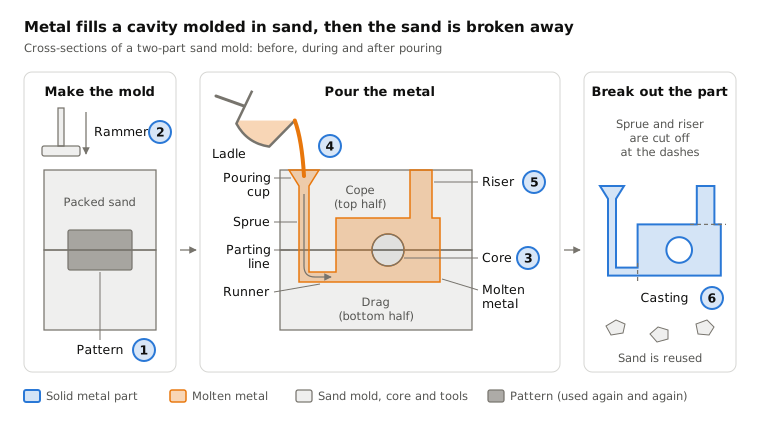
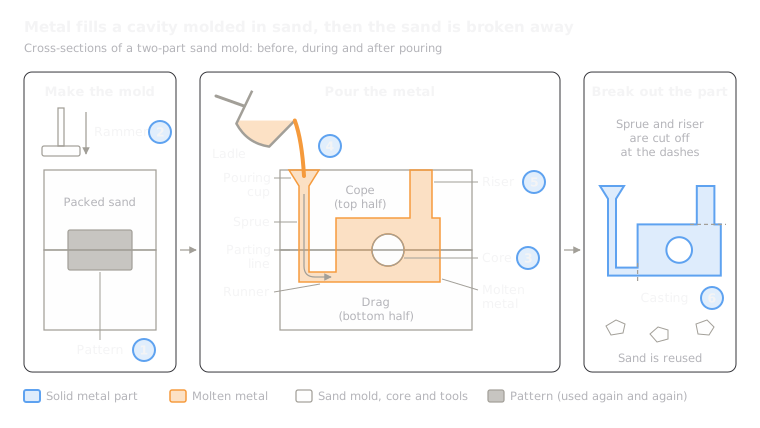 1.1ShortSand castingMetal poured into a cavity packed in sand; the sand is broken awayOpen the lesson
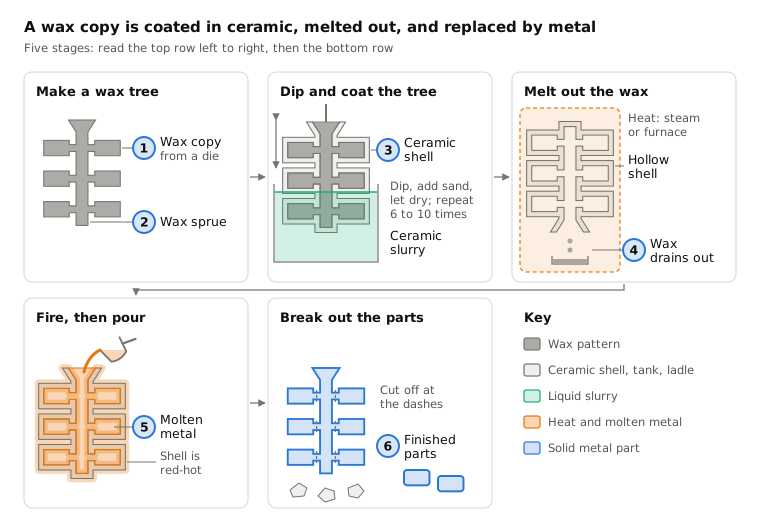
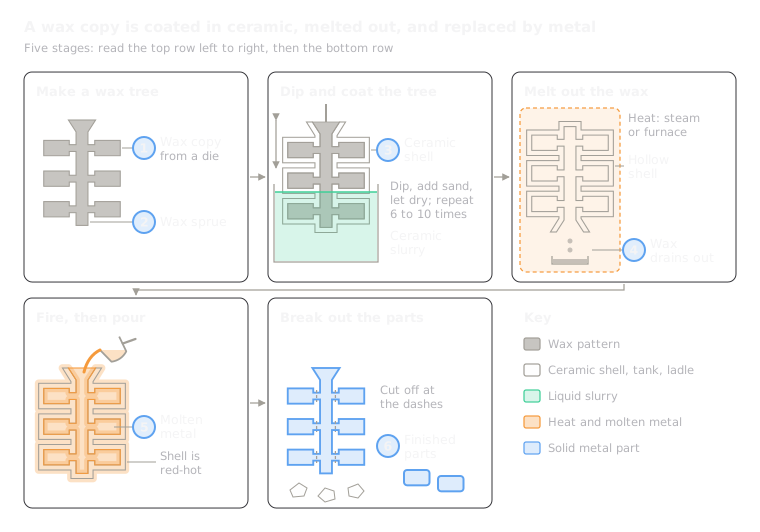 1.2Investment casting (lost wax)Wax copy coated in ceramic, melted out, then filled with metalOpen the lesson
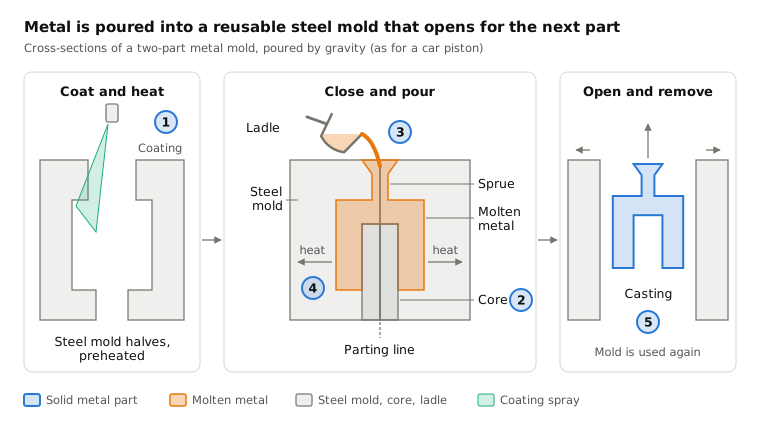
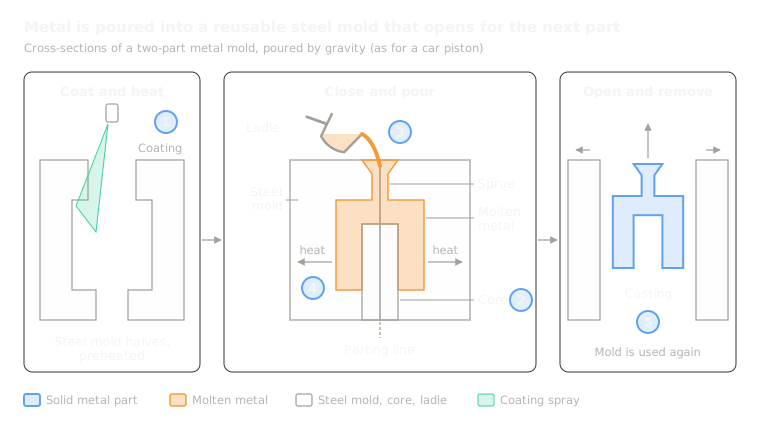 1.3Permanent mold castingMetal poured by gravity into a reusable steel moldOpen the lesson
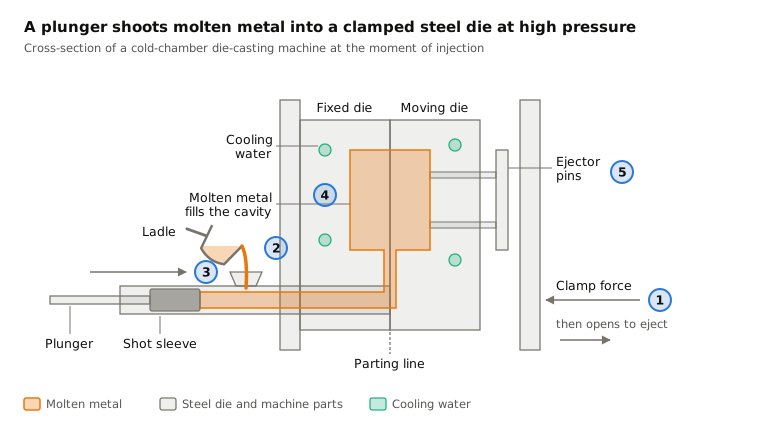
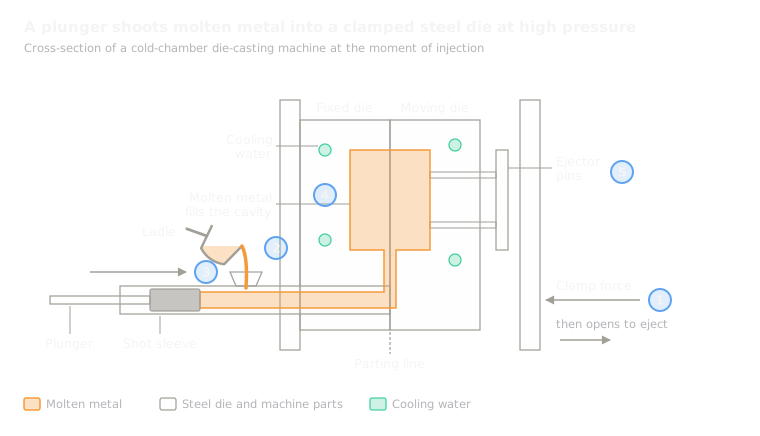 1.4Die castingMetal shot into a steel die at high pressureOpen the lesson
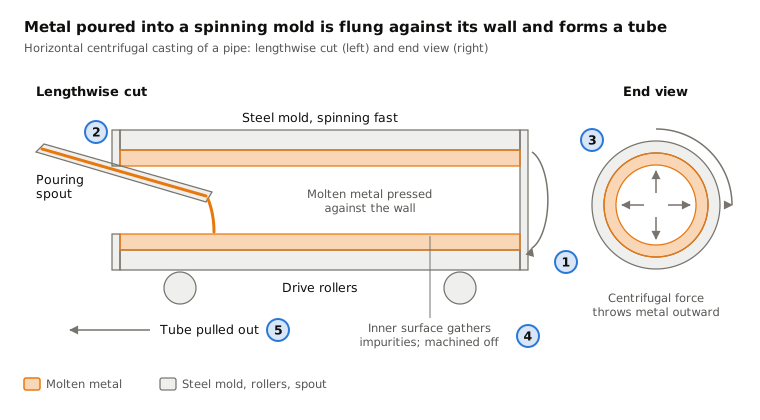
 1.5Centrifugal castingMetal flung against the wall of a spinning moldOpen the lesson
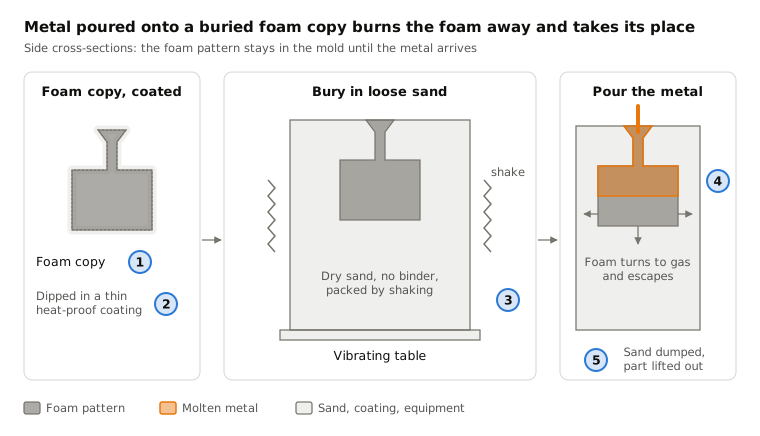
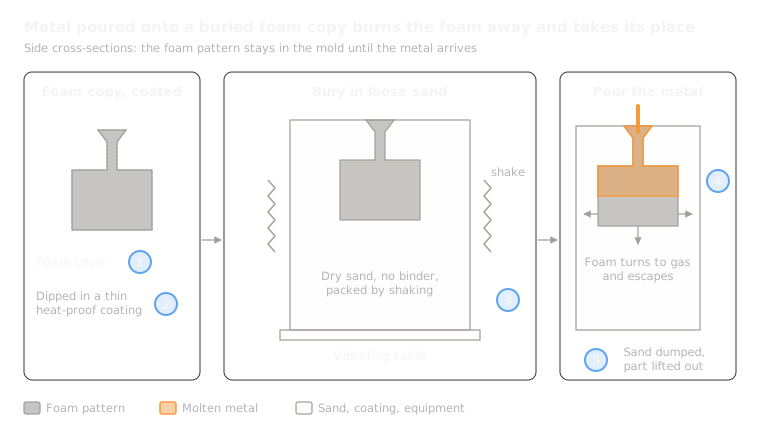 1.6Lost foam castingMetal poured onto a foam copy buried in loose sandOpen the lesson
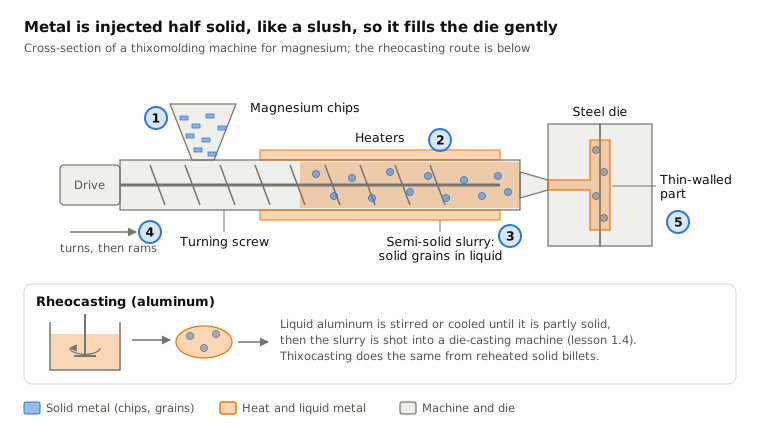
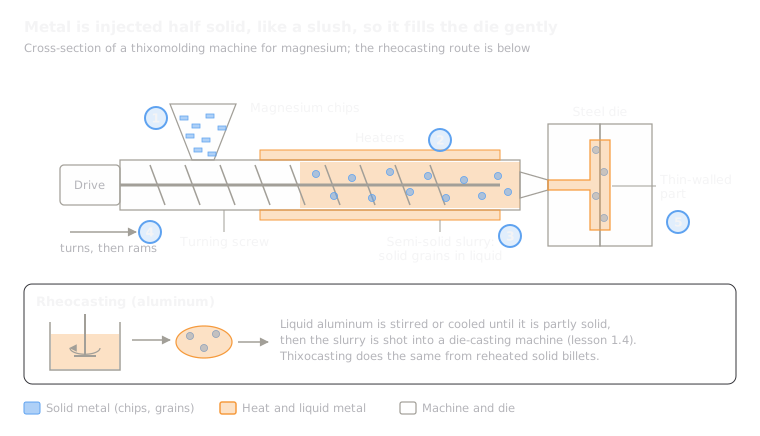 1.7Semi-solid casting (thixomolding and rheocasting)A half-solid metal slush injected into a steel dieOpen the lesson
Try it
Put AI to work in your CAD.
Model parts, generate drawings and automate the repetitive work inside your CAD software.