

Injection molding
Melt forced into a closed steel mold
Injection molding melts plastic pellets and forces the melt into a closed steel mold, where it cools into a finished part. Bottle caps, toy bricks, phone cases and car dashboards are all made this way. Once the mold exists, each extra part costs very little, which is why most plastic objects around you are injection molded.
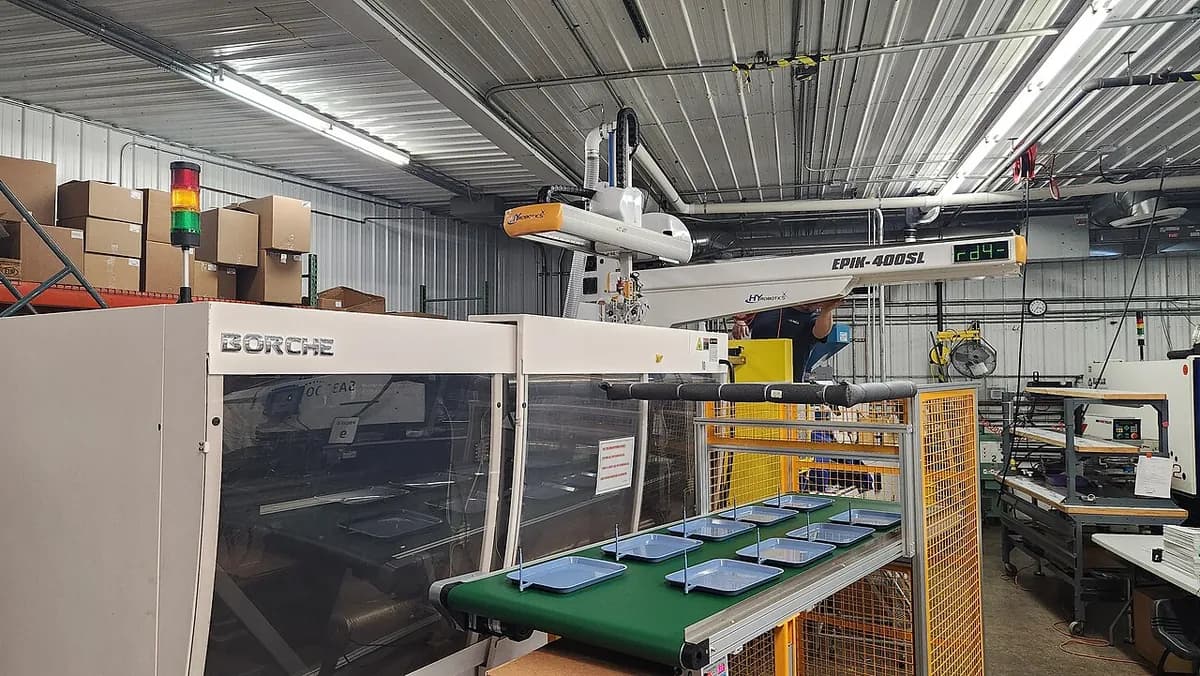
Injection molding in a minute, by MecMade
How it works
Feed. Plastic pellets (raw plastic grains a few millimeters across) fall from the hopper (a funnel) into the barrel, a heated steel tube.
Melt. A turning screw drags the pellets forward. Friction from the screw and heat from the heater bands melt them, and the melt collects in front of the screw tip.
Clamp. The clamp unit closes the two mold halves and holds them shut with tens to thousands of tonnes of force. This stops melt leaking out at the parting line (the joint between the halves).
Inject and pack. The screw stops turning and rams forward like a plunger. Melt shoots through the nozzle and the sprue (the feed channel) into the cavity (the part-shaped hollow). The screw keeps pushing to pack in extra plastic as the part shrinks.
Cool. Water flowing through channels in the steel carries the heat away until the part is solid. This is usually the longest step. Meanwhile the screw turns again to prepare the next shot.
Open and eject. The moving half pulls back. Ejector pins push the part, with its sprue, off the core (the steel bump that shapes the inside). The mold closes and the cycle repeats.
Key facts
- Materials
- Thermoplastics (plastics that soften every time they are heated) such as polypropylene, ABS, nylon and polycarbonate; also some thermosets and liquid silicone rubber
- Typical parts
- Caps, toy bricks, electronics housings, car interior parts, syringes, combs
- Part size
- From under a gram to car bumpers weighing several kilograms
- Precision
- Typically about ±0.05 to ±0.1 mm; tighter on small precision parts
- Surface finish
- Copies the mold: anything from mirror gloss to a leather-like texture, with no finishing needed
- Batch size it suits
- Thousands to millions of identical parts
- Tooling and machine cost
- Molds from a few thousand dollars (simple, aluminum) to well over $100,000 (large, many cavities, hardened steel); machines from tens of thousands to over a million dollars
- Speed
- Typically 10–60 s per cycle; thin caps in a few seconds, often many parts per shot
Strengths and limits
Strengths
- Very low cost per part once the mold is paid for
- Fast, automated and highly repeatable
- Complex shapes, snap-fit clips, threads and fine detail in one shot
- Huge choice of plastics, colors and textures
Limits
- The mold is costly and often takes weeks to make
- A design change means reworking or remaking the steel mold
- Walls must be fairly thin and even (often about 1–4 mm), or parts warp and show sink marks (small dents over thick spots)
- Undercuts (features that would lock the part in the mold) need sliding mold parts, which add cost
Where it's used
- PackagingBottle caps, closures, thin-walled food tubs
- Consumer goodsToy bricks, kitchen tools, appliance housings
- AutomotiveDashboards, door panels, bumpers, light housings, clips
- MedicalSyringes, pipette tips, inhaler bodies
- ElectronicsPhone and laptop casings, connectors, keys and buttons
How to recognize it
- A fine line around the part where the two mold halves met (the parting line).
- Small round marks, slightly raised or sunken, left by ejector pins on the hidden side.
- A small nub or scar where the plastic entered (the gate mark).
- Thin walls of even thickness backed by ribs (thin stiffening walls), and molded-in text such as a recycling symbol or date wheel.
Compare with
Watch it
tronicarts · The whole machine and one full cycle in 3D animation
Autodesk · A five-minute explainer with history and everyday examples
ARBURGofficial · A real press filling 72 cavities per shot at high speed
Ian Collier (How It's Made excerpt) · How the steel mold itself is machined and polished
See real photos
- Wikipedia: Injection moulding — real molds, including a LEGO brick mold and a mold with side actions
- Wikipedia: Injection molding machine — an open mold in a press and a large press with a robot
- Wikimedia Commons photo search
Remember
- Melt, inject under pressure, cool, eject: a part every few seconds to a minute.
- The mold is the big cost and each part is cheap, so it pays off at high volume.
- Good designs use thin, even walls, a slight draft (taper) and as few undercuts as possible.
More in Molding plastics and rubber
All 100 processes
 2.2Overmolding and two-shot moldingA second plastic molded onto the firstOpen the lesson
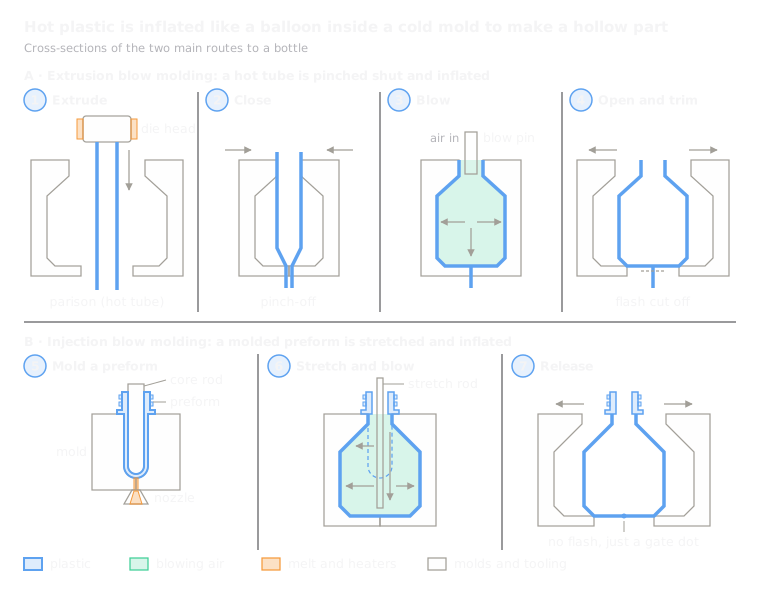 2.3Blow molding (extrusion and injection blow molding)Hot tube or preform inflated in a moldOpen the lesson
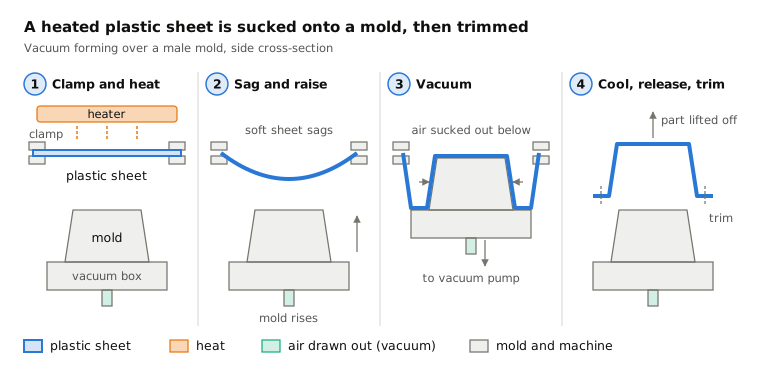
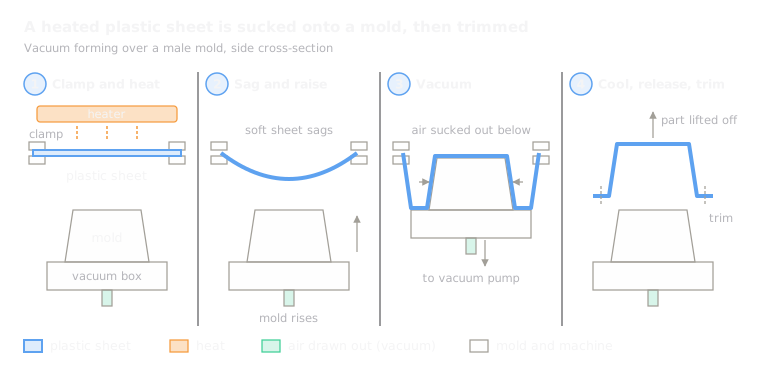 2.4ThermoformingHeated sheet sucked onto a moldOpen the lesson
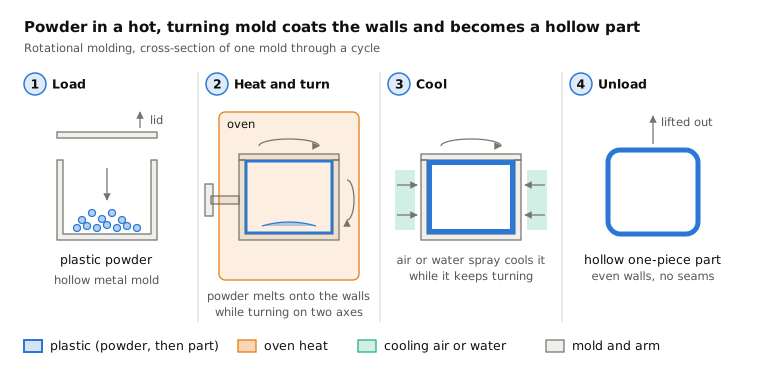
 2.5Rotational moldingPowder coats a hot, turning moldOpen the lesson
 2.6Compression molding (SMC, BMC, rubber)A charge pressed and cured in a hot moldOpen the lesson
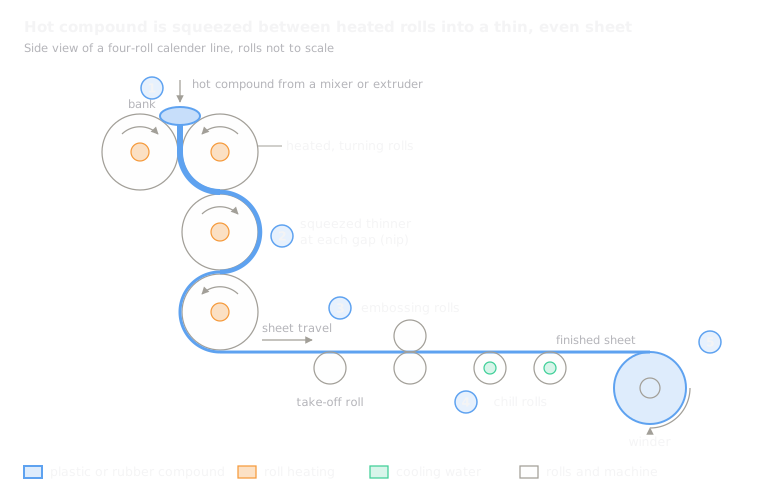 2.7CalenderingCompound squeezed into sheet between rollsOpen the lesson
Try it
Put AI to work in your CAD.
Model parts, generate drawings and automate the repetitive work inside your CAD software.