

Calendering
Compound squeezed into sheet between rolls
Calendering squeezes a hot, dough-like plastic or rubber compound between a series of heated, polished rolls, flattening it into a continuous sheet or film of very even thickness. Vinyl flooring, PVC shower curtains, fake leather and the rubber layers inside tires are made this way. It is like a pasta machine, but huge, heated and running nonstop.
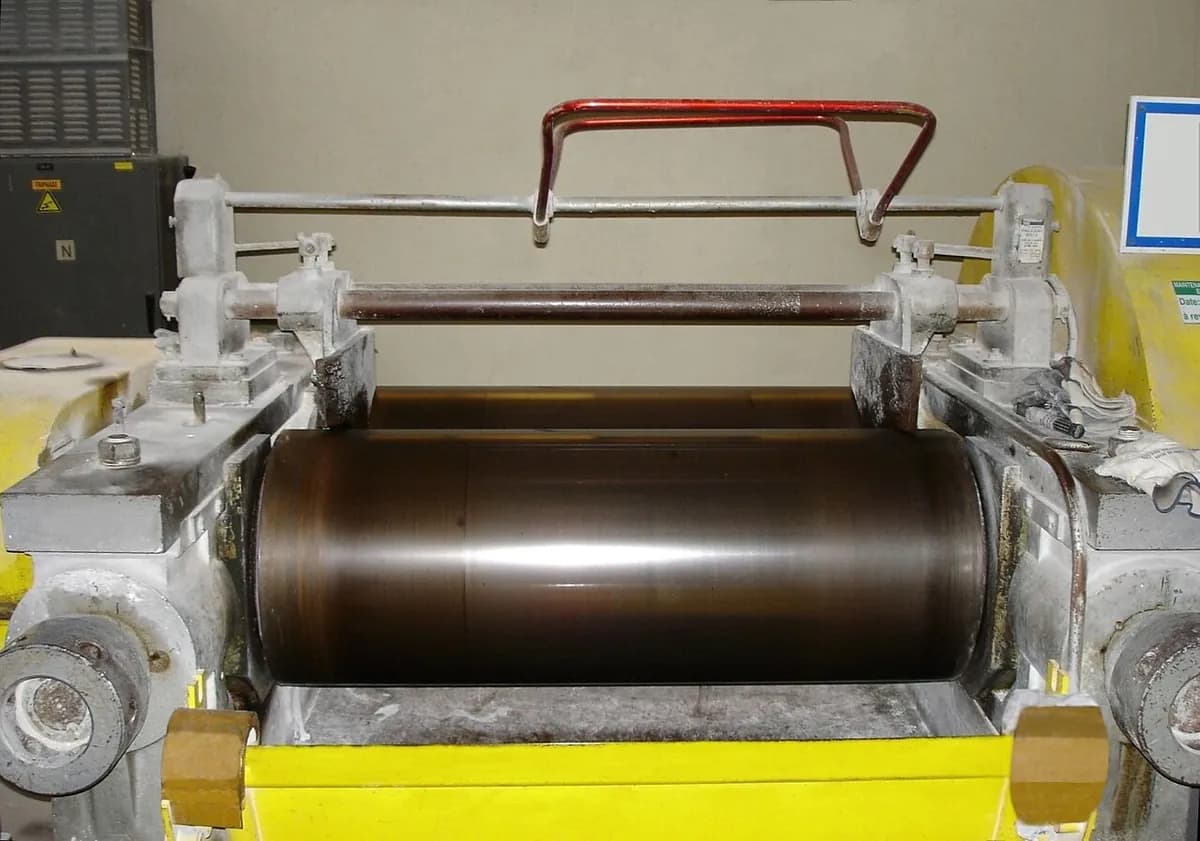
How it works
Feed. A mixer or extruder supplies a hot, soft compound (plastic or rubber mixed with additives). It forms a rolling pile, called the bank, above the first gap between two rolls.
Squeeze. The heated rolls turn in opposite directions and drag the compound through the narrow gaps between them, called nips. Each nip is slightly tighter, so the sheet gets thinner and more even.
Strip and emboss. A take-off roll peels the sheet off the last roll. Patterned embossing rolls can press a texture into it, such as a leather grain.
Cool. Water-cooled chill rolls set the sheet so it keeps its thickness and pattern.
Wind. The finished sheet is trimmed at the edges and wound onto large rolls, or cut into panels.
The same machine can also press compound onto a fabric or steel cord to coat it, which is how rubber is applied to tire cords and how coated fabrics are made.
Key facts
- Materials
- Mostly PVC (rigid and flexible), also ABS and some polyolefins; natural and synthetic rubbers
- Typical parts
- Flooring, wall coverings, shower curtains, credit-card stock, faux leather, roofing membranes, rubber sheets and tire plies
- Part size
- Continuous sheet typically 1–3 m wide; thickness from about 0.05 mm to a few millimeters
- Precision
- Very even thickness, typically within a few hundredths of a millimeter on thin film
- Surface finish
- Mirror-smooth, matte or embossed, set by the last rolls
- Batch size it suits
- Large volumes only: long runs of sheet measured in tonnes
- Tooling and machine cost
- Very high: a full calender line typically costs millions of dollars; embossing rolls add tens of thousands
- Speed
- Typically tens of meters per minute, often over 100 m/min for thin film
Strengths and limits
Strengths
- Extremely even thickness and wide sheets
- Handles heat-sensitive PVC and filled compounds gently
- Embossed textures and coatings in the same pass
- Very high output
Limits
- Huge, costly lines that only pay off at high volume
- Only flat sheet and film, no shaped parts
- Changing material or color takes time and creates scrap
- Thick, precise sheet is hard: rolls bend slightly under load
Where it's used
- BuildingVinyl flooring, wall coverings, roofing and pond membranes
- AutomotiveTire plies and inner liners, dashboard skins, faux-leather seats
- PackagingRigid PVC film for blister packs
- Consumer goodsShower curtains, tablecloths, bags, credit-card stock
- IndustrialRubber sheets, conveyor belt covers, coated fabrics
How to recognize it
- Wide, flat sheet or film of perfectly even thickness, often sold on large rolls.
- An embossed texture repeating at a regular interval (one roll turn), such as a leather grain.
- Flexible vinyl with a slightly glossy or printed face and a fabric backing.
- Trimmed, straight edges along the length of the roll.
Compare with
Watch it
MIT Thin-film · The physics of squeezing material between rolls, with diagrams
D&M Plastic Machinery · A PVC sheet calender line running
Zebung Rubber Hose · A rubber sheet coming off a calender in a factory
See real photos
- Wikipedia: Calender — the machine, roll types and uses; mostly text
- Wikimedia Commons photo search
Remember
- Hot compound is squeezed through a row of heated rolls into an even sheet.
- It makes wide PVC film, flooring, faux leather and rubber sheet at high speed.
- The lines are expensive, so calendering is only for very large volumes.
More in Molding plastics and rubber
All 100 processes
 2.1ShortInjection moldingMelt forced into a closed steel moldOpen the lesson
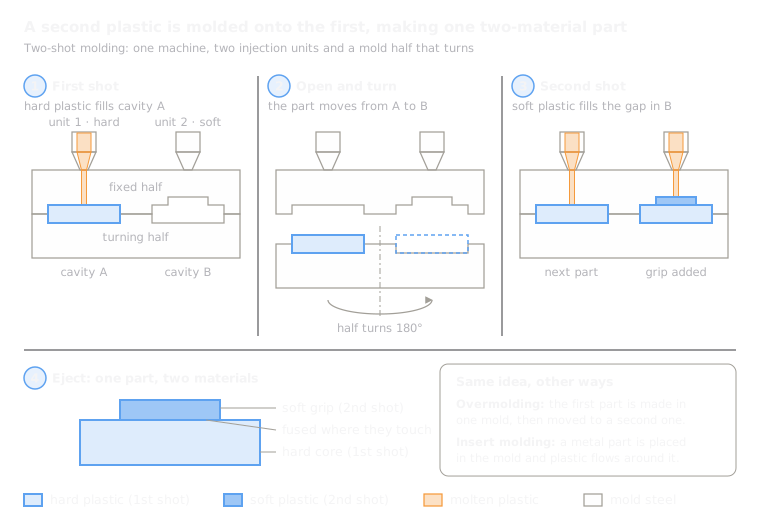 2.2Overmolding and two-shot moldingA second plastic molded onto the firstOpen the lesson
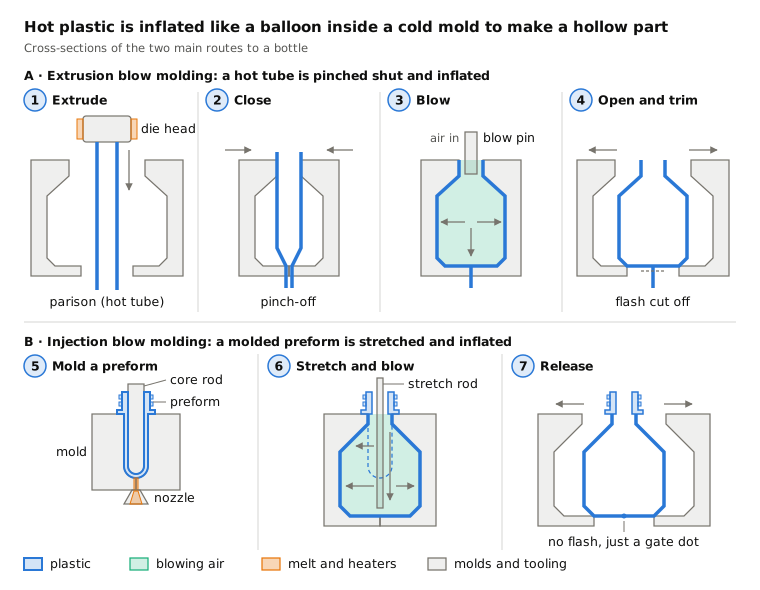
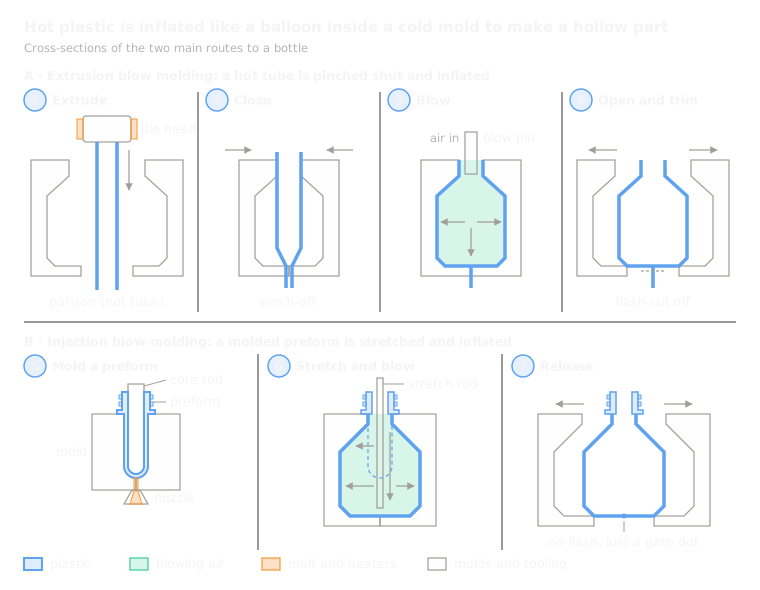 2.3Blow molding (extrusion and injection blow molding)Hot tube or preform inflated in a moldOpen the lesson
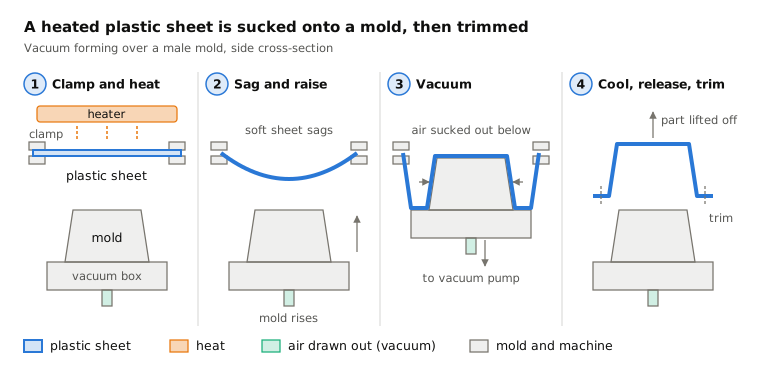
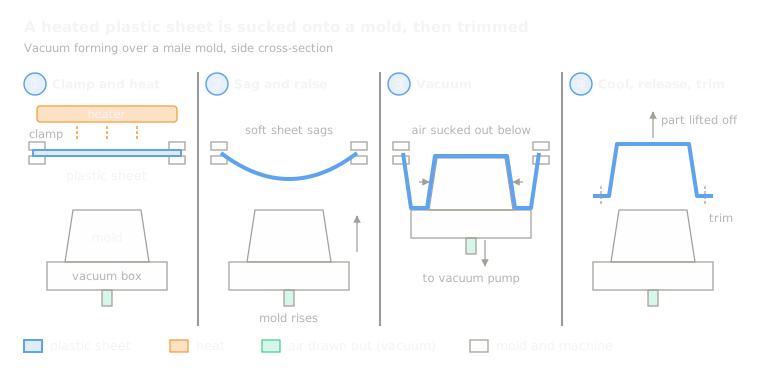 2.4ThermoformingHeated sheet sucked onto a moldOpen the lesson
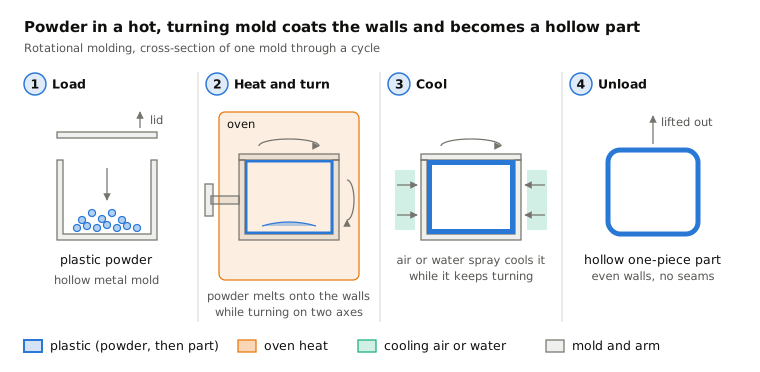
 2.5Rotational moldingPowder coats a hot, turning moldOpen the lesson
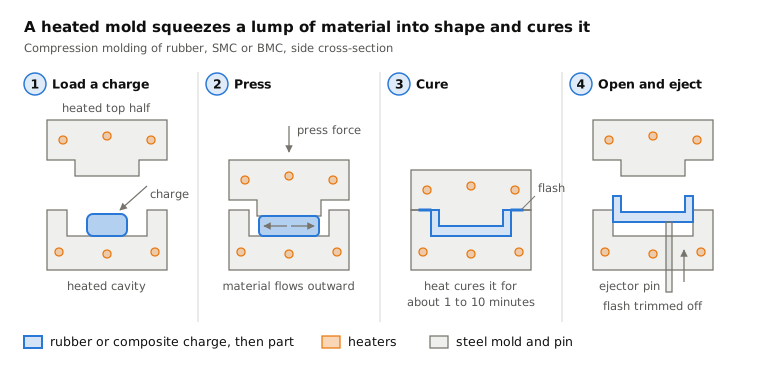
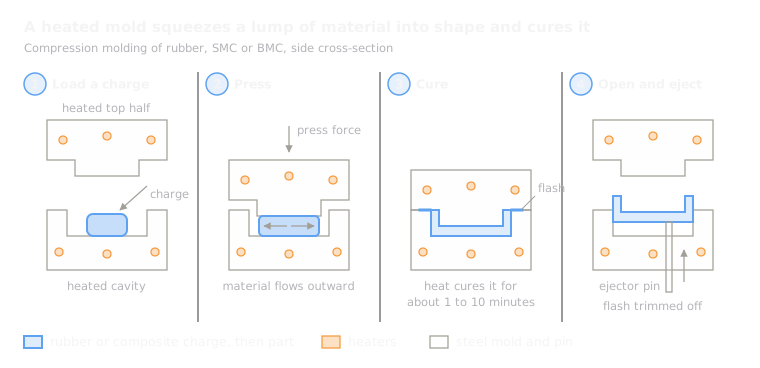 2.6Compression molding (SMC, BMC, rubber)A charge pressed and cured in a hot moldOpen the lesson
Try it
Put AI to work in your CAD.
Model parts, generate drawings and automate the repetitive work inside your CAD software.