

Rolling
Pull metal through the gap between turning rolls
Rolling squeezes metal between two turning rolls to make it thinner and longer, much like a pasta machine flattens dough. Car body panels, drink-can sheet, steel beams and rails all come from rolling mills. Most steel and aluminum passes through rolls at some stage of its life.
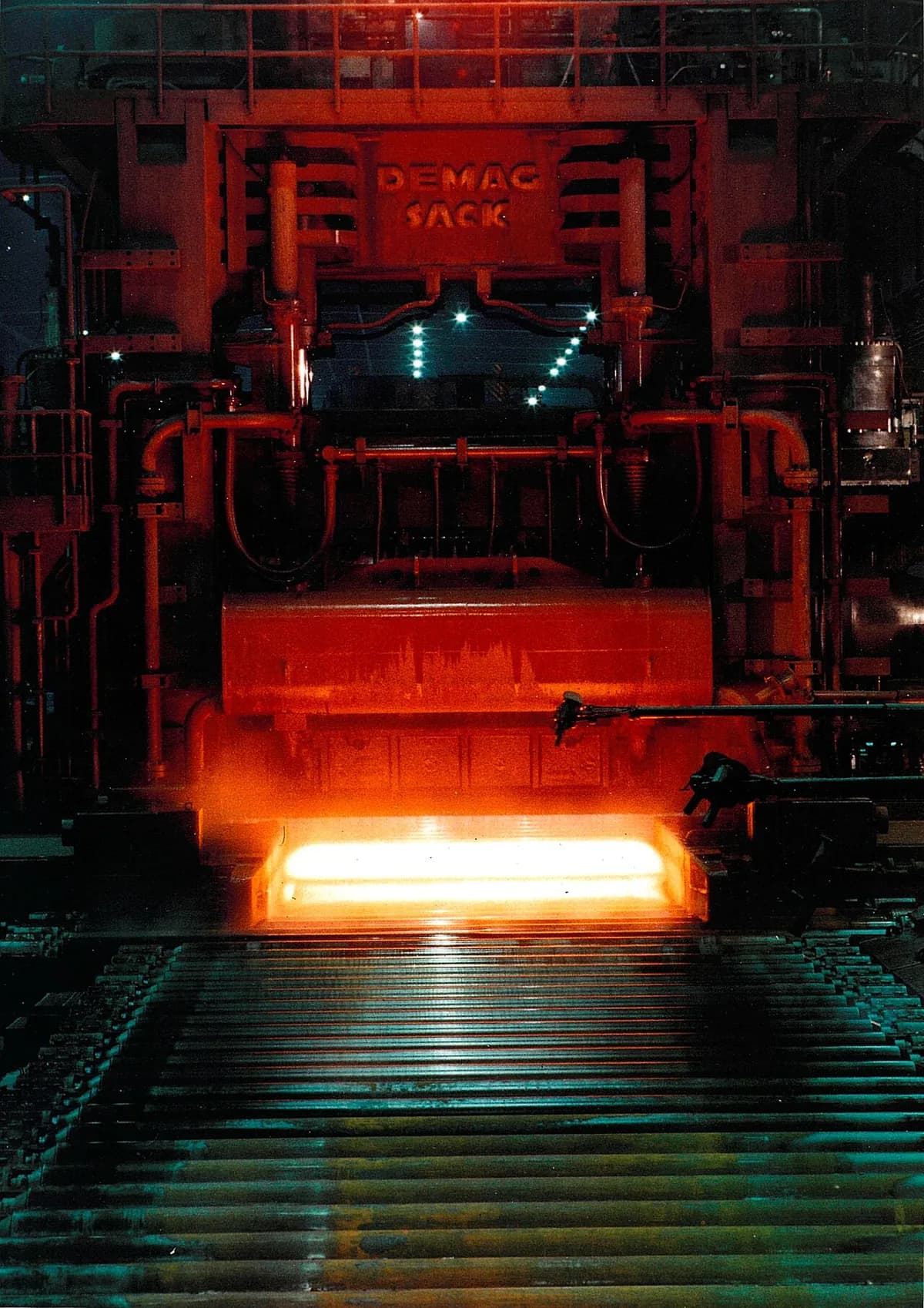
How it works
Feed the slab. A slab (a thick, flat block of metal, often about 20–25 cm thick for steel) arrives from a reheating furnace at about 1,100–1,250 °C. Cold rolling, used for thin and precise sheet, starts from already-rolled strip at room temperature.
The rolls bite. Friction between the turning rolls and the slab grips it and drags it in. The roll gap (the opening between the rolls) is set smaller than the incoming thickness.
Squeeze and stretch. In the gap the metal is pressed thinner. Its volume stays the same, so it comes out longer and faster than it went in, while its width barely changes.
Repeat, stand after stand. Each pass removes only part of the thickness. A hot strip mill first passes the steel back and forth through a roughing mill. Then a row of finishing stands, each with a smaller gap, takes it to its final thickness.
Cool and coil. Water sprays cool the strip, and a coiler winds it into a coil weighing many tonnes. Plates and bars are cut to length instead, and grooved rolls shape beams and rails (shape rolling).
Key facts
- Materials
- Steels, aluminum, copper and brass, titanium, nickel alloys, zinc
- Typical parts
- Sheet and plate, strip coils, foil, bars and rods, I-beams, rails
- Part size
- Strip up to about 2 m wide and often over a kilometer long per coil; from plates over 100 mm thick down to foil thinner than a hair
- Precision
- Hot-rolled: about ±0.1–0.2 mm on thickness. Cold-rolled: about ±0.01–0.05 mm
- Surface finish
- Hot-rolled: dark, flaky oxide skin (mill scale). Cold-rolled: smooth and bright, ready for paint or plating
- Batch size it suits
- Very high volume: a large hot strip mill rolls millions of tonnes a year
- Tooling and machine cost
- Rolls: thousands to hundreds of thousands of dollars each. A full hot strip mill: hundreds of millions of dollars or more
- Speed
- Strip can leave the last finishing stand at up to about 20 m/s (over 70 km/h)
Strengths and limits
Strengths
- Very fast and cheap per tonne; mills run around the clock
- Long products with a uniform thickness and cross-section
- Hot rolling breaks up the coarse cast structure, making the metal tougher
- Cold rolling gives smooth, precise and stronger sheet
Limits
- Huge investment, so only large producers own mills
- Only constant cross-sections (flat, bar, beam, rail); no complex 3D shapes
- Hot-rolled surfaces carry scale and have looser tolerances
- Cold-rolled metal hardens; it often needs annealing (softening by heating) between passes
Where it's used
- AutomotiveBody panels, chassis rails, wheels made from rolled sheet
- ConstructionI-beams and H-beams, rebar (reinforcing bar), roofing and cladding sheet
- PackagingDrink-can sheet, aluminum foil, tinplate for food cans
- TransportRailway rails, ship plate, aircraft aluminum sheet
- Appliances and electronicsWasher and fridge cabinets, copper foil for circuit boards
- EnergyPlate for pipelines, electrical steel for transformers and motors
How to recognize it
- A long product with the same thickness or cross-section all along its length: sheet, plate, bar, beam or rail.
- Hot-rolled steel has a dark blue-grey, slightly flaky skin; cold-rolled steel is smooth, flat and bright.
- Faint streaks running along the length of bright sheet, showing the rolling direction.
- Raised letters or numbers repeating along a rail or beam, pressed in by the last roll stand.
Compare with
Watch it
Shubham Kola · Animated basics of hot and cold rolling
AIST Association for Iron & Steel Technology · The whole route from slab to coil
ArcelorMittal Belgium · A real hot strip mill running at full speed
Factory Secrets: How It's Made (third-party channel) · How grooved rolls shape giant steel beams
See real photos
- Wikipedia: Rolling (metalworking) — photos of slabs, roll stands and rolled products
- Wikimedia Commons photo search
Remember
- Rolling makes metal thinner and longer by pulling it through a gap between turning rolls.
- Hot rolling shapes big slabs cheaply; cold rolling gives thin, smooth, precise sheet.
- Sheet, plate, foil, beams and rails all come out of rolling mills.
More in Bulk forming
All 100 processes
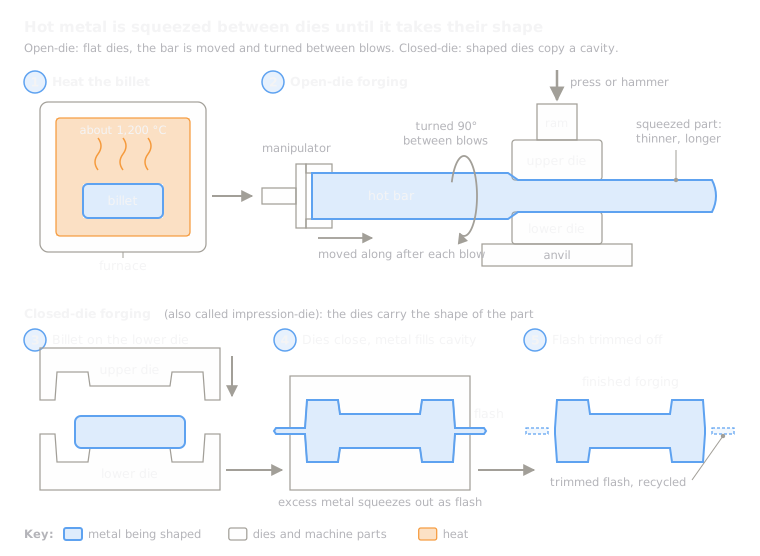 3.1ShortForging (open-die and closed-die)Squeeze hot metal between flat or shaped diesOpen the lesson
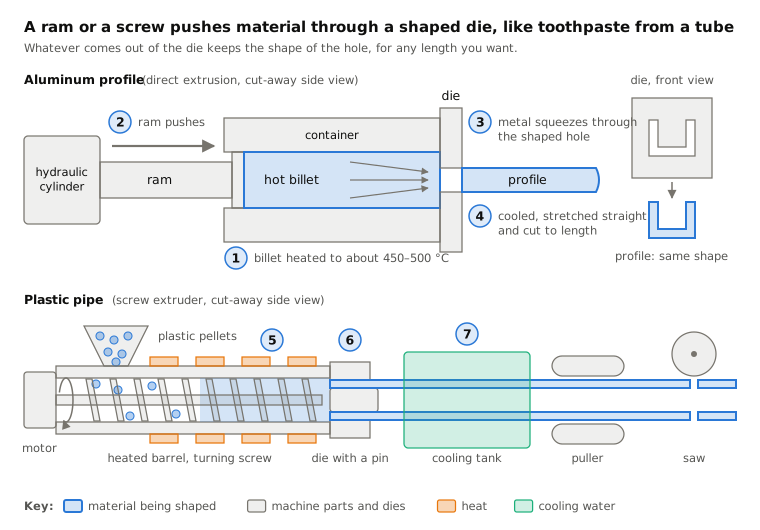
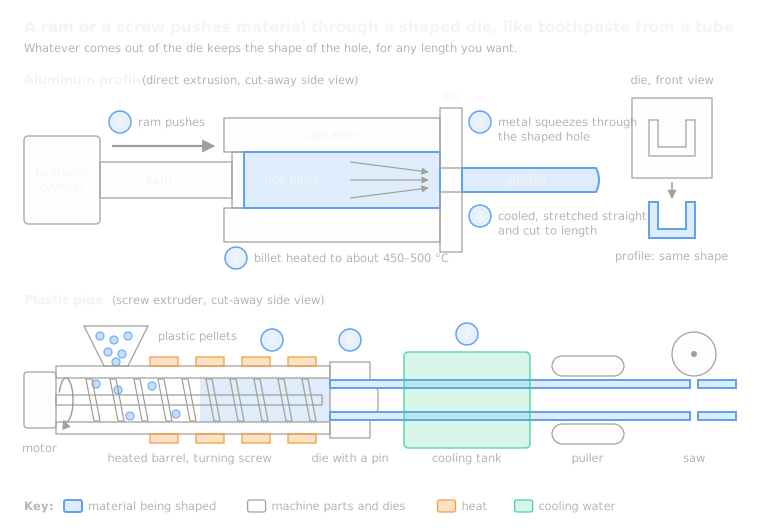 3.3Extrusion (aluminum profiles and plastic pipes)Push metal or plastic through a shaped dieOpen the lesson
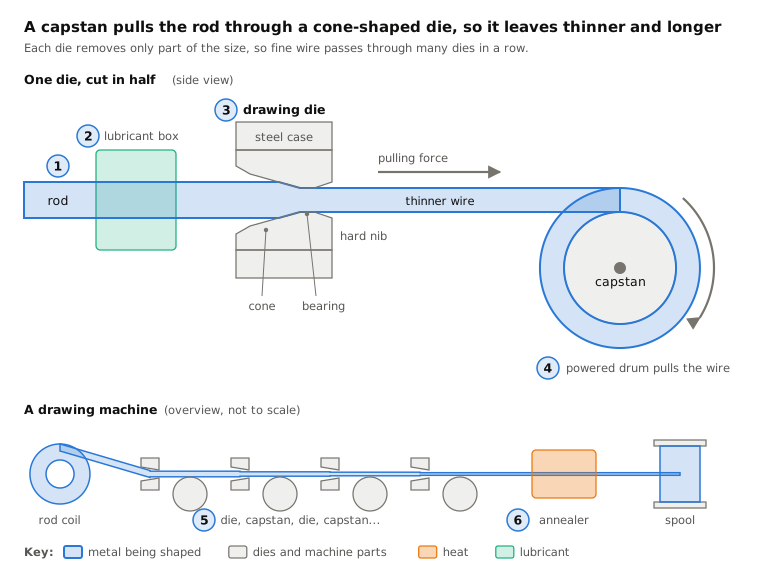
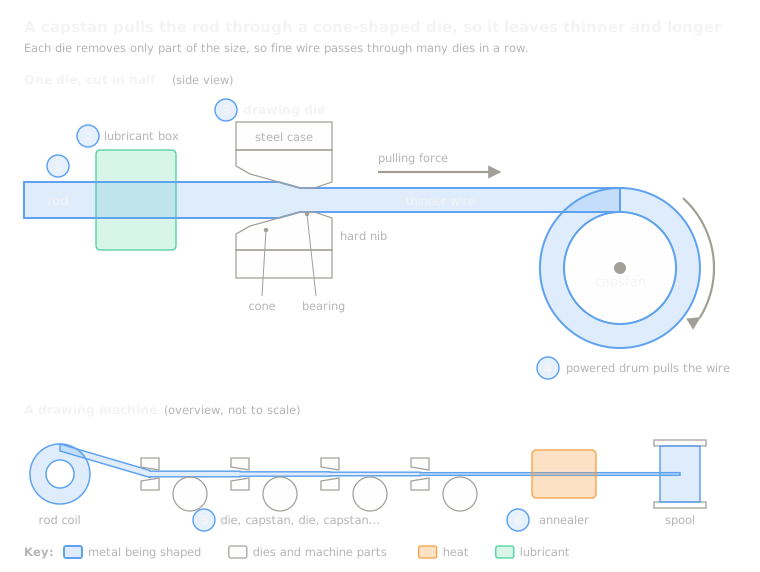 3.4Wire drawingPull a rod through ever-smaller diesOpen the lesson
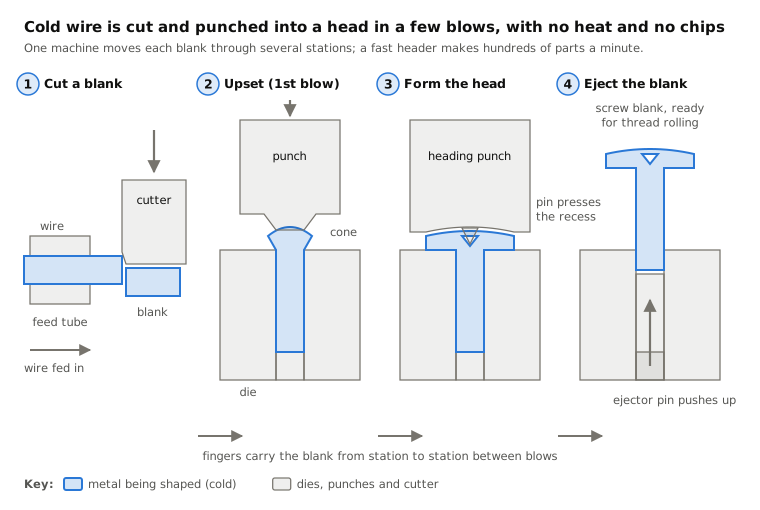
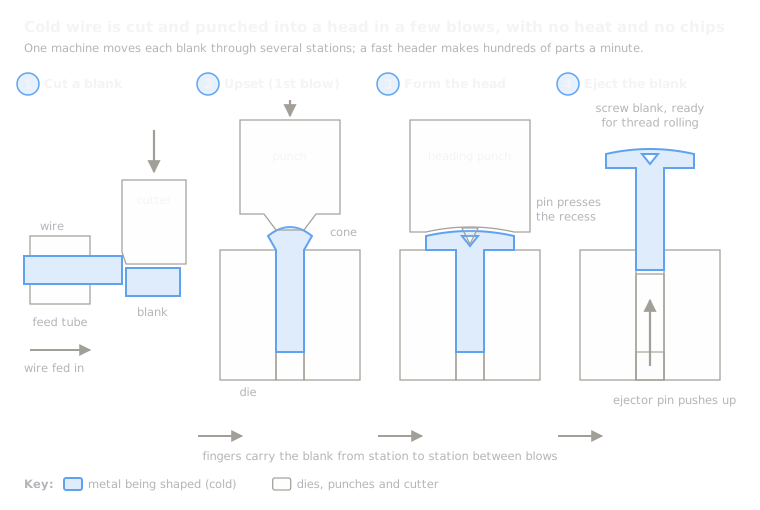 3.5Cold headingCut wire into blanks and punch a head, coldOpen the lesson
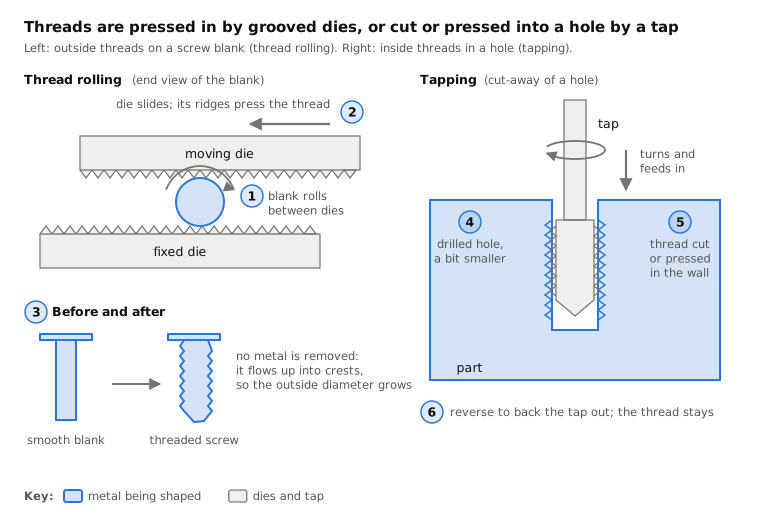
 3.6Thread rolling and tappingPress a thread onto a blank, or cut or press one in a holeOpen the lesson
Try it
Put AI to work in your CAD.
Model parts, generate drawings and automate the repetitive work inside your CAD software.