

Laser peen forming
Laser shots stretch one face so a plate curves
Laser peen forming bends metal plates without any die, using thousands of tiny laser-driven shock waves. Each shot squeezes a small patch of one surface; together they stretch that face, and the plate slowly curves, like a page that curls when one side gets damp. It shapes thick aircraft wing panels and straightens distorted parts with great control.
How it works
Cover the surface with water. The plate is fixed under the laser, and a thin layer of water flows over the area to be treated.
Fire a laser pulse. A high-energy pulsed laser fires a very short pulse, about 20 nanoseconds long, through the water onto a spot a few millimeters wide.
Make a plasma burst. The pulse turns a thin skin of the surface into plasma (a glowing, electrically charged gas). The water traps it, so pressure spikes and drives a shock wave into the metal.
Leave a compressed layer. The shock squeezes the metal under the spot, leaving a layer, often 1–2 mm deep, with compressive residual stress (stress locked inside the metal that pushes outward on its neighbors).
Repeat in a pattern. A robot moves the laser spot by spot along a computed pattern. The locked-in stresses add up and the plate curves; it is measured and corrected with more shots.
Key facts
- Materials
- Aluminum alloys (including aluminum-lithium), titanium, steels, nickel alloys
- Typical parts
- Gently or doubly curved wing and fuselage panels, stiffened panels, distorted parts that need straightening
- Part size
- From small parts to panels several meters long, limited by the robot's reach
- Precision
- Curvature builds up in small, controlled steps; final shape is measured and corrected, typically to within a few tenths of a millimeter
- Surface finish
- Slightly dimpled pattern of overlapping spots; often improves fatigue life (resistance to cracking under repeated loads)
- Batch size it suits
- Small series of large, high-value parts, plus repair and straightening
- Tooling and machine cost
- No dies; laser cells cost millions of dollars, so the work is often bought as a service
- Speed
- A few shots per second; a large panel can take hours
Strengths and limits
Strengths
- No die: the shape is a program, easy to change
- Works on thick, stiff plates and integrally stiffened panels
- Leaves a protective compressed layer that resists fatigue cracks
- Can straighten distorted parts precisely
Limits
- Very expensive laser equipment
- Only gentle curvatures, not deep shapes
- Slow for large areas
- Needs careful modeling and measuring to hit the shape
Where it's used
- AircraftWing skin panels with gentle compound curves
- SpaceCurved panels for launch vehicles and tanks
- ShipbuildingForming and straightening large plates
- Repair and finishingStraightening parts distorted by welding or machining
How to recognize it
- A faint, regular grid of overlapping square or round spots on one face.
- Gently curved thick panels with no die or press marks.
- Often a matte, slightly dimpled patch on an otherwise machined surface.
Compare with
Watch it
Curtiss-Wright Surface Technologies · An animation of one shot: water overlay, plasma, shock wave and residual stress
LSP Technologies · What the process is and which parts it makes
LSP Technologies · A plate curving live as the laser works across it
LSP Technologies · The same tool used to straighten a distorted part
See real photos
- Wikipedia: Laser peening — the process, its history and a section on laser peen forming
- Wikimedia Commons photo search
Remember
- Each laser shot locks a compressive stress into a small patch of one face.
- Thousands of shots in a pattern make the plate curve, with no die at all.
- Best for gentle curves on thick, valuable aerospace panels and for straightening.
More in Sheet and tube forming
All 100 processes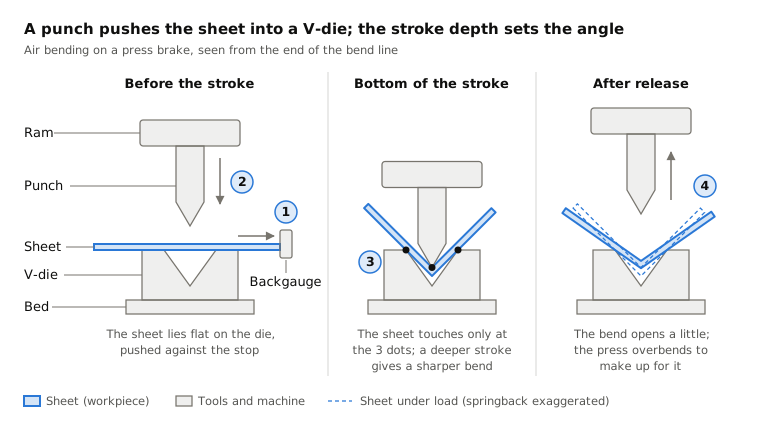
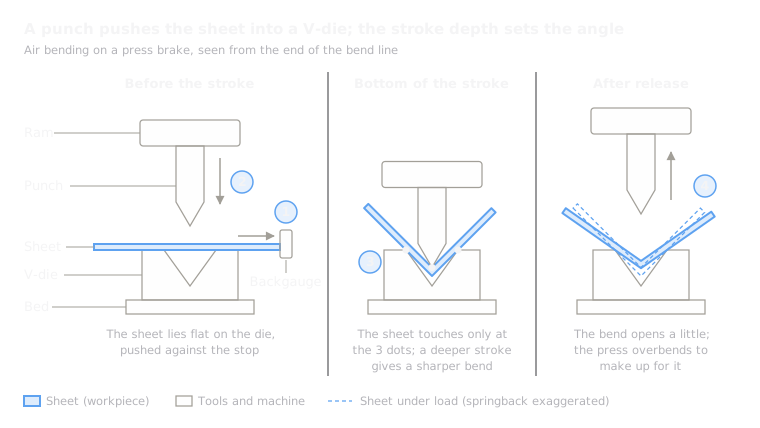 4.1Sheet metal bendingA press brake folds sheet along straight linesOpen the lesson
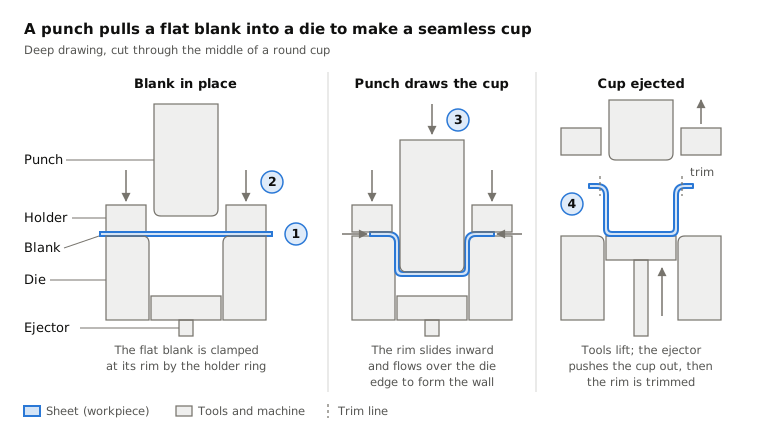
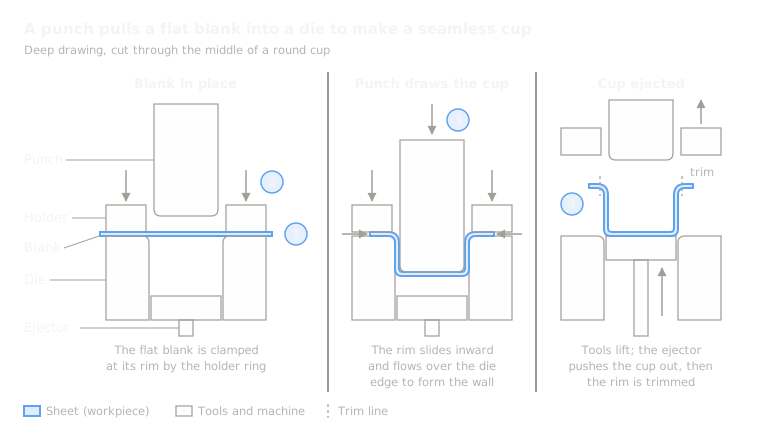 4.2ShortStamping and deep drawingMatched dies cut and press sheet into shape, often in a secondOpen the lesson
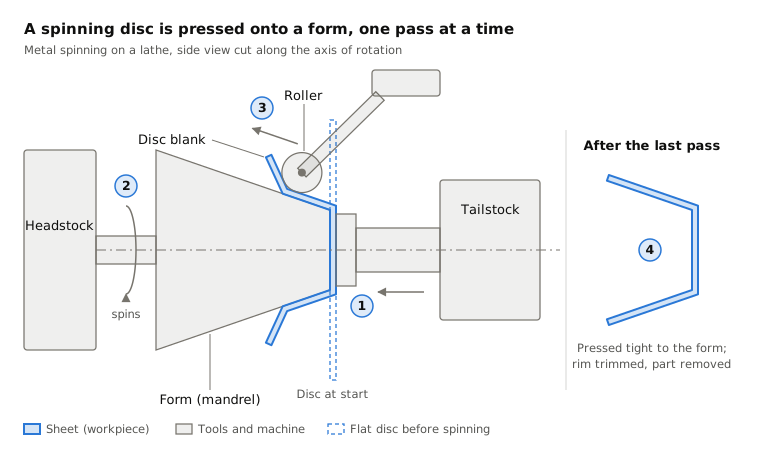
 4.3Metal spinningA roller presses a spinning disc over a formOpen the lesson
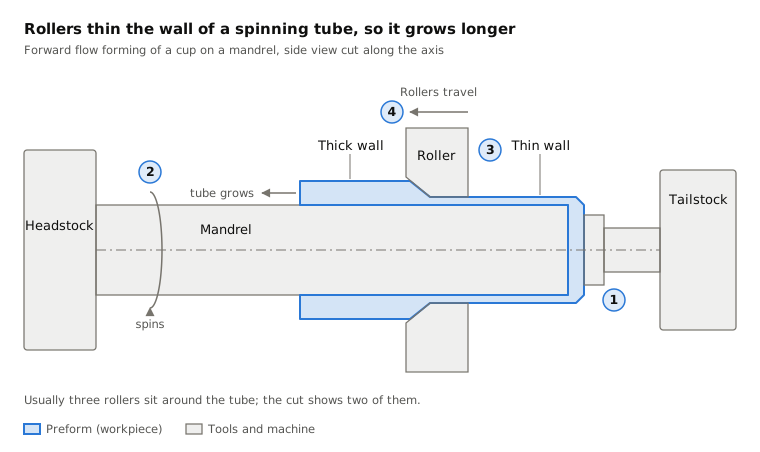
 4.4Flow formingRollers stretch a spinning tube thinner and longer over a mandrelOpen the lesson
 4.5HydroformingFluid pressure pushes tube or sheet into a dieOpen the lesson
 4.6Incremental sheet formingA round tool traces contours into clamped sheet, with no dieOpen the lesson
 4.7Superplastic formingHot gas blows a superplastic sheet into one dieOpen the lesson
 4.8Electromagnetic formingA magnetic pulse throws metal onto a fitting, without contactOpen the lesson
 4.9Explosive formingAn underwater blast pushes sheet into one dieOpen the lesson
Try it
Put AI to work in your CAD.
Model parts, generate drawings and automate the repetitive work inside your CAD software.