

Shot peening
Surface hammered by tiny balls to leave it compressed
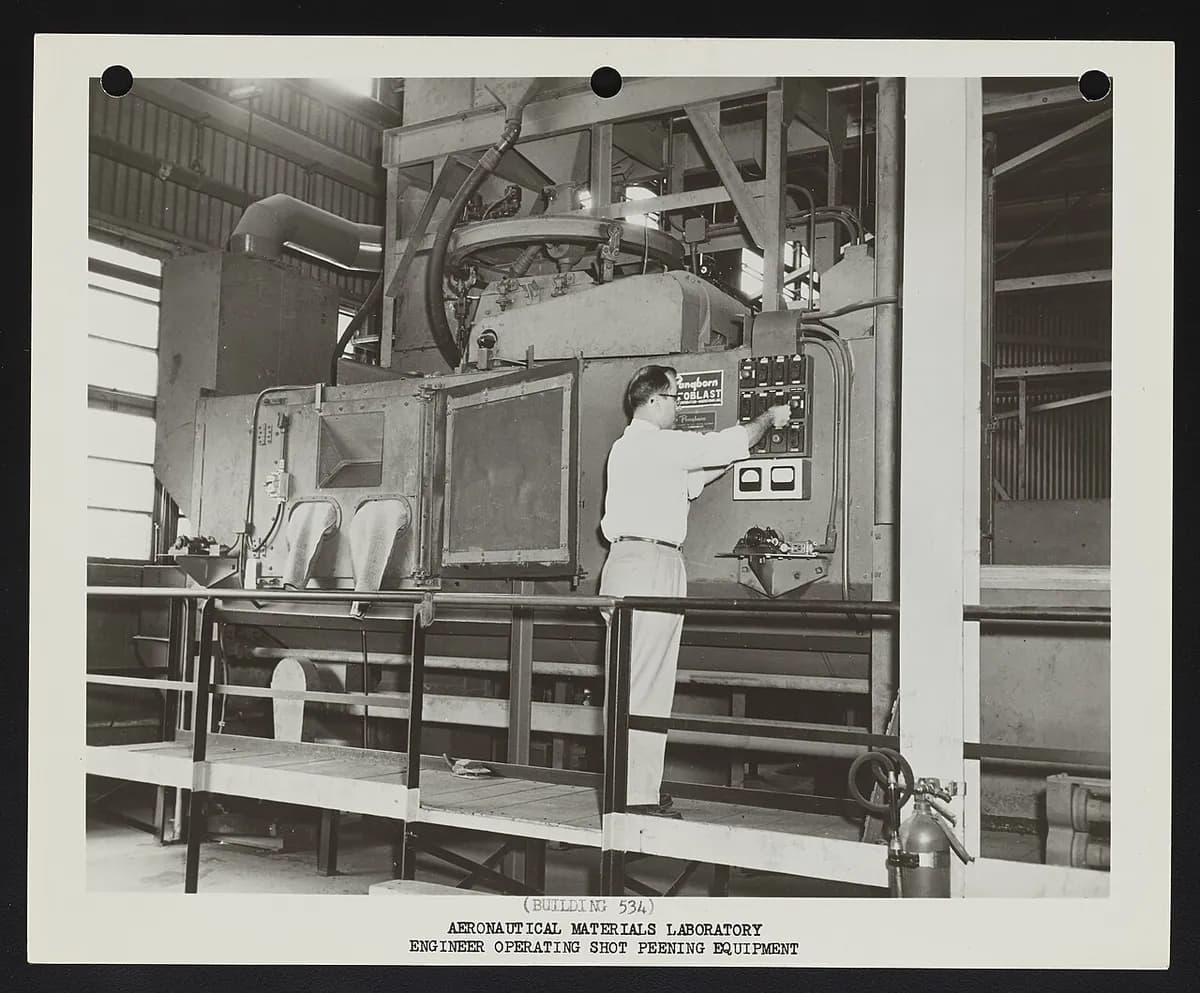
Shot peening blasts a metal surface with millions of tiny balls, each leaving a small dent. Together the dents leave the outer skin squeezed (in compression), which makes it much harder for fatigue cracks to start and grow. Car springs, gears and jet-engine parts last far longer because of it.
How it works
Blast the surface with shot. Shot (small round balls of steel, glass or ceramic, typically a few tenths of a millimeter to about 1 mm) is fired by compressed air or thrown by a spinning wheel. Areas that must stay untouched are masked.
Each ball dents the surface. On impact the ball pushes the metal aside, stretching a thin surface layer sideways like a tiny hammer blow.
The skin ends up squeezed. The unstretched metal underneath holds the stretched skin back, leaving it in compression to a depth of typically a few tenths of a millimeter. Fatigue cracks (cracks that grow little by little under repeated loads) need tension to open, so they struggle to start there.
Check intensity and coverage. An Almen strip (a thin standard steel strip) is peened alongside the parts; how much it curves measures the peening intensity. Inspectors also check coverage, the share of the surface covered by dents, usually 100 % or more.
Key facts
- Materials
- Steels, aluminum and titanium alloys, nickel superalloys; shot of cast steel, cut wire, glass or ceramic
- Typical parts
- Springs, gears, crankshafts, connecting rods, turbine blades and disks, landing gear, welded joints
- Part size
- From small springs to aircraft wing skins, limited by the machine or robot reach
- Precision
- Shape barely changes; thin parts can bend slightly, which peen forming uses on purpose
- Surface finish
- Uniformly dimpled and matte, a little rougher than before
- Batch size it suits
- Single aerospace parts to millions of springs on automatic lines
- Tooling and machine cost
- Cabinets from tens of thousands of dollars; robotic, computer-controlled cells into the hundreds of thousands or more
- Speed
- Seconds to minutes per part, depending on size and required coverage
Strengths and limits
Strengths
- Fatigue life often several times longer for springs and gears
- Cheap and fast compared with redesigning a part
- Also fights stress-corrosion cracking
- Works on finished parts, including welds
Limits
- Benefit is lost if the surface is later ground away or heated too much
- The surface becomes slightly rough and matte
- Thin or delicate parts can distort
- Needs careful control (intensity, coverage) to be reliable
Where it's used
- AutomotiveSuspension coil springs, leaf springs, gears, crankshafts, connecting rods
- AerospaceLanding gear, turbine blades and disks, wing skins (peen forming)
- EnergyTurbine parts, welded pipes and pressure vessels
- IndustryGears, shafts, drill rods, welded structures
- MedicalSome orthopedic implants
How to recognize it
- An even, satin-matte surface made of countless tiny overlapping dimples.
- Often seen on coil springs, gear roots and connecting rods, usually under paint.
- Sharp edges look slightly rounded, and the surface feels faintly rough.
Compare with
Watch it
Vapor Honing Technologies · A beginner's explanation of peening and its uses
Curtiss-Wright Corporation · How intensity and coverage are controlled in industry
Newcomb Spring · Springs being peened in production
FerroECOBlast · Robots peening jet-engine parts
See real photos
- Wikipedia: Shot peening — principle, shot types, Almen strip, coverage and uses
- Wikimedia Commons photo search
Remember
- Shot peening dents the surface with tiny balls, leaving the skin compressed.
- A compressed skin stops fatigue cracks from starting and growing.
- It changes properties, not shape, and is checked with Almen strips.
Try it
Put AI to work in your CAD.
Model parts, generate drawings and automate the repetitive work inside your CAD software.