

Case hardening and nitriding
Carbon or nitrogen diffused into the surface
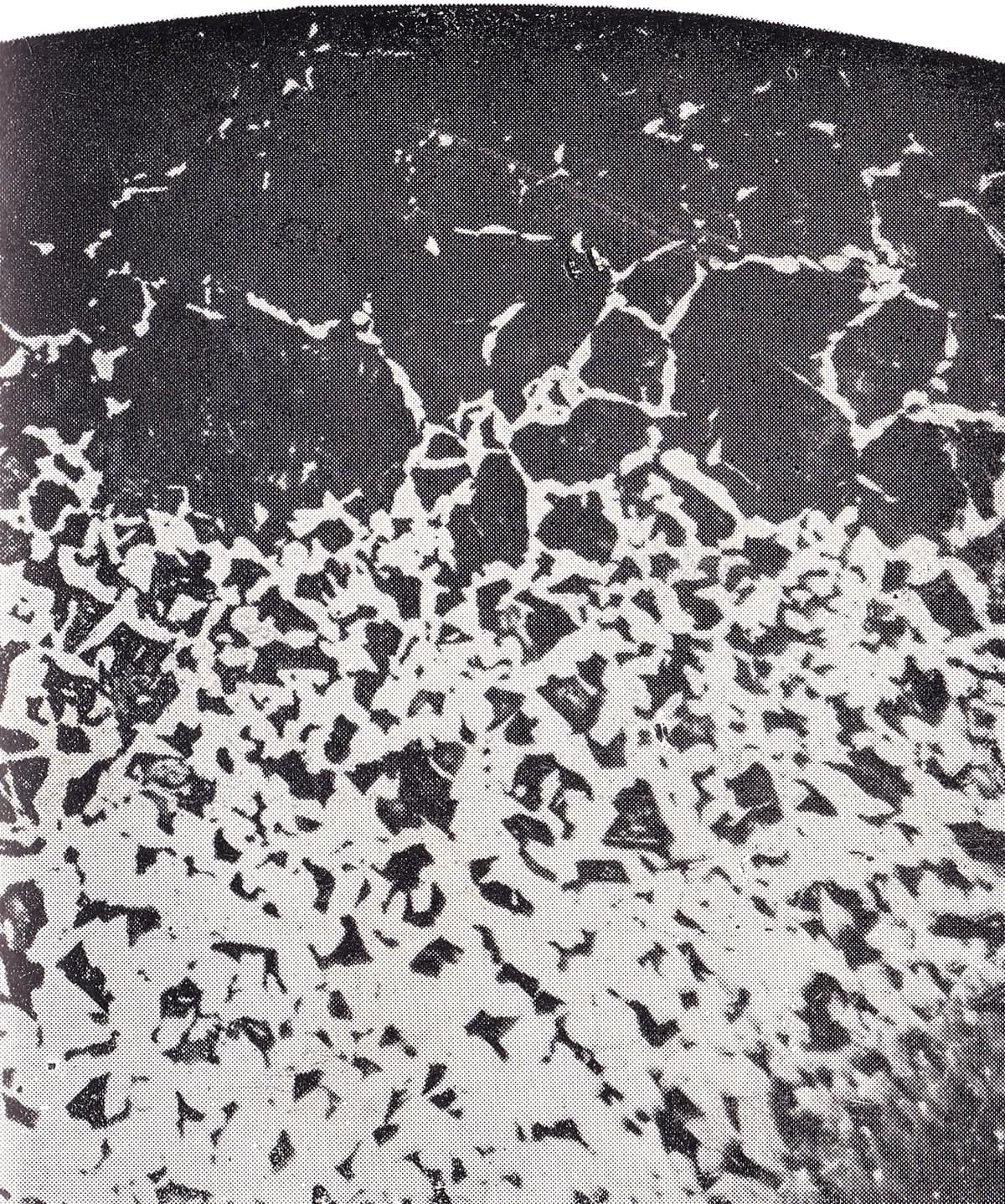
Case hardening makes only the outer skin of a steel part hard, while the inside stays tough. Carbon (carburizing) or nitrogen (nitriding) atoms are soaked into the surface in a hot furnace. Gear teeth, camshafts and crankshafts need exactly this: a skin that resists wear over a core that does not crack.
How it works
Load the parts into the furnace. Clean parts go into a sealed furnace filled with a carbon-rich gas (carburizing, typically about 900–950 °C) or with ammonia gas or plasma (nitriding, typically about 500–570 °C). Areas that must stay soft are masked, for example with a copper coating or a paste.
Let the atoms diffuse in. Carbon or nitrogen atoms enter the surface and creep inward by diffusion (atoms slowly wandering into the metal). The longer the soak, the deeper the case (the hardened skin), typically over several hours.
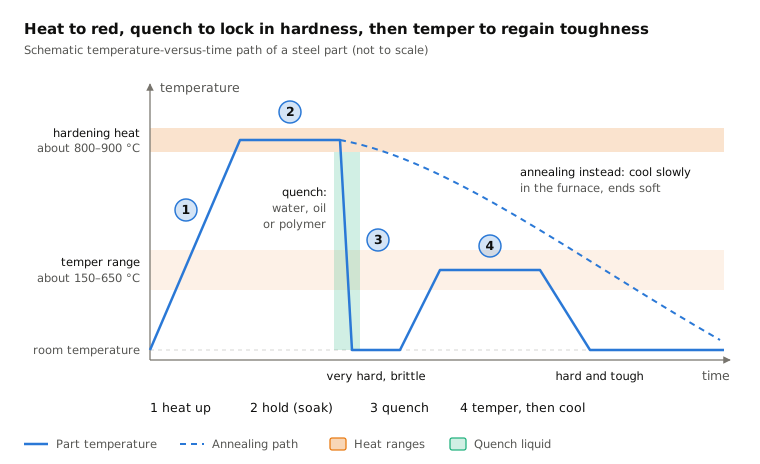
Finish the cycle. Carburized parts are quenched in oil and then tempered, as in lesson 12.1, so the carbon-rich skin turns very hard. Nitrided parts are already hard and simply cool slowly, so they barely distort.
Check the case. A test piece is cut, polished and measured for hardness from the surface inward to confirm the case depth.
Key facts
- Materials
- Carburizing: low-carbon steels; nitriding: alloy steels with chromium, molybdenum or aluminum, tool steels, some stainless steels
- Typical parts
- Gears, camshafts, crankshafts, bearing races, pins, injection-mold parts, extrusion screws
- Part size
- From small pins to large gears over a meter across, limited by the furnace
- Precision
- Carburizing distorts parts slightly, so key faces are often ground after; nitriding keeps sizes within a few hundredths of a millimeter
- Surface finish
- Carburized parts are often dark and need cleaning or grinding; nitrided parts are matte gray
- Batch size it suits
- Batches of hundreds to thousands of parts per furnace load
- Tooling and machine cost
- Industrial furnaces from about a hundred thousand to millions of dollars; most firms send parts to specialist heat-treat shops
- Speed
- Carburizing: several hours per load; nitriding: often 10–60 hours or more, depending on the case depth
Strengths and limits
Strengths
- Very hard, wear-resistant skin over a tough core that resists shock
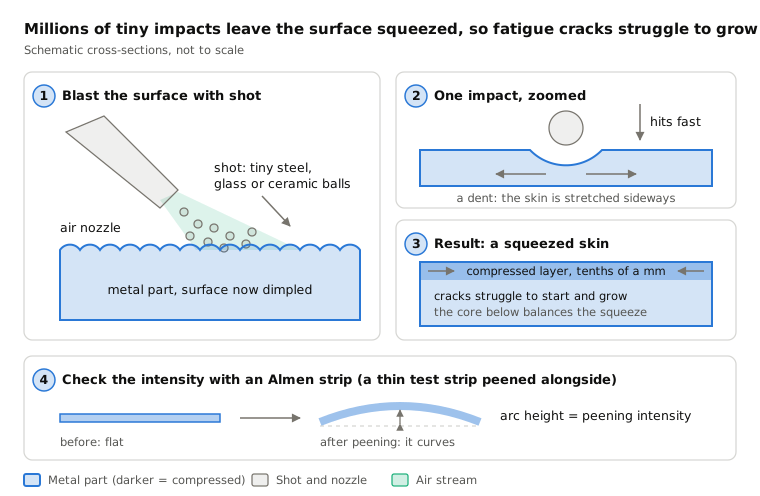
- Raises fatigue strength, so parts last longer under repeated loads
- Nitriding needs no quench, so distortion is minimal
- Many parts treated at once in one furnace load
Limits
- The case is thin; deep damage or heavy grinding can remove it
- Carburizing plus quench can warp parts
- Nitriding is slow, and only suits certain alloy steels
- Specialist furnaces and gas control; usually outsourced
Where it's used
- AutomotiveGearbox gears, camshafts, crankshafts, piston pins
- AerospaceTransmission gears, bearings, landing-gear parts
- ToolingInjection-mold parts, extrusion dies, plastic extruder screws
- Industrial machineryGears, shafts, chain parts, hydraulic components
- FirearmsSlides and barrels, often salt-bath nitrided
How to recognize it
- Matte gray or black surfaces on gears and shafts, with ground bearing faces.
- A file skates off the surface, even though the part may bend rather than snap.
- On a cut and etched sample, a darker or lighter rim of uniform depth around the edge.
Compare with
Watch it
Artisan Makes · A simple explanation, then workshop case hardening
THE FACILITY · Pack carburizing, quench and a file test before and after
ION HEAT · How the two nitriding methods differ
Ionitech Ltd. · Parts glowing inside a plasma nitriding chamber
See real photos
- Wikipedia: Carburizing — carburizing methods and hardened parts
- Wikipedia: Nitriding — gas, salt-bath and plasma nitriding
- Wikimedia Commons photo search
Remember
- Case hardening puts a hard skin over a tough core.
- Carburizing adds carbon at high heat, then quenches; nitriding adds nitrogen at lower heat, with no quench.
- Perfect for gears and shafts that must resist both wear and shock.
Try it
Put AI to work in your CAD.
Model parts, generate drawings and automate the repetitive work inside your CAD software.