

Heat treatment (hardening, tempering, annealing)
Heat, quench and temper (or slow-cool) the whole part
Heat treatment changes how hard or tough a metal is by heating and cooling it in a controlled way, without changing its shape. The same steel can be made soft enough to machine, or hard enough to cut other metals. A kitchen knife, a spring and a gear all owe their behavior to it.
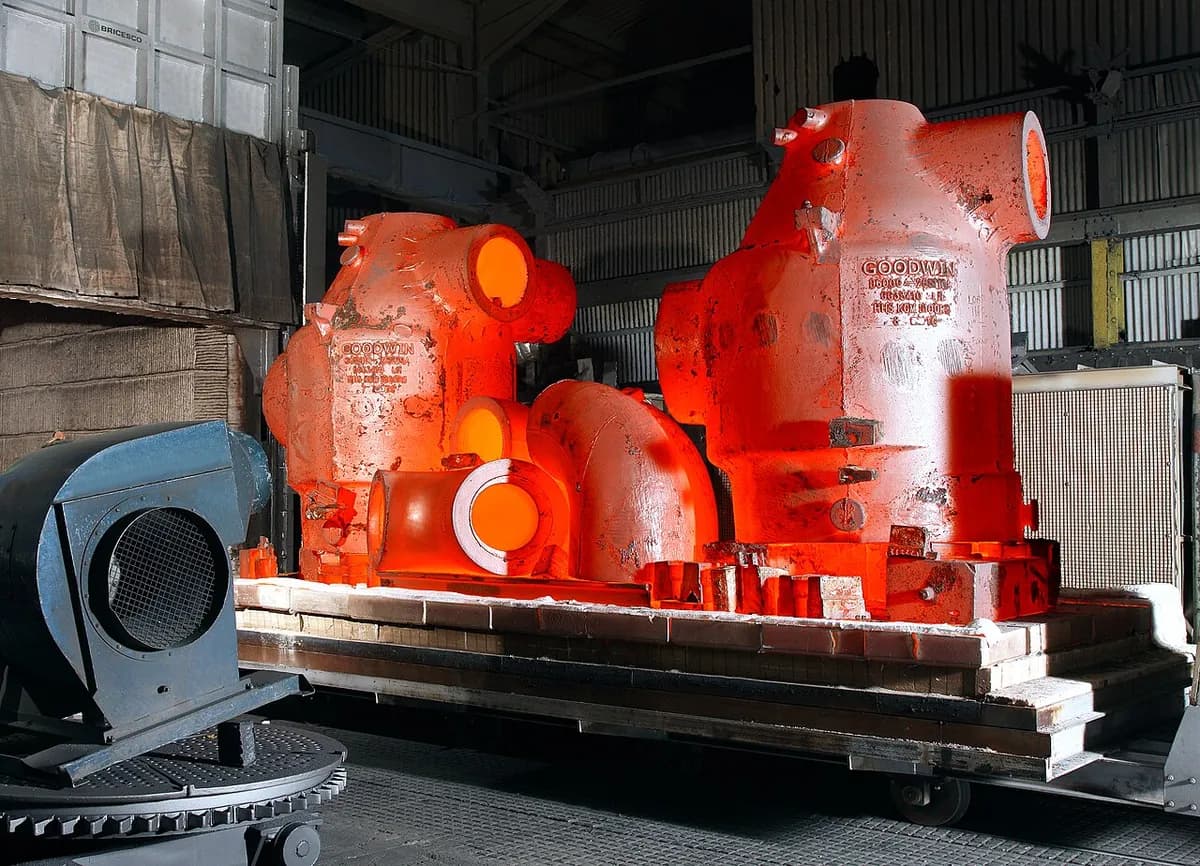
How it works
Heat up. The part goes into a furnace and is heated until it glows red, typically about 800–900 °C for common steels. At that heat the atoms rearrange into a form (austenite) that can dissolve the carbon in the steel.
Hold (soak). The part stays at temperature until it is hot all the way through. Thick parts need longer, often around an hour per 25 mm of thickness as a rule of thumb.
Quench. The hot part is plunged into water, oil or a polymer solution and cools in seconds. The carbon gets trapped, forming martensite (a very hard but brittle structure).
Temper, then cool. The part is reheated to a much lower temperature, typically about 150–650 °C, held, then cooled. This trades a little hardness for much more toughness (resistance to cracking); the higher the temper, the tougher and softer the part.
Annealing takes the other road: after the hold, the part cools very slowly inside the furnace and ends up soft and easy to machine or bend. Normalizing is in between: the part cools in still air.
Key facts
- Materials
- Mainly carbon and alloy steels and tool steels; also cast iron, titanium and aluminum alloys (with their own recipes)
- Typical parts
- Gears, shafts, axles, springs, knives, tools, bolts, bearings
- Part size
- From small pins to parts of several tons, limited by the furnace and quench tank
- Precision
- Shape is kept, but parts can distort or grow slightly, often tenths of a millimeter, so critical faces are ground afterwards
- Surface finish
- A dark oxide scale forms in air; vacuum or protective-gas furnaces keep parts bright
- Batch size it suits
- Single parts to continuous furnaces running thousands of parts a day
- Tooling and machine cost
- Small furnaces from a few thousand dollars; industrial lines with quench tanks and gas control from hundreds of thousands to millions
- Speed
- Hours per cycle (heat, hold, quench, temper); batches of many parts at once
Strengths and limits
Strengths
- One steel can be made soft, tough or very hard to suit the job
- Treats the whole part, through its thickness
- Large batches at once, so low cost per part
- Can undo earlier effects: annealing softens work-hardened metal
Limits
- Quenching can warp or crack parts, especially thin or uneven ones
- Low-carbon steels barely harden; the alloy must suit the treatment
- Scale and distortion often mean extra grinding or cleaning
- Energy-hungry furnaces and long cycle times
Where it's used
- AutomotiveGears, crankshafts, axles, springs
- ToolsDrill bits, chisels, knives, dies and molds
- AerospaceLanding gear, engine shafts, high-strength fasteners
- Energy and heavy industryTurbine shafts, mining and earth-moving parts
- ConstructionHigh-strength bolts, rebar, wire rope
How to recognize it
- Rainbow temper colors (straw, bronze, blue) near ground edges, typical of tools and knives.
- Dark gray or black oxide scale on unground surfaces.
- A file skates off a hardened surface instead of biting in.
- Ground bearing faces next to darker, untouched surfaces on the same part.
Compare with
Watch it
Welding Inspection · The four main treatments explained for beginners
THATLAZYMACHINIST · Torch heating, quench, file test and temper colors in a workshop
Clansman Dynamics · A robot moving a glowing part from furnace to quench
Bodycote · Industrial heat-treatment plants and furnace loads
See real photos
- Wikipedia: Heat treating — furnaces, quenching and microstructure illustrations
- Wikimedia Commons photo search
Remember
- Heat treatment changes properties, not shape.
- Quenching makes steel very hard but brittle; tempering buys back toughness.
- Annealing (slow cooling) does the opposite and makes steel soft.
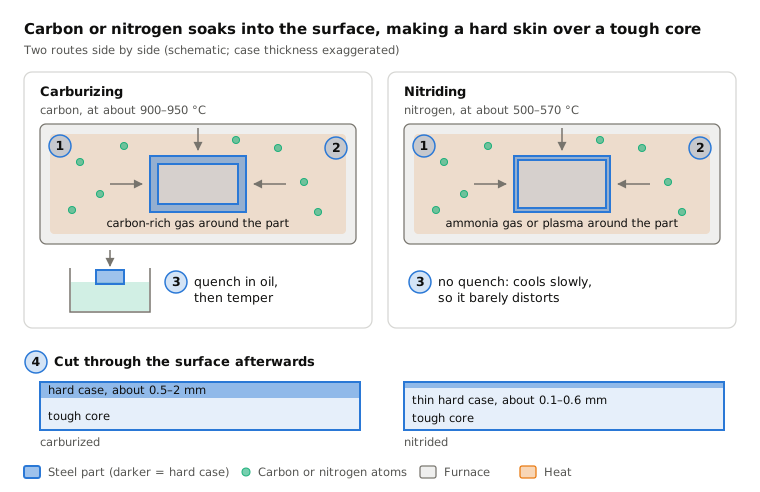
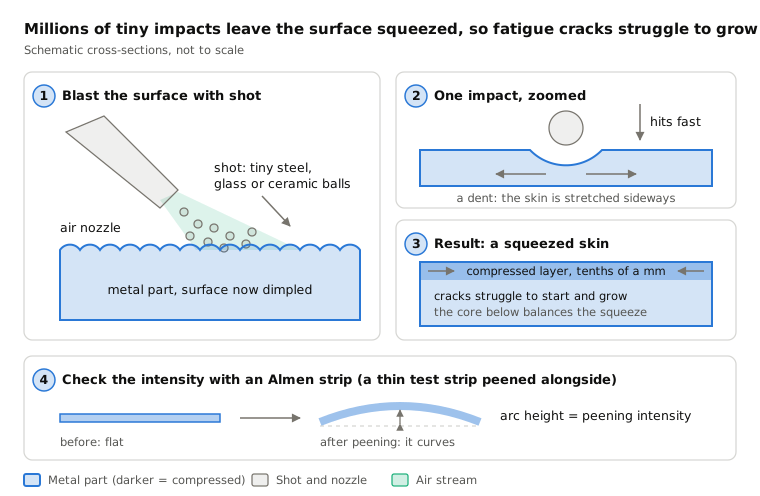
Try it
Put AI to work in your CAD.
Model parts, generate drawings and automate the repetitive work inside your CAD software.