

Heat treatment and surface hardening
These processes change what a finished metal part can do, not its shape. Controlled heating and cooling, atoms soaked into the surface, or millions of tiny impacts make parts harder, tougher or longer-lasting under repeated loads. They usually come near the end of the route, after the part has been formed or machined.
The big idea
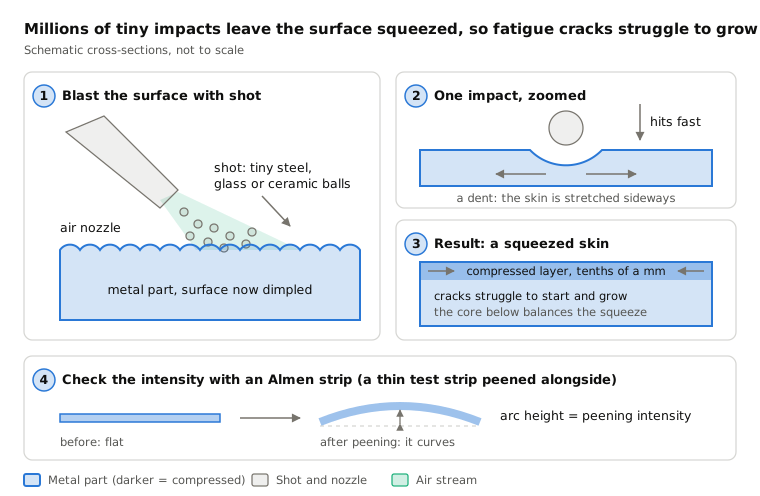
A metal's strength depends on how its atoms are arranged inside, and that arrangement can be changed without moving the outside shape. Think of a loaf of bread: the same dough becomes soft or crusty depending on how you bake it. Heat treatment changes the whole part; case hardening changes only a skin a fraction of a millimeter to a few millimeters deep; shot peening squeezes the surface so fatigue cracks struggle to grow. Three properties keep coming back: hardness (resistance to scratches and wear), toughness (resistance to cracking under shock) and fatigue life (how many load cycles a part survives).
The 3 processes in this chapter
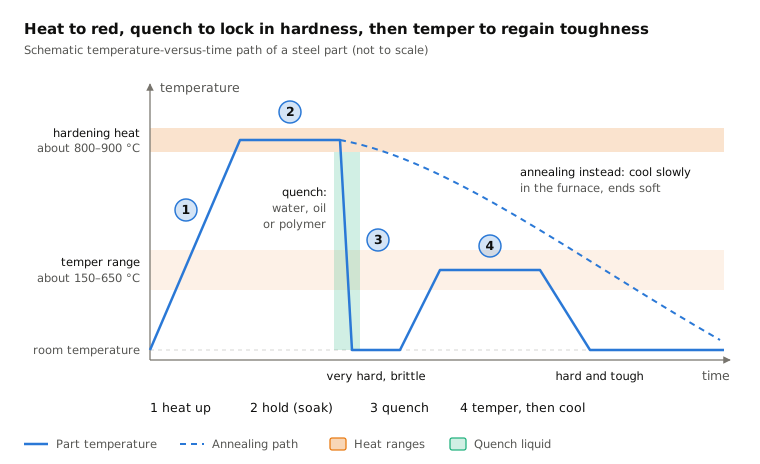
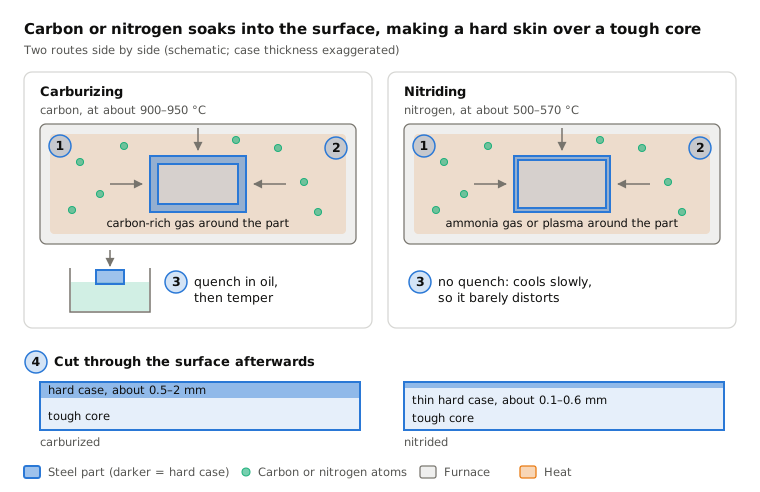
Side by side
| Process | In one line | Best for | Batch size | Precision |
|---|---|---|---|---|
| 12.1Heat treatment (hardening, tempering, annealing) | Heat, quench and temper (or slow-cool) the whole part | Making steel hard and tough, or soft for machining | Single parts to continuous lines | Shape kept; slight distortion, often ground after |
| 12.2Case hardening and nitriding | Carbon or nitrogen diffused into the surface | Gears and shafts: a hard skin over a tough core | Furnace batches of hundreds to thousands | Nitriding: within hundredths of a mm; carburizing: slight distortion |
| 12.3Shot peening | Surface hammered by tiny balls to leave it compressed | Springs, gears, turbine parts that see repeated loads | Single parts to millions of springs | Shape essentially unchanged |
How to choose within this family
- The whole part must be hard or strong right through: heat treatment (quench and temper).
- The part must be soft to machine or bend first: annealing, then harden later if needed.
- The surface must resist wear while the core resists shock: case hardening.
- Distortion must be minimal: nitriding rather than carburizing.
- The part fails by fatigue (cracks after many cycles): add shot peening, often after hardening.
Key words
- Hardness
- resistance to scratching, denting and wear.
- Toughness
- ability to absorb a shock without cracking.
- Quench
- fast cooling in water, oil or polymer that locks in hardness.
- Temper
- gentle reheating after a quench that trades a little hardness for toughness.
- Anneal
- heating then very slow cooling that leaves metal soft.
- Case
- the hardened outer skin of a case-hardened part.
- Residual compressive stress
- a squeeze left inside the surface that keeps cracks closed.
- Fatigue
- slow cracking under many repeated loads, even small ones.
Try it
Put AI to work in your CAD.
Model parts, generate drawings and automate the repetitive work inside your CAD software.