

Coatings and surface finishing
Coatings add a thin layer on top of a finished part to protect it, harden it or give it color, without changing its shape. Every process in this chapter answers two questions: how does the layer form, and how thick does it get? The answers run from films a few atoms thick to sprayed layers several millimeters deep.
The big idea
A coating is a skin: the part underneath does the structural work, and the skin faces the world. Think of a wooden table: the wood carries the load, but the varnish decides whether it survives a spilled drink. The processes differ in how the skin gets there:
- A liquid that dries or cures: spray painting, screen printing.
- Powder melted into a film: powder coating.
- Dipping in molten metal: hot-dip galvanizing.
- Electrochemistry in a bath: electroplating, anodizing (which grows oxide out of the metal itself) and electroforming (which keeps the layer and removes the part).
- Vapor, atom by atom: PVD and CVD.
- Sprayed particles that stack up: thermal spraying (melted) and cold spray (solid).
Roughly from thinnest to thickest: PVD and CVD films (nanometers to about 20 µm) → electroplating and anodizing (about 5–50 µm) → paint and powder coat (about 25–150 µm) → galvanizing (about 50–200 µm) → thermal spray (about 0.1–1 mm) → cold spray and electroforming (up to several millimeters or more).
The 11 processes in this chapter
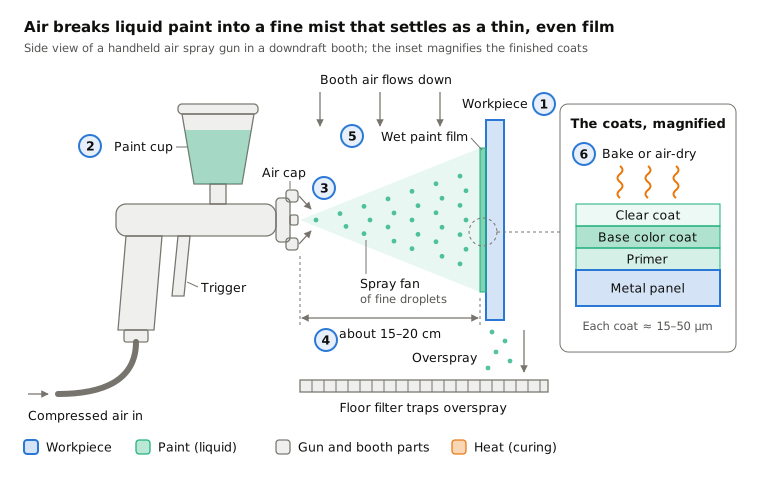
 11.1Spray paintingLiquid paint atomized into a fine mist that dries or curesOpen the lesson
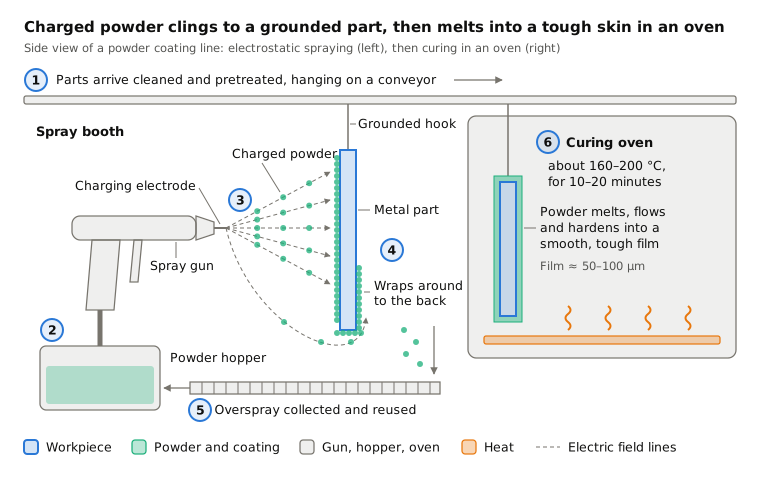
 11.2Powder coatingCharged dry powder clings to the part, then melts in an ovenOpen the lesson
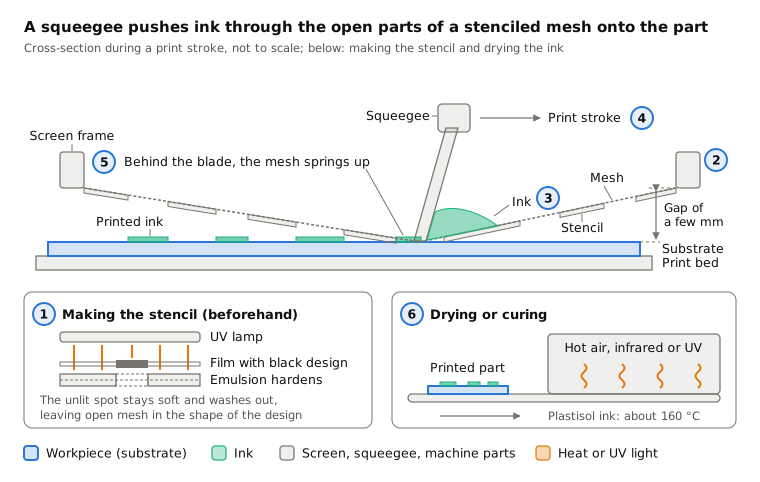
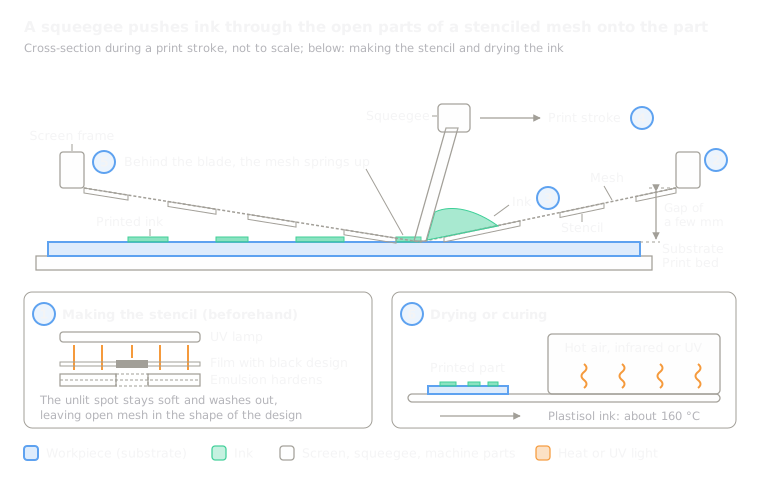 11.3Screen printingInk pushed through a mesh stencilOpen the lesson
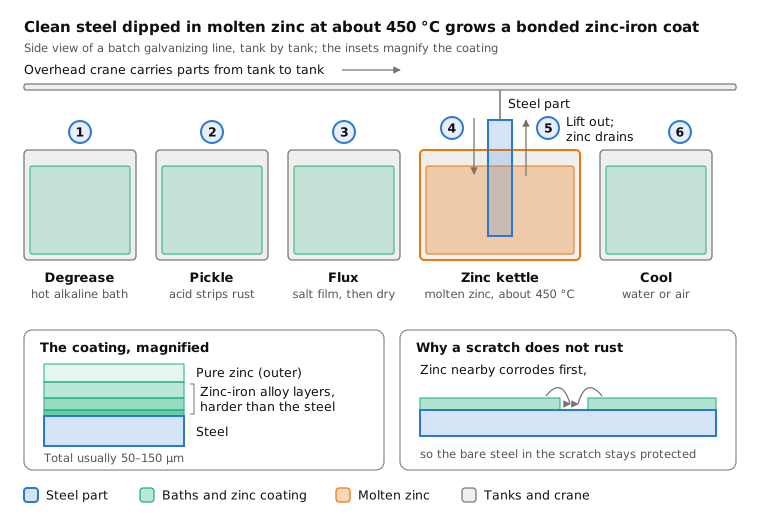
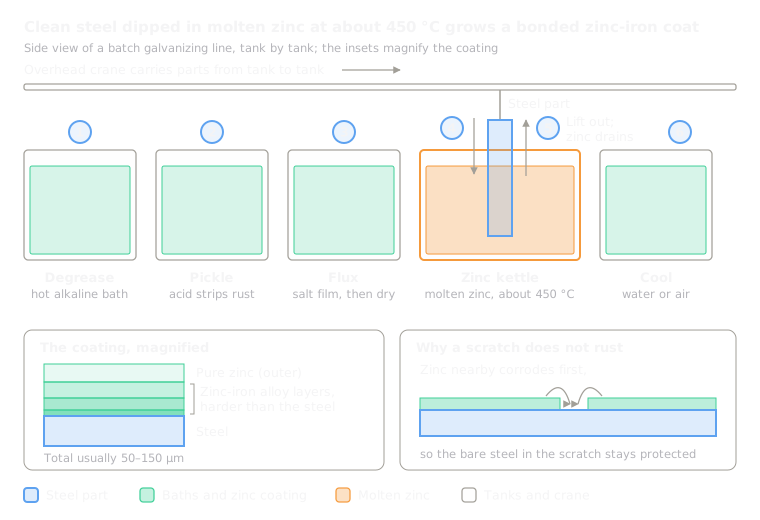 11.4Hot-dip galvanizingSteel dipped in molten zinc forms a bonded zinc layerOpen the lesson
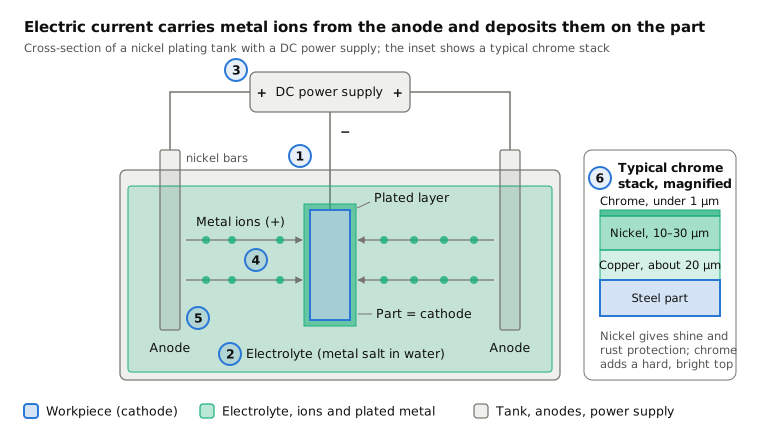
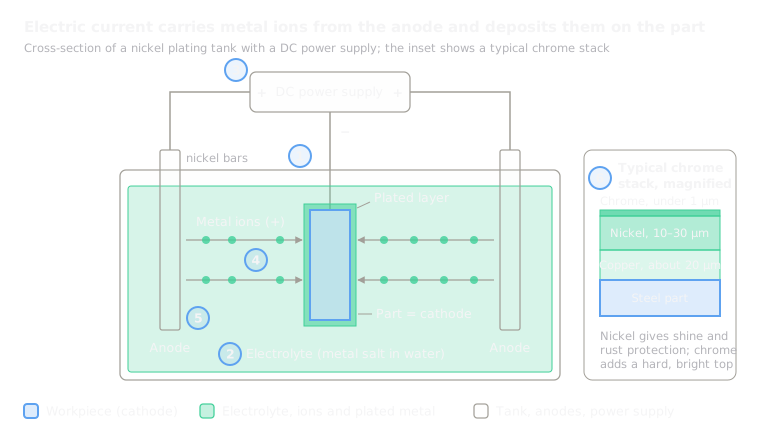 11.5Electroplating (chrome, nickel, zinc)Electric current deposits metal from a bathOpen the lesson
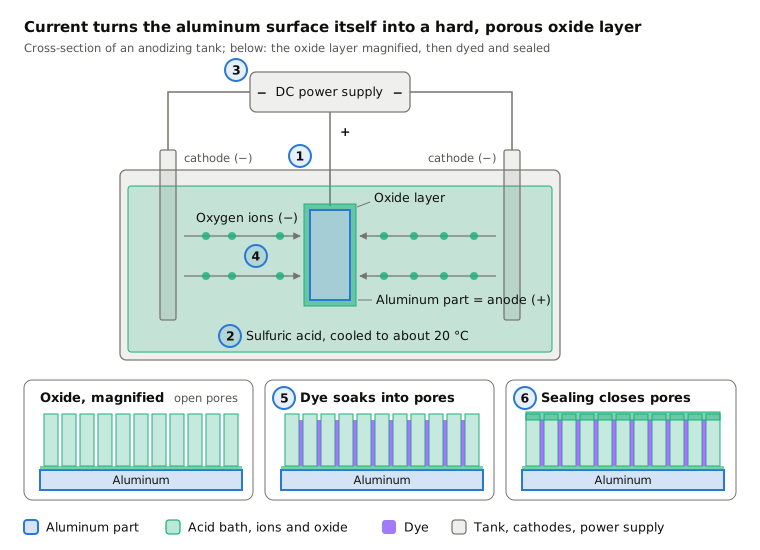
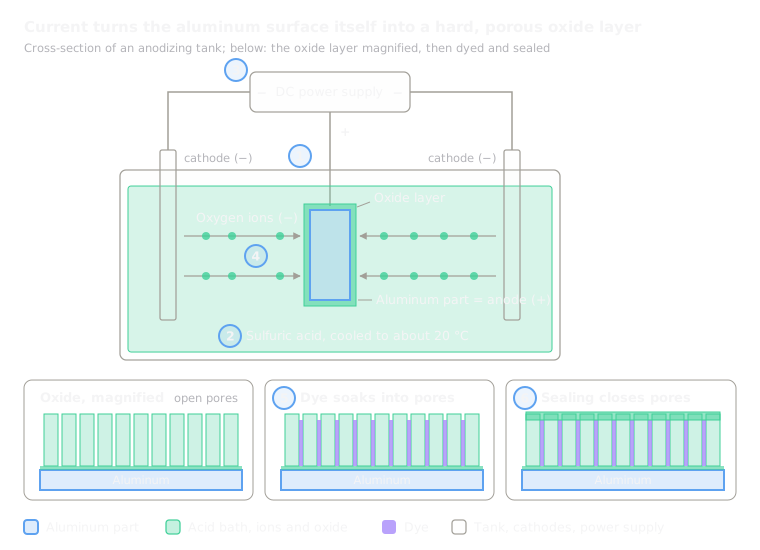 11.6AnodizingCurrent grows a hard oxide out of aluminum itselfOpen the lesson
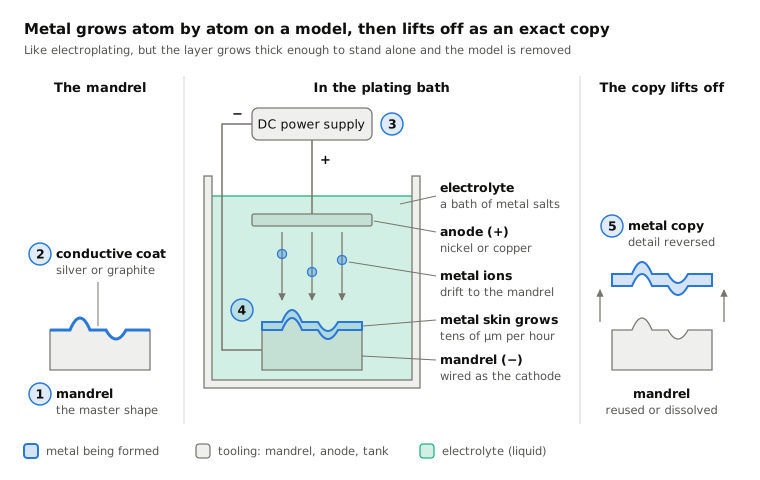
 11.7ElectroformingPlating grown thick on a model, then lifted offOpen the lesson
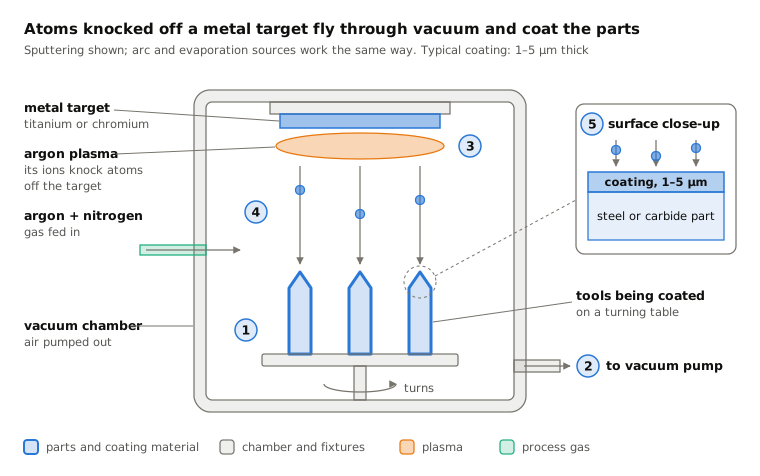
 11.8PVD coating (thin films in vacuum)Atoms knocked off a target coat parts in vacuumOpen the lesson
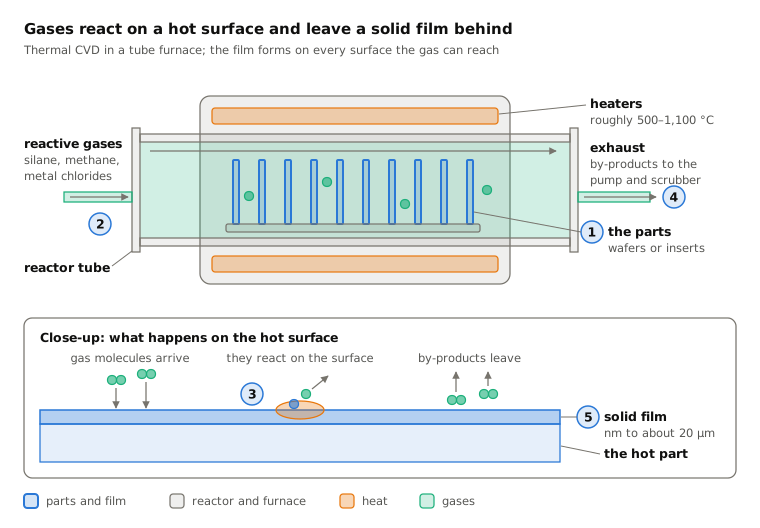
 11.9CVD coatingGases react on a hot surface and leave a filmOpen the lesson
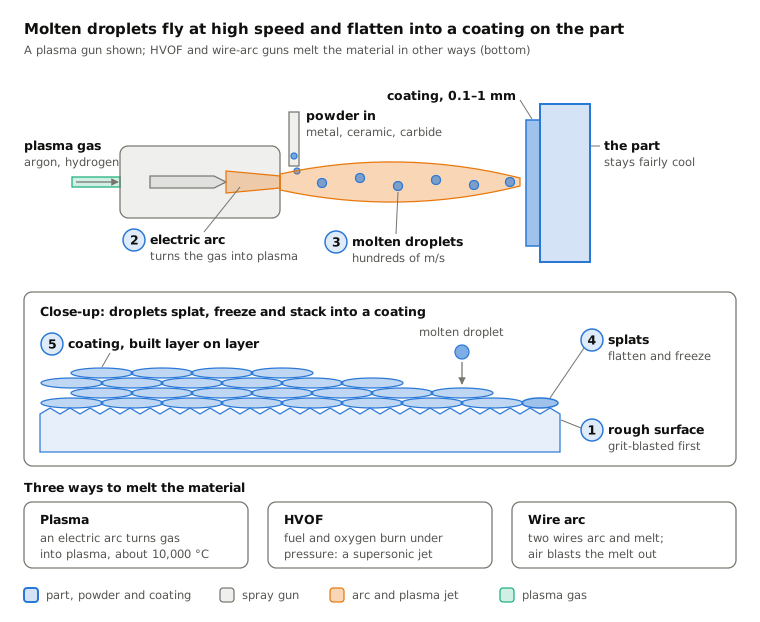
 11.10Thermal spraying (plasma, HVOF, arc)Melted droplets fired at a part stack into a layerOpen the lesson
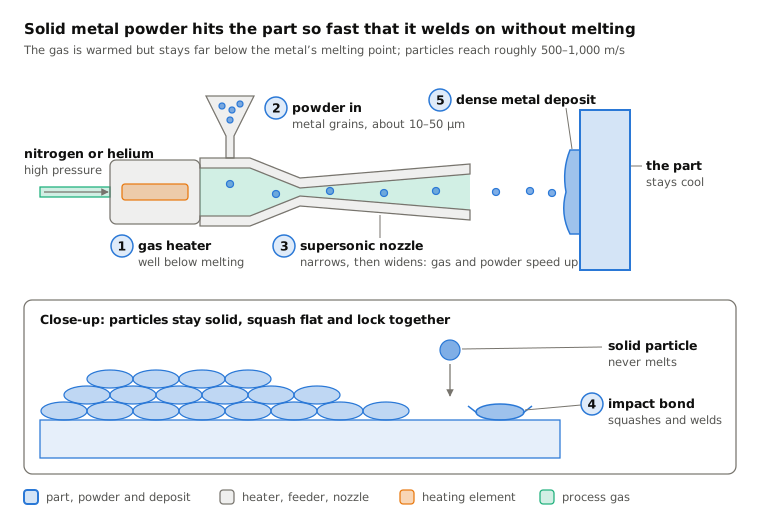
 11.11Cold spraySolid metal grains weld on by sheer speedOpen the lesson
Side by side
| Process | In one line | Best for | Batch size | Precision |
|---|---|---|---|---|
| 11.1Spray painting | Liquid paint atomized into a fine mist that dries or cures | Color and protection on almost anything | One-offs to car-body lines | Film about 25–100 µm, even with good technique |
| 11.2Powder coating | Charged dry powder clings to the part, then melts in an oven | Tough, solvent-free finishes on metal | Small batches to continuous lines | Film about 50–150 µm |
| 11.3Screen printing | Ink pushed through a mesh stencil | Graphics, labels, printed electronics | Tens to thousands of prints | Line detail down to a fraction of a millimeter |
| 11.4Hot-dip galvanizing | Steel dipped in molten zinc forms a bonded zinc layer | Rust protection for structural steel | Single beams to high-volume racks | Layer about 50–200 µm, uneven |
| 11.5Electroplating (chrome, nickel, zinc) | Electric current deposits metal from a bath | Chrome, nickel, zinc, gold finishes | Small to very large series | Layer about 5–50 µm, controllable |
| 11.6Anodizing | Current grows a hard oxide out of aluminum itself | Durable, colorable aluminum surfaces | Small to very large series | Layer about 5–50 µm, very even |
| 11.7Electroforming | Plating grown thick on a model, then lifted off | Thin shells copying fine detail | One-offs to medium series | Copies detail below 1 µm |
| 11.8PVD coating (thin films in vacuum) | Atoms knocked off a target coat parts in vacuum | Hard, thin films on tools and decor | Batches of hundreds to thousands | Film about 1–5 µm |
| 11.9CVD coating | Gases react on a hot surface and leave a film | Chip layers, thick insert coatings | Large batches | Nanometers to about 20 µm, very uniform |
| 11.10Thermal spraying (plasma, HVOF, arc) | Melted droplets fired at a part stack into a layer | Thick wear, heat and rust coatings; repairs | One-offs to series | About 0.1–1 mm, ground if needed |
| 11.11Cold spray | Solid metal grains weld on by sheer speed | Dense metal repairs and builds | Repairs to small series | Coarse, machined afterwards |
How to choose within this family
- Start from the job: color and basic protection → paint or powder coat; rust protection for steel → galvanizing or sprayed zinc; wear and hardness → PVD, CVD, hard plating or thermal spray.
- Check the thickness you need: micron films keep sharp edges and exact sizes; millimeter layers can rebuild worn parts.
- Check the heat the part can take: CVD runs near 1,000 °C, galvanizing near 450 °C and powder curing near 200 °C, while plating, anodizing and spraying keep the part cool.
- Check what the process can reach: baths and gases coat holes and hidden faces; sprays and PVD coat only what they can see.
- Match the material: anodizing is mainly for aluminum, galvanizing for steel, cold spray for ductile metals.
Key words
- Substrate
- the part being coated, as opposed to the coating on it.
- Adhesion
- how well a coating sticks; it depends heavily on surface cleaning and roughening.
- Electrolyte
- a liquid that conducts electricity, used in plating, anodizing and electroforming.
- Line of sight
- a process that only coats surfaces it can see directly, like a spray or PVD.
- Conformal coating
- a layer that follows every surface evenly, including holes, as CVD does.
- Micron (µm)
- a thousandth of a millimeter; a human hair is roughly 50–100 µm thick.
- Plasma
- a gas so energized that it conducts electricity and glows.
- Masking
- covering areas that must stay uncoated.
Try it
Put AI to work in your CAD.
Model parts, generate drawings and automate the repetitive work inside your CAD software.