

Spray painting
Liquid paint atomized into a fine mist that dries or cures
Spray painting turns liquid paint into a fine mist and lays it on a surface as a thin, even film. The glossy color on a car body is sprayed this way, mostly by robots. It is one of the most common ways to give products color and protect them from rust and weather.
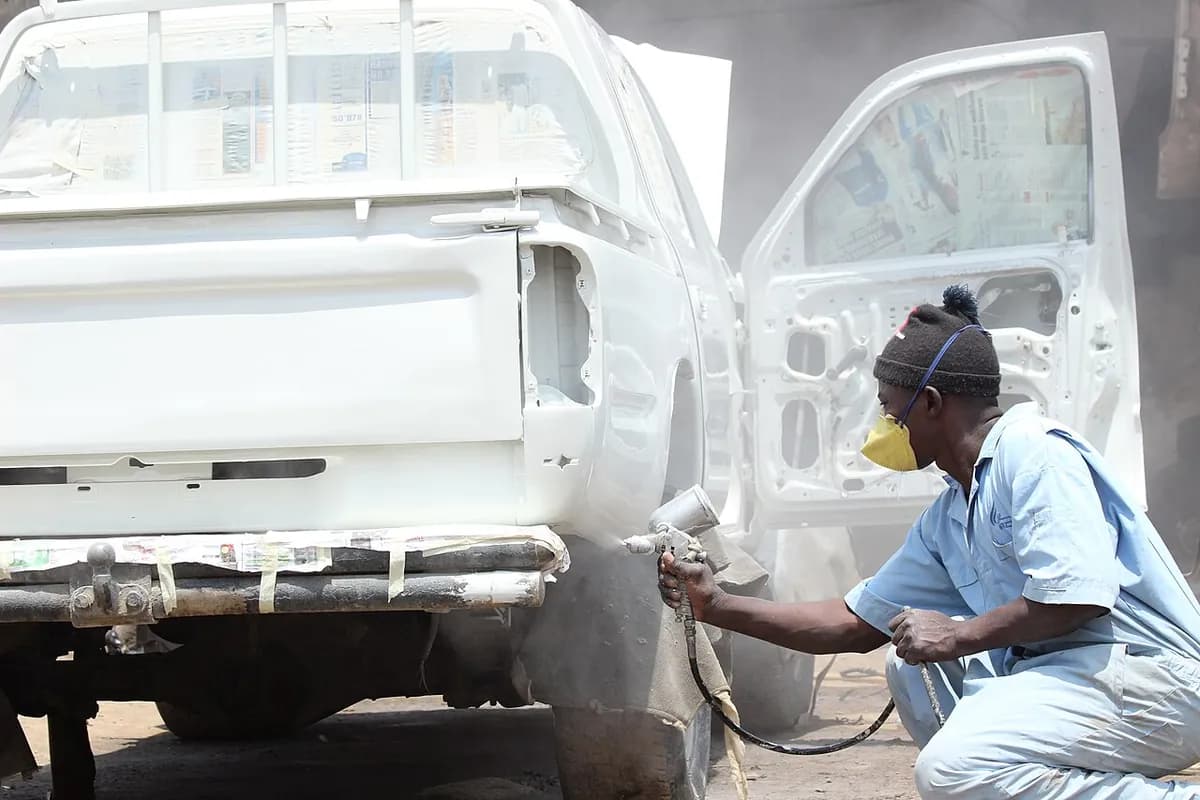
How it works
Prepare the surface. Clean off oil and dust, sand lightly so the paint can grip, and mask (cover with tape and paper) areas that must stay bare. Most paint defects start with a dirty surface.
Fill the gun and connect the air. Paint, thinned to the right viscosity (resistance to flow), goes into the cup. A hose brings compressed air, and small knobs set the paint flow, fan width and air pressure.
Atomize the paint. Pulling the trigger lets a thin stream of paint out of the fluid tip (the paint nozzle). Jets of air from the air cap shatter it into tiny droplets, a step called atomization.
Spray in steady passes. Hold the gun square to the surface, typically about 15–20 cm away. Move at an even speed and overlap each pass by about half, so the film comes out uniform.
Build the wet film. Droplets land, merge and flow into a smooth wet film, typically 15–50 µm (micrometers, thousandths of a millimeter) per coat. Droplets that miss the part, called overspray, are pulled down by the booth airflow into filters.
Flash off and cure. Between coats, the solvent or water evaporates for a few minutes (flash-off). The film then hardens in air or in an oven: around 60 °C in repair shops, roughly 130–150 °C on car lines.
Other guns change only the atomizer. HVLP guns (high volume, low pressure) use lots of air at low pressure, which cuts overspray. Airless guns pump paint at very high pressure through a tiny hole, which suits walls and steelwork. Car lines use electrostatic rotary bells: a cup spinning at tens of thousands of rpm flings out electrically charged droplets. The car body is grounded (connected to earth), so it attracts them.
Key facts
- Materials
- Liquid paints, primers, lacquers and clear coats, solvent-borne or waterborne; applied to metal, plastic, wood and composites
- Typical parts
- Car bodies, furniture, appliances, machine housings, aircraft, bicycles
- Part size
- From small brackets to whole aircraft; the size of the booth sets the limit
- Precision
- Film thickness typically 15–50 µm per coat; robots hold it to roughly ±5–10 µm, by hand it depends on the painter
- Surface finish
- Matte to mirror gloss; usually a fine “orange peel” ripple, polished out on premium work
- Batch size it suits
- From a single repair to hundreds of car bodies per shift
- Tooling and machine cost
- A hand gun costs tens to hundreds of dollars, a professional booth tens of thousands; a car-plant paint shop can cost hundreds of millions
- Speed
- Seconds to minutes per coat by hand; a car line paints roughly one body per minute; baking takes about 20–40 minutes
Strengths and limits
Strengths
- Works on almost any material, size and shape
- Any color, gloss or effect, including metallic and pearl finishes
- Cheap to start, and colors are quick to change
- Fast and very repeatable with robots and electrostatic bells
Limits
- Overspray wastes paint: a basic air gun may put well under half of it on the part
- Solvent-borne paints release VOCs (volatile organic compounds), so booths, filters and masks are needed
- Each coat is thin, and sharp edges and deep recesses get less paint
- By hand, quality depends on skill and cleanliness: runs, orange peel and dust specks are common defects
Where it's used
- AutomotiveCar bodies (primer, base coat, clear coat), bumpers, body-shop repairs
- AerospaceAircraft liveries (paint schemes), corrosion-resistant primers on airframes
- Furniture and woodLacquered cabinets and tables, guitars and pianos
- Machinery and appliancesTractors, machine tools, washing machines, power-tool housings
- ConstructionSteel beams and bridges, walls and ceilings sprayed with airless guns
- Consumer goodsBicycles, plastic phone and laptop cases, toys
How to recognize it
- A smooth film that hides the material; in a reflection you often see a fine “orange peel” ripple, like the skin of an orange.
- Thinner paint on sharp edges and in deep corners, and sometimes runs or sags (drips) on vertical faces.
- A chip shows the layers in cross-section: bare metal, then primer, color and clear coat.
- Crisp masking lines where two colors meet, sometimes with a tiny ridge of paint.
Compare with
Watch it
Pittsburgh Spray Equipment Co · How to set fluid flow, fan width and air pressure, and the basic spraying stroke
Behind the Scenics · The parts of an HVLP gun and what each one does
Graco Industrial Equipment · How a spinning bell atomizes paint and charges it on factory lines
Process Factory • Production Lines & Factories · Robots painting car bodies, and the ovens that cure each coat
See real photos
- Wikipedia: Spray painting — overview of HVLP, airless and electrostatic spraying, spray booths and safety
- Wikimedia Commons photo search
Remember
- A spray gun uses air, pressure or a spinning bell to break paint into droplets that settle as a thin film.
- Good results come from a clean surface, steady passes and a booth that pulls overspray away.
- Overspray is the main waste; HVLP and electrostatic methods put more of the paint on the part.
More in Coatings and surface finishing
All 100 processes
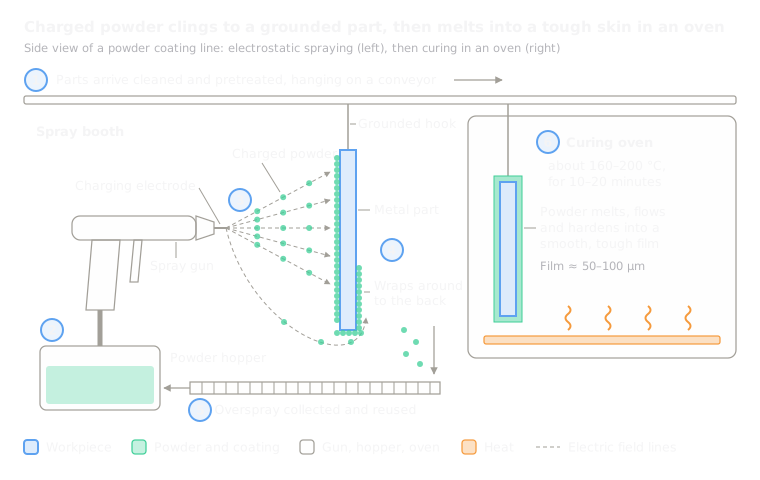 11.2Powder coatingCharged dry powder clings to the part, then melts in an ovenOpen the lesson
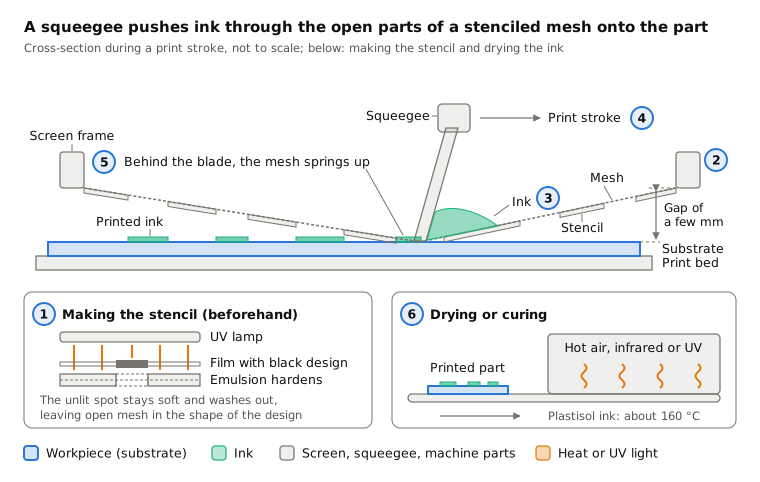
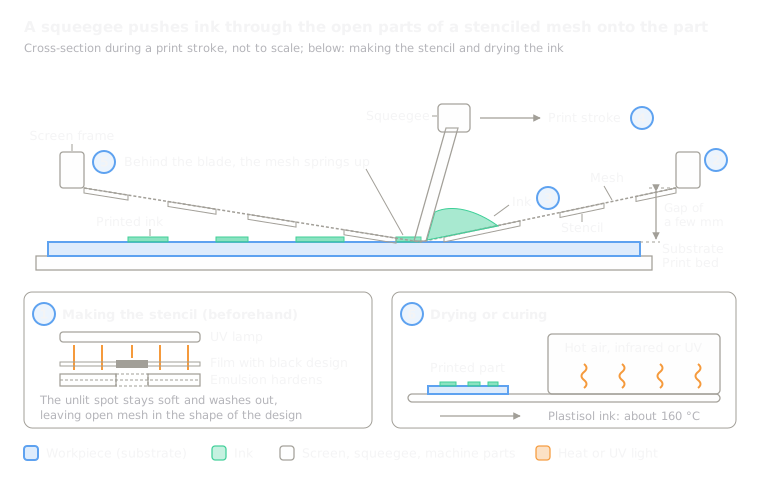 11.3Screen printingInk pushed through a mesh stencilOpen the lesson
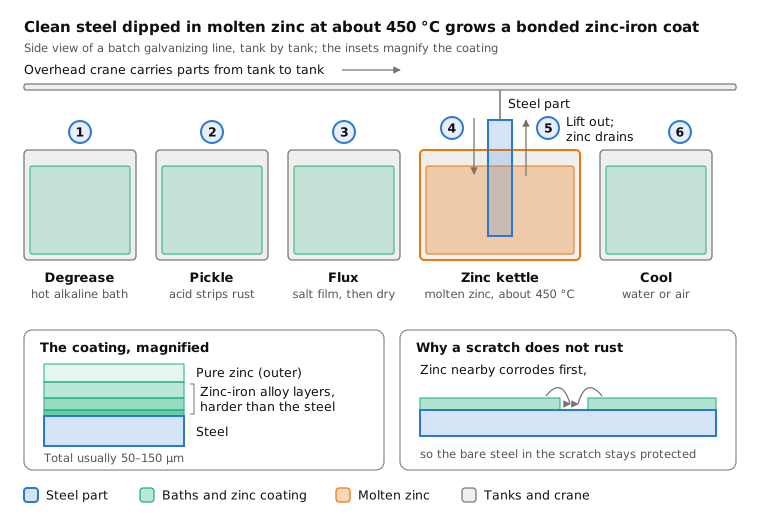
 11.4Hot-dip galvanizingSteel dipped in molten zinc forms a bonded zinc layerOpen the lesson
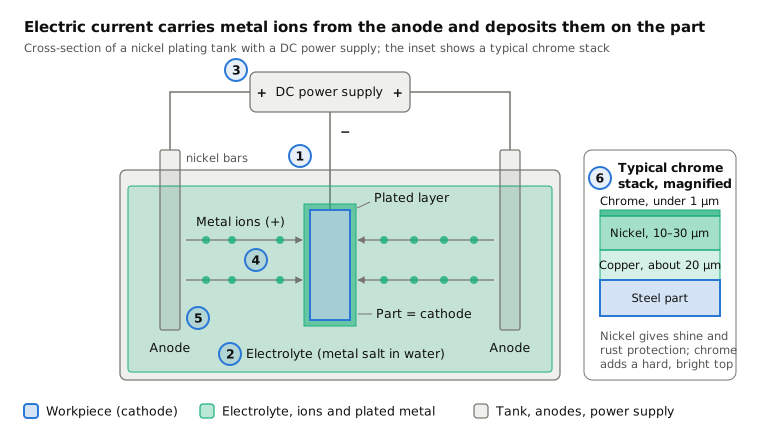
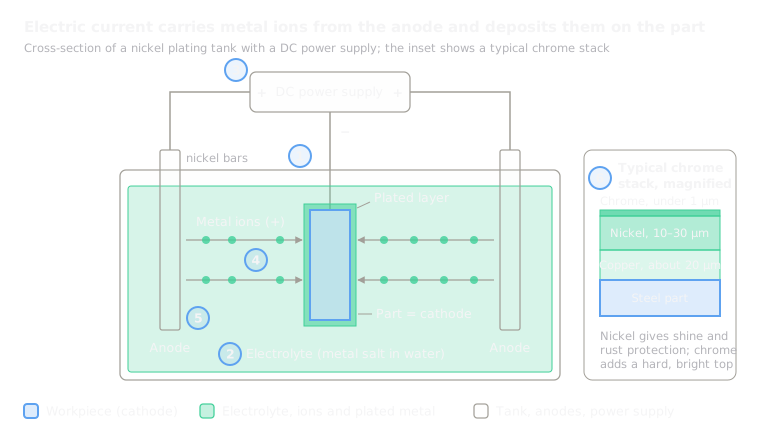 11.5Electroplating (chrome, nickel, zinc)Electric current deposits metal from a bathOpen the lesson
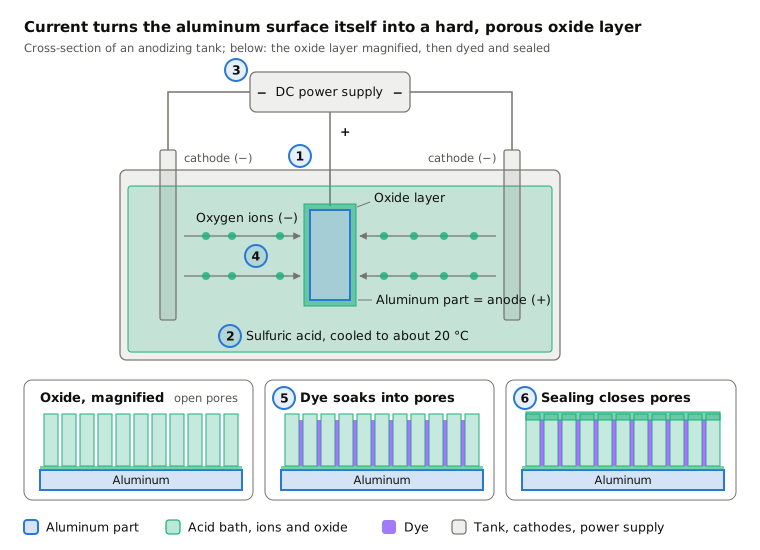
 11.6AnodizingCurrent grows a hard oxide out of aluminum itselfOpen the lesson
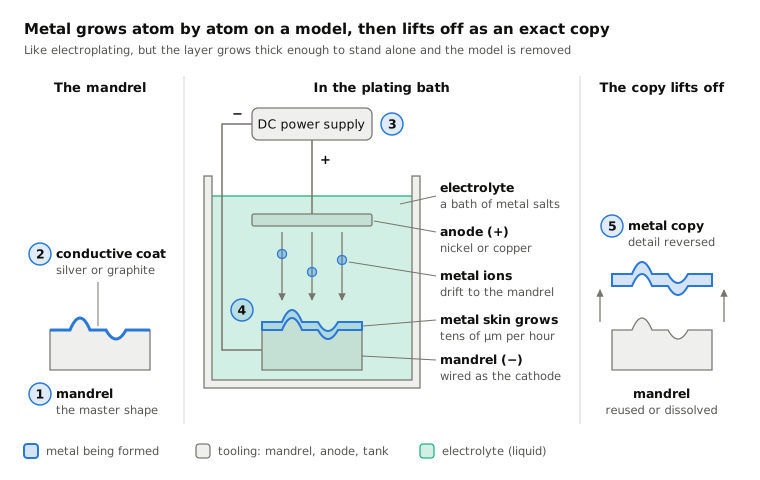
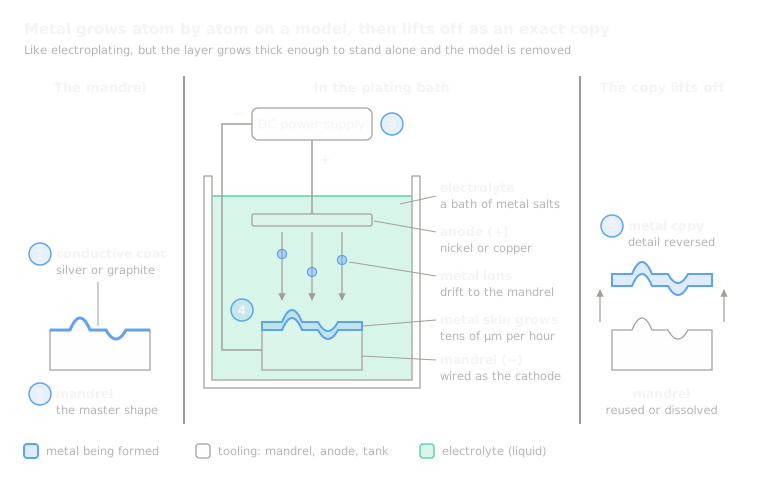 11.7ElectroformingPlating grown thick on a model, then lifted offOpen the lesson
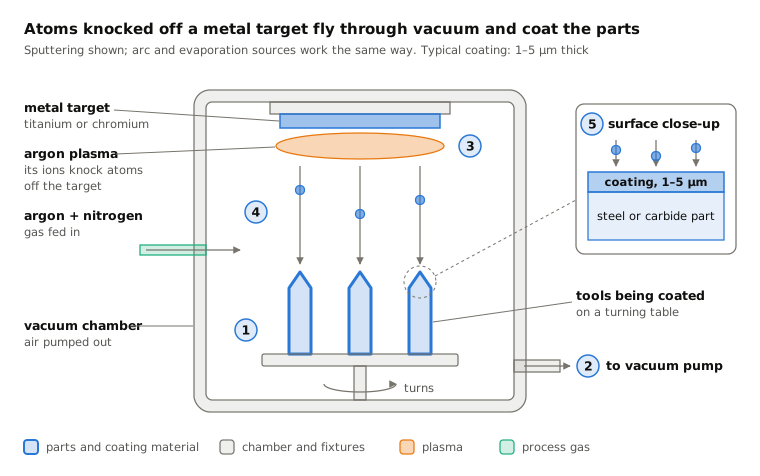
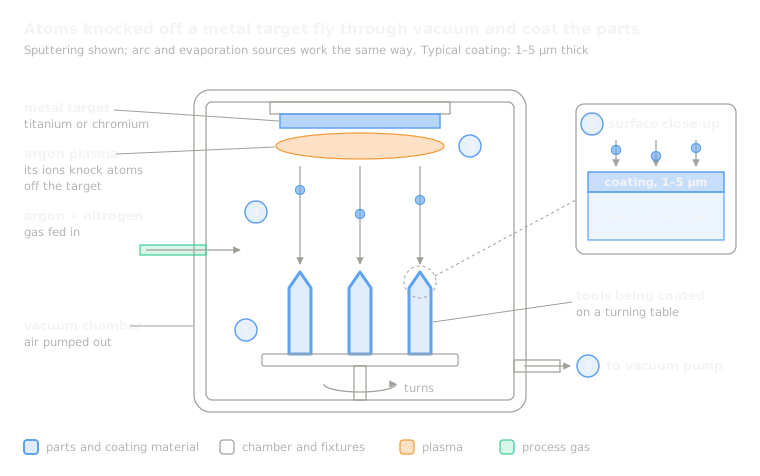 11.8PVD coating (thin films in vacuum)Atoms knocked off a target coat parts in vacuumOpen the lesson
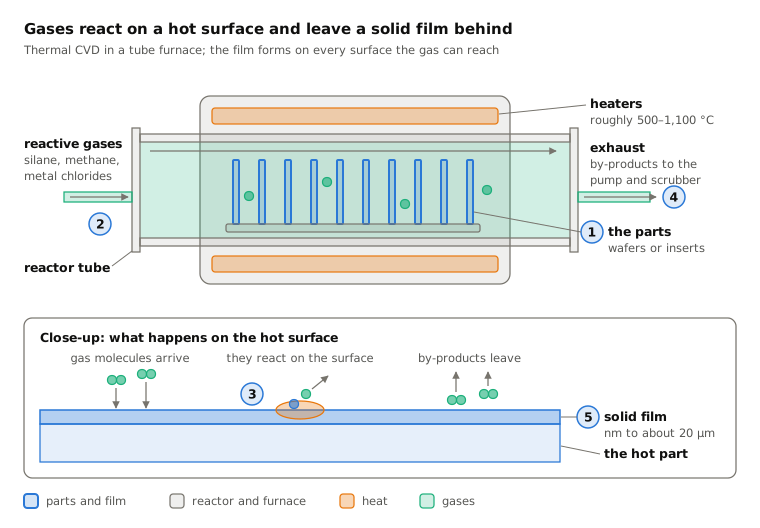
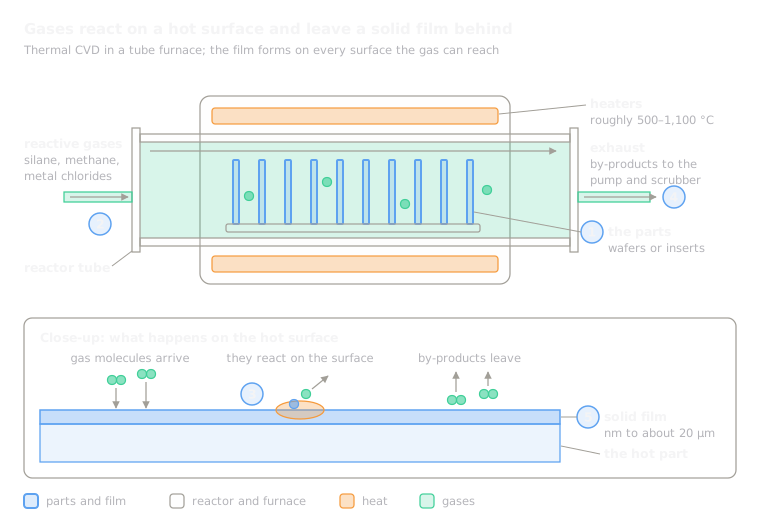 11.9CVD coatingGases react on a hot surface and leave a filmOpen the lesson
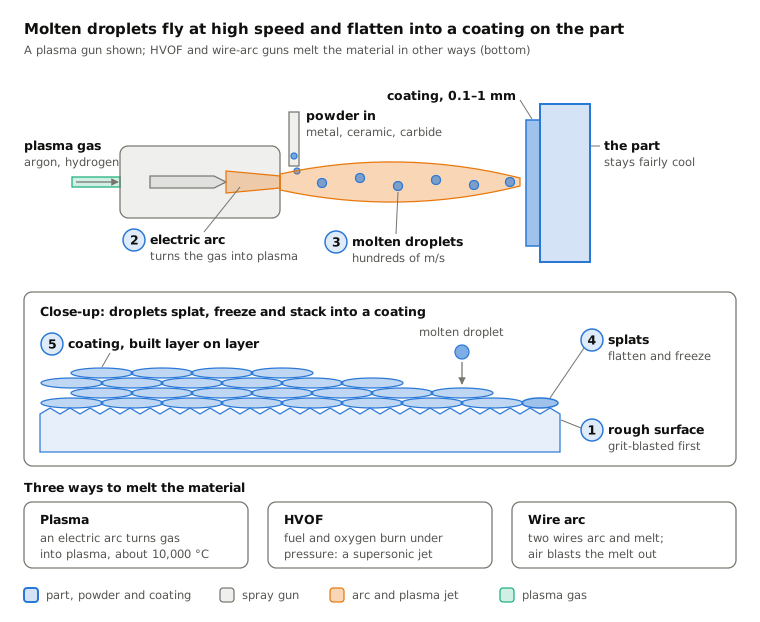
 11.10Thermal spraying (plasma, HVOF, arc)Melted droplets fired at a part stack into a layerOpen the lesson
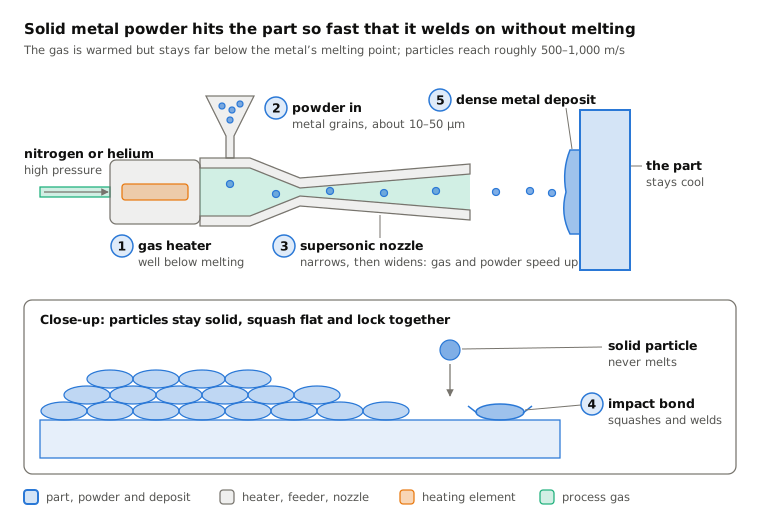
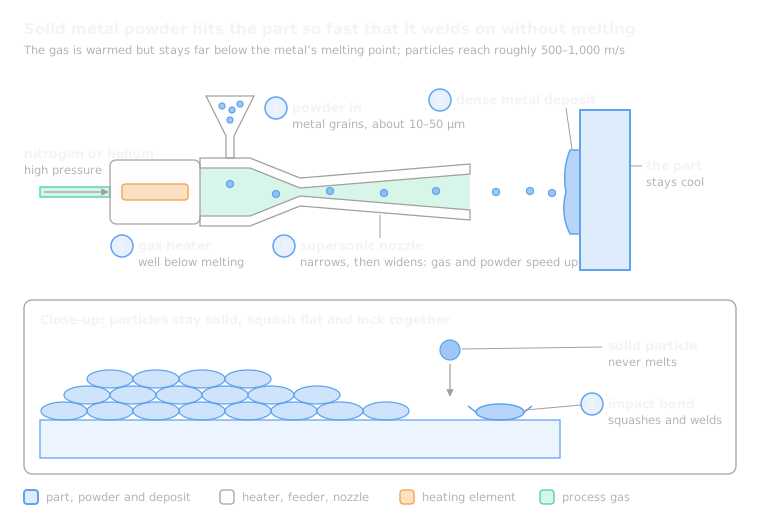 11.11Cold spraySolid metal grains weld on by sheer speedOpen the lesson
Try it
Put AI to work in your CAD.
Model parts, generate drawings and automate the repetitive work inside your CAD software.