

Filament winding
Resin-wet fiber wound onto a spinning mandrel
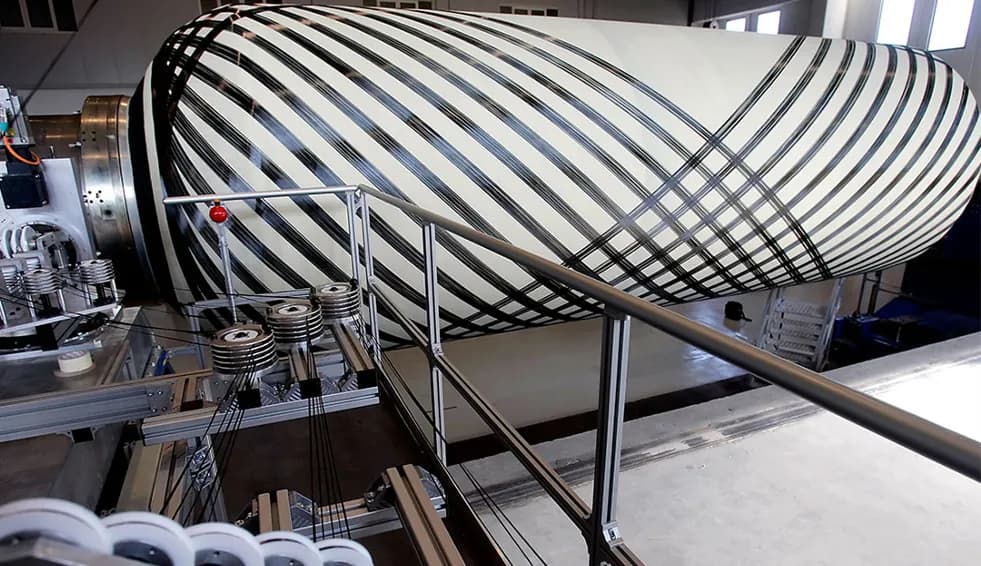
Filament winding wraps resin-wet fiber around a spinning core called a mandrel, layer after layer, like thread on a spool. A moving carriage guides the fiber so it lands at an exact angle. Pipes, gas cylinders, hydrogen tanks and rocket motor cases are made this way.
How it works
Feed the fiber. Rovings (untwisted bundles of continuous fiber) unwind from spools and pass through tensioners, which keep them evenly taut.
Wet it with resin. The fiber runs over a drum turning in a resin bath. Alternatively, towpreg (fiber already soaked in resin, like a thin prepreg tape) is wound dry.
Guide it onto the spinning mandrel. A carriage with a delivery eye (the guide the fiber leaves from) travels back and forth while the mandrel turns. A computer links the two motions.
Build up the layers. The speed of the carriage compared with the spin sets the fiber angle: near 90° for hoop layers, a set angle for helical layers, near 0° for polar layers over the ends. Layers are stacked until the wall is thick enough.
Cure, then remove the mandrel. The part cures (the resin hardens), often in an oven while still turning. The mandrel is then pulled out, or it stays inside as a liner, as in most pressure tanks.
Key facts
- Materials
- Glass fiber (most common), carbon or aramid (a tough synthetic fiber); epoxy, polyester or vinyl ester resin
- Typical parts
- Pipes, pressure vessels, gas and hydrogen tanks, drive shafts, poles, rocket motor cases
- Part size
- From tubes a few centimeters across to tanks and pipes several meters in diameter
- Precision
- Inner surface as accurate as the mandrel; fiber angle and wall thickness controlled layer by layer
- Surface finish
- Inside smooth; outside ridged by the fiber bands unless sanded, wrapped or coated
- Batch size it suits
- One-off large tanks to tens of thousands of cylinders a year on multi-spindle machines
- Tooling and machine cost
- Mandrels from hundreds to hundreds of thousands of dollars; machines from tens of thousands to millions
- Speed
- Minutes for a small tube; hours for a large tank, plus curing time
Strengths and limits
Strengths
- Fibers stay continuous and are placed at exact angles: very high strength for the weight
- Ideal for parts under internal pressure, such as tanks and pipes
- Highly automated and repeatable
- Low material waste
Limits
- Only shapes that can spin: tubes, cylinders, domes and near-round bodies
- Concave shapes are hard, because the fiber bridges across hollows
- The outside surface is rough unless finished
- The mandrel must come out, unless it stays as a liner
Where it's used
- Energy and gasHydrogen and natural-gas tanks for vehicles, LPG cylinders
- Chemical and waterCorrosion-proof pipes and storage tanks
- Aerospace and defenseRocket motor cases, launch tubes, pressure bottles
- Automotive and industryCarbon drive shafts, rollers, hydraulic cylinders
- Sports and leisureGolf club shafts, bike parts, scuba and paintball air tanks
How to recognize it
- Crisscross diamond pattern of fiber bands on the outside, sometimes visible under clear resin.
- Round or capsule shapes with domed ends and a small opening at one or both poles.
- A smooth, exact inside surface and a slightly ridged outside.
Compare with
Watch it
Rock West Composites · How fiber is wetted and wound onto a turning mandrel
Vashishtha Research · Wet winding next to dry winding on a small machine
Composites Central · A large glass-fiber tank wound in a factory
MIKROSAM · An automated line that winds and cures gas tanks
See real photos
- Wikipedia: Filament winding — the process, winding patterns and products
- Wikimedia Commons photo search
Remember
- Resin-wet fiber is wound around a spinning mandrel by a moving carriage.
- The ratio of carriage speed to spin sets the fiber angle.
- It is the go-to process for strong, light pipes and pressure tanks.
More in Composites
All 100 processes
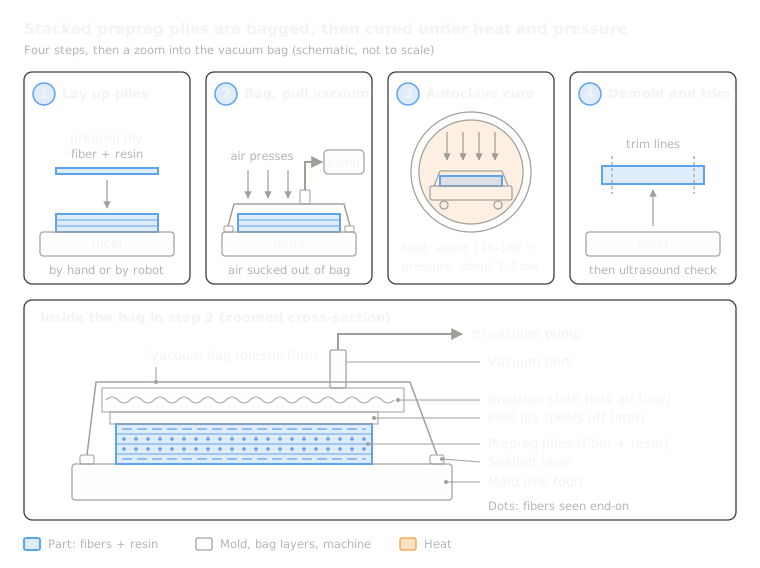 10.1Layup and autoclave curingPrepreg plies stacked on a mold, vacuum-bagged and cured under heat and pressureOpen the lesson
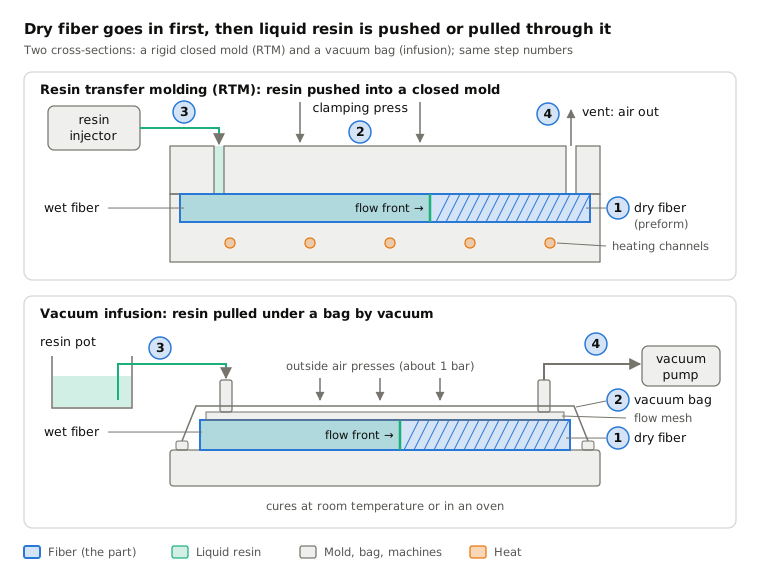
 10.2Resin transfer molding and infusionDry fiber in a mold; liquid resin pushed in (RTM) or pulled in by vacuum (infusion)Open the lesson
 10.3PultrusionFibers pulled through resin and a heated die, nonstopOpen the lesson
Try it
Put AI to work in your CAD.
Model parts, generate drawings and automate the repetitive work inside your CAD software.