

Composites
Composites combine strong fibers (glass, carbon or aramid) with a resin that holds them in place and hardens. The four processes in this chapter differ in how the fibers are placed and how the resin gets to them. Each one builds the material and the part at the same time.
The big idea
The fibers carry the load; the resin keeps them in position, shares the load between them and protects them. Think of reinforced concrete: steel bars take the pull, concrete holds them where they belong. A composite is only strong in the directions its fibers point, so every process here is really about laying fibers where the forces will go. Two choices shape each method: fiber that arrives already soaked in resin (prepreg) or dry fiber that is soaked later with liquid resin; and an open mold with one finished face or a closed mold with two.
The 4 processes in this chapter
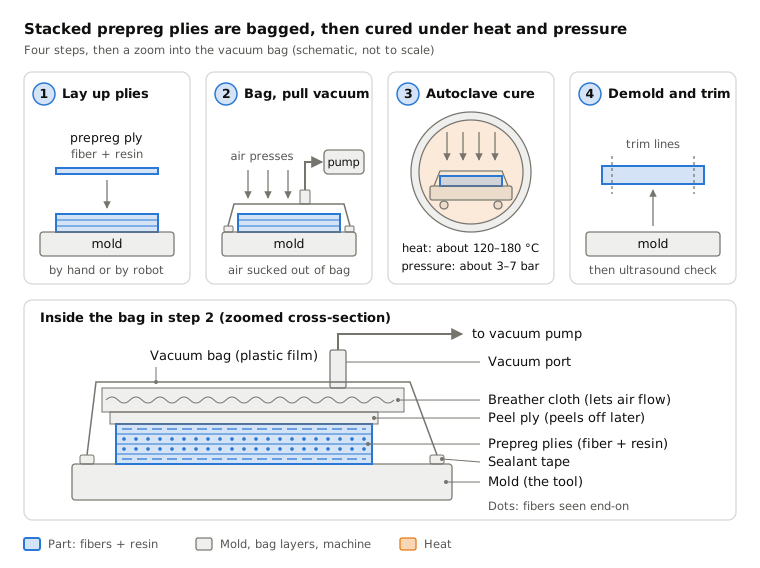
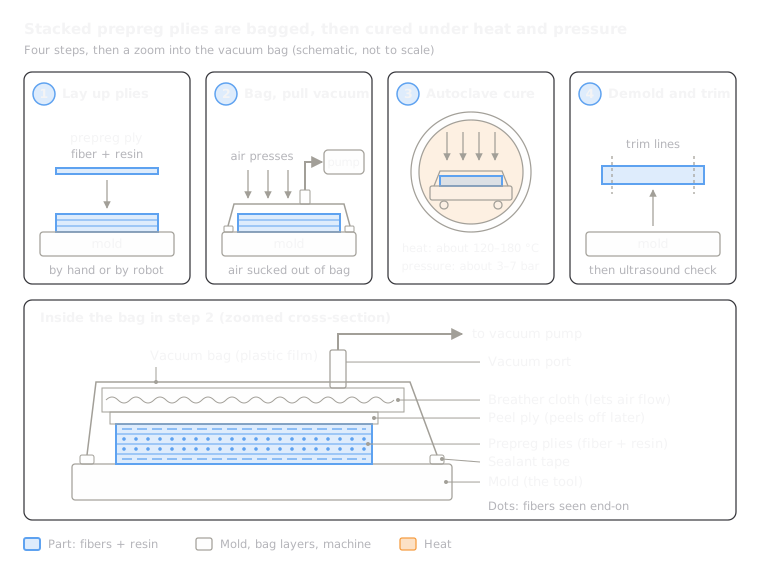 10.1Layup and autoclave curingPrepreg plies stacked on a mold, vacuum-bagged and cured under heat and pressureOpen the lesson
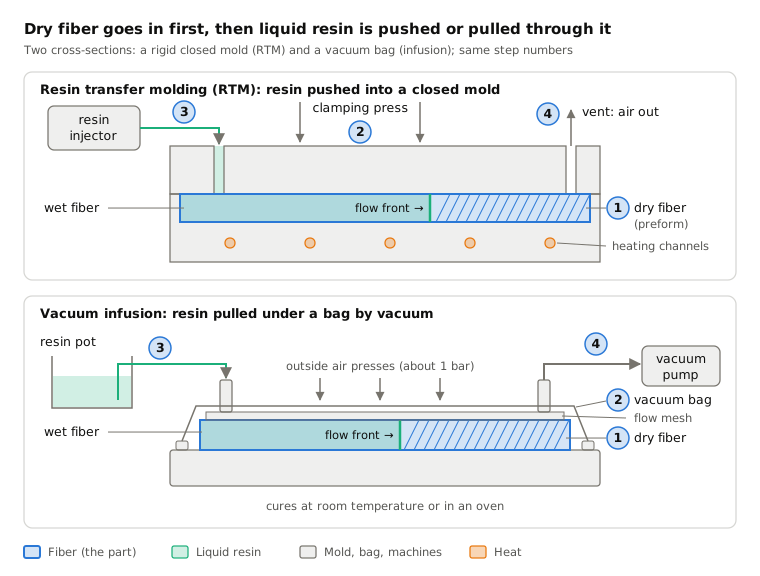
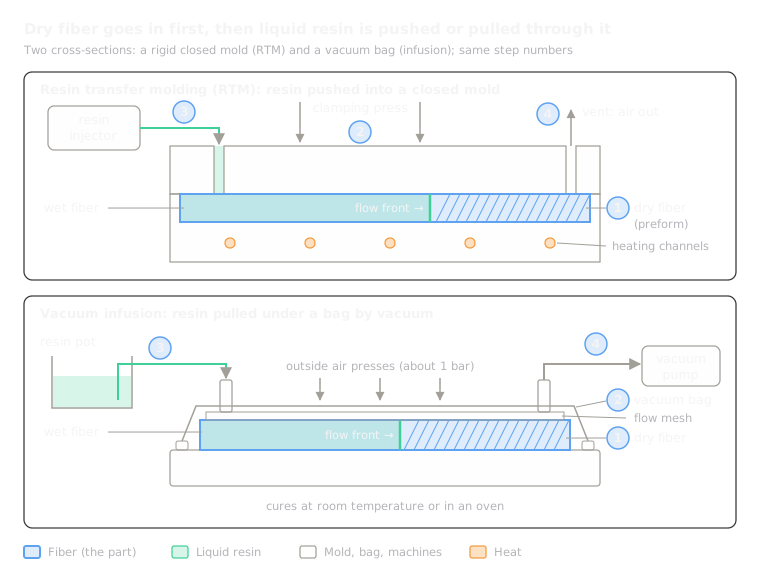 10.2Resin transfer molding and infusionDry fiber in a mold; liquid resin pushed in (RTM) or pulled in by vacuum (infusion)Open the lesson
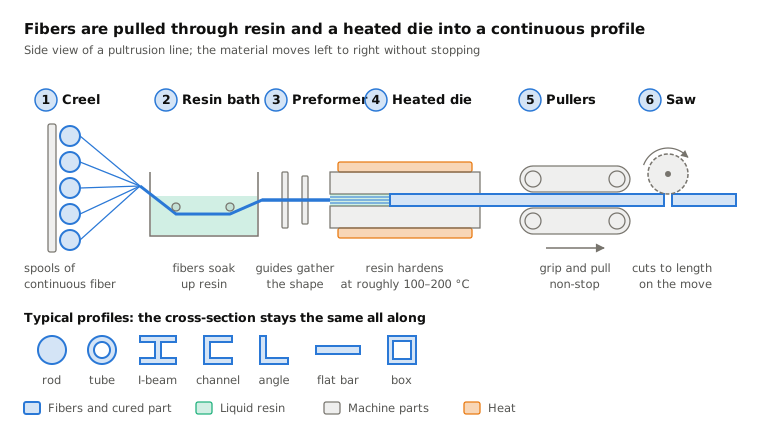
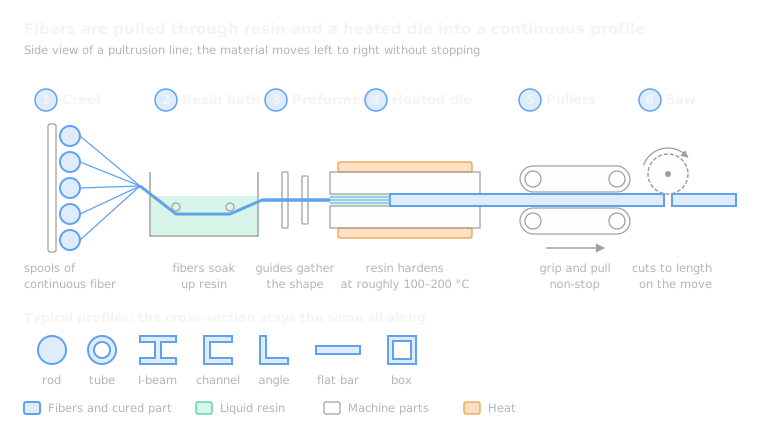 10.3PultrusionFibers pulled through resin and a heated die, nonstopOpen the lesson
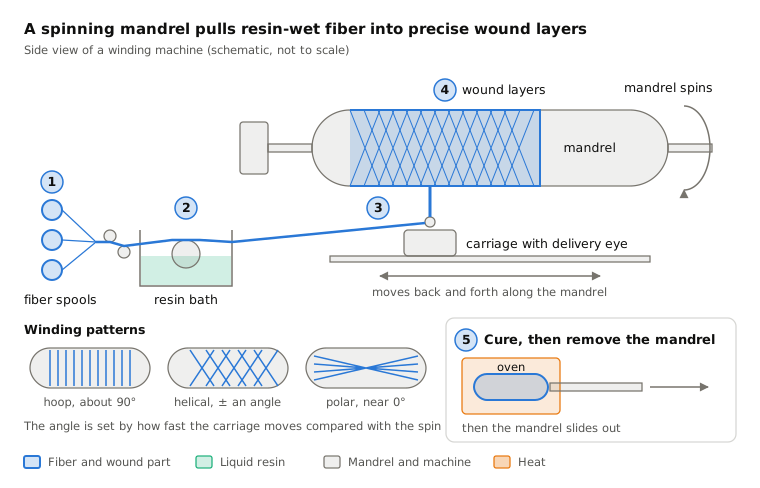
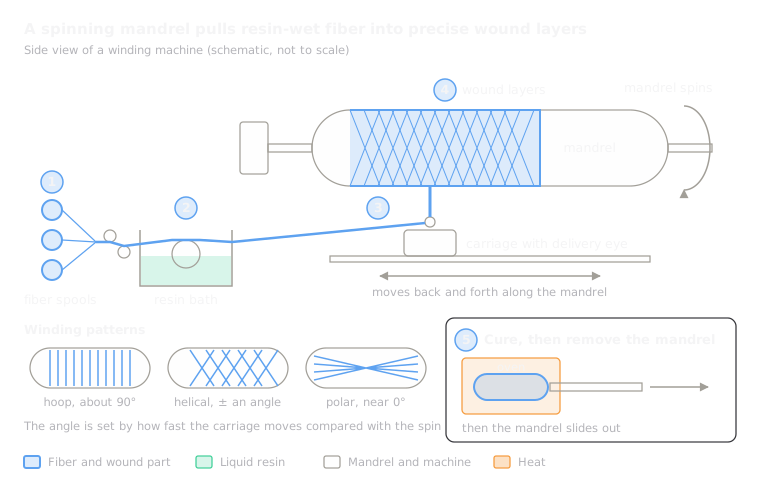 10.4Filament windingResin-wet fiber wound onto a spinning mandrelOpen the lesson
Side by side
| Process | In one line | Best for | Batch size | Precision |
|---|---|---|---|---|
| 10.1Layup and autoclave curing | Prepreg plies stacked on a mold, vacuum-bagged and cured under heat and pressure | The lightest, strongest shells: aircraft, racing cars | One-offs to a few thousand a year | About ±0.2–0.5 mm on the shape |
| 10.2Resin transfer molding and infusion | Dry fiber in a mold; liquid resin pushed in (RTM) or pulled in by vacuum (infusion) | Car parts (RTM); hulls and wind blades (infusion) | One-offs (infusion) to tens of thousands (RTM) | RTM about ±0.2–0.5 mm; infusion one accurate face |
| 10.3Pultrusion | Fibers pulled through resin and a heated die, nonstop | Straight profiles: beams, rods, grating | Kilometers of one profile | About ±0.2–0.5 mm on the section |
| 10.4Filament winding | Resin-wet fiber wound onto a spinning mandrel | Pipes, tanks, pressure vessels, shafts | One-offs to tens of thousands a year | Inside as exact as the mandrel |
How to choose within this family
- Round and hollow, especially under pressure (tanks, pipes): filament winding.
- Long and straight with one cross-section: pultrusion.
- Large shells such as hulls or blades, on a budget: vacuum infusion.
- Medium parts in volume with two good faces: RTM.
- Top performance at any cost, as in aircraft and racing: prepreg layup and autoclave.
Key words
- Fiber
- the strong, stiff thread (glass, carbon, aramid) that carries the load.
- Resin (matrix)
- the liquid plastic that soaks the fibers and hardens around them.
- Cure
- the chemical reaction that turns liquid resin into a hard solid, often sped up by heat.
- Ply
- one layer of fiber cloth or tape in a stack.
- Prepreg
- fiber sold already soaked in partly cured resin, stored frozen until use.
- Preform
- dry fiber already shaped like the part, ready for resin.
- Mandrel
- the core that fiber is wound onto in filament winding.
- Void
- a tiny trapped bubble that weakens the part.
Try it
Put AI to work in your CAD.
Model parts, generate drawings and automate the repetitive work inside your CAD software.