

Powders and ceramics
These processes build solid parts from powders or liquids instead of melting metal or cutting a block. They all rely on sintering: heating packed particles below their melting point until they bond into one solid. What changes from one process to the next is how the particles are shaped, and how heat and pressure are applied.
The big idea
Sintering is how particles stick together without melting. Where two particles touch, atoms drift across the contact point (diffusion) and build a solid bridge, called a neck. As necks grow, the gaps between particles (pores) shrink, so the part gets denser and usually a little smaller. Think of a bowl of snowballs left overnight: they never melt, yet by morning they have fused into one lump. Pressure speeds this up by pushing particles together; fast or internal heating saves time and keeps the tiny crystals fine.
The 6 processes in this chapter
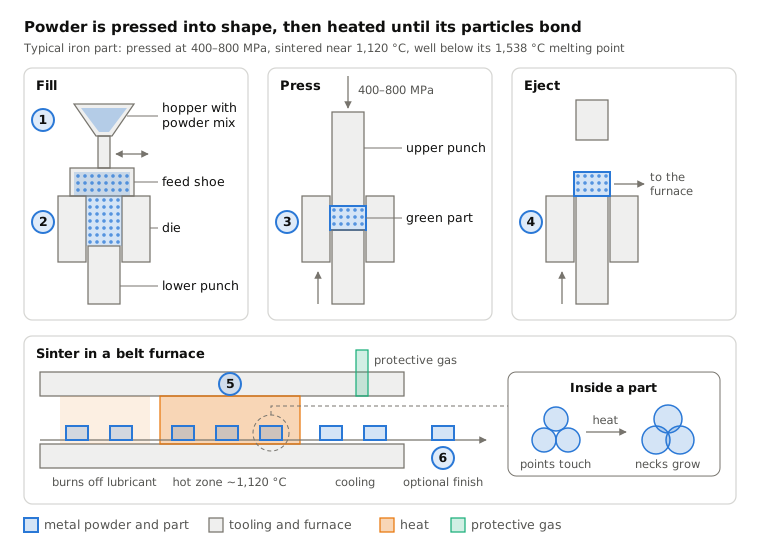
 9.1Powder metallurgy (press and sinter)Press powder in a die, then sinter in a belt furnaceOpen the lesson
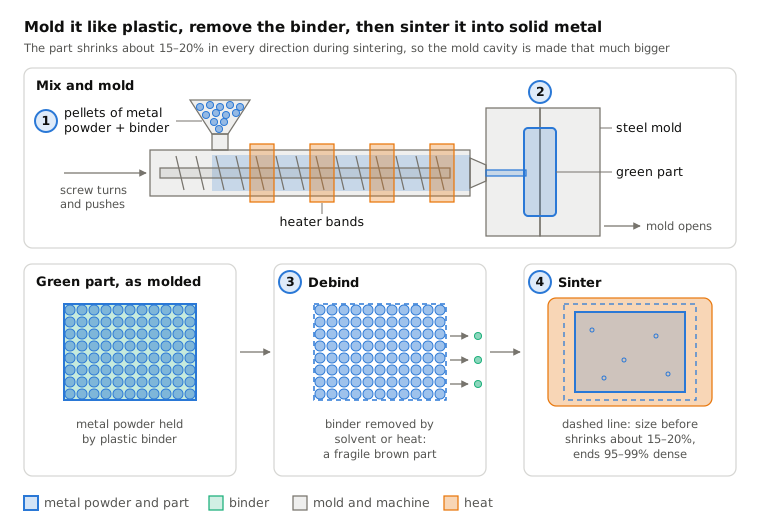
 9.2Metal injection molding (MIM)Mold a powder-and-binder paste, remove the binder, sinterOpen the lesson
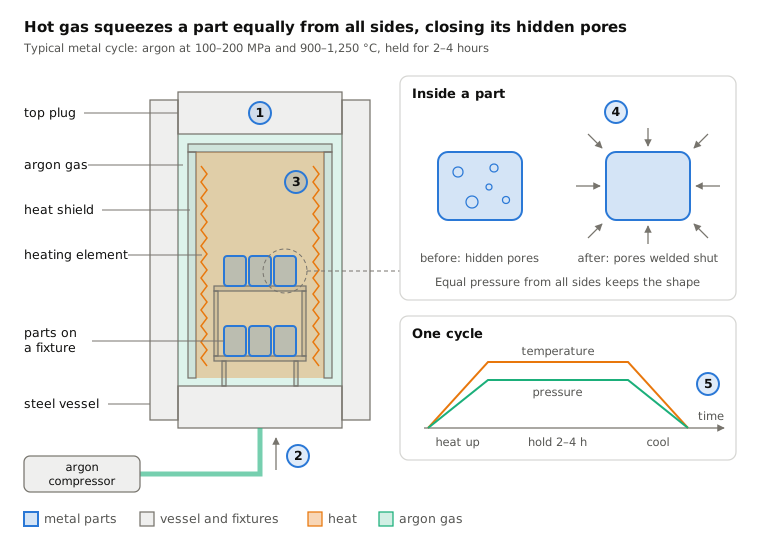
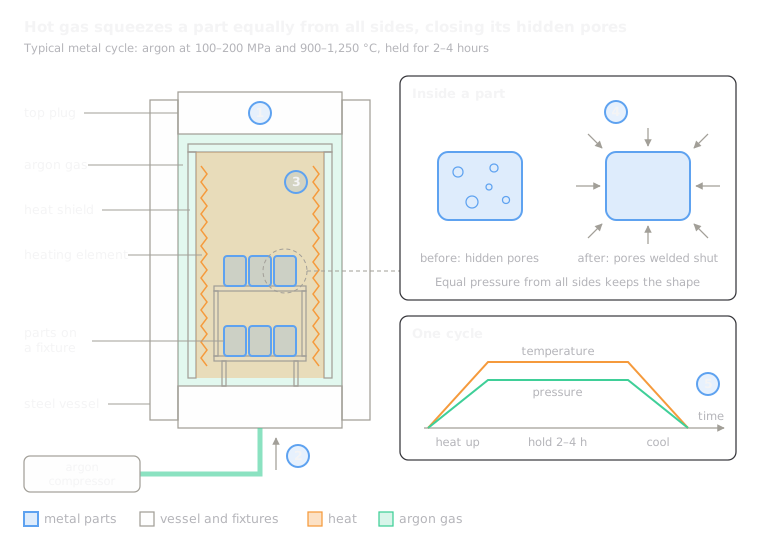 9.3Hot isostatic pressing (HIP)Squeeze with hot argon from all sides to close poresOpen the lesson
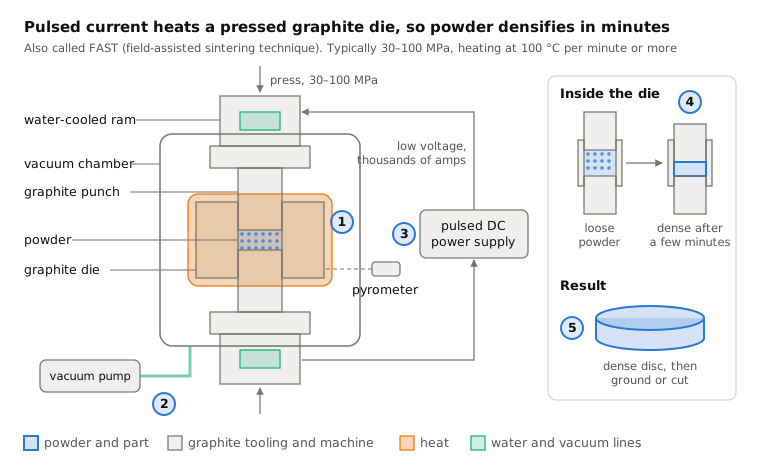
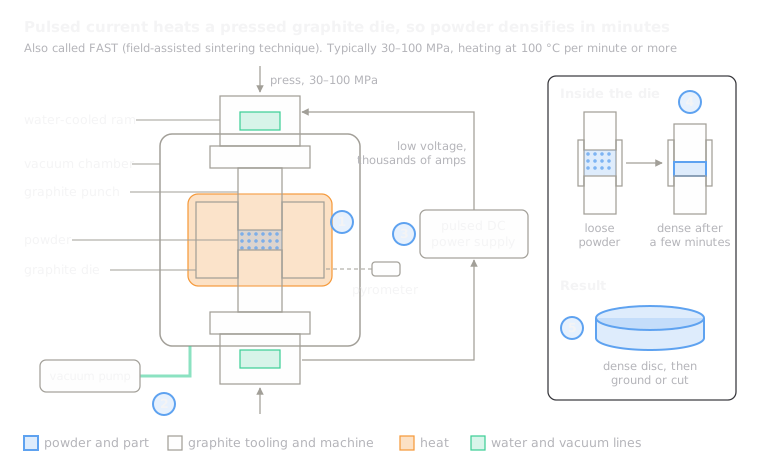 9.4Spark plasma sintering (SPS)Pulsed current heats a pressed graphite die in minutesOpen the lesson
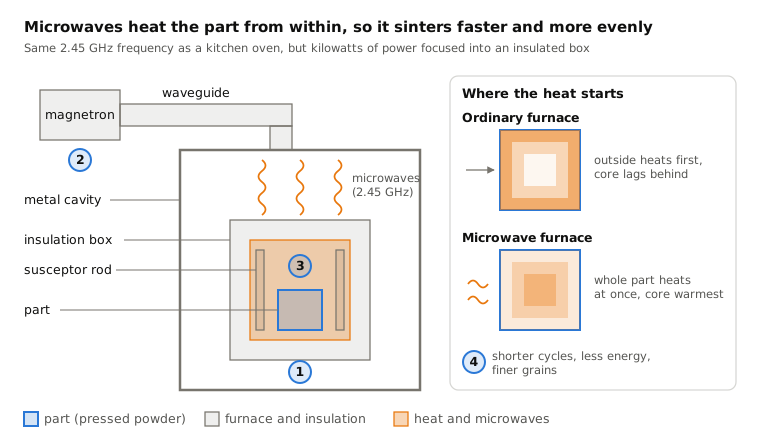
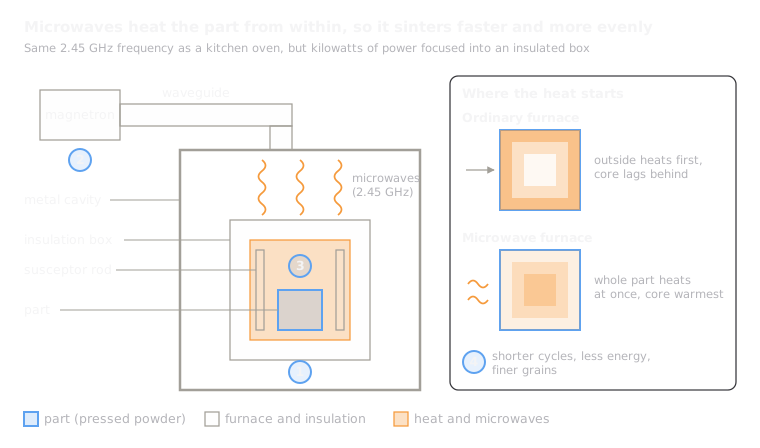 9.5Microwave sinteringMicrowaves heat the part from withinOpen the lesson
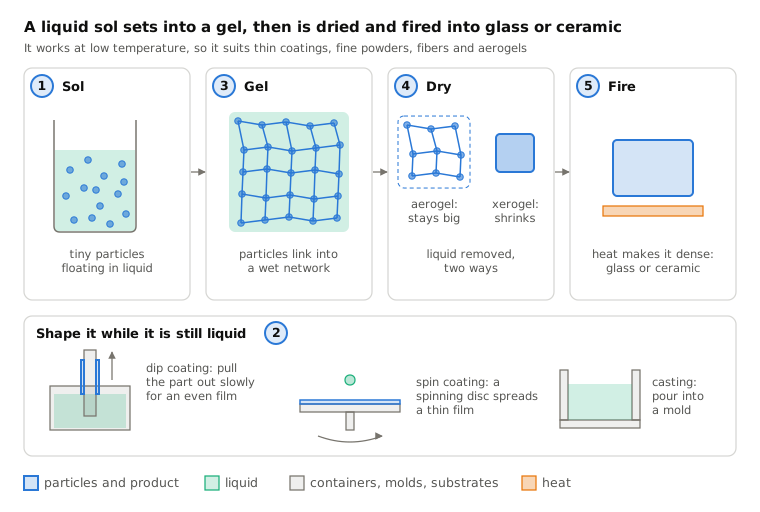
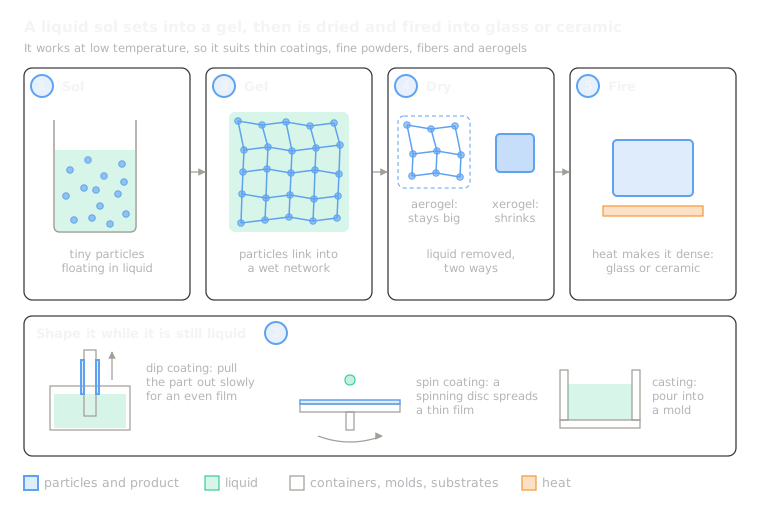 9.6Sol-gel processingA liquid sets into a gel, then is dried and firedOpen the lesson
Side by side
| Process | In one line | Best for | Batch size | Precision |
|---|---|---|---|---|
| 9.1Powder metallurgy (press and sinter) | Press powder in a die, then sinter in a belt furnace | Small gears, bushings, simple-outline parts | 10,000 to millions a year | About ±0.05–0.1 mm |
| 9.2Metal injection molding (MIM) | Mold a powder-and-binder paste, remove the binder, sinter | Tiny, complex, nearly dense steel parts | 10,000 to millions a year | About ±0.3–0.5% of a dimension |
| 9.3Hot isostatic pressing (HIP) | Squeeze with hot argon from all sides to close pores | Critical castings, printed parts, powder in cans | One part to full furnace loads | Shape kept; only pores shrink |
| 9.4Spark plasma sintering (SPS) | Pulsed current heats a pressed graphite die in minutes | Hard ceramics and new materials as discs | One-offs, small batches | Rough; ground afterward |
| 9.5Microwave sintering | Microwaves heat the part from within | Ceramics such as dental zirconia | Lab work to small batches | Like other sintering, about ±0.5–1% |
| 9.6Sol-gel processing | A liquid sets into a gel, then is dried and fired | Thin coatings, aerogels, pure powders | Single samples to coating lines | Films to tens of nanometers |
How to choose within this family
- Need hundreds of thousands of simple metal parts cheaply: press-and-sinter powder metallurgy.
- Need small, complex metal parts that are nearly fully dense: metal injection molding.
- Need to remove hidden pores from a casting or 3D print that must not fail: hot isostatic pressing.
- Need a dense disc of a hard-to-sinter or new material, fast: spark plasma sintering, or microwave sintering for ceramics without pressure.
- Need a thin, pure coating or an ultra-light material: sol-gel processing.
Key words
- Sintering
- bonding packed particles by heating them below their melting point.
- Neck
- the solid bridge that grows where two particles touch.
- Diffusion
- atoms slowly drifting through a solid; it is what builds the necks.
- Porosity
- the share of a part's volume that is empty pores.
- Green part
- a shaped part before sintering, held together only weakly.
- Binder
- a wax or plastic that holds powder in shape until it is removed.
- Density
- how much of a part is solid material; 100% means no pores.
- Shrinkage
- the size a part loses as its pores close during sintering.
Try it
Put AI to work in your CAD.
Model parts, generate drawings and automate the repetitive work inside your CAD software.