

Microwave sintering
Microwaves heat the part from within
Microwave sintering heats a pressed powder part with microwaves instead of hot furnace walls. The energy is absorbed inside the material, so the whole part warms at once, much as a kitchen microwave heats soup from within. That can cut sintering cycles from many hours to much less, and keep the material's structure finer.
How it works
Load the part. A pressed powder part (often a ceramic) is placed inside a box of insulation that lets microwaves through but keeps heat in. Rods of silicon carbide, called susceptors (materials that absorb microwaves well), often stand beside it.
Make microwaves. A magnetron (the tube that also powers a kitchen oven) produces microwaves, typically at 2.45 GHz and several kilowatts. A metal channel called a waveguide carries them into a closed metal cavity, where they bounce around.
Heat from inside. The part's molecules and charges absorb the waves and turn them into heat throughout its volume. Many ceramics barely absorb microwaves when cold, so the susceptors heat them first until they start to absorb on their own (“hybrid” heating).
Sinter and cool. At temperature (for example about 1,200–1,500 °C for many ceramics), the particles bond and the part shrinks and densifies as in any sintering. A pyrometer (a contactless thermometer) watches the temperature and the power is adjusted, then the part cools in the box.
Key facts
- Materials
- Mainly ceramics (alumina, zirconia, ferrites, silicon nitride); also powder metal parts and some composites
- Typical parts
- Dental zirconia crowns, ceramic components, hard-metal tips, research samples
- Part size
- Mostly small to medium: from a few grams to parts a few tens of centimeters long
- Precision
- Like other sintering: shrinkage must be predicted; often about ±0.5–1% of a dimension as sintered
- Surface finish
- As sintered, like the pressed part; ground or polished where needed
- Batch size it suits
- Lab work, small batches, and a few continuous industrial lines
- Tooling and machine cost
- No shape tooling (the part is shaped beforehand); furnaces from small lab units to industrial systems costing hundreds of thousands of dollars
- Speed
- Often minutes to a few hours per cycle, typically much shorter than a conventional furnace for the same part
Strengths and limits
Strengths
- Fast heating from inside, so shorter cycles
- Less energy wasted heating furnace walls
- Finer grains, often giving stronger parts
- Compact equipment for small labs and clinics
Limits
- Many materials absorb poorly when cold and need susceptors
- Hot spots and “thermal runaway” (a spot that overheats faster and faster) can crack parts
- Temperature is hard to measure and control evenly
- Metals reflect microwaves, so bulk metal parts are harder to treat
Where it's used
- DentalFast sintering of zirconia crowns and bridges in clinic-sized furnaces
- Advanced ceramicsAlumina, silicon nitride and ultra-high-temperature ceramics for extreme heat
- ElectronicsFerrites and other electroceramics
- Additive manufacturingSintering of printed metal and ceramic parts in microwave kilns
- ResearchFast trials of new ceramic and composite recipes
How to recognize it
- You usually cannot tell from the part: it looks like any sintered ceramic or metal piece.
- The furnace gives it away: a metal box fed by a waveguide, with no glowing heating elements inside.
- Lab and maker parts often sit in a white fiber-insulation box or a silicon carbide crucible.
Compare with
Watch it
National Science Foundation News · Why microwave furnaces speed up ceramic making, with lab footage
Hunan WISE Microwave Technology Co., Ltd · The parts of an industrial furnace: magnetrons, waveguides, chamber
The Virtual Foundry, Inc. · The susceptor idea, with 3D-printed metal parts in a crucible
CERAMBOT · A small microwave kiln firing printed ceramic parts
See real photos
- Wikipedia: Sintering — general sintering article with a section on microwave sintering; English Wikipedia has no separate article
- Wikimedia Commons photo search
Remember
- Microwave sintering heats the part itself, not the furnace walls.
- Heating from inside gives shorter cycles and finer grains.
- Poor absorption when cold and hot spots are the main challenges, solved with susceptors and careful control.
More in Powders and ceramics
All 100 processes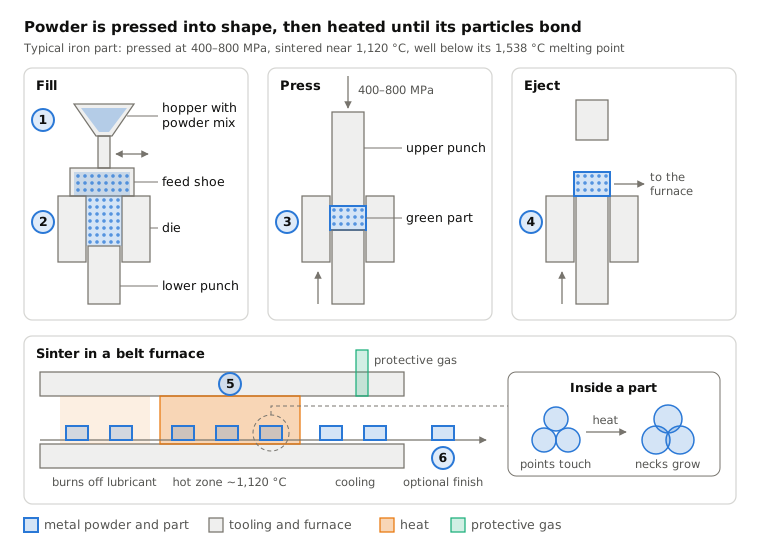
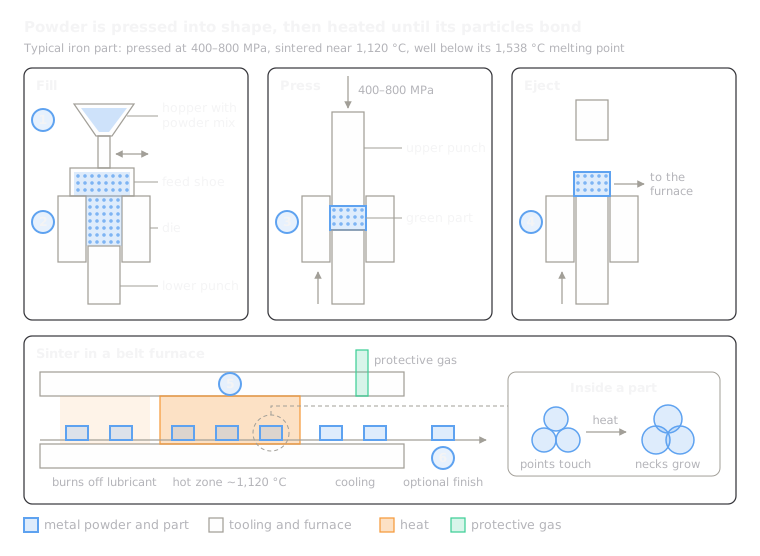 9.1Powder metallurgy (press and sinter)Press powder in a die, then sinter in a belt furnaceOpen the lesson
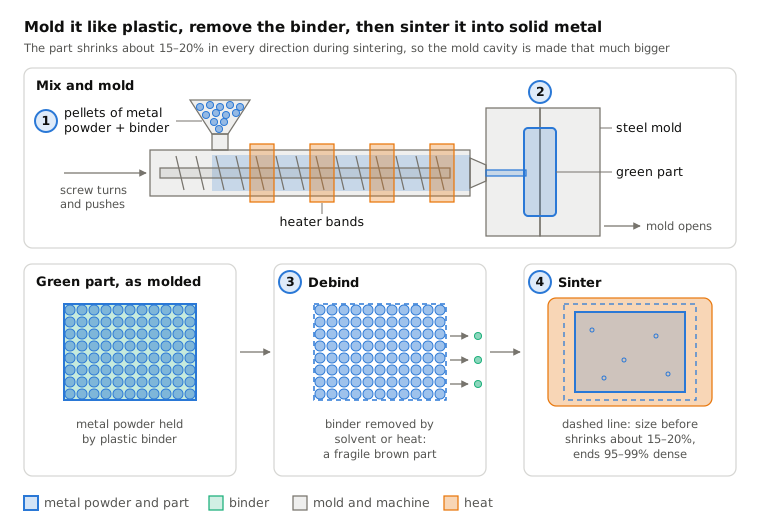
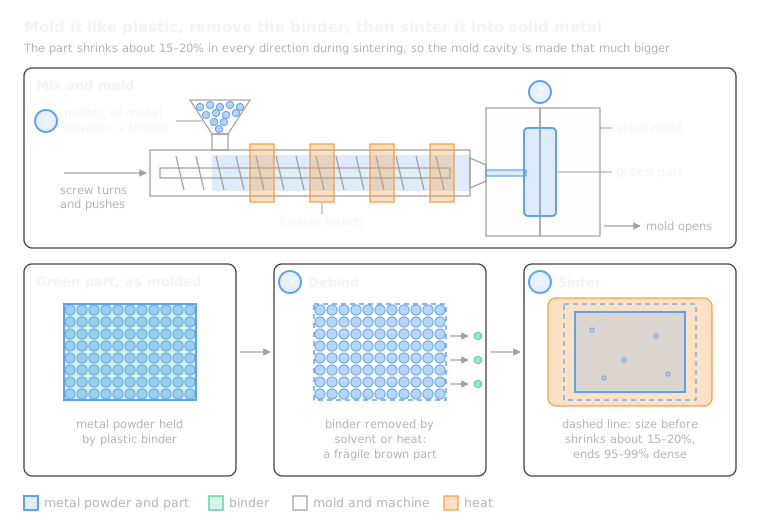 9.2Metal injection molding (MIM)Mold a powder-and-binder paste, remove the binder, sinterOpen the lesson
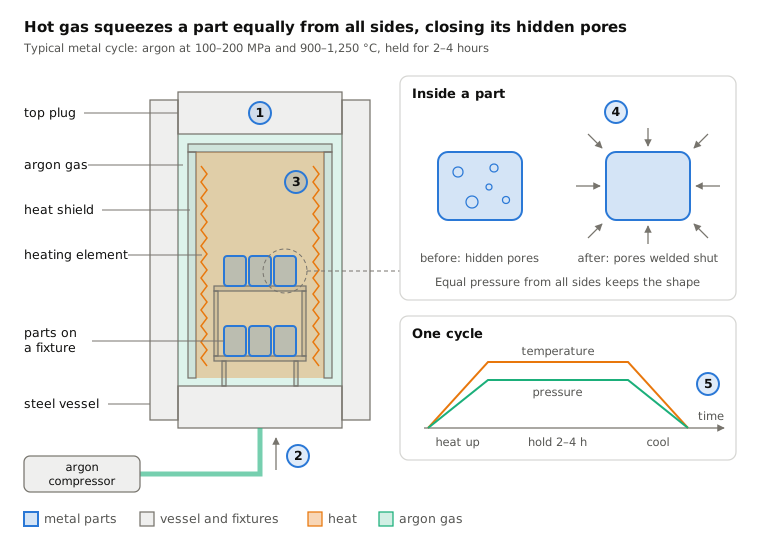
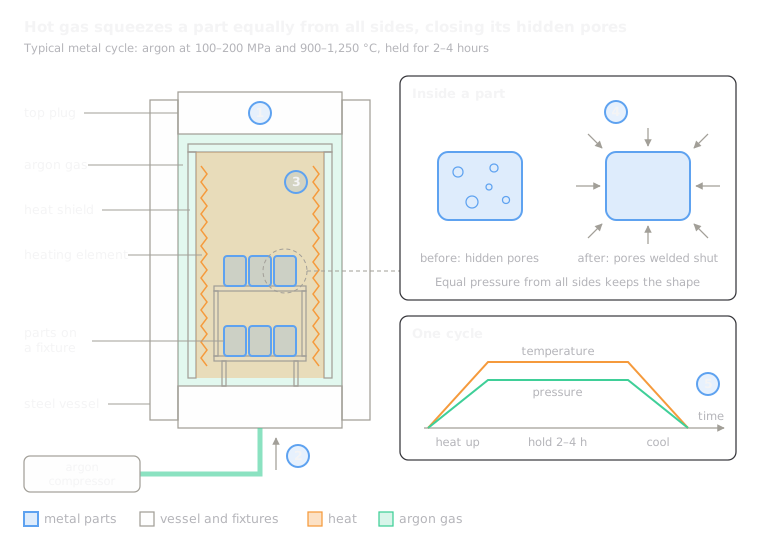 9.3Hot isostatic pressing (HIP)Squeeze with hot argon from all sides to close poresOpen the lesson
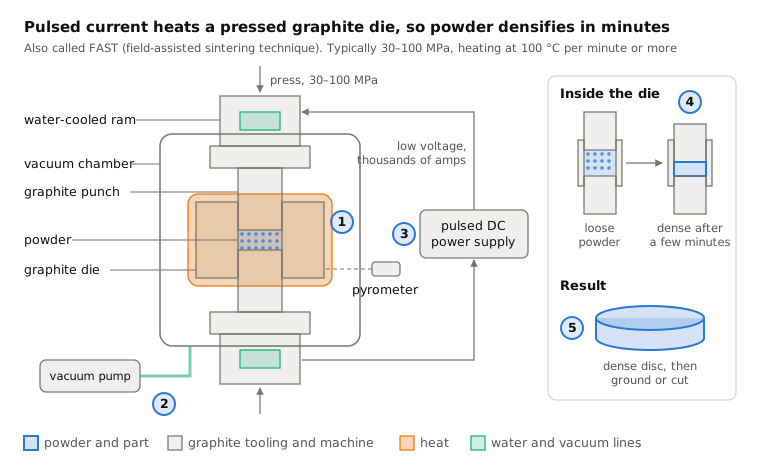
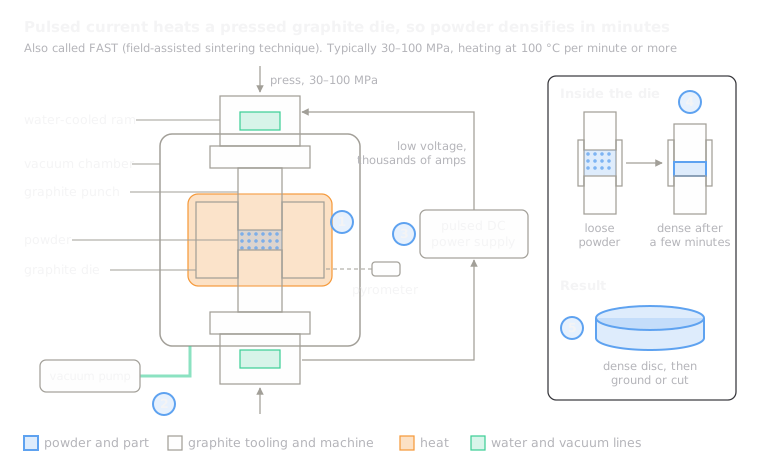 9.4Spark plasma sintering (SPS)Pulsed current heats a pressed graphite die in minutesOpen the lesson
 9.6Sol-gel processingA liquid sets into a gel, then is dried and firedOpen the lesson
Try it
Put AI to work in your CAD.
Model parts, generate drawings and automate the repetitive work inside your CAD software.