

Powder metallurgy (press and sinter)
Press powder in a die, then sinter in a belt furnace
Powder metallurgy makes metal parts without ever melting the metal: you press fine powder into a die, then heat it until the particles bond. Small gears in cordless drills and oil-filled bronze bushings in desk fans are made this way. It is one of the cheapest ways to make small, accurate metal parts by the million.
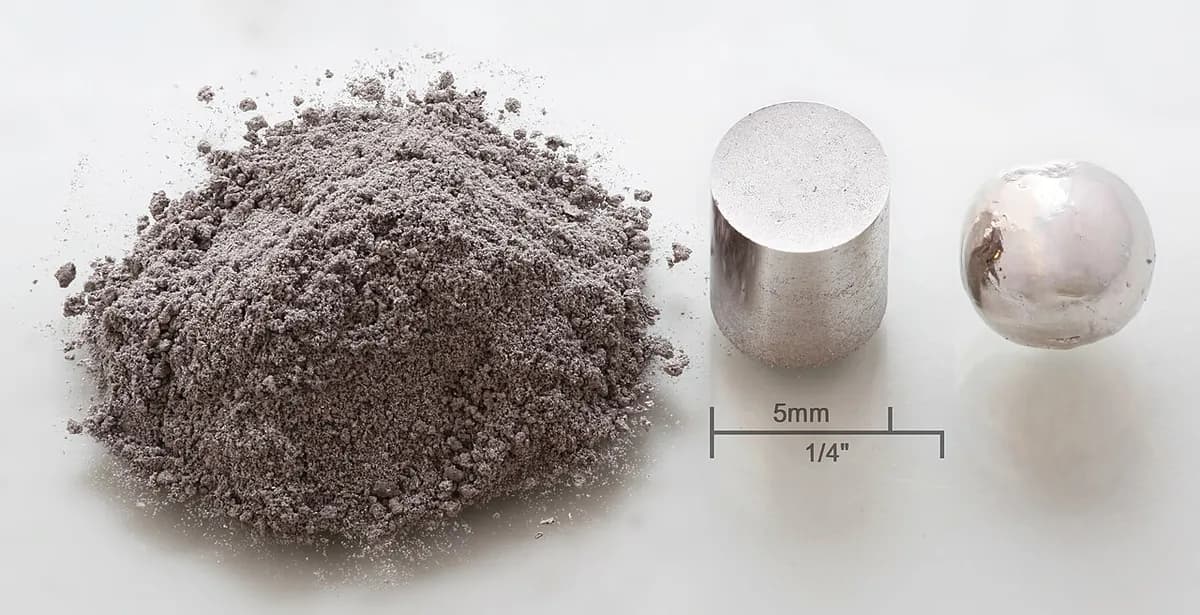
How it works
Blend. Fine metal powder, with grains mostly under 0.15 mm (about like flour), is mixed with alloy powders such as graphite or copper. About 0.5–1% wax lubricant is added so the powder slides in the die.
Fill. A feed shoe slides over the die and drops powder into the cavity (the hollow that gives the shape). The lower punch sits at a set depth, so each fill holds the same amount.
Press. Upper and lower punches squeeze the powder from both ends at about 400–800 MPa (4–8 tonnes per square centimeter). The result is a “green” part: full shape, but held only by interlocked grains, so it is about as fragile as chalk.
Eject. The lower punch rises and pushes the part out. The feed shoe sweeps it aside as it returns to refill, so the press makes a part every few seconds.
Sinter. A mesh belt carries the parts through a long furnace filled with protective gas (gas that prevents oxidation, the reaction behind rust). The lubricant burns off first. Then, at about 1,120 °C for iron and steel, atoms drift across each contact point (diffusion) and grow solid “necks” between particles.
Finish if needed. Many parts are ready as they leave the furnace. Others get a sizing press for tighter dimensions, oil soaking for self-lubricating bearings, heat treatment for hardness, or machining for side holes and threads.
Key facts
- Materials
- Mostly iron and steel; also stainless steel, bronze, brass, copper, aluminum, magnet alloys and tungsten carbide
- Typical parts
- Gears, sprockets, cams, bushings, lock parts, magnets, filters
- Part size
- Typically a few grams to about 2 kg, mostly palm-sized; press force limits the face area
- Precision
- About ±0.05–0.1 mm as sintered; tighter after a sizing press
- Surface finish
- Fine matte gray, roughly Ra 1–3 µm (Ra is the average height of surface bumps)
- Batch size it suits
- High volume: typically from about 10,000 to millions of parts a year
- Tooling and machine cost
- Die set roughly $10,000–100,000; presses and furnaces cost hundreds of thousands to millions of dollars
- Speed
- About 10–30 parts per minute per press; the furnace trip takes roughly 1–3 hours but runs nonstop
Strengths and limits
Strengths
- Near-net shape: little or no machining and very little scrap
- Low cost per part at high volume
- Makes mixes that melting cannot, like copper-tungsten or metal with built-in pores
- Very repeatable from part to part
Limits
- Leftover pores (often 5–15% of the volume) make parts weaker than solid steel
- Die sets are expensive, so small batches rarely pay off
- Shapes must come straight out of the die: no undercuts or side holes
- Size and height are limited by press force and by how evenly powder packs
Where it's used
- AutomotiveOil-pump gears, timing sprockets, valve-timing rotors, gearbox synchronizer hubs
- Power tools and appliancesPlanetary gears; self-lubricating bushings in drills, fans and mixers
- Locks and hardwareLock cams, levers, latch parts
- ElectricalSoft magnetic motor cores, ferrite and rare-earth magnets
- FiltersPorous bronze and stainless steel filters, mufflers on air valves
- Cutting toolsTungsten carbide inserts and drill tips
How to recognize it
- A uniform matte gray surface; under a magnifier you may spot tiny pores.
- Prism-like shapes: the outline stays the same from top to bottom, with flat faces and steps only along the pressing direction.
- Bronze bushings that feel slightly oily, because their pores hold oil.
- Chamfers that end in a tiny flat at the edge, because a knife-sharp punch edge would break.
Compare with
Watch it
MPIF Videos · The whole route from powder to finished part, from the industry association
Simeko AG · What happens between the particles inside the furnace
Comtec Mfg., Inc. · Real compaction presses, a sintering furnace and finished parts
GKN Powder Metallurgy · How the metal powder itself is made, and modern production lines
See real photos
- Wikipedia: Powder metallurgy — overview of the process, with photos of sintered parts
- Wikimedia Commons photo search
Remember
- Press powder into shape, then heat it below its melting point so the particles bond.
- Best for small parts with a simple outline, made by the hundreds of thousands with almost no waste.
- Leftover pores cost some strength, but they make self-lubricating bearings and filters possible.
More in Powders and ceramics
All 100 processes
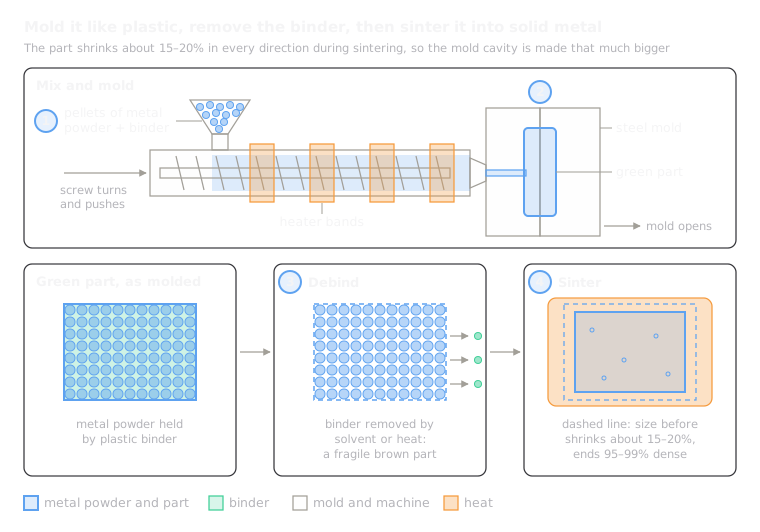 9.2Metal injection molding (MIM)Mold a powder-and-binder paste, remove the binder, sinterOpen the lesson
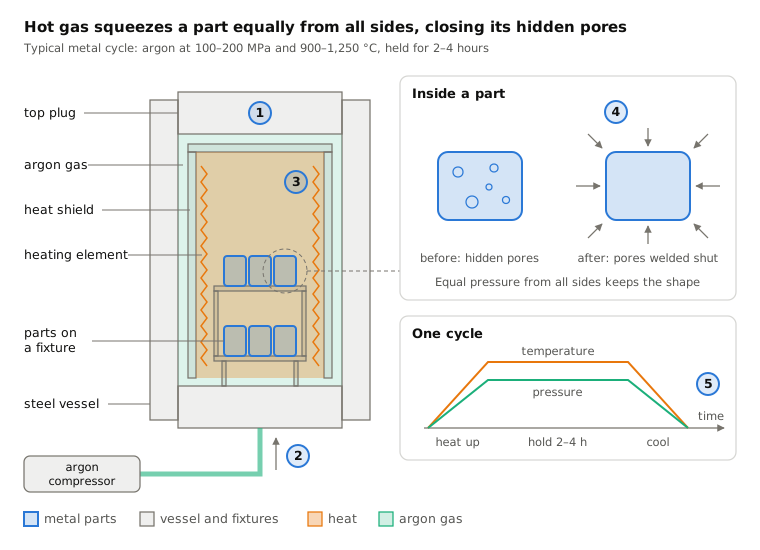
 9.3Hot isostatic pressing (HIP)Squeeze with hot argon from all sides to close poresOpen the lesson
 9.4Spark plasma sintering (SPS)Pulsed current heats a pressed graphite die in minutesOpen the lesson
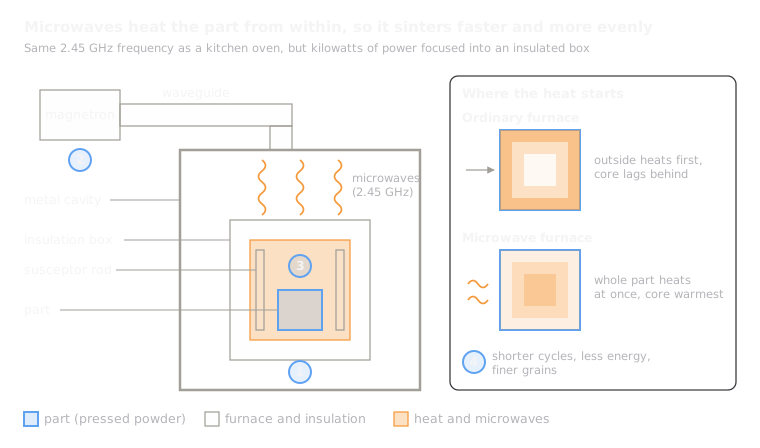 9.5Microwave sinteringMicrowaves heat the part from withinOpen the lesson
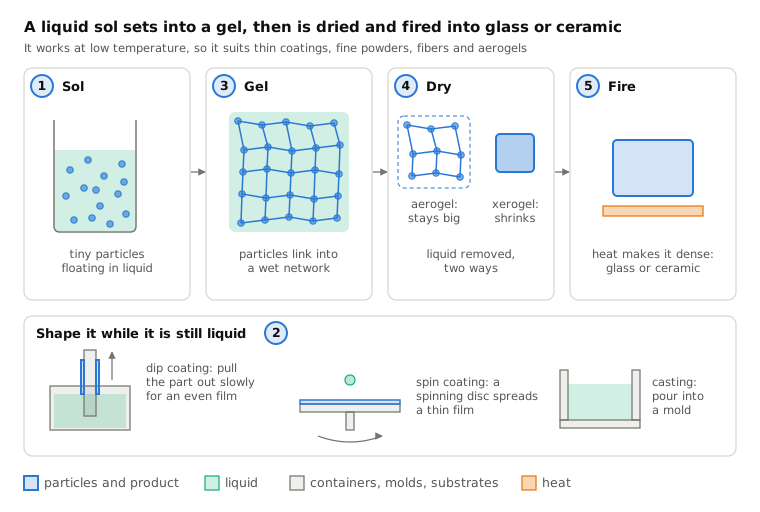
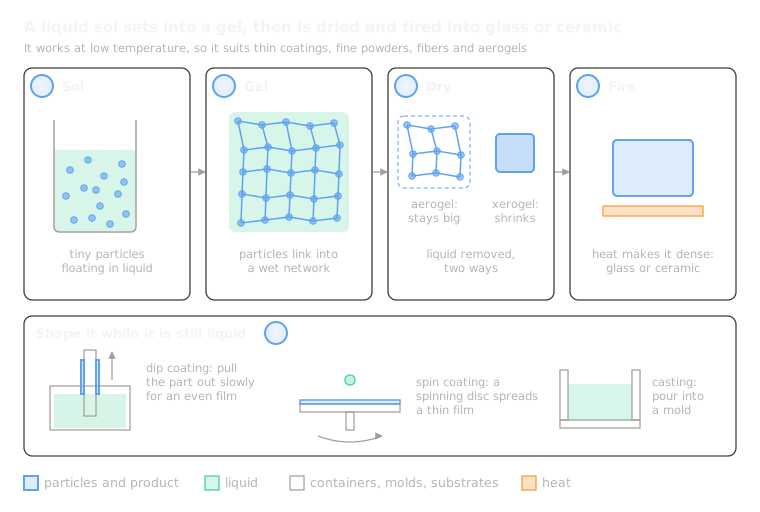 9.6Sol-gel processingA liquid sets into a gel, then is dried and firedOpen the lesson
Try it
Put AI to work in your CAD.
Model parts, generate drawings and automate the repetitive work inside your CAD software.