

Volumetric printing (CAL)
Light from every angle cures a spinning vial of resin all at once (volumetric printing)
Volumetric printing makes a whole object at once inside a vial of liquid resin, with no layers at all. In computed axial lithography (CAL), the vial spins while a projector shines changing light patterns through it, like a CT scan run in reverse. A small object can appear in a minute or two.
How it works
Compute the patterns. Software turns the 3D model into hundreds of 2D light images, one for each viewing angle, much as a CT scanner works in reverse.
Spin the vial. A clear vial of thick, light-sensitive resin turns steadily on a rotating stage.
Project. A projector shows the image that matches the vial's current angle, so every angle gets its own pattern.
Let the dose add up. Each point in the resin collects light from every angle. Only points inside the object pass the threshold (the minimum light dose that makes resin gel) and turn solid.
Drain, rinse and cure. After roughly 30 seconds to a few minutes, the liquid resin is poured off. The object is rinsed and given a final UV cure.
Key facts
- Materials
- Clear, thick photopolymer resins (acrylates), hydrogels that can carry living cells, and resins filled with glass particles that are later fired into glass
- Typical parts
- Small research parts: lenses and optics, glass microfluidic chips, soft tissue scaffolds, objects printed around an existing insert
- Part size
- A few millimeters to a few centimeters, limited by the vial
- Precision
- Features down to about 0.3 mm in the first printers; research systems reach tens of micrometers
- Surface finish
- Very smooth, with no layer lines
- Batch size it suits
- One-offs and research samples
- Tooling and machine cost
- No tooling. Mostly laboratory setups built around a projector and a rotation stage; few commercial machines exist yet
- Speed
- Seconds to a few minutes for a centimeter-sized object
Strengths and limits
Strengths
- No layers: smooth surfaces and no weak layer boundaries
- Very fast for small parts
- No supports, since the thick resin holds the part in place
- Can print around an existing object, such as a metal rod
Limits
- Small objects only, a few centimeters at most
- Resin must be clear and thick, so few materials work
- Light scattering and dose errors blur fine details
- Still mostly a research technique
Where it's used
- Research labsTesting new resins, optics and printing methods
- BiomedicalSoft hydrogel scaffolds with living cells for tissue research
- OpticsSmall lenses and light guides
- MicrofluidicsGlass chips with tiny internal channels
How to recognize it
- Small, perfectly smooth resin objects with no stair steps on curves.
- No support marks anywhere, even under overhangs.
- Sometimes an object fused around an insert, like a handle printed onto a metal shaft.
Compare with
Watch it
Seeker · A beginner's explanation of the Berkeley volumetric printer
The Action Lab · A hands-on demo of an object appearing inside resin
KPIX | CBS NEWS BAY AREA · Real lab footage with the researchers who built it
Berkeley Sensor & Actuator Center · A research talk on how CAL works, including printing in microgravity
See real photos
- Wikipedia: Computed axial lithography — the principle and its history; few images
- Wikimedia Commons photo search
Remember
- Volumetric printing hardens a whole object at once, with no layers.
- CAL spins the resin and lights it from every angle; only where enough light adds up does it turn solid.
- It is fast and smooth, but still small-scale and mostly in research labs.
More in Additive manufacturing
All 100 processes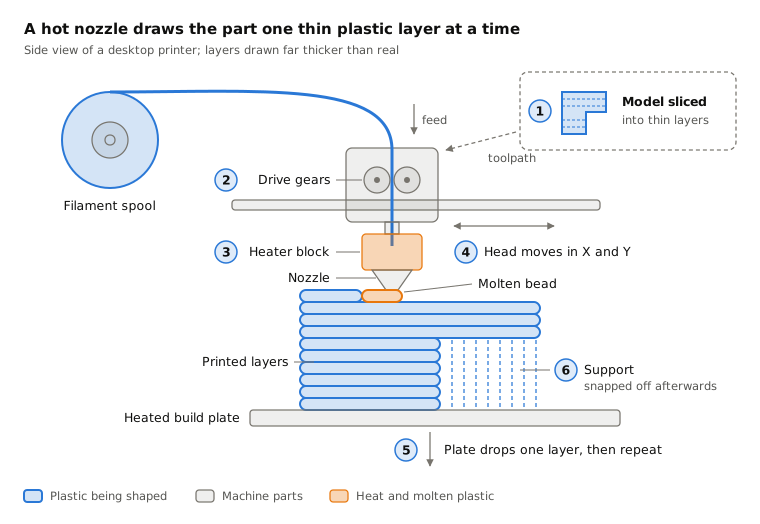
 8.1ShortFDM (fused deposition modeling)Extrudes molten plastic filament through a moving nozzle (material extrusion)Open the lesson
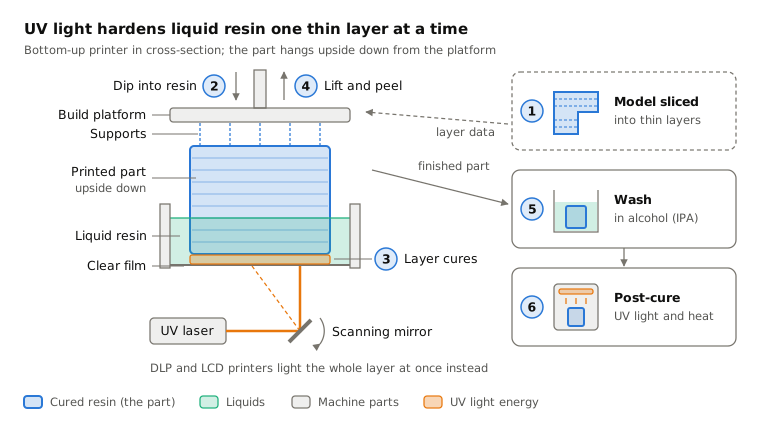
 8.2Stereolithography (SLA/DLP)Hardens liquid resin layer by layer with a laser or projector (vat photopolymerization)Open the lesson
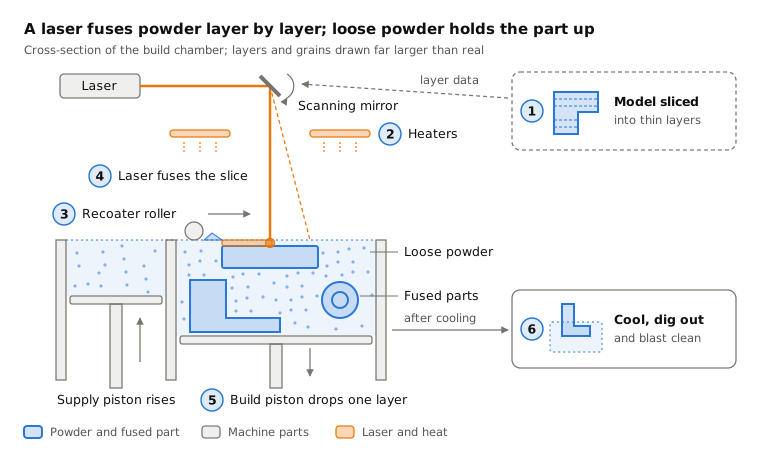
 8.3Selective laser sintering (SLS)A laser fuses nylon powder in a bed; the loose powder supports the part (powder bed fusion)Open the lesson
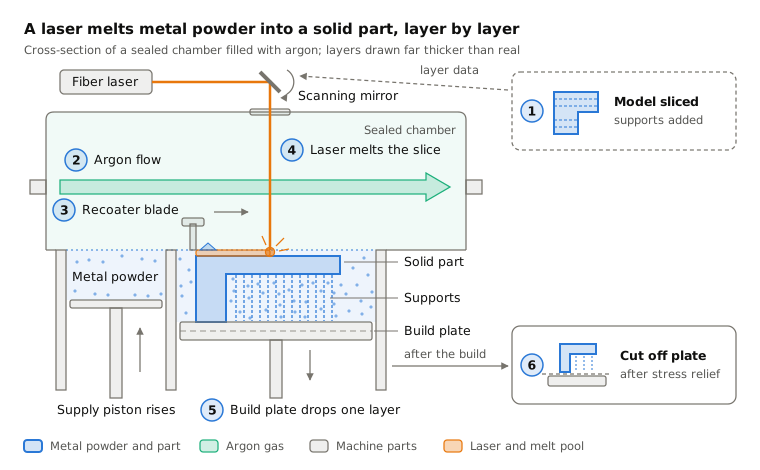
 8.4Laser powder bed fusion (metal, SLM/DMLS)A laser melts thin layers of metal powder (powder bed fusion)Open the lesson
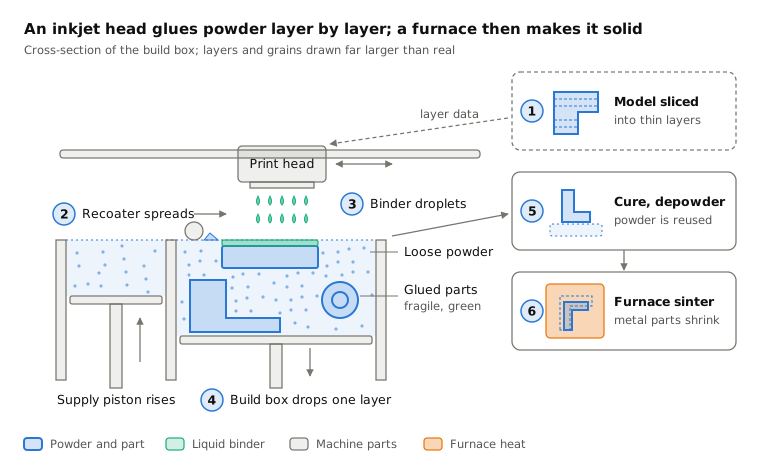
 8.5Binder jettingInkjet heads glue powder, then the part is cured or sintered (binder jetting)Open the lesson
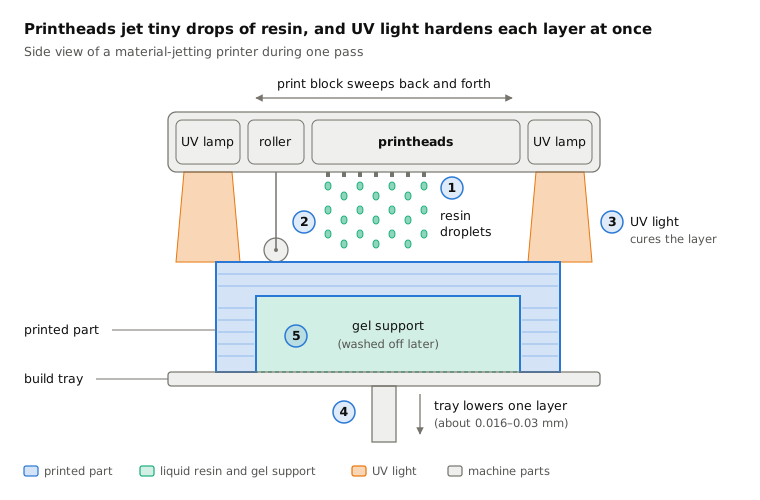
 8.6Material jetting (PolyJet)Jets droplets of resin and cures them with UV light (material jetting)Open the lesson
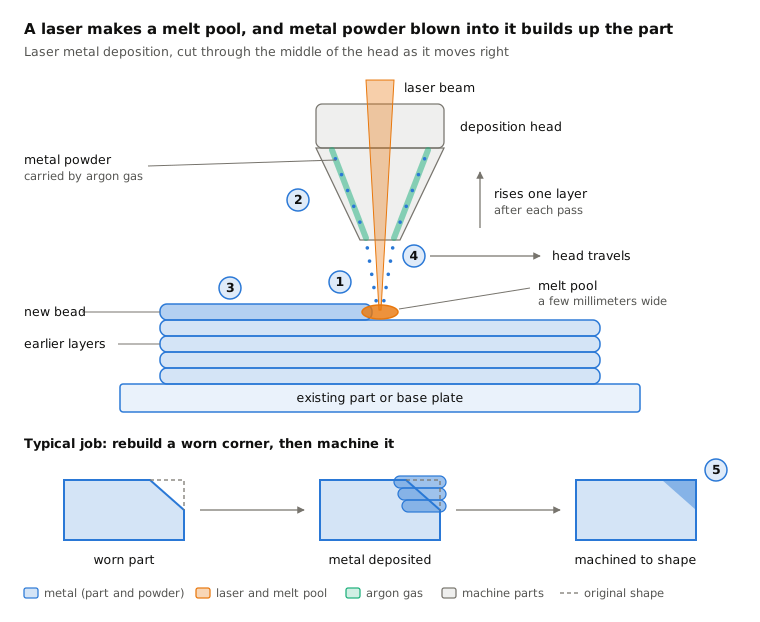
 8.7Directed energy deposition (DED/LMD)A laser melts a pool on the part; blown powder adds metal (directed energy deposition)Open the lesson
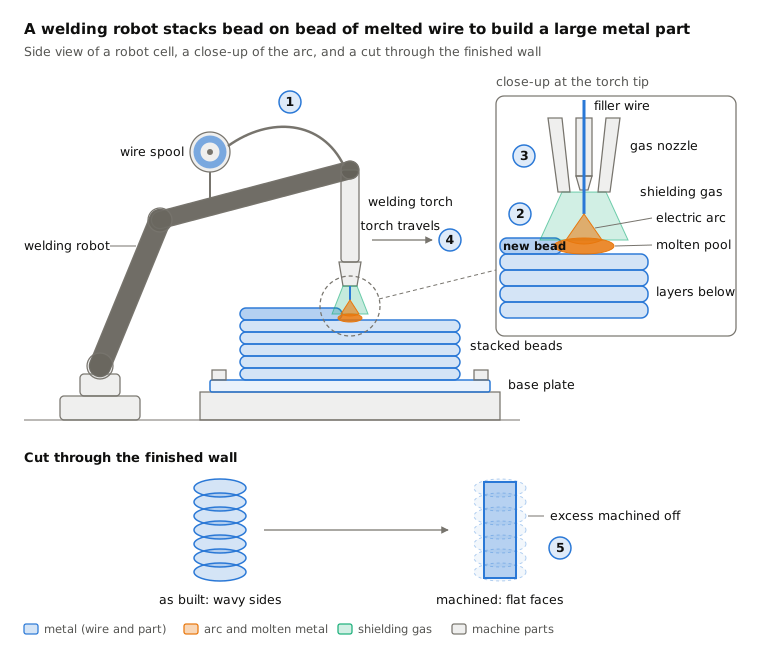
 8.8Wire arc additive manufacturing (WAAM)A welding robot stacks arc-melted wire into beads (directed energy deposition)Open the lesson
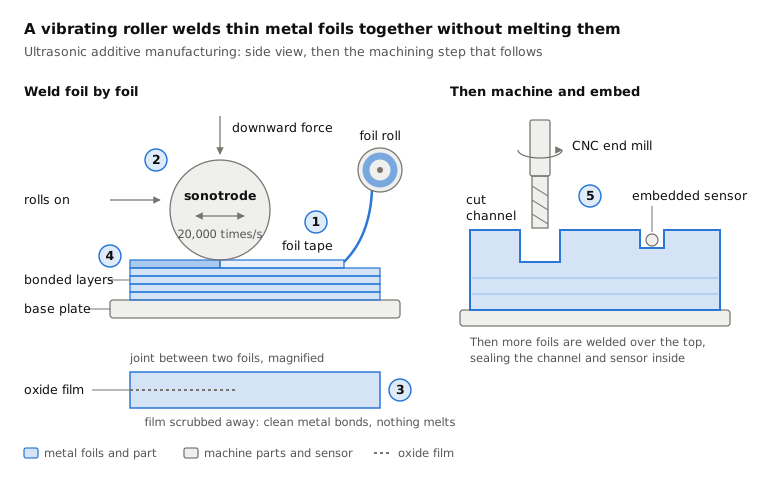
 8.9Ultrasonic additive manufacturing (UAM)Ultrasonic vibration welds metal foils without melting, then a mill trims them (sheet lamination)Open the lesson
Try it
Put AI to work in your CAD.
Model parts, generate drawings and automate the repetitive work inside your CAD software.