

Directed energy deposition (DED/LMD)
A laser melts a pool on the part; blown powder adds metal (directed energy deposition)
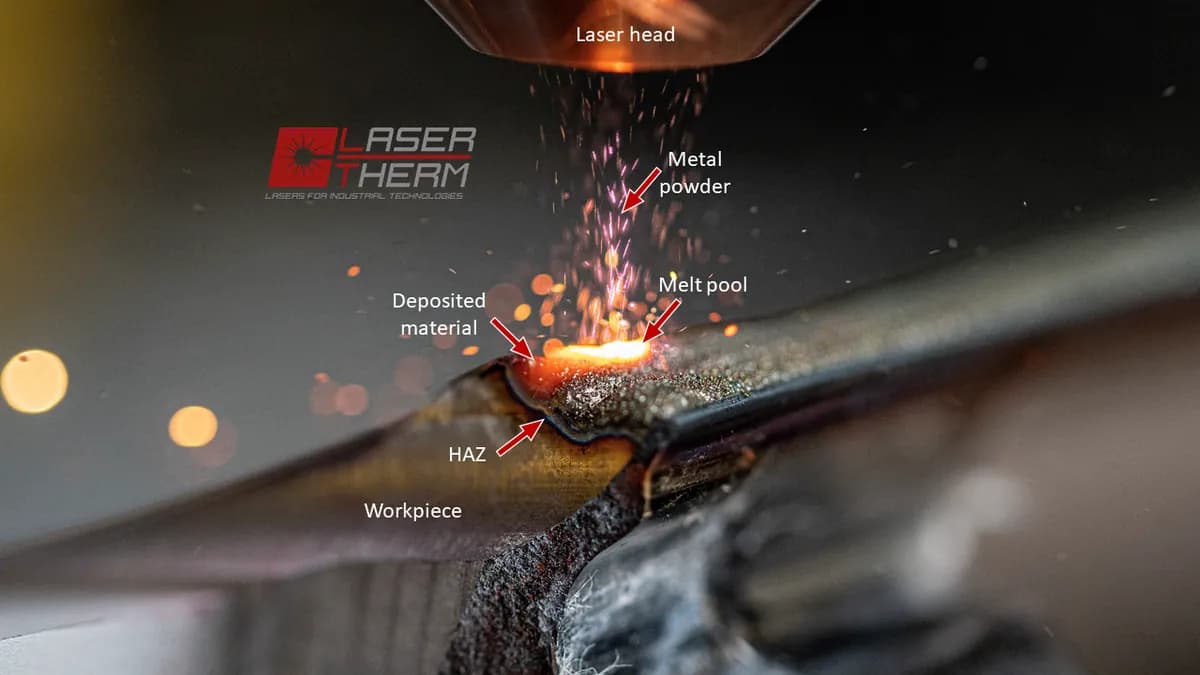
Directed energy deposition (DED) adds metal by melting it exactly where it lands, like a welding torch that builds instead of joins. In laser metal deposition (LMD), its most common form, a laser melts a tiny pool and blown-in powder becomes new metal. It is the go-to method for repairing costly worn parts and adding features to existing ones.
How it works
Melt a small pool. A focused laser beam, typically hundreds of watts to a few kilowatts, melts a spot on the part. This melt pool (a tiny puddle of liquid metal) is a few millimeters wide.
Blow in the powder. Nozzles around the beam blow fine metal powder into the pool. Argon (an inert gas) carries the powder and shields the hot metal from air.
Let the bead freeze. The powder melts into the pool. As the head moves on, the metal behind it cools in a fraction of a second into a bead (a raised track of new metal).
Trace the layer, then step up. A robot or 5-axis machine (one that can also tilt and turn the part) guides the head along each layer's path. Then it rises one layer and repeats.
Machine to size. The surface comes out rippled and slightly oversize, so the part is milled or ground to its final shape. In a repair, this restores the original outline.
Key facts
- Materials
- Weldable metals: titanium alloys, nickel superalloys (heat-resistant alloys for jet engines), stainless and tool steels, cobalt and copper alloys. Mixing two powders can grade one metal into another
- Typical parts
- Repaired turbine blades, shafts and molds; wear-resistant coatings; features added to existing parts; near-net-shape blanks (close to final shape, needing only light machining)
- Part size
- From a few millimeters of repair up to parts over 1 m, limited by the robot or machine reach
- Precision
- About ±0.5 mm as deposited; final machining brings it to about ±0.05 mm
- Surface finish
- Rough and rippled as deposited; smooth only after machining
- Batch size it suits
- One-offs, repairs and small batches
- Tooling and machine cost
- No tooling. Industrial laser systems typically cost several hundred thousand to over a million dollars
- Speed
- Typically about 0.1–2 kg of metal per hour: faster than powder-bed fusion, slower than WAAM
Strengths and limits
Strengths
- Adds metal to existing parts, so worn parts can be repaired
- Builds large parts without a powder bed
- Can switch or blend metals within one part
- A tilting 5-axis head builds many overhangs without supports
Limits
- Rough surfaces: almost every part needs machining afterward
- Coarser detail than powder-bed fusion: no fine lattices or tiny holes
- Heat causes stress and distortion that must be managed
- Costly lasers, and fine metal powder is a fire and breathing hazard
Where it's used
- AerospaceRepairing turbine blade tips and blisks (one-piece bladed disks); titanium preforms
- Power generationRestoring worn turbine and pump parts
- Oil and gasWear- and corrosion-resistant cladding on drilling tools and valves
- ToolingRepairing and modifying molds and dies instead of replacing them
- Heavy industryRebuilding worn shafts, rollers and gears
How to recognize it
- Fine, parallel ripples on the surface, one for each bead laid by a pass of the head.
- A boundary line where new metal meets the original part, visible on a cut or polished surface.
- Machined faces right next to rough, wavy ones on the same part.
- Thick walls with rounded, bead-shaped edges rather than sharp corners.
Compare with
Watch it
3Dnatives · A two-minute beginner's tour of DED, its materials and its uses
AM Media | The Cool Parts Show · An expert compares powder and wire feed and explains why 5-axis heads need no supports
AM Media | The Cool Parts Show · Real repair work: new metal laid on worn blade tips
Vision Miner · The wire-fed version of laser deposition at work
See real photos
- Wikipedia: Directed energy deposition — how the powder-fed and wire-fed versions work; few photos
- Wikimedia Commons photo search
Remember
- DED melts metal exactly where it is added, using a focused heat source and powder or wire.
- It shines at repairing and adding to existing parts, and at building large, rough shapes.
- Plan for machining: parts come off the machine rippled and slightly oversize.
More in Additive manufacturing
All 100 processes
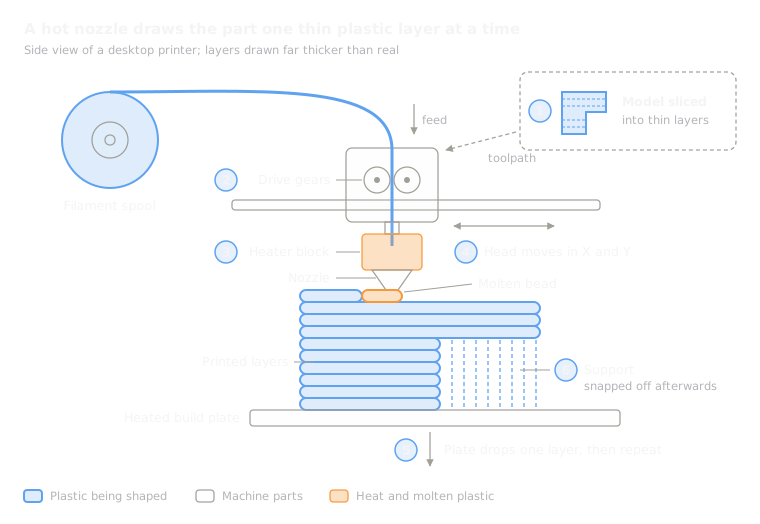 8.1ShortFDM (fused deposition modeling)Extrudes molten plastic filament through a moving nozzle (material extrusion)Open the lesson
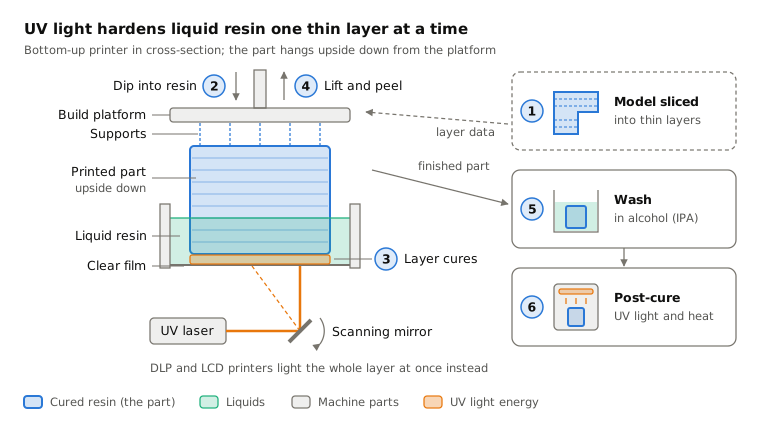
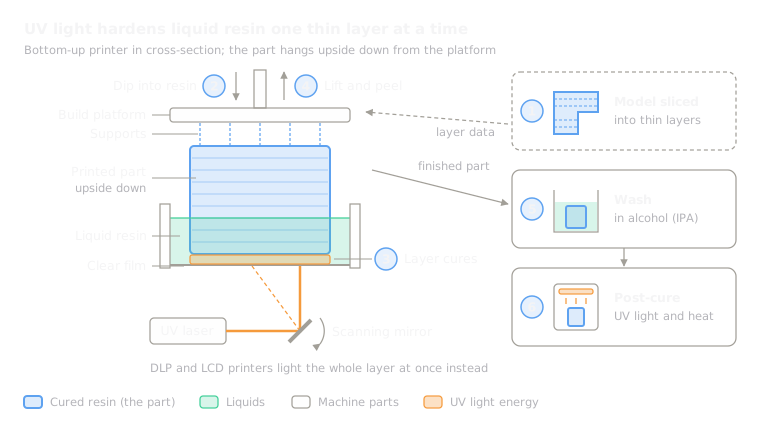 8.2Stereolithography (SLA/DLP)Hardens liquid resin layer by layer with a laser or projector (vat photopolymerization)Open the lesson
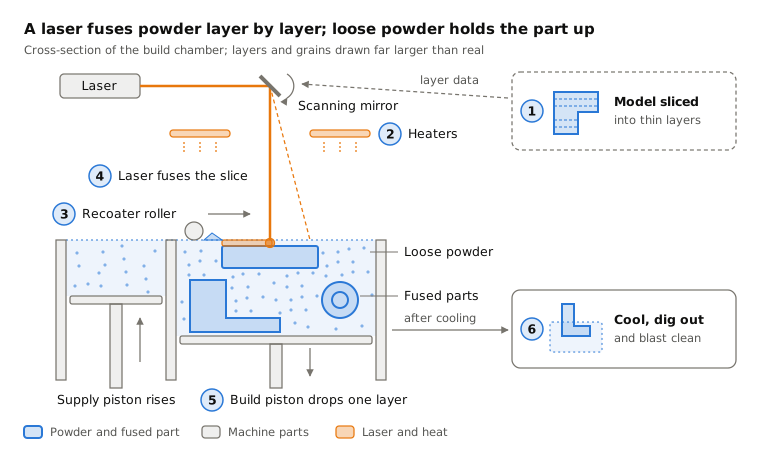
 8.3Selective laser sintering (SLS)A laser fuses nylon powder in a bed; the loose powder supports the part (powder bed fusion)Open the lesson
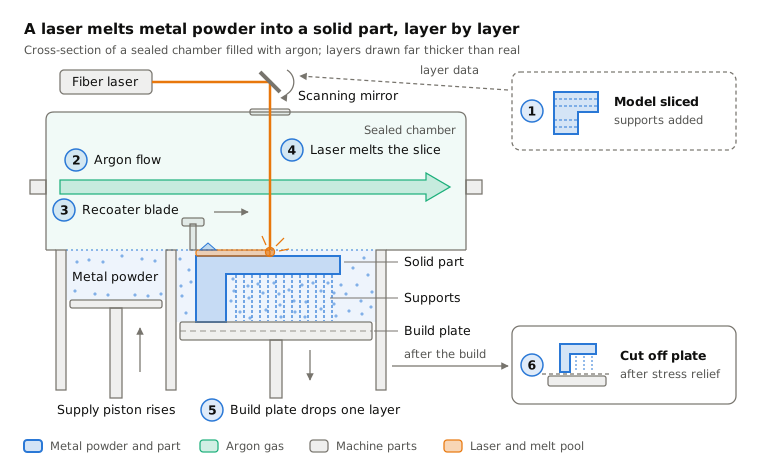
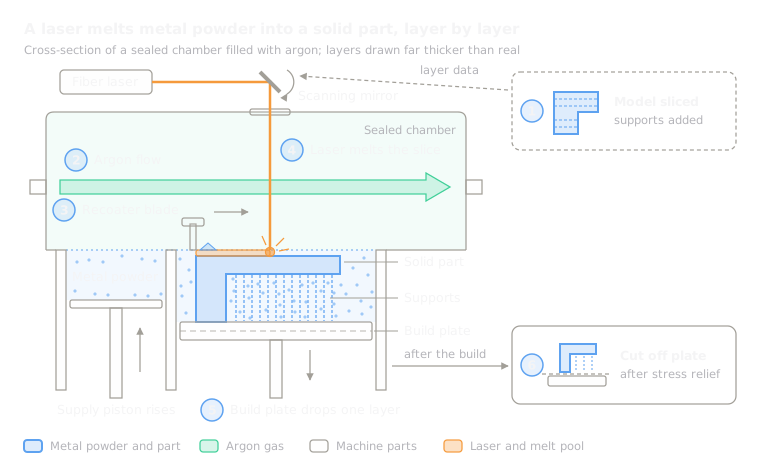 8.4Laser powder bed fusion (metal, SLM/DMLS)A laser melts thin layers of metal powder (powder bed fusion)Open the lesson
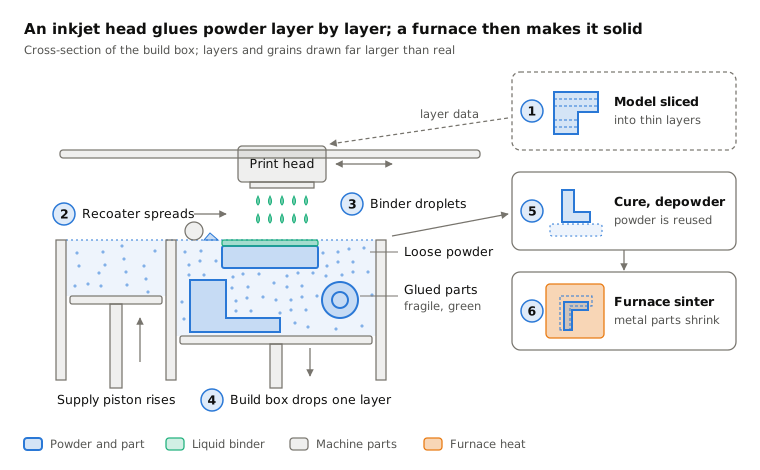
 8.5Binder jettingInkjet heads glue powder, then the part is cured or sintered (binder jetting)Open the lesson
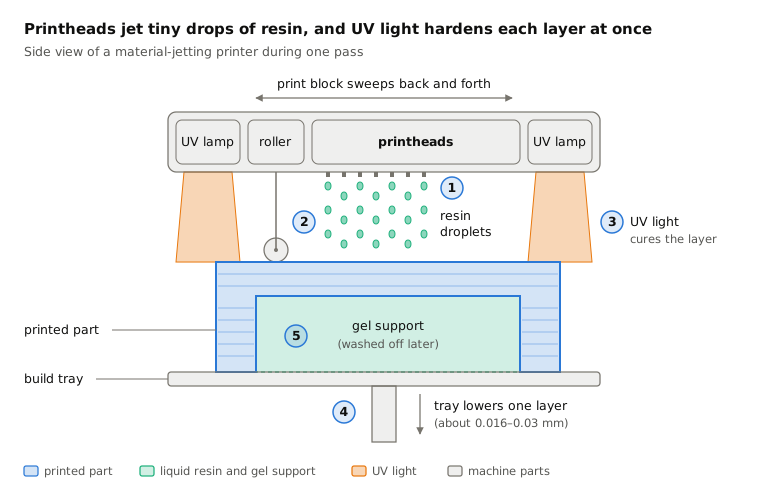
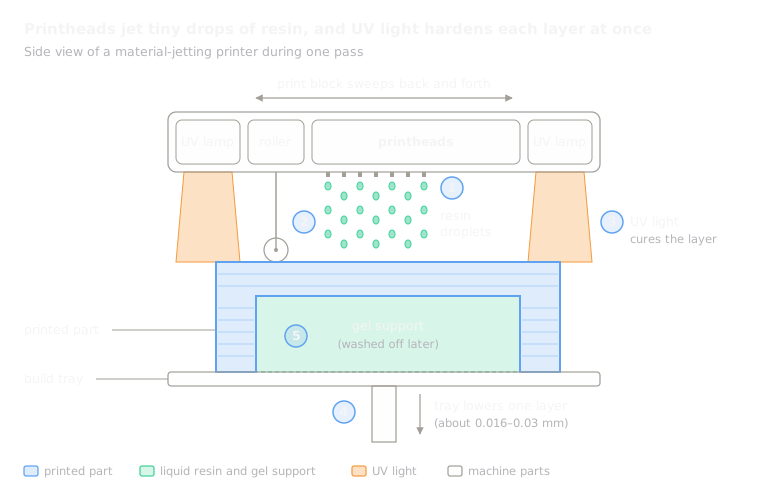 8.6Material jetting (PolyJet)Jets droplets of resin and cures them with UV light (material jetting)Open the lesson
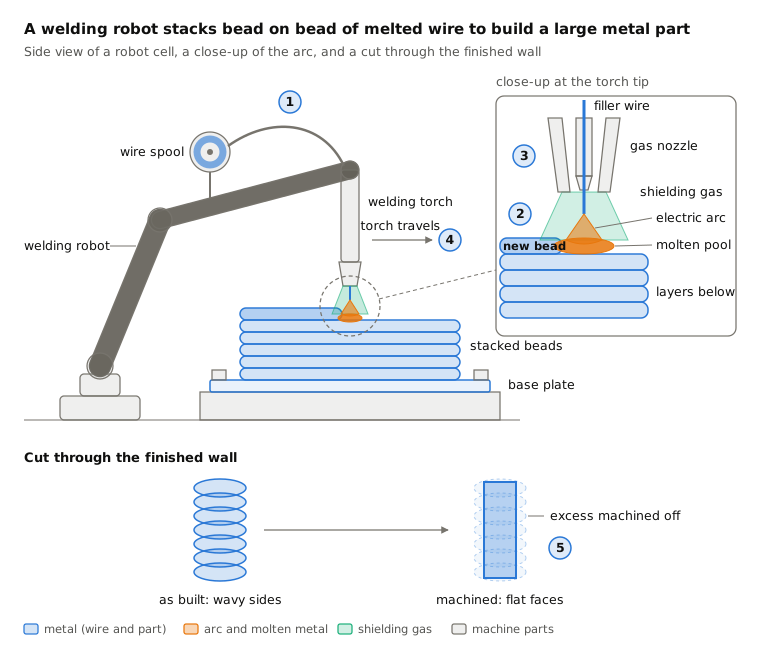
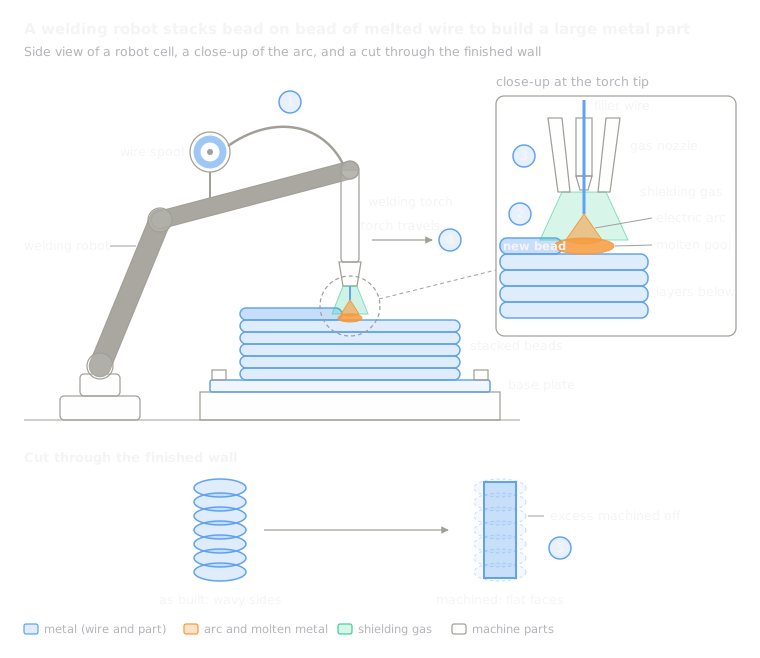 8.8Wire arc additive manufacturing (WAAM)A welding robot stacks arc-melted wire into beads (directed energy deposition)Open the lesson
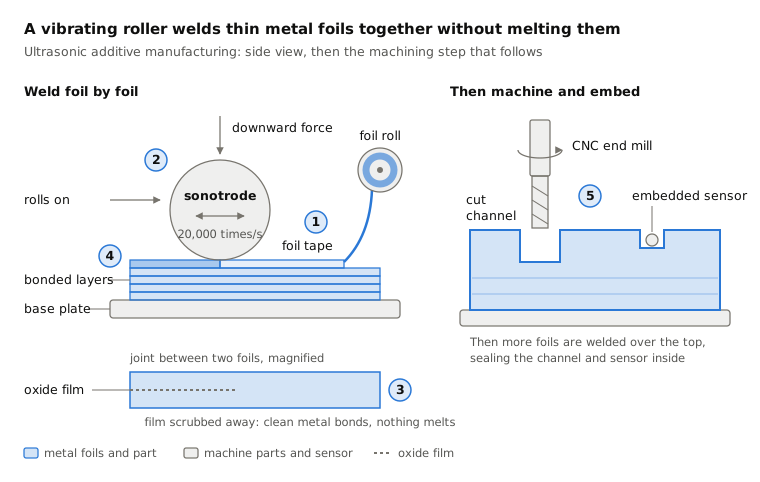
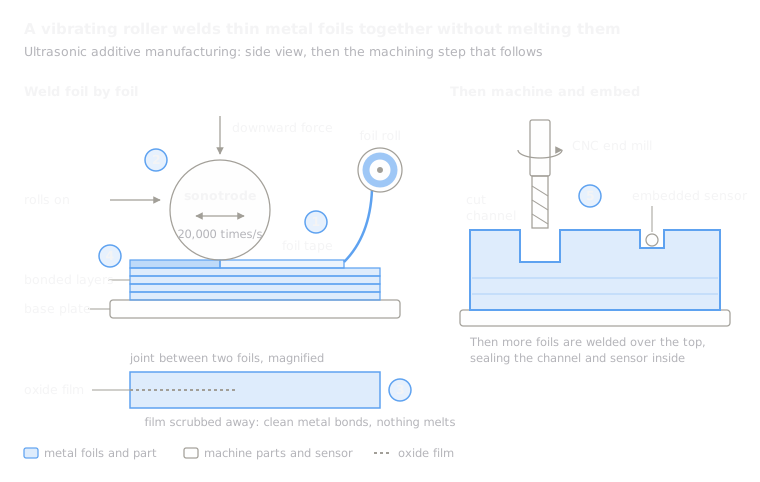 8.9Ultrasonic additive manufacturing (UAM)Ultrasonic vibration welds metal foils without melting, then a mill trims them (sheet lamination)Open the lesson
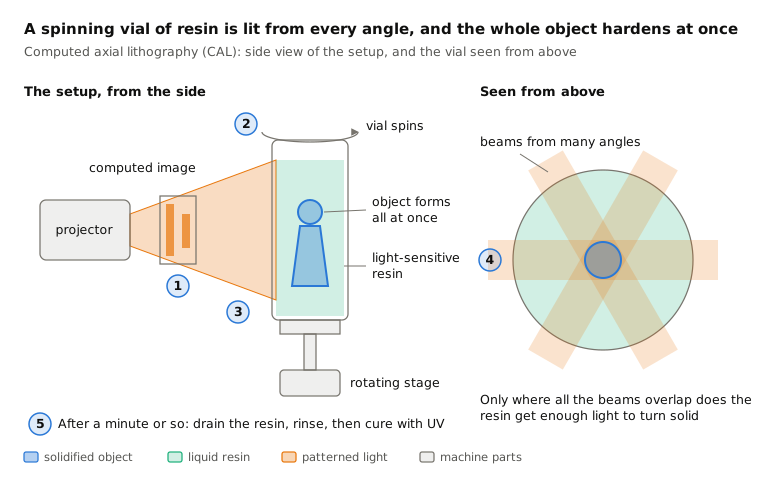
 8.10Volumetric printing (CAL)Light from every angle cures a spinning vial of resin all at once (volumetric printing)Open the lesson
Try it
Put AI to work in your CAD.
Model parts, generate drawings and automate the repetitive work inside your CAD software.