

Arc welding (MIG/MAG, TIG, stick)
Fusion: an electric arc melts the edges and usually a filler
Arc welding joins metal parts by melting their edges with an electric arc, so they flow together and freeze as one piece. It is the most common way to join steel, from bike frames and trailers to bridges and ships. The other fusion welding methods in this chapter refine the same idea: melt, mix, refreeze.
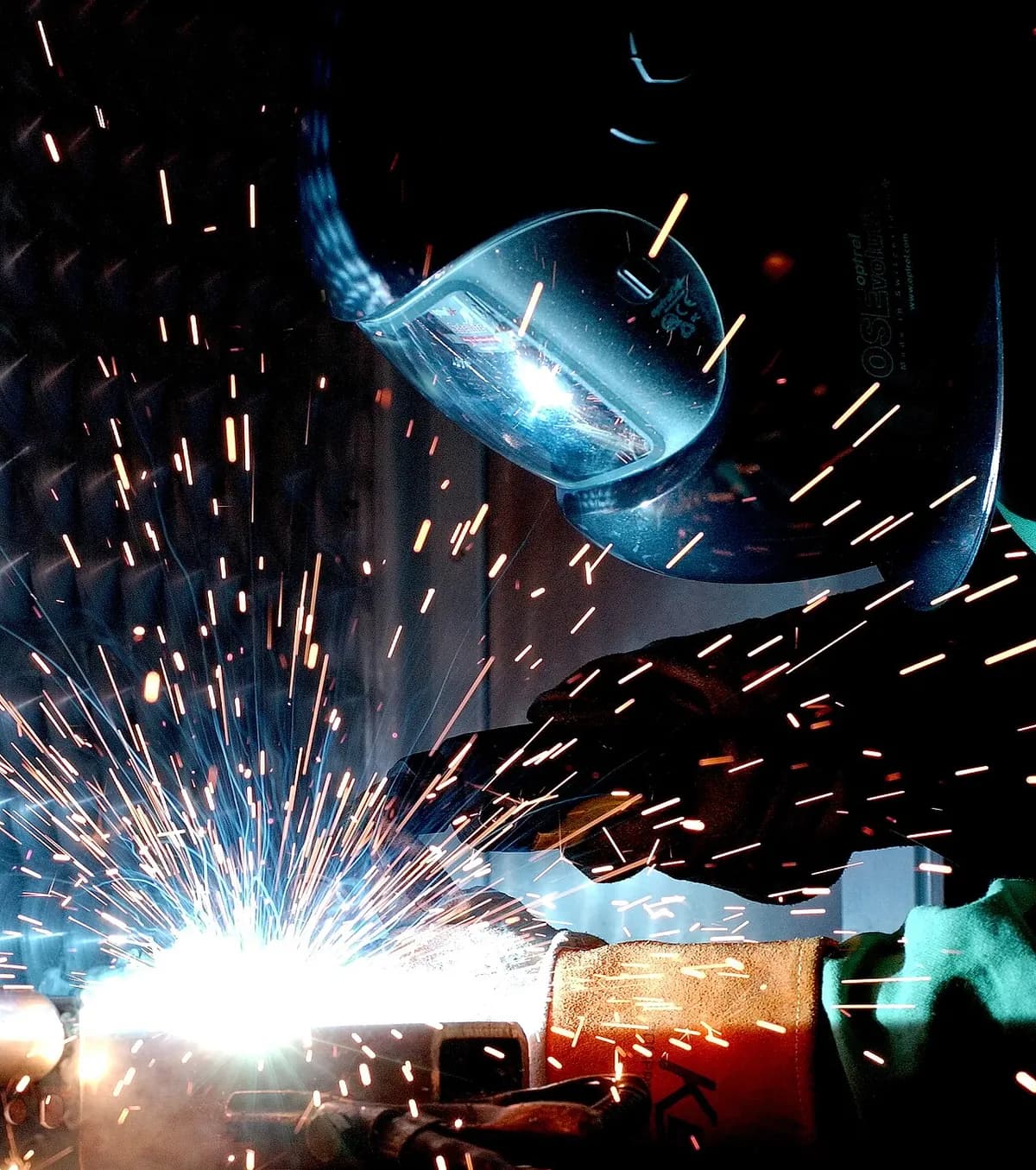
Arc welding (MIG/MAG, TIG, stick) in a minute, by MecMade
How it works
Close the circuit. A power source sends current through a cable to the torch, and a ground clamp on the workpiece carries it back. Typical settings are tens to a few hundred amps at only about 10–35 volts.
Strike the arc. When the wire touches the metal and pulls back, an electric arc (a continuous spark through hot, electrically conducting gas) forms. It reaches several thousand degrees Celsius.
Melt a pool. The arc melts the edges of both parts into one small puddle of liquid metal, the weld pool. For comparison, steel melts at about 1,500 °C.
Feed the filler. In MIG/MAG a motor pushes a thin wire through the torch nonstop. Its tip melts in the arc and drips into the pool, adding metal to fill the joint.
Shield the pool. Gas flowing from the nozzle pushes the air away. Without it, oxygen and nitrogen would cause porosity (trapped gas bubbles) and brittle welds.
Travel and freeze. The welder or a robot moves the torch along the joint. Behind it, the pool freezes into a bead (the raised ridge of weld metal) that is one piece with both parts.
Three variants, one principle. MIG/MAG (metal inert gas / metal active gas) feeds wire automatically under argon or an argon–CO2 mix. TIG (tungsten inert gas) uses a tungsten electrode that does not melt, while the welder dips a separate filler rod into the pool. Stick welding uses a rod coated with flux (a chemical powder) that burns to make its own shielding gas and a crust called slag.
Key facts
- Materials
- Carbon and stainless steels (all three variants); aluminum, titanium, copper and nickel alloys mostly with TIG or MIG
- Typical parts
- Steel frames, car chassis, pipes, tanks, ship hulls, bridges, bike frames
- Part size
- From sheet about 0.5–1 mm thick (TIG) to plates over 100 mm (many passes); assemblies of any size
- Precision
- About ±1 mm on a welded assembly; heat distortion is the main limit, so precise faces are machined afterward
- Surface finish
- Raised, rippled bead; spatter (MIG) or slag (stick) to clean off; ground flush when looks matter
- Batch size it suits
- One-offs and repairs up to mass production with robots
- Tooling and machine cost
- A few hundred to a few thousand dollars for a hand set; roughly $100,000 or more for a robot cell
- Speed
- Typically 0.1–0.5 m of weld per minute by hand; TIG is the slowest, robots the fastest
Strengths and limits
Strengths
- Joins almost any steel, and most other metals with TIG
- Cheap, portable equipment; stick works outdoors and in wind
- A good weld can be as strong as the parts it joins
- Works at any scale, from bike frames to ships
Limits
- Heat warps thin parts and changes the metal next to the weld (the heat-affected zone)
- Quality depends on the welder's skill or on a well-tuned robot
- Fumes, intense UV light and spatter demand ventilation and protective gear
- Hidden flaws (porosity, cracks, lack of fusion) need inspection on critical parts
Where it's used
- ConstructionSteel beams, columns, bridge girders
- AutomotiveChassis, suspension arms, exhaust systems (robotic MIG)
- EnergyPipelines, pressure vessels, wind-tower sections
- ShipbuildingHull plates, decks and frames
- Aerospace and food equipmentThin stainless and aluminum parts (TIG)
- Repair and farmingField repairs of machinery with stick welding
How to recognize it
- A raised bead along the joint with fine half-moon ripples; neat TIG beads look like a row of stacked coins.
- Tiny metal balls (spatter) stuck next to MIG welds.
- Straw, blue or rainbow heat tint on stainless steel beside the weld.
- Rougher beads with leftover glassy slag on stick welds.
Compare with
Watch it
TimWelds · How the variants differ, side by side
Miller Welders · The MIG torch, wire feed and weld pool up close
DIY PRO · Tungsten, filler rod and arc in close-up
FANUC America · Robots welding a large part in a factory cell
See real photos
- Wikipedia: Arc welding — overview with photos of welders, torches and beads
- Wikipedia: Gas metal arc welding — MIG/MAG torches, setups and weld close-ups
- Wikipedia: Gas tungsten arc welding — TIG torches, tungsten electrodes and arc photos
- Wikimedia Commons photo search
Remember
- An electric arc melts both edges, usually with a filler, into one pool that freezes into the joint.
- Shielding gas or flux keeps air away from the hot metal; without it, welds turn porous and brittle.
- MIG/MAG is fast and easy, TIG is slow and precise, stick is rugged and portable.
More in Joining
All 100 processes
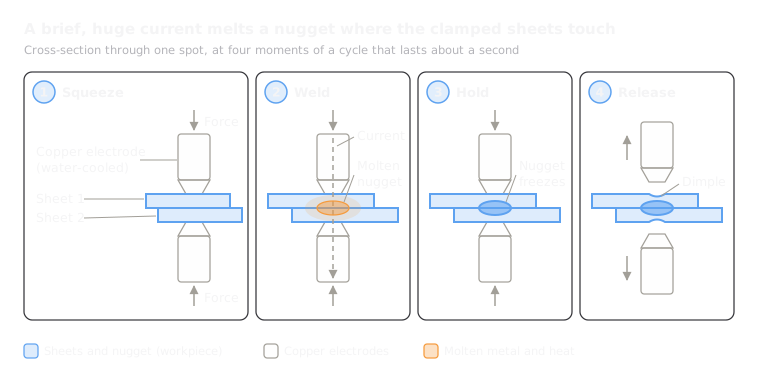 7.2Resistance spot weldingFusion: a pulse of current melts a nugget between clamped sheetsOpen the lesson
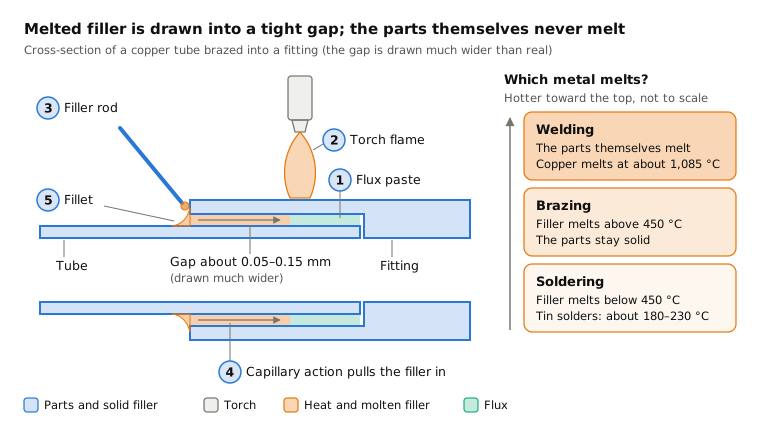
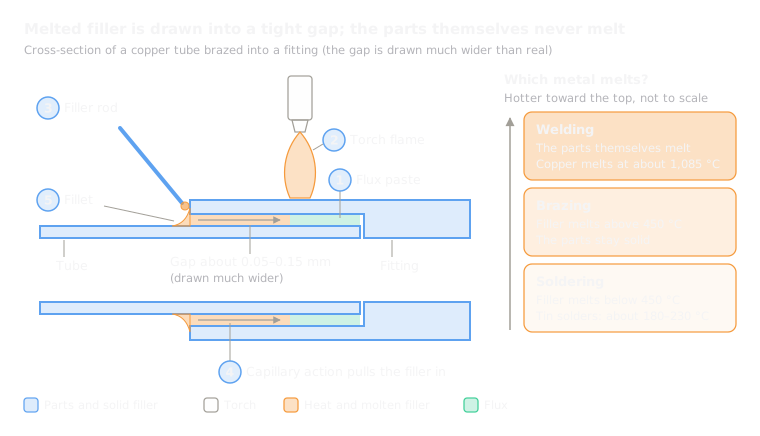 7.3Brazing and solderingFiller only: a lower-melting filler flows into a tight gapOpen the lesson
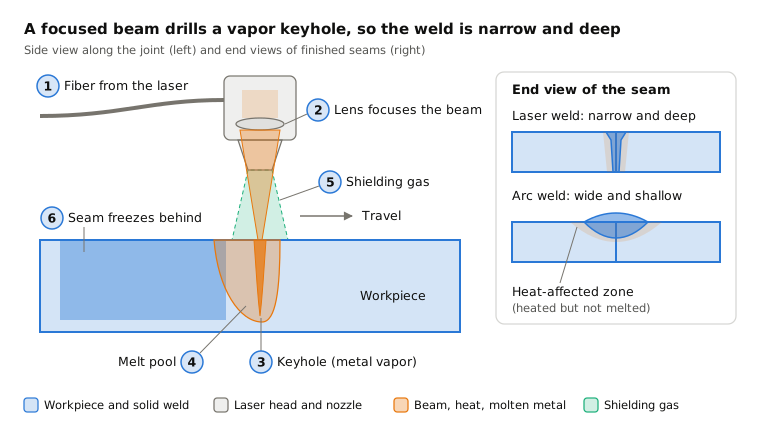
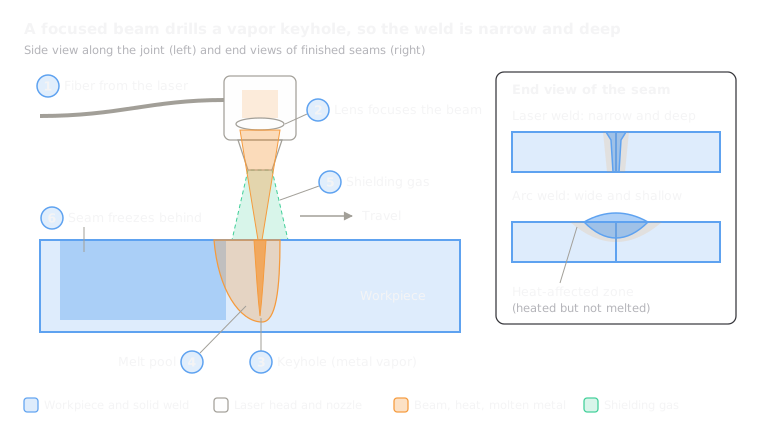 7.4Laser weldingFusion: a focused laser drills a keyhole for narrow, deep weldsOpen the lesson
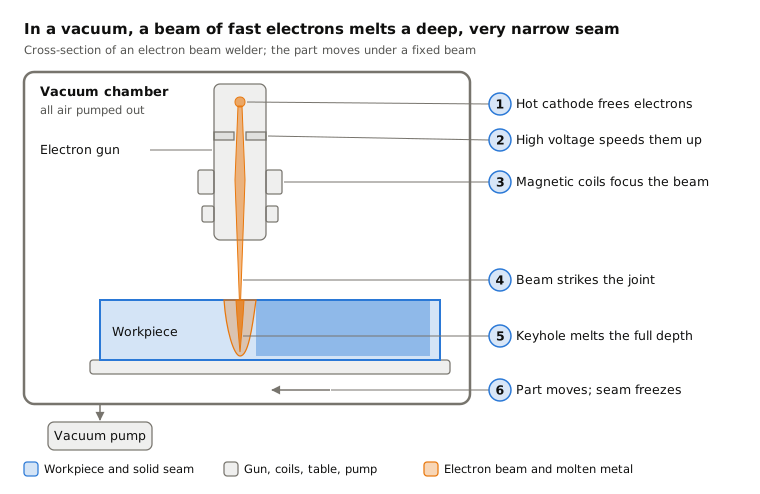
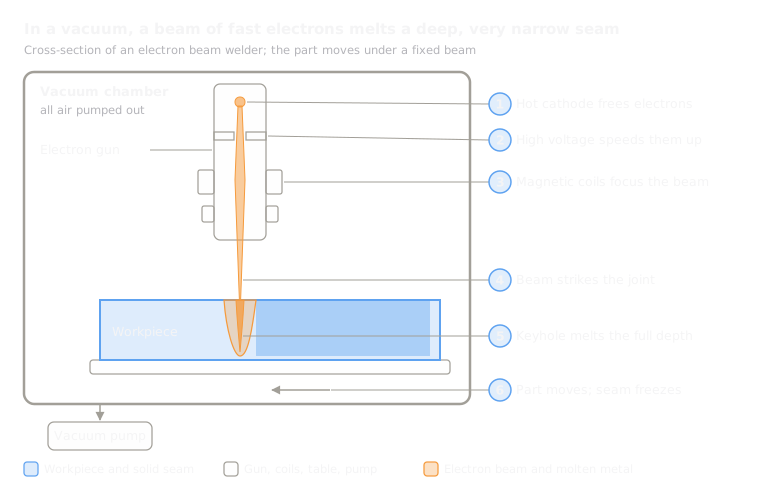 7.5Electron beam weldingFusion: an electron beam in a vacuum welds very thick metalOpen the lesson
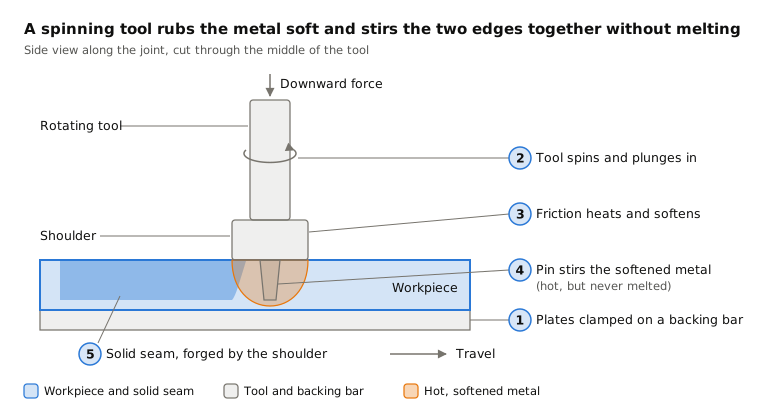
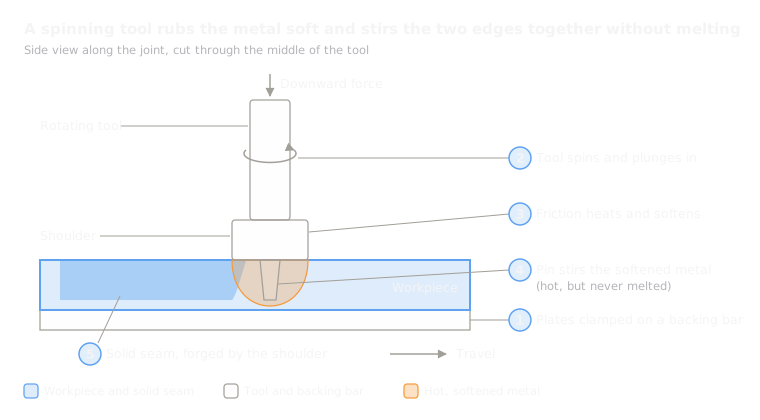 7.6Friction stir weldingSolid state: a spinning tool stirs softened edges togetherOpen the lesson
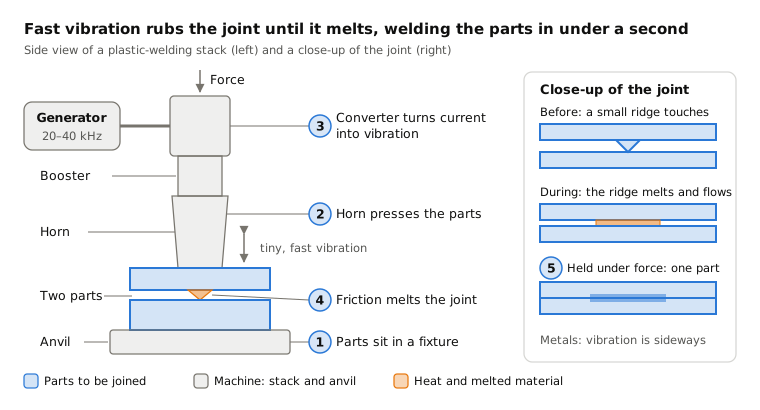
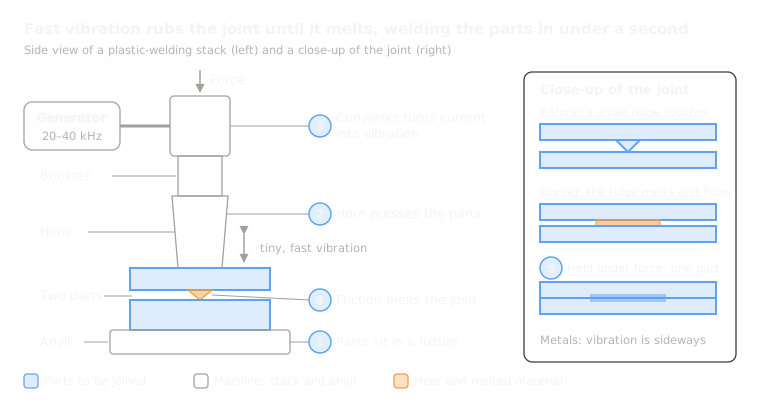 7.7Ultrasonic weldingSolid state: fast vibration bonds small joints in under a secondOpen the lesson
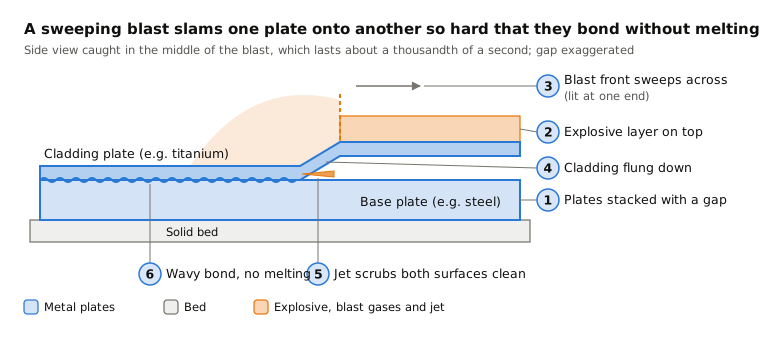
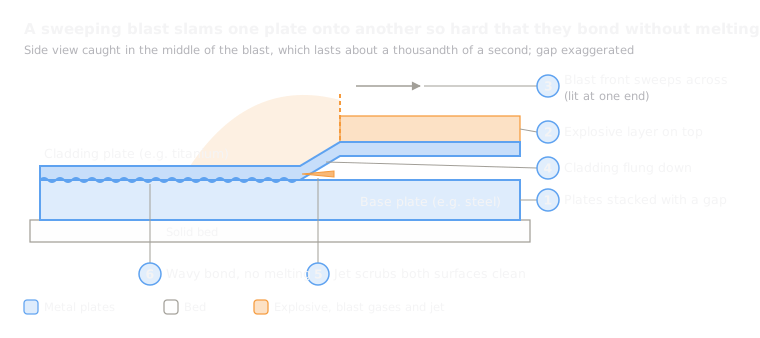 7.8Explosion welding (cladding)Solid state: a blast slams one plate onto anotherOpen the lesson
Try it
Put AI to work in your CAD.
Model parts, generate drawings and automate the repetitive work inside your CAD software.