

Ultrasonic machining
A vibrating tool hammers abrasive grains into the surface
Ultrasonic machining makes a shaped tool vibrate about 20,000 times a second against hard, brittle material, through a paste of abrasive grains. Each blow chips away microscopic flakes, so the tool's shape slowly sinks into glass or ceramic without cracking it. It makes the square, star-shaped and slotted holes in glass and ceramic that a drill would shatter.
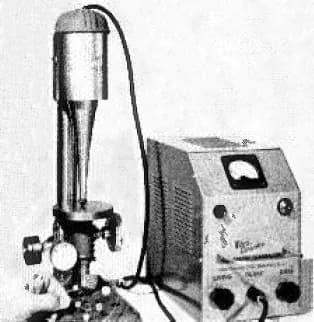
How it works
Make the signal. A generator produces an electrical signal at typically 18–40 kHz (thousand cycles per second), just above the range of human hearing.
Turn it into vibration. A piezoelectric transducer (a crystal stack that grows and shrinks with voltage) converts the signal into mechanical vibration.
Amplify it. The horn, or sonotrode (a tapered metal bar), magnifies the motion to a few hundredths of a millimeter at the tool tip.
Feed the slurry. A slurry (water mixed with abrasive grains such as boron carbide, silicon carbide or alumina) flows between the tool and the part.
Chip. Each blow of the tool drives grains into the surface. Brittle material cracks off in microscopic chips; the tool itself never cuts directly.
Feed and copy. A light, steady force pushes the tool down, so its exact negative shape sinks into the part. Fresh slurry carries the debris away.
Key facts
- Materials
- Hard, brittle materials: glass, quartz, sapphire, alumina and zirconia ceramics, silicon carbide, ferrite, carbides. Poor on soft, ductile metals.
- Typical parts
- Round and odd-shaped holes, slots, shallow cavities and engraving in brittle parts
- Part size
- Features from about 0.1 mm up to a few tens of millimeters; the tool face is usually small
- Precision
- Typically a few hundredths of a millimeter
- Surface finish
- Fine and matte, with no heat damage or burrs; smoother with finer grit, often Ra (average height of surface bumps) under 1 µm
- Batch size it suits
- From prototypes to large series (one part to 100,000 or more)
- Tooling and machine cost
- Tools are simple and soft (often low-carbon steel) but wear fast; machines from tens of thousands of dollars, more for CNC rotary versions
- Speed
- Slow: the tool typically advances a fraction of a millimeter to about a millimeter per minute
Strengths and limits
Strengths
- Cuts glass, ceramics and gemstones without cracking them
- Any hole shape, not just round
- No heat, no chemical change, no burrs
- Works on electrical insulators, unlike EDM and ECM
Limits
- Slow, especially for deep holes
- The tool wears and must be replaced or reshaped
- Poor on soft, ductile metals, which dent instead of chipping
- Deep holes taper, and slurry struggles to reach the bottom
Where it's used
- ElectronicsHoles and slots in ceramic substrates, ferrite and quartz parts
- OpticsShaped holes in glass, quartz and sapphire windows
- AerospaceFeatures in technical ceramics and ceramic composites
- Watchmaking and jewelryDrilling gemstones and sapphire parts
- LaboratoriesGlass and quartz parts for scientific instruments
How to recognize it
- Non-round holes (squares, stars, slots) cut into glass or ceramic.
- Hole walls with a fine, frosted matte texture and no heat marks.
- A slight taper in deep holes, and tiny chips along the exit edge.
Compare with
Watch it
ADTW Study · An animation of the vibrating tool, slurry and cavity
Innovative learning of Engineering By MuthuKumar · The transducer, horn, tool and slurry feed explained
Berkness Company · Real footage from a machining shop
DMG MORI · The modern rotary variant: a spinning diamond tool that also vibrates
See real photos
- Wikipedia: Ultrasonic machining — principle, frequencies, abrasives and variants (mostly text)
- Wikimedia Commons photo search
Remember
- A tool vibrating about 20,000 times a second hammers abrasive grains that chip away brittle material.
- It is the shaped-hole method for glass, ceramics and gems, which drills and sparks cannot handle.
- Look for odd-shaped holes in glass or ceramic with a frosted wall.
More in Cutting and non-traditional machining
All 100 processes
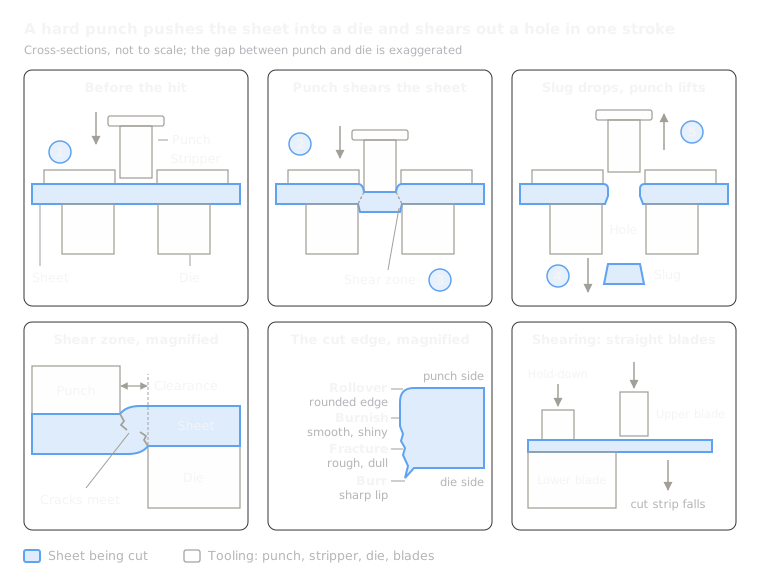 6.1Punching and shearingA punch shears shapes out of sheet against a dieOpen the lesson
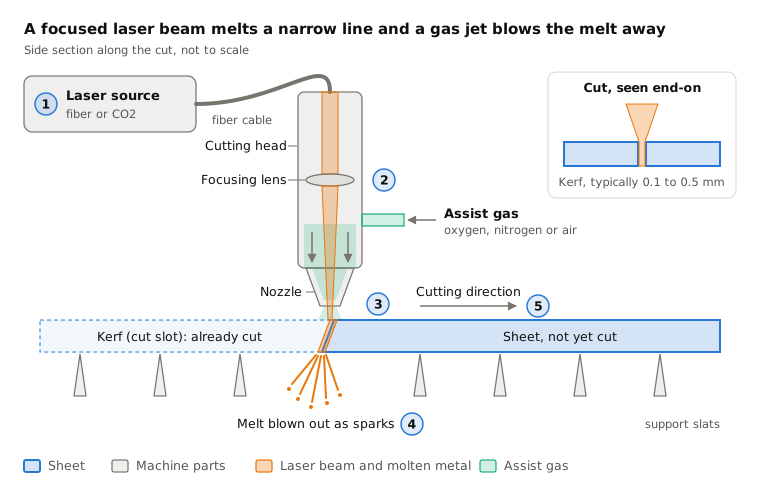
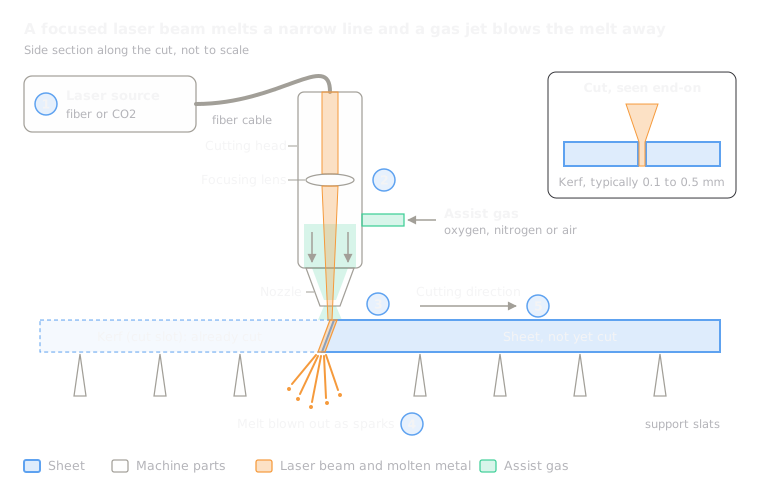 6.2Laser cuttingFocused light melts or vaporizes a narrow cutOpen the lesson
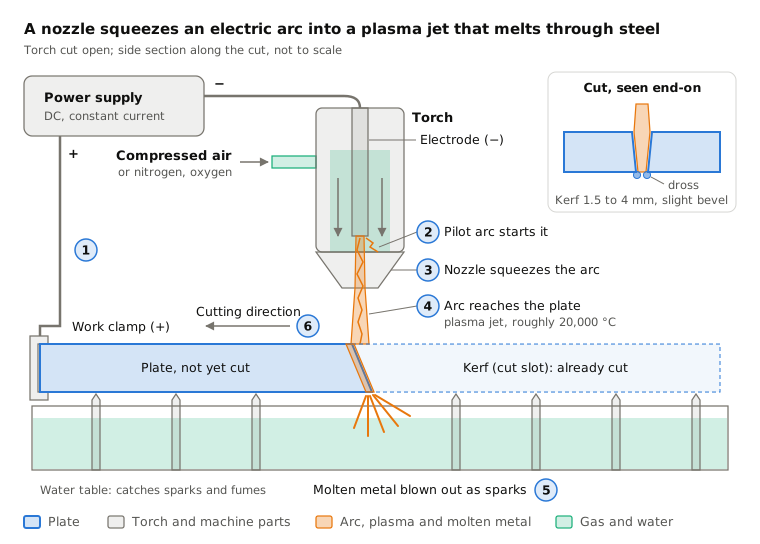
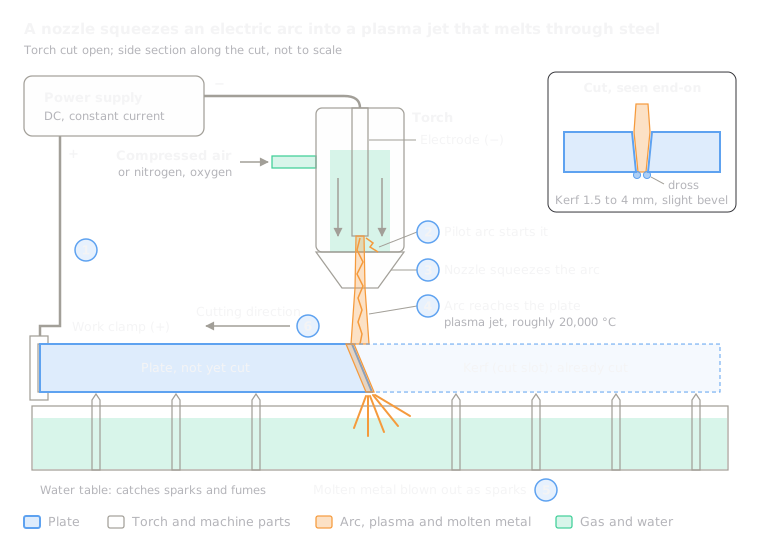 6.3Plasma cuttingA superheated gas jet melts through conductive plateOpen the lesson
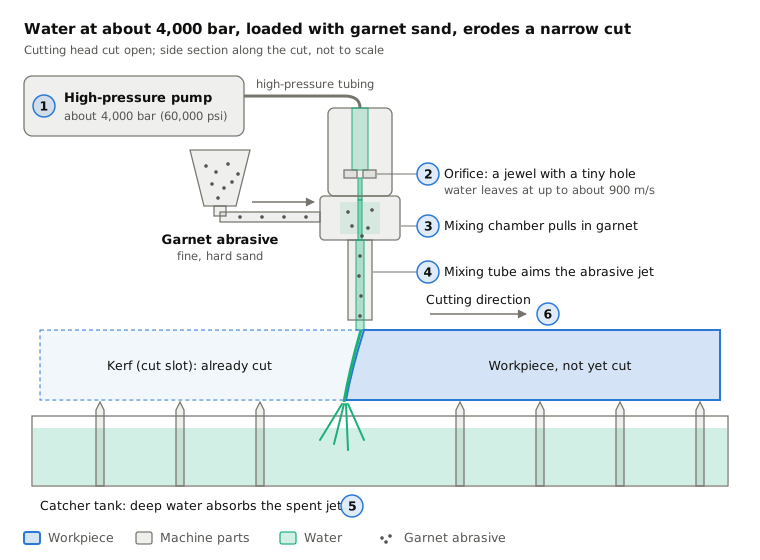
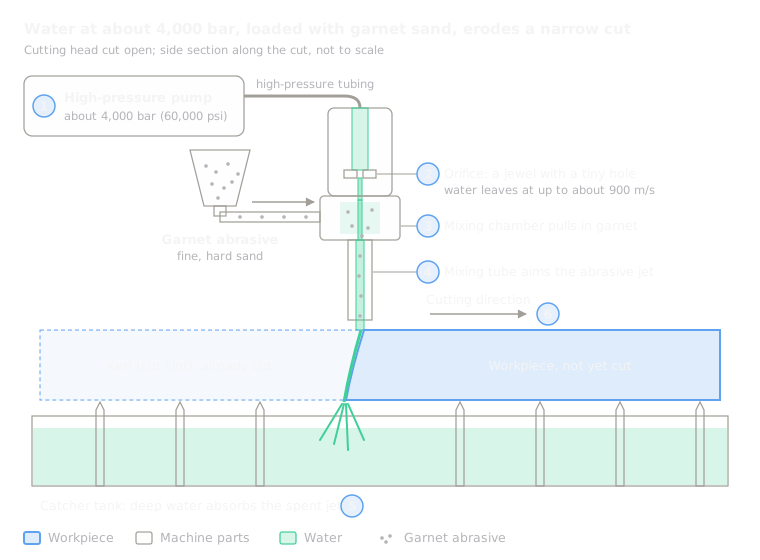 6.4Waterjet cuttingVery high-pressure water, usually with abrasive, erodes a cutOpen the lesson
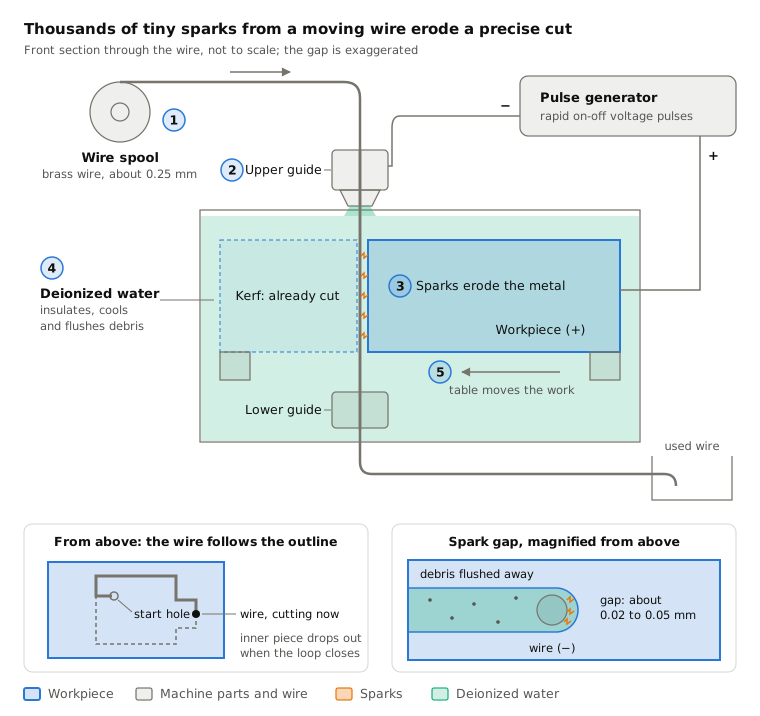
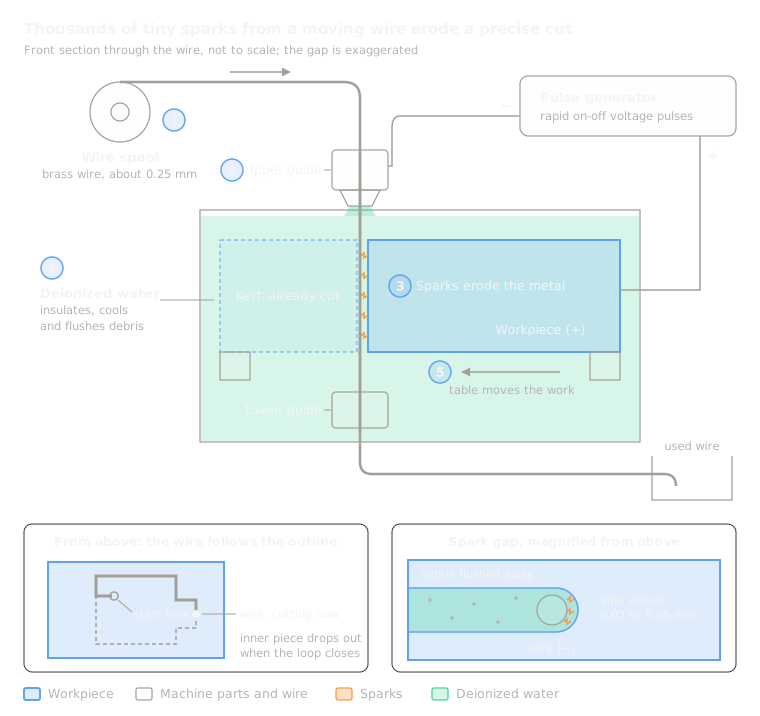 6.5Wire EDMSparks from a thin moving wire cut through-profilesOpen the lesson
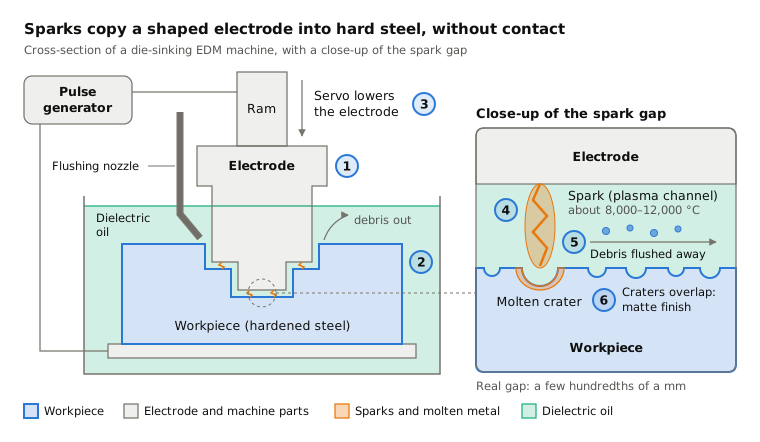
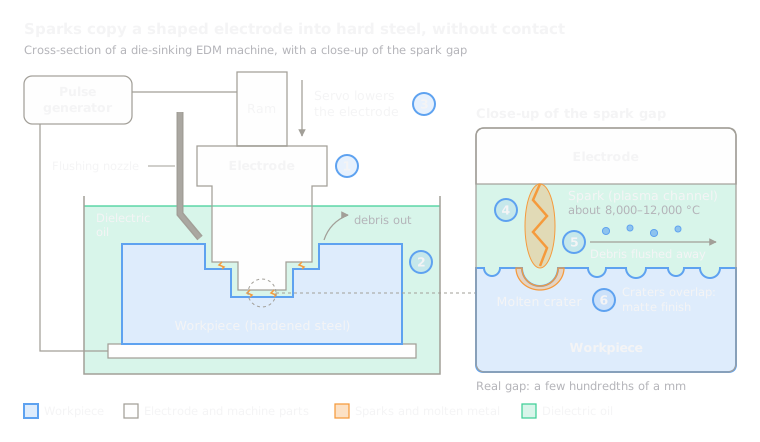 6.6Sinker EDMSparks copy a shaped electrode into a blind cavityOpen the lesson
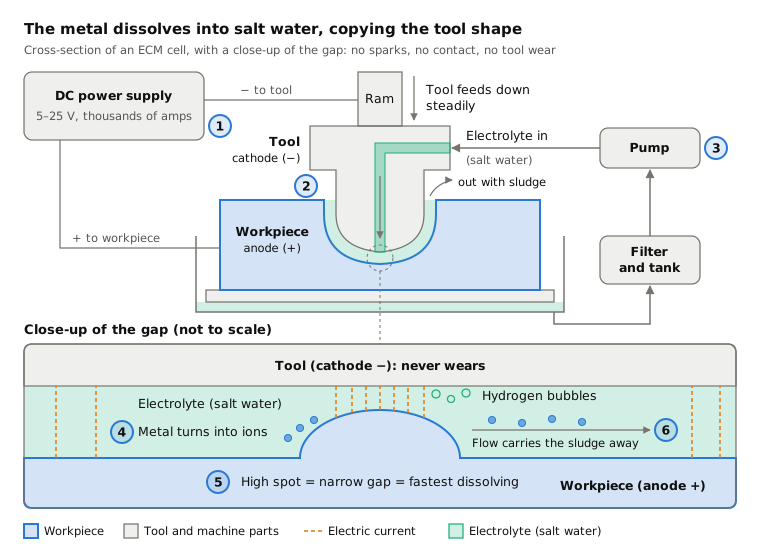
 6.7Electrochemical machining (ECM)Electrolysis dissolves metal in the shape of the toolOpen the lesson
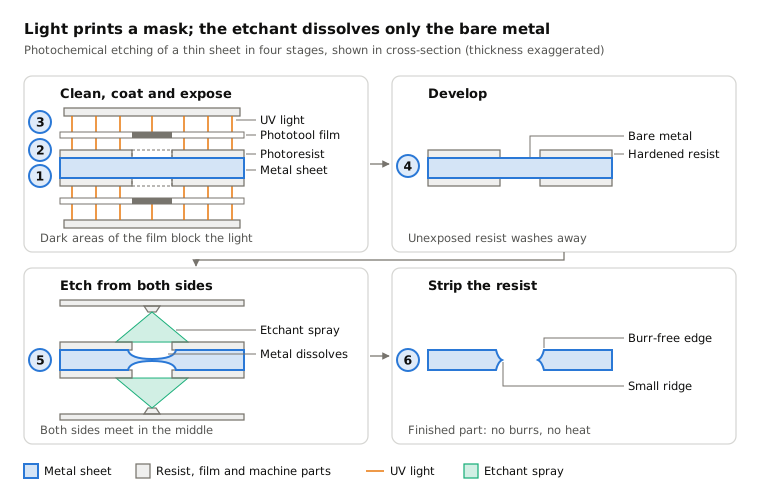
 6.8Chemical machining and photochemical etchingA light-printed mask lets an etchant dissolve only bare metalOpen the lesson
Try it
Put AI to work in your CAD.
Model parts, generate drawings and automate the repetitive work inside your CAD software.