

Chemical machining and photochemical etching
A light-printed mask lets an etchant dissolve only bare metal
Chemical machining removes metal by dissolving it, while a mask protects the areas you want to keep. Its most common form, photochemical etching, prints that mask with light, much like developing a photo. Electric shaver foils, phone speaker grilles and tiny electronic contacts are made this way.
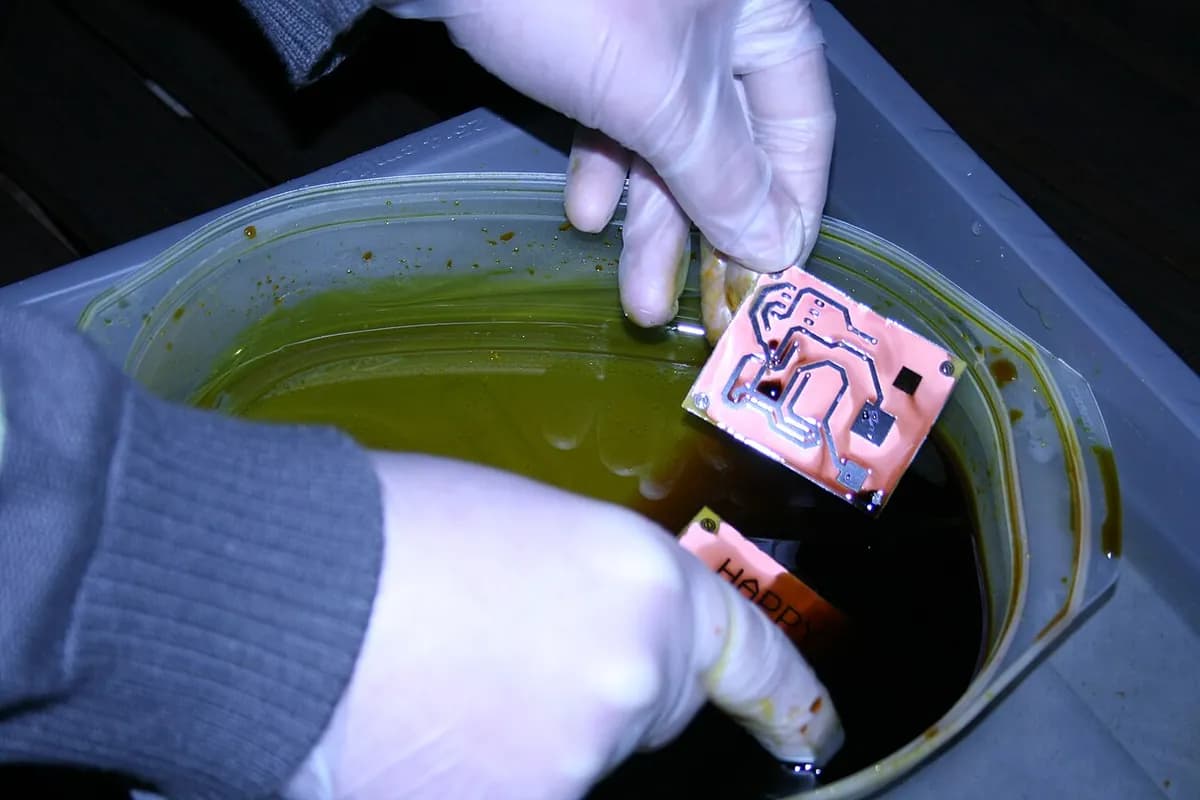
How it works
Clean. The metal sheet is degreased and deoxidized so the mask sticks perfectly.
Coat. Both sides are laminated with photoresist (a light-sensitive plastic film).
Expose. The sheet sits between two phototools (films printed with the part's shape) and is flashed with UV light. The light hardens the resist wherever the film is clear.
Develop. A rinse washes away the resist the light never reached, leaving windows of bare metal where the cuts will be.
Etch. The sheet travels under sprays of warm etchant (a corrosive solution, often ferric chloride) on both sides. The metal dissolves from top and bottom until the two meet and break through.
Strip. The remaining resist is removed and the sheet is rinsed. Dozens of finished parts are then snapped out of the sheet from tiny holding tabs.
Chemical milling is the big cousin: a large aerospace panel is coated with a maskant (protective rubbery coating), the mask is cut by hand, and the whole panel is dipped in a tank to thin selected areas.
Key facts
- Materials
- Almost any metal: stainless steel, copper, brass, nickel, aluminum, titanium, nickel alloys, regardless of hardness
- Typical parts
- Flat, thin parts with fine detail: meshes, filters, shims, flat springs, lead frames, stencils; chemical milling: thinned pockets in aircraft skins
- Part size
- Sheet typically about 0.01–2 mm thick; parts from a few millimeters across to sheet-sized; chemically milled panels several meters long
- Precision
- Often about ±10% of the sheet thickness; the smallest holes are roughly as wide as the sheet is thick
- Surface finish
- The sheet keeps its original surface; cut edges are smooth and burr-free, with a slight ridge at mid-thickness
- Batch size it suits
- From prototypes in a few days to millions of parts; cost depends on the number of sheets, not on part complexity
- Tooling and machine cost
- Very low tooling: a phototool costs a few hundred dollars; the etching line and chemical handling are the real investment
- Speed
- Etching typically removes a few hundredths of a millimeter per minute from each side; a thin sheet goes through in minutes
Strengths and limits
Strengths
- No burrs, no heat, no stress in the metal
- Hardness does not matter
- Cheap tooling that changes in hours
- Complexity is free: 10 holes or 10,000 cost the same
Limits
- Only thin sheet, typically under about 2 mm
- Holes cannot be much smaller than the sheet thickness
- Edges are not perfectly square: slight undercut and ridge
- Corrosive chemicals need careful handling and waste treatment
Where it's used
- ElectronicsLead frames, shielding cans, contacts, solder-paste stencils
- AerospaceChemically milled fuselage and wing skins, shims, filters
- Automotive and energyFuel cell plates, battery grids, sensors, heat exchanger plates
- MedicalSurgical blades, implantable meshes, filters
- Consumer goodsShaver foils, speaker grilles, watch parts, decorative plates
- Hobby and jewelryModel kit details, etched jewelry, nameplates
How to recognize it
- A very thin metal part with incredibly fine holes or patterns.
- Smooth, burr-free cut edges; under a magnifier, a slight ridge runs along the middle of the thickness.
- Tiny tab marks around the outline, where the part was held in the sheet.
- Lettering or logos sunk to half the sheet depth (half-etching) on nameplates and model parts.
Compare with
Watch it
Precision Micro · Each step of the process, clearly explained
United Western Enterprises Inc. · A walk through a real photo etching shop
NW Etch · Production shots of coating, exposing and etching
Advanced Chemical Etching Ltd · A full etching production line in a factory
See real photos
- Wikipedia: Photochemical machining — steps, materials and applications
- Wikipedia: Chemical milling — maskant, scribing, tank immersion and aerospace uses
- Wikimedia Commons photo search
Remember
- A light-printed mask decides where the etchant dissolves the metal.
- It suits thin sheet with fine, complex patterns, and leaves no burrs or heat damage.
- Look for very fine holes, burr-free edges and a slight ridge mid-thickness.
More in Cutting and non-traditional machining
All 100 processes
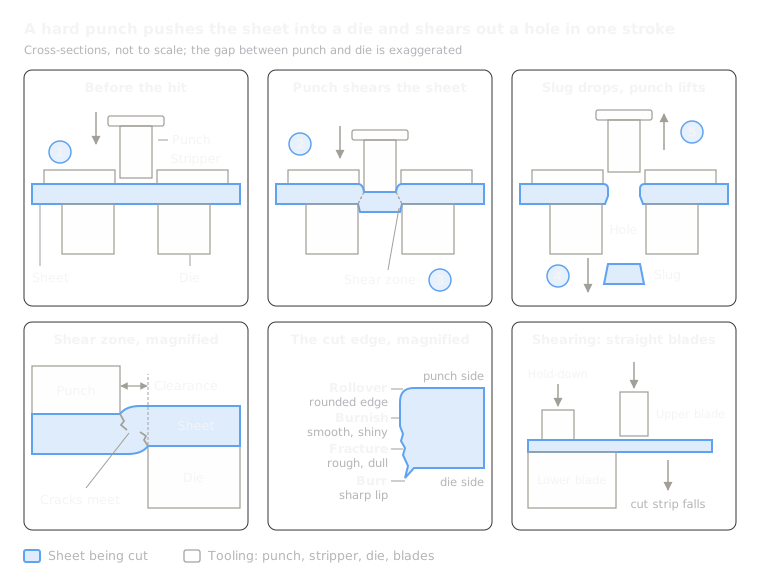 6.1Punching and shearingA punch shears shapes out of sheet against a dieOpen the lesson
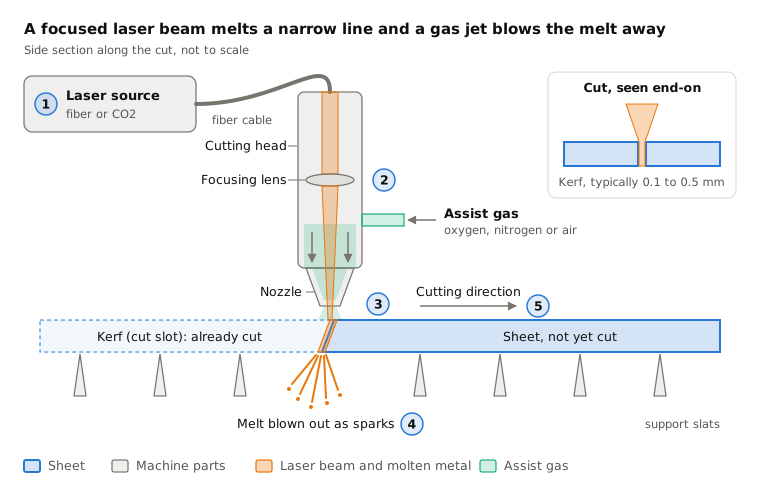
 6.2Laser cuttingFocused light melts or vaporizes a narrow cutOpen the lesson
 6.3Plasma cuttingA superheated gas jet melts through conductive plateOpen the lesson
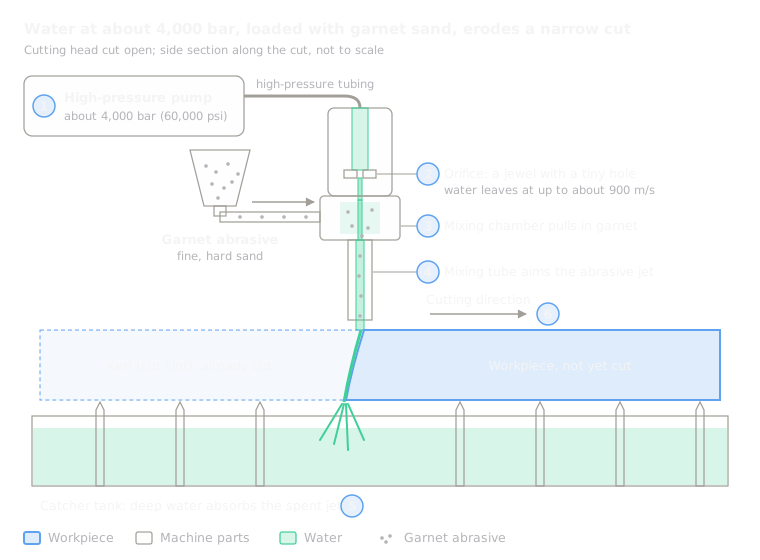 6.4Waterjet cuttingVery high-pressure water, usually with abrasive, erodes a cutOpen the lesson
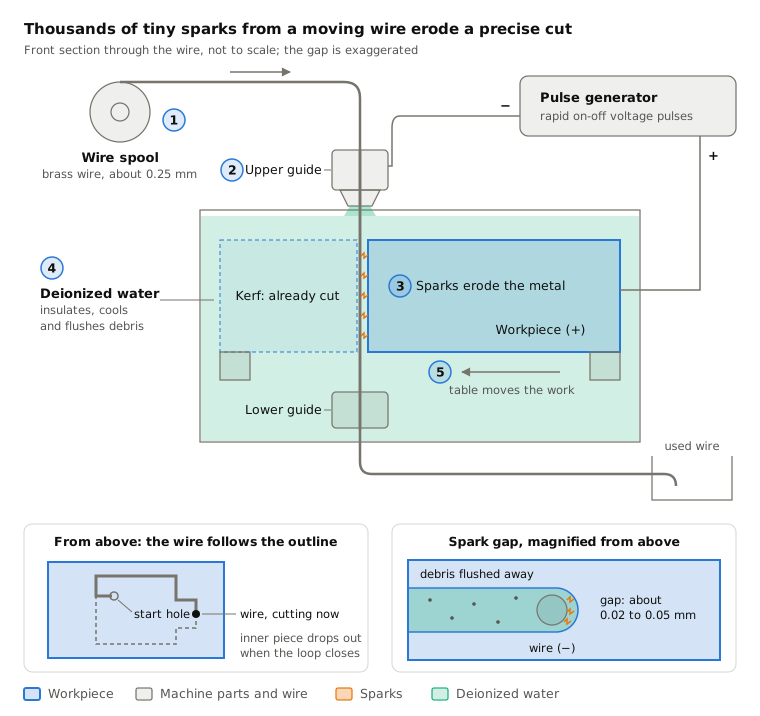
 6.5Wire EDMSparks from a thin moving wire cut through-profilesOpen the lesson
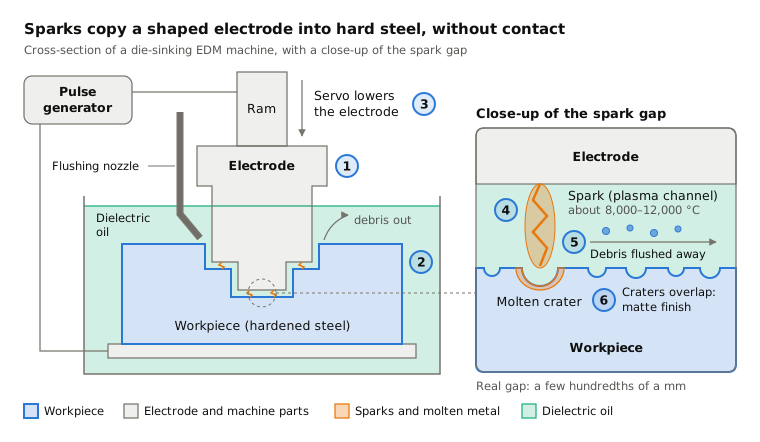
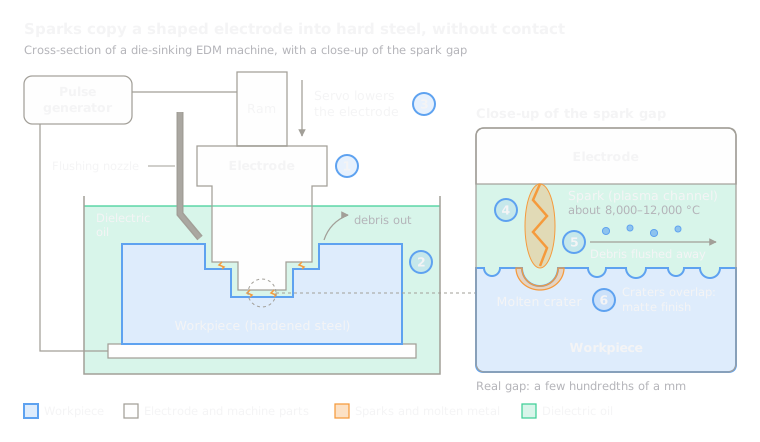 6.6Sinker EDMSparks copy a shaped electrode into a blind cavityOpen the lesson
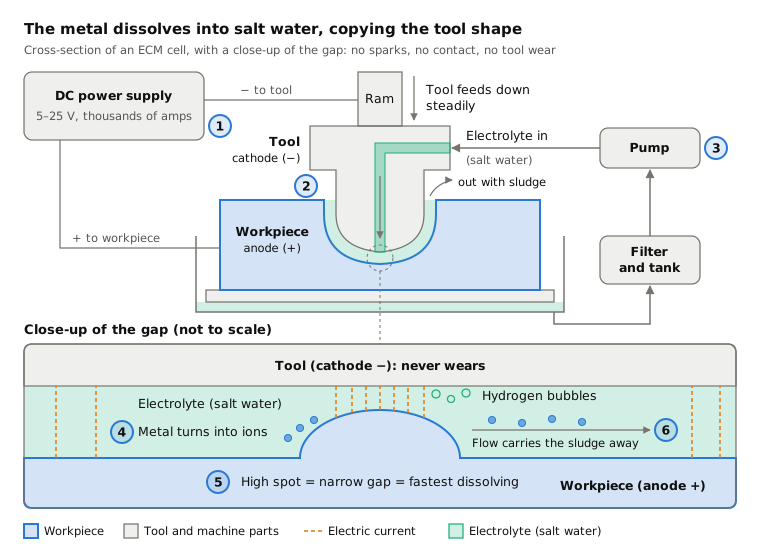
 6.7Electrochemical machining (ECM)Electrolysis dissolves metal in the shape of the toolOpen the lesson
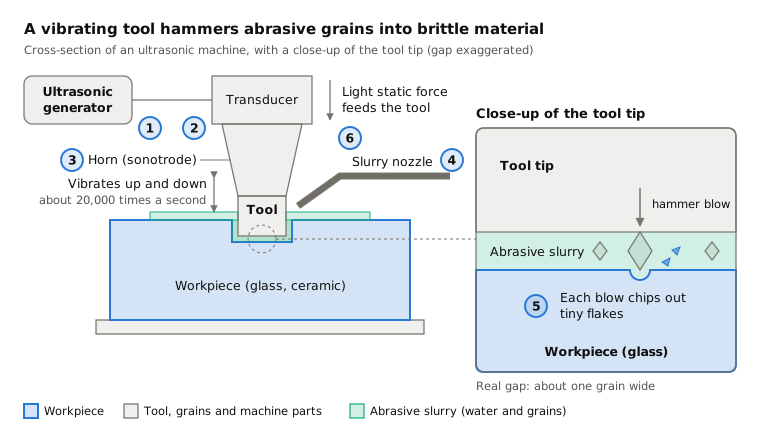
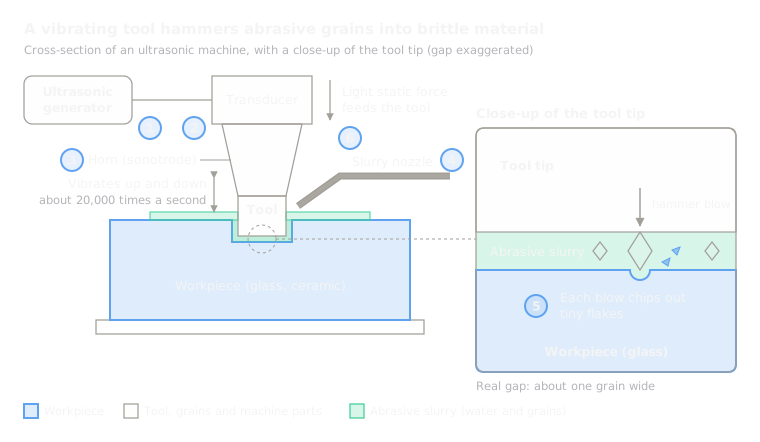 6.9Ultrasonic machiningA vibrating tool hammers abrasive grains into the surfaceOpen the lesson
Try it
Put AI to work in your CAD.
Model parts, generate drawings and automate the repetitive work inside your CAD software.