

Sinker EDM
Sparks copy a shaped electrode into a blind cavity
Sinker EDM (electrical discharge machining, also called die-sinking or ram EDM) burns a shaped cavity into metal with tiny electric sparks. A graphite or copper electrode, shaped as the cavity's negative (bumps where the cavity needs hollows), sinks into the steel without ever touching it. Many molds for plastic parts, such as caps, phone cases and car interior trim, get their deep ribs and sharp inside corners this way.
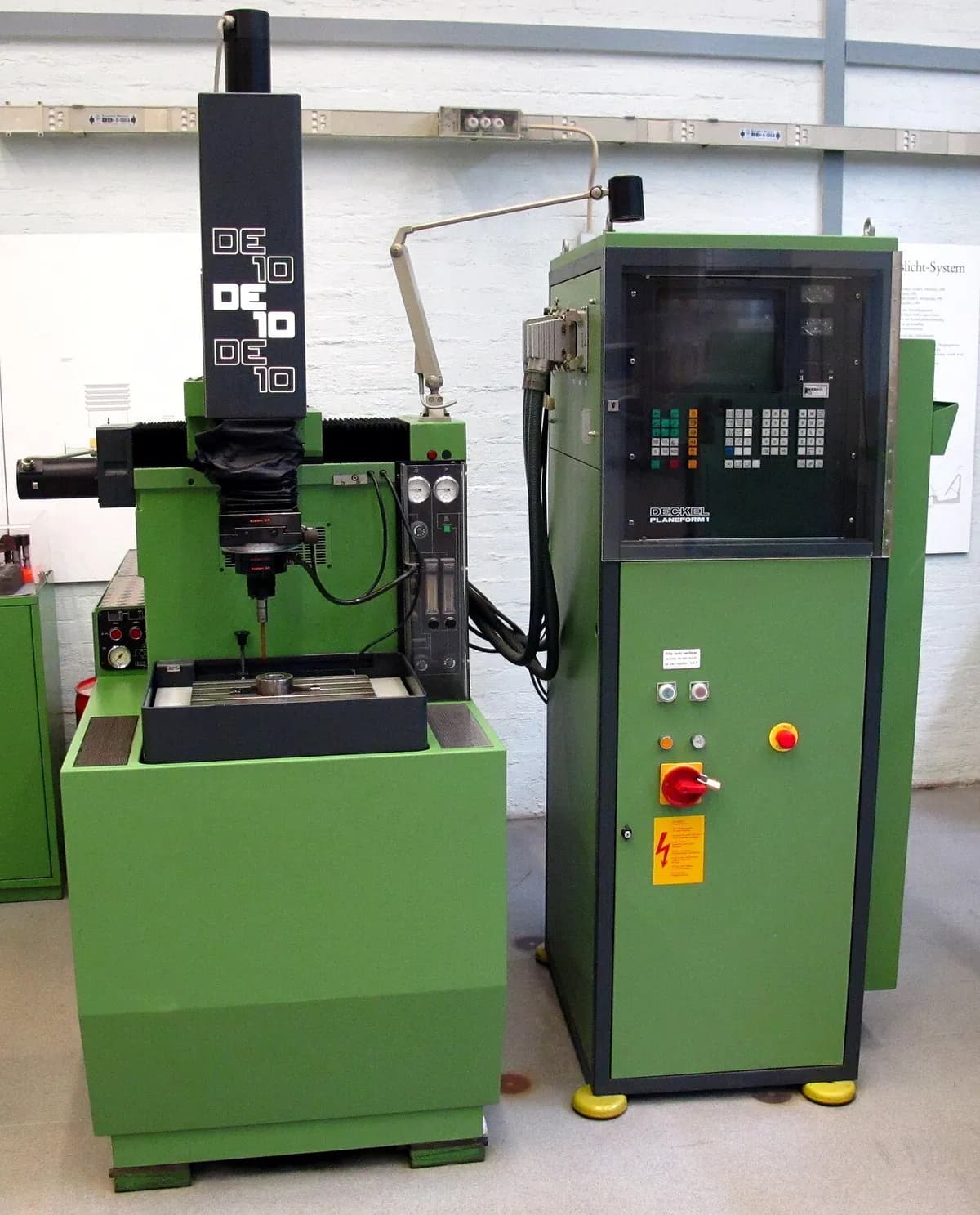
How it works
Shape the electrode. A graphite or copper electrode is milled into the exact negative of the cavity, slightly undersize to leave room for the spark gap.
Submerge the workpiece. The steel block sits on the table in a tank of dielectric oil (an electrically insulating fluid). The oil blocks current until a spark forms, cools the metal and carries debris away.
Close the gap. A servo (a motor that constantly corrects its own position) lowers the electrode until only a tiny gap remains, typically a few hundredths of a millimeter. The two never touch.
Spark. The pulse generator fires short voltage pulses. Each one breaks through the oil, and a spark at roughly 8,000–12,000 °C melts and vaporizes a microscopic crater.
Flush and advance. Between pulses, oil sweeps the debris out of the gap. The servo holds the gap constant while the electrode sinks deeper, at thousands of sparks per second.
Finish gently. The machine switches to weaker sparks, often with a fresh finishing electrode and a small orbiting motion. Smaller sparks leave smaller craters, giving the final size and texture.
Key facts
- Materials
- Any electrically conductive material: hardened tool steel, tungsten carbide, titanium, nickel alloys, copper. Not plastics, glass or most ceramics.
- Typical parts
- Mold and die cavities, deep narrow ribs and slots, sharp inside corners, blind keyways and internal hexagons in hardened parts
- Part size
- From features under 1 mm up to cavities in mold blocks roughly a meter across
- Precision
- Typically about ±0.01 mm; a few microns (thousandths of a millimeter) with careful finishing
- Surface finish
- Matte and finely cratered. Roughness Ra (average height of surface bumps) runs from about 10 µm when roughing to about 0.2 µm when finishing.
- Batch size it suits
- One-offs and tooling (every mold is unique); small precision parts in modest series
- Tooling and machine cost
- Machine roughly $100,000–500,000; one custom electrode per shape, often several (roughing and finishing)
- Speed
- Slow: typically 2–400 mm³ of metal per minute; a mold cavity often takes hours to days
Strengths and limits
Strengths
- Cuts hardened steel and carbide as easily as soft metal
- No cutting force, so thin ribs and fine details survive
- Sharp inside corners and deep blind cavities of almost any shape
- Even, repeatable textures straight from the machine
Limits
- Works only on electrically conductive materials
- Slow: hours or days for a deep cavity
- Needs a custom electrode for each shape, and electrodes wear
- Leaves a thin recast layer (re-solidified, brittle skin) that may need polishing
Where it's used
- Plastic injection moldsCavities for caps, housings, connectors and car interior parts
- Die casting and forgingHardened dies for aluminum housings and forged hand tools
- AerospaceShaped cooling holes in nickel-alloy turbine blades
- ElectronicsMolds and stamping dies for tiny connector parts
- Tool roomsRemoving broken taps and drills stuck in expensive parts
How to recognize it
- A uniform matte, "frosted" surface made of tiny overlapping craters, with no tool marks running in one direction.
- Sharp inside corners and deep, narrow ribs that no spinning cutter could reach.
- On molded plastic parts, an even fine-grained matte texture often comes from a spark-eroded mold (graded on the VDI 3400 texture scale).
- In the shop: dark grey graphite electrodes that look like precise "negatives" of the part.
Compare with
Watch it
Practical Machinist · The basic physics of EDM, explained for beginners
temmy candra wijaya · An animation of the electrode, gap and sparks
Defiance Machine · A real machine burning a cavity under oil
Sodick Inc. · Automatic electrode changes for unattended running
See real photos
- Wikipedia: Electrical discharge machining — principle diagram, sinker and wire EDM machines
- Wikimedia Commons photo search
Remember
- Sinker EDM copies a shaped electrode into any conductive metal, however hard, using tiny sparks in oil.
- It is slow and needs custom electrodes, so it pays off for molds, dies and shapes nothing else can make.
- Look for sharp inside corners and a uniform matte, cratered surface.
More in Cutting and non-traditional machining
All 100 processes
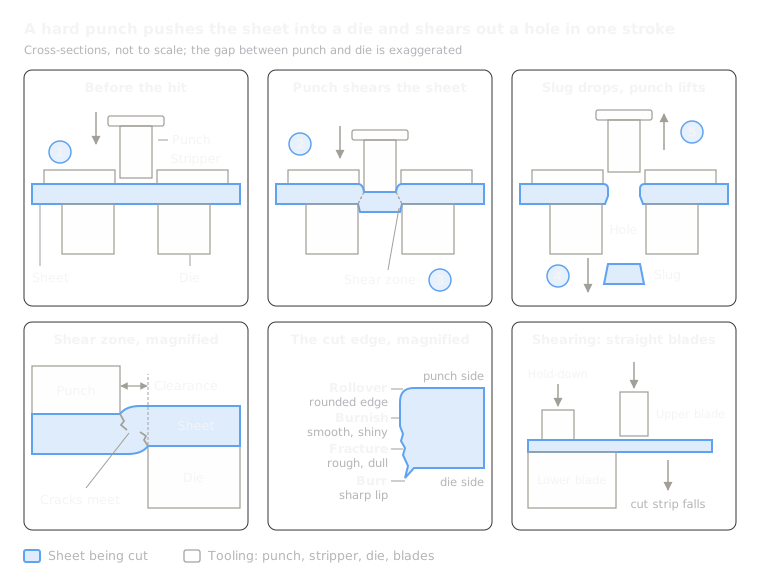 6.1Punching and shearingA punch shears shapes out of sheet against a dieOpen the lesson
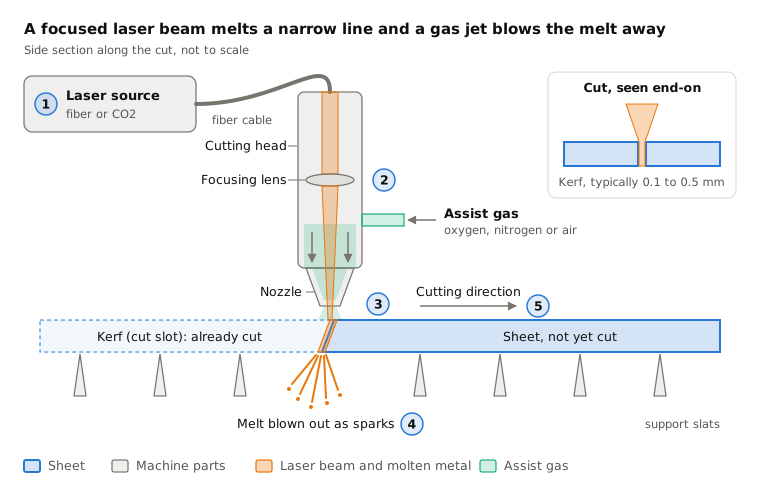
 6.2Laser cuttingFocused light melts or vaporizes a narrow cutOpen the lesson
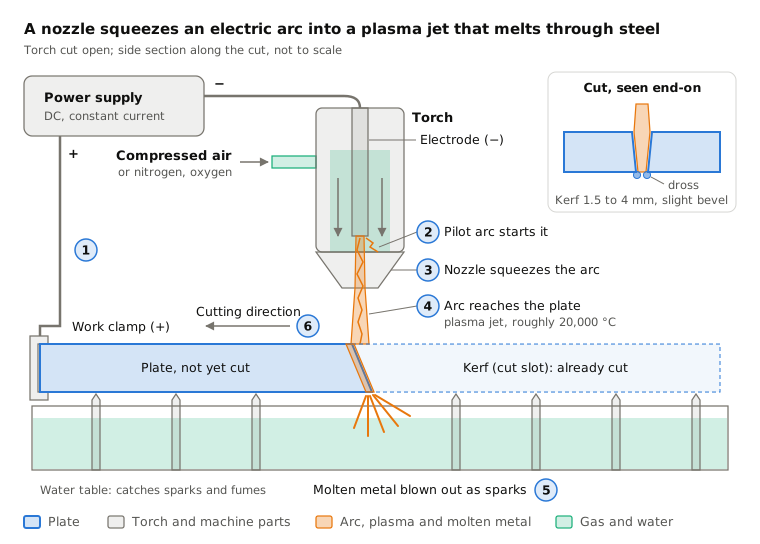
 6.3Plasma cuttingA superheated gas jet melts through conductive plateOpen the lesson
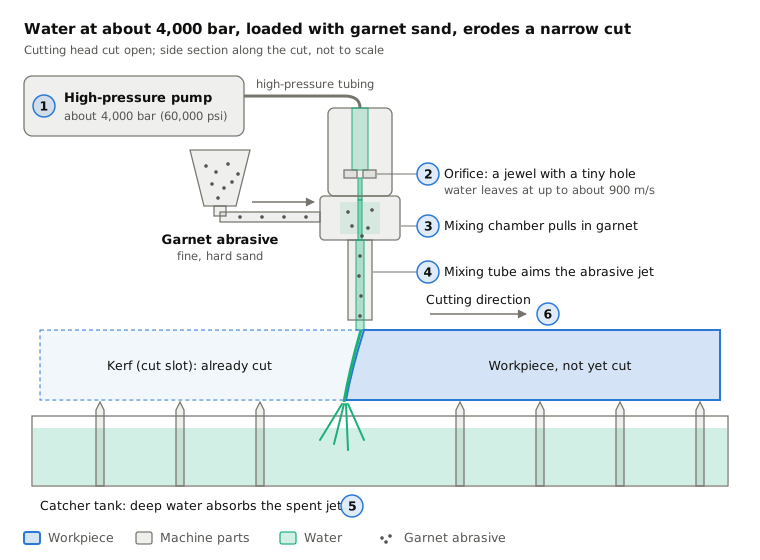
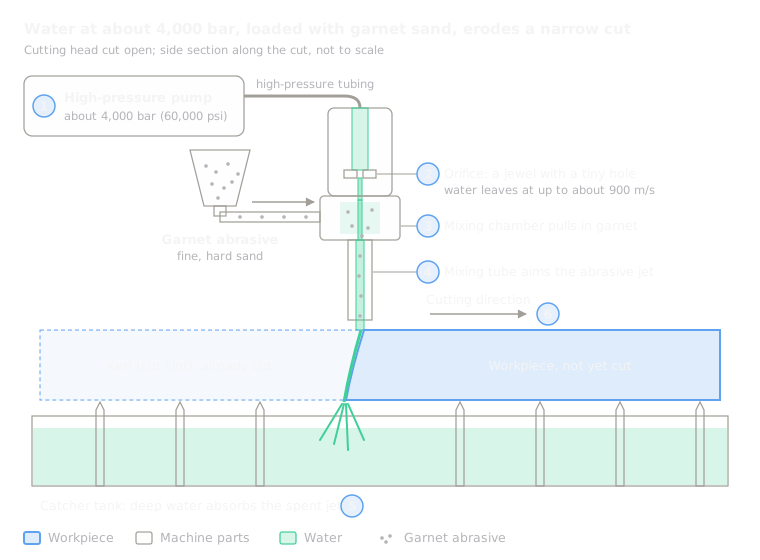 6.4Waterjet cuttingVery high-pressure water, usually with abrasive, erodes a cutOpen the lesson
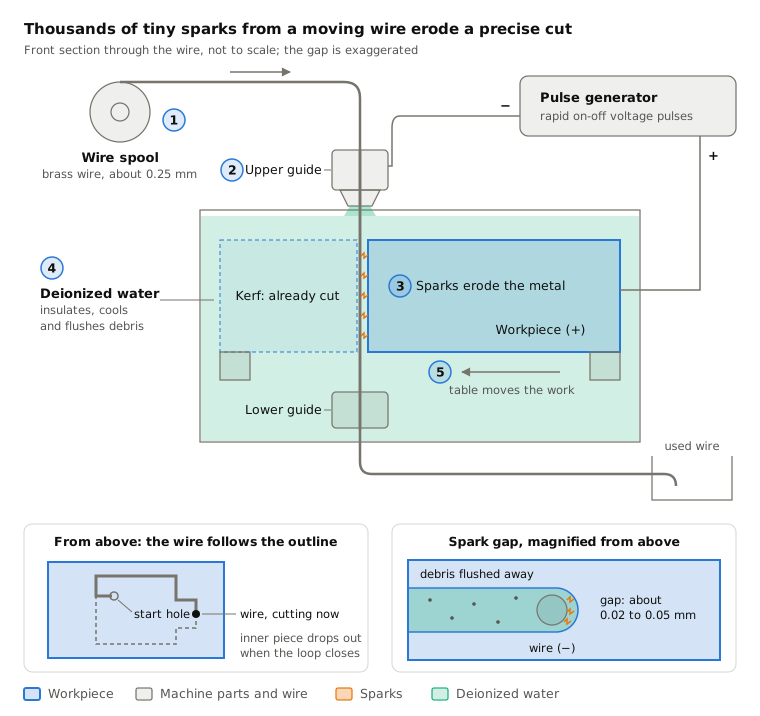
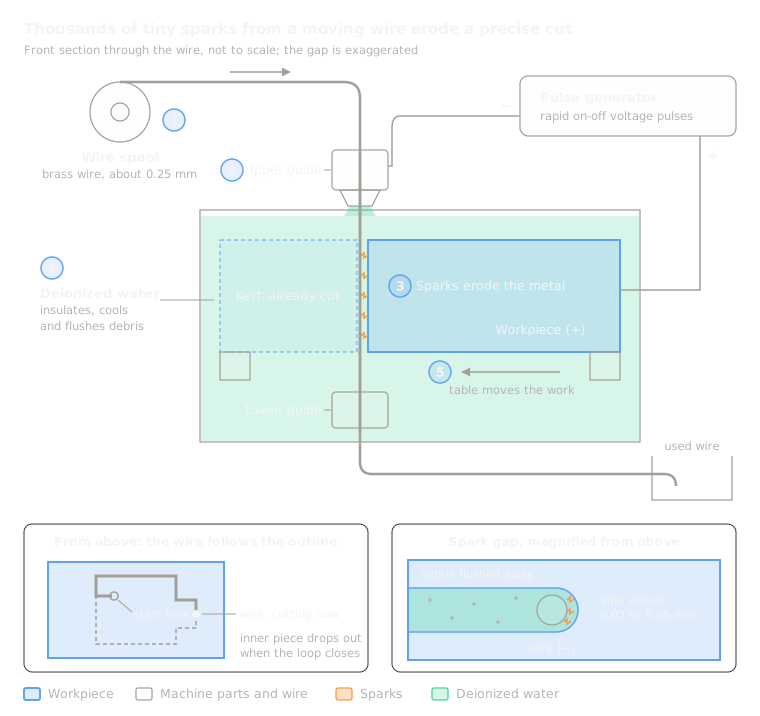 6.5Wire EDMSparks from a thin moving wire cut through-profilesOpen the lesson
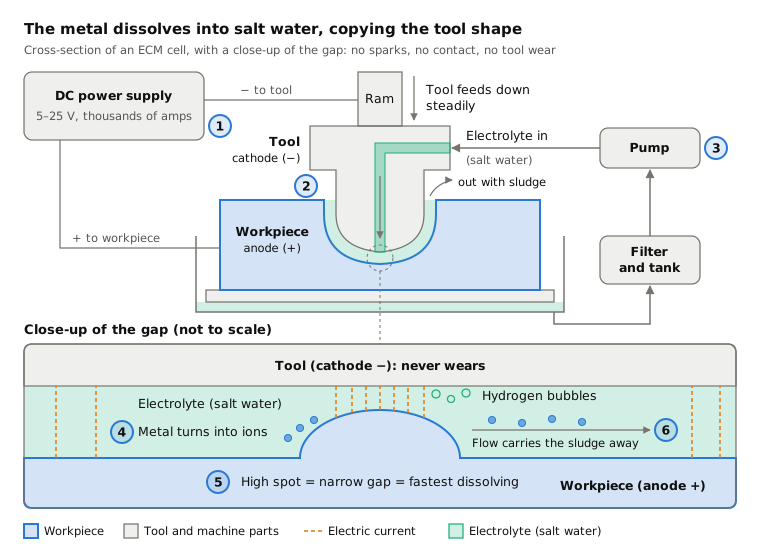
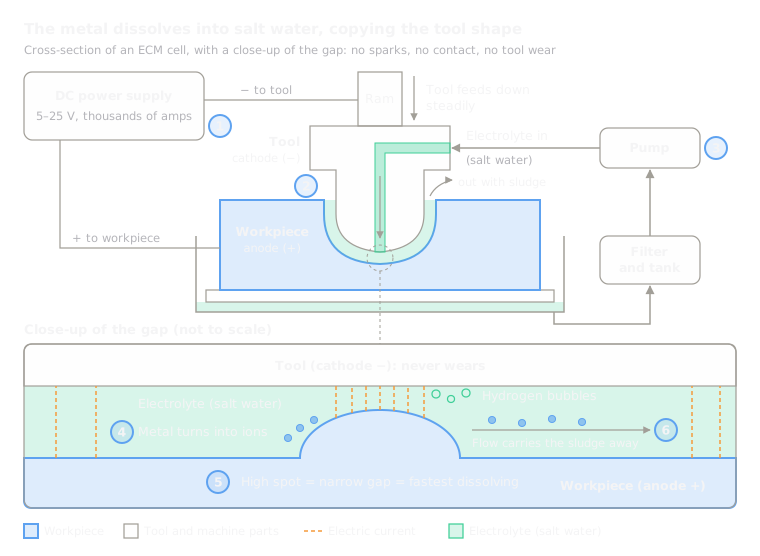 6.7Electrochemical machining (ECM)Electrolysis dissolves metal in the shape of the toolOpen the lesson
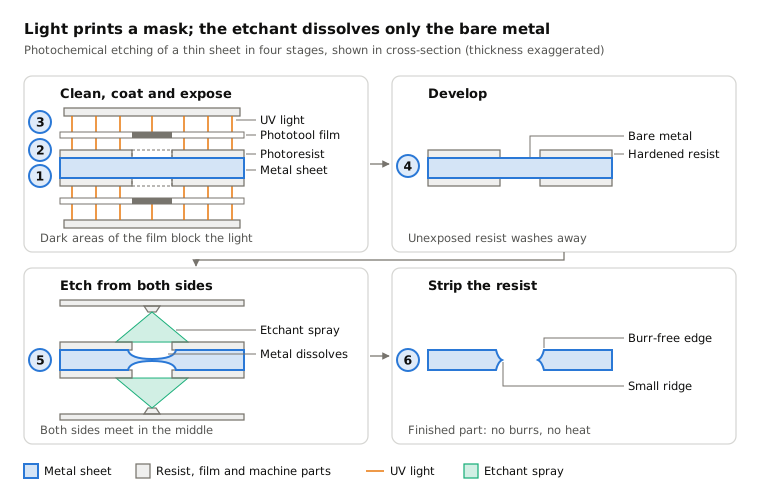
 6.8Chemical machining and photochemical etchingA light-printed mask lets an etchant dissolve only bare metalOpen the lesson
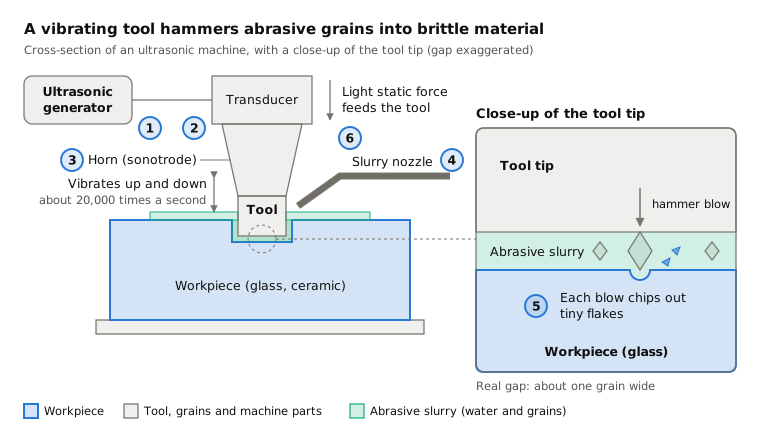
 6.9Ultrasonic machiningA vibrating tool hammers abrasive grains into the surfaceOpen the lesson
Try it
Put AI to work in your CAD.
Model parts, generate drawings and automate the repetitive work inside your CAD software.