

Electrochemical machining (ECM)
Electrolysis dissolves metal in the shape of the tool
Electrochemical machining (ECM) removes metal by dissolving it, atom by atom, with electric current and salt water. It works like electroplating in reverse: the shaped tool never touches the part, never wears, and leaves no heat damage or burrs. Jet-engine makers use it to shape blades from tough nickel alloys.
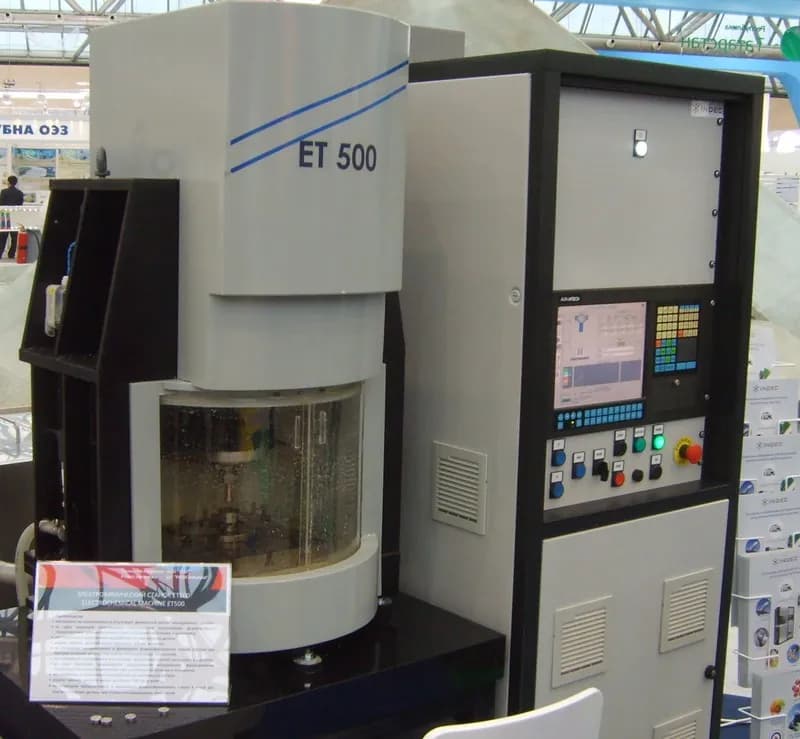
How it works
Wire the circuit. A DC power supply makes the workpiece the anode (positive side) and the shaped tool the cathode (negative side). It runs at low voltage, typically 5–25 V, but thousands of amps.
Close the gap. The tool, usually copper, brass or stainless steel, is brought within a few tenths of a millimeter of the part. The two never touch.
Pump the electrolyte. An electrolyte (a liquid that conducts electricity), typically sodium chloride or sodium nitrate in water, is pumped fast through the tool and across the gap.
Dissolve the metal. Current flows through the electrolyte, and atoms on the workpiece surface leave as metal ions (electrically charged atoms). Hydrogen bubbles form on the tool, which never wears.
Feed and copy. The tool advances steadily. Metal dissolves fastest where the gap is narrowest, so high spots vanish and the part takes the tool's shape in reverse.
Flush and filter. The flow carries away the dissolved metal as sludge (metal hydroxide), plus gas and heat. The electrolyte is filtered, cooled and reused.
Key facts
- Materials
- Any electrically conductive metal, especially hard-to-cut alloys: nickel superalloys, titanium, cobalt alloys, hardened steel. Hardness does not matter.
- Typical parts
- Turbine blades and blisks (one-piece bladed disks), gun-barrel rifling, deep cooling holes, deburring of internal cross-holes in valve and injector bodies
- Part size
- From cross-holes about a millimeter wide to engine parts several hundred millimeters across
- Precision
- Typically about ±0.05 mm; pulsed ECM (PECM) can hold about ±0.01 mm
- Surface finish
- Smooth and often bright, with no burrs, cracks or heat-damaged layer; roughness Ra (average height of surface bumps) typically 0.1–2 µm, near-mirror with PECM
- Batch size it suits
- Medium to high volumes of high-value parts: the tool does not wear, but developing it takes trial and error
- Tooling and machine cost
- High: machines often several hundred thousand dollars or more, plus custom tools and a large electrolyte-handling system
- Speed
- Set by the current: roughly 2 cm³ of steel dissolved per minute for every 1,000 A; the tool typically advances a fraction of a millimeter to a few millimeters per minute
Strengths and limits
Strengths
- No tool wear: one tool can make thousands of parts
- Cuts any metal, however hard, with no heat damage
- No cutting force and no burrs; smooth, stress-free surfaces
- Fast on complex 3D shapes in tough alloys
Limits
- Works only on electrically conductive metals
- Expensive machines and slow, trial-and-error tool development
- Sharp inside corners and fine details are hard: the gap rounds them
- Large volumes of electrolyte and metal sludge to filter and dispose of safely
Where it's used
- AerospaceTurbine blades and blisks in nickel and titanium alloys; cooling holes
- DefenseRifling (spiral grooves) inside gun barrels
- AutomotiveDeburring cross-holes in fuel injectors, valve bodies and transmission parts
- Power generationBlades for gas and steam turbines
- Tool makingForging-die cavities in hardened steel
How to recognize it
- Smooth, often bright or satin surfaces with no tool marks, no burrs and no heat discoloration.
- Edges and inside corners slightly rounded, never razor-sharp.
- Complex curved shapes, like blade airfoils, in very hard alloys with no visible machining lines.
- Cross-holes inside a part with neatly rounded, burr-free edges.
Compare with
Watch it
Piyush Singh · An animated tour of the circuit, the gap and the flow
MTDCNC · Real ECM machines and finished parts up close
EMAG · How industrial ECM and pulsed ECM machines work
CamcraftInc · ECM in a production shop making precision parts
See real photos
- Wikipedia: Electrochemical machining — principle diagram, history and applications
- Wikimedia Commons photo search
Remember
- ECM dissolves metal with current and salt water; the tool never touches the part and never wears.
- The part copies the tool because metal dissolves fastest where the gap is narrowest.
- It suits tough alloys and high volumes; look for smooth, burr-free surfaces and softly rounded edges.
More in Cutting and non-traditional machining
All 100 processes
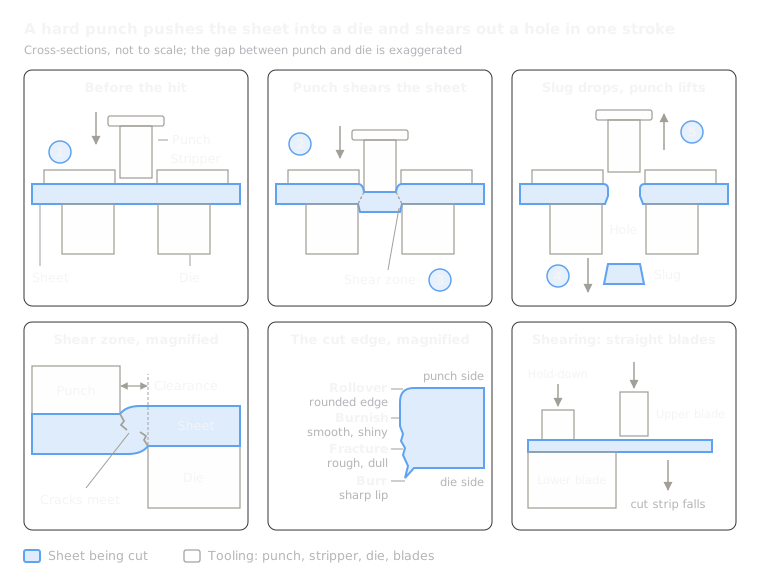 6.1Punching and shearingA punch shears shapes out of sheet against a dieOpen the lesson
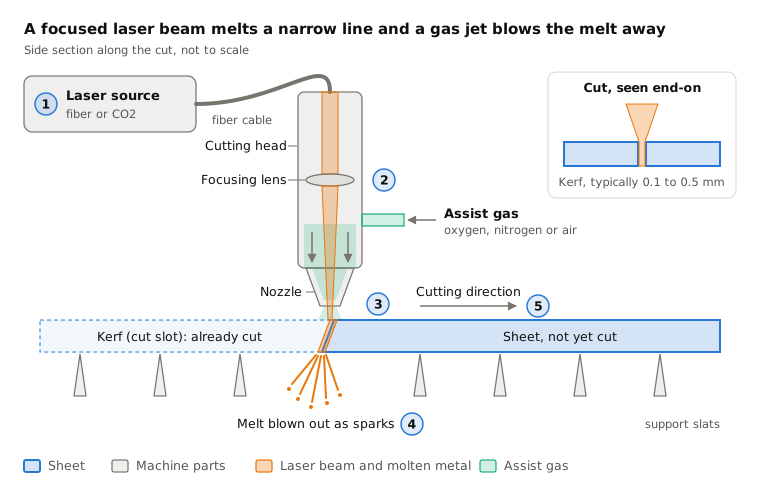
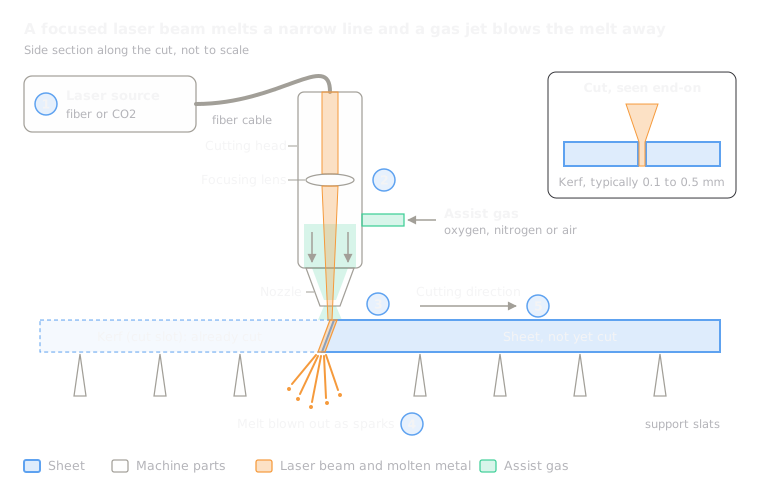 6.2Laser cuttingFocused light melts or vaporizes a narrow cutOpen the lesson
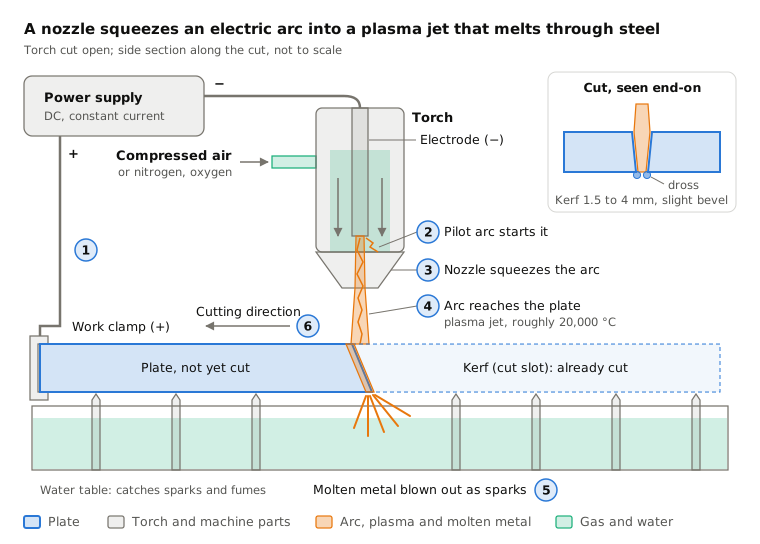
 6.3Plasma cuttingA superheated gas jet melts through conductive plateOpen the lesson
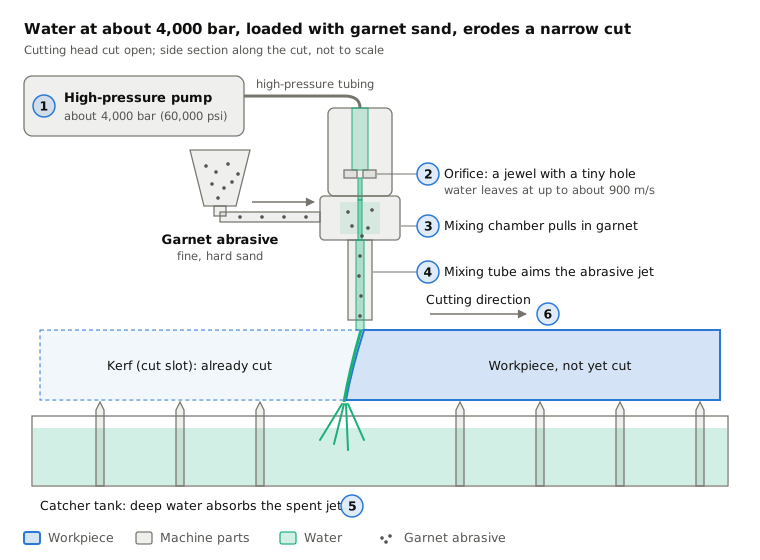
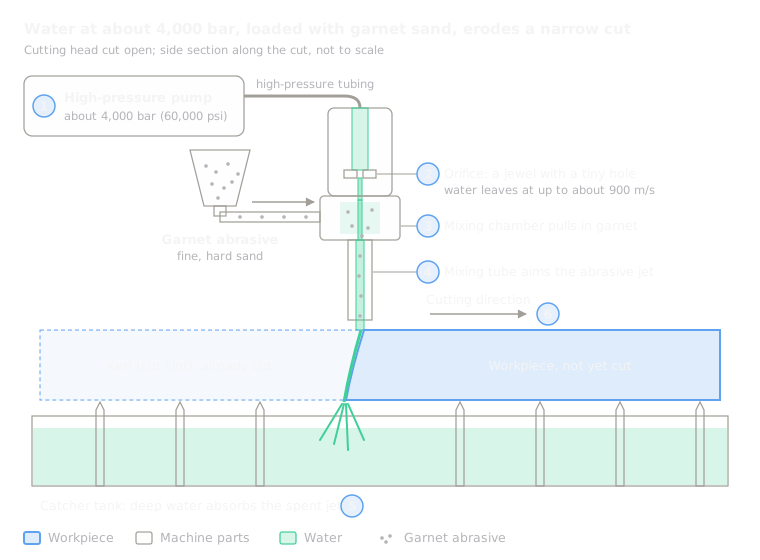 6.4Waterjet cuttingVery high-pressure water, usually with abrasive, erodes a cutOpen the lesson
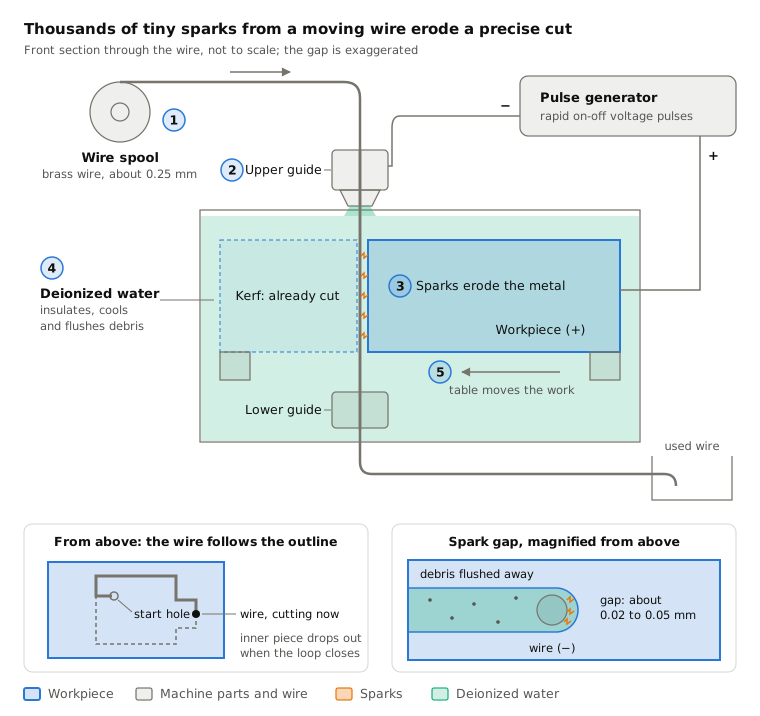
 6.5Wire EDMSparks from a thin moving wire cut through-profilesOpen the lesson
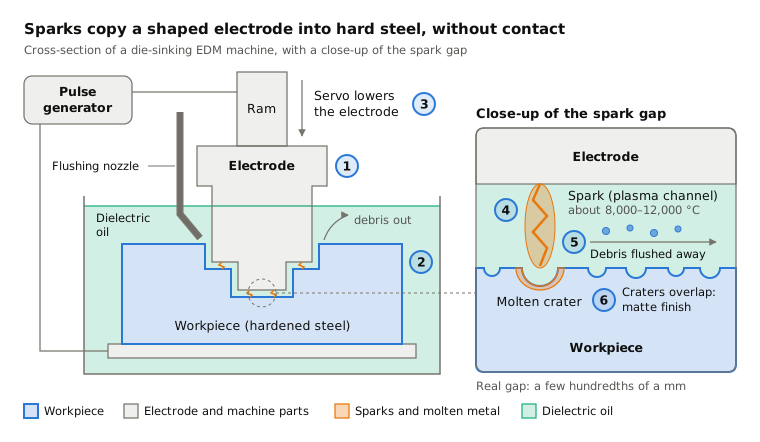
 6.6Sinker EDMSparks copy a shaped electrode into a blind cavityOpen the lesson
 6.8Chemical machining and photochemical etchingA light-printed mask lets an etchant dissolve only bare metalOpen the lesson
 6.9Ultrasonic machiningA vibrating tool hammers abrasive grains into the surfaceOpen the lesson
Try it
Put AI to work in your CAD.
Model parts, generate drawings and automate the repetitive work inside your CAD software.