

Cutting and non-traditional machining
This chapter covers nine ways to cut through sheet and plate, or to remove material where a turning or milling cutter cannot reach or cannot survive. They share one principle: deliver concentrated energy to a small spot, and only there. What changes from one process to the next is the kind of energy, and that decides which materials and shapes each one handles.
The big idea
Think of the ways to get through a sheet of ice: a chisel, a blowtorch, a jet of hot water, a handful of salt. Each works, but on different ice and at different speeds. Here, punching uses brute shear force; laser cutting uses focused light; plasma cutting uses a superheated jet of electrically charged gas; waterjet cutting uses water at very high pressure; wire and sinker EDM use thousands of tiny sparks; ECM uses electrolysis (current through salt water); chemical machining uses an etchant that dissolves metal; and ultrasonic machining uses vibration that hammers abrasive grains.
The 9 processes in this chapter
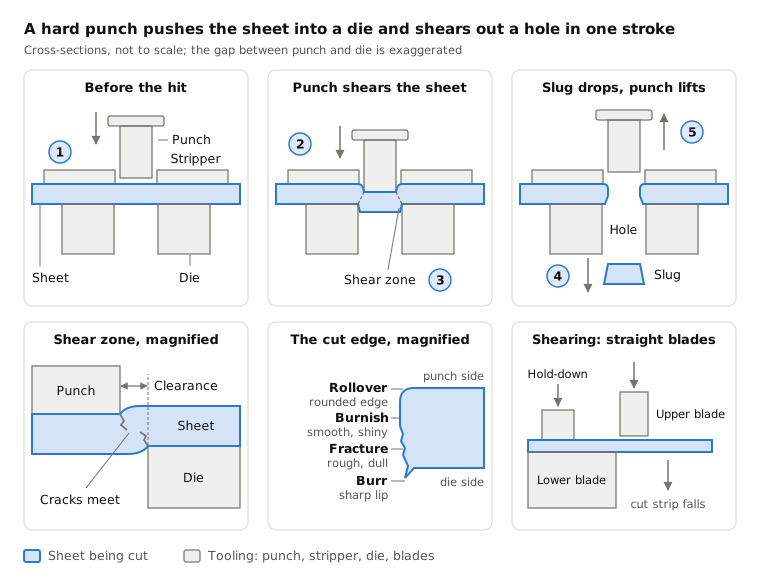
 6.1Punching and shearingA punch shears shapes out of sheet against a dieOpen the lesson
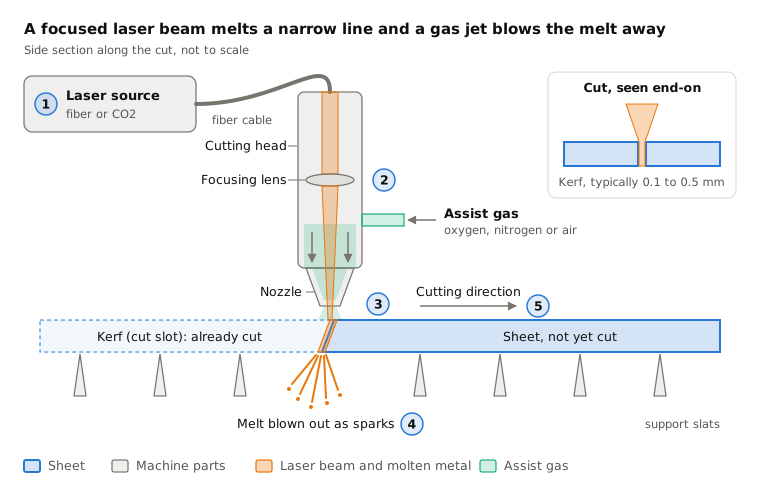
 6.2Laser cuttingFocused light melts or vaporizes a narrow cutOpen the lesson
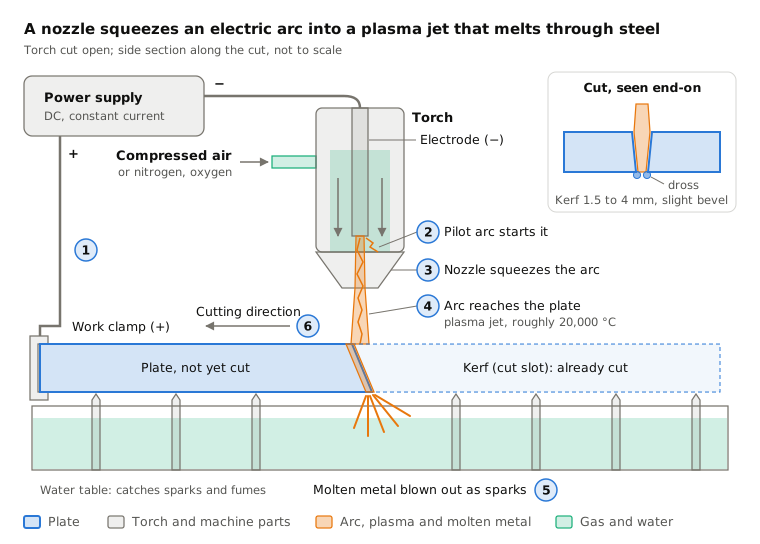
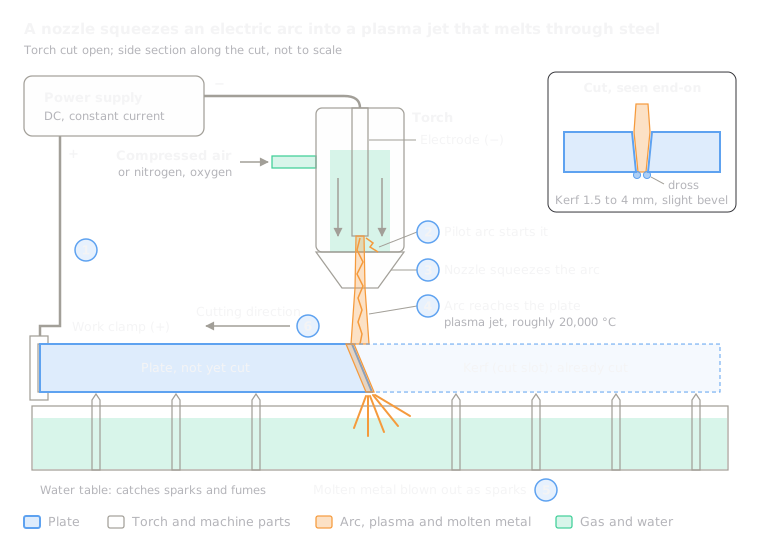 6.3Plasma cuttingA superheated gas jet melts through conductive plateOpen the lesson
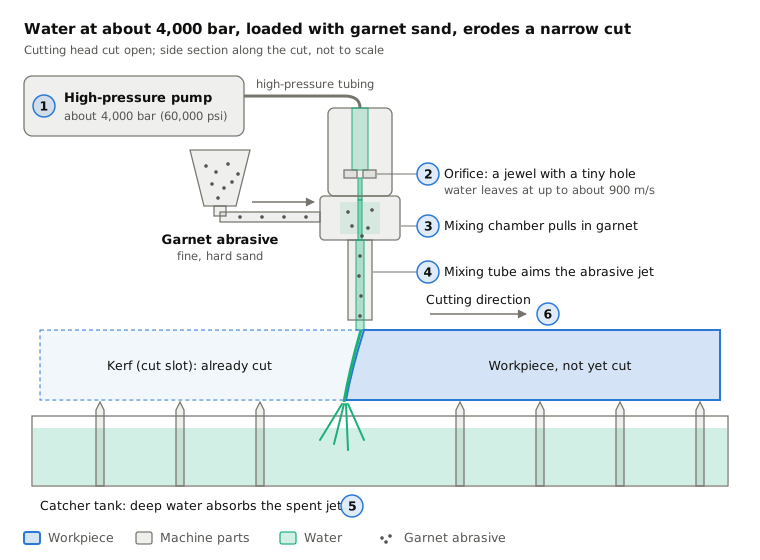
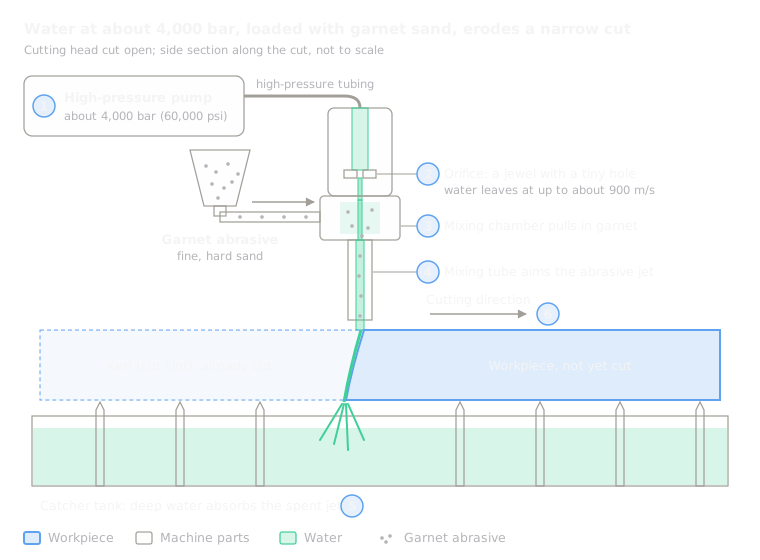 6.4Waterjet cuttingVery high-pressure water, usually with abrasive, erodes a cutOpen the lesson
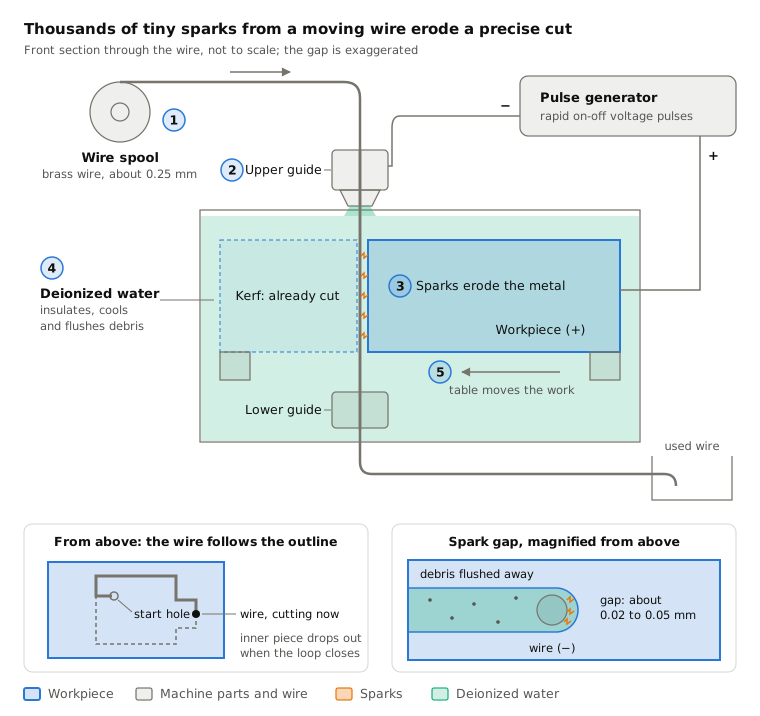
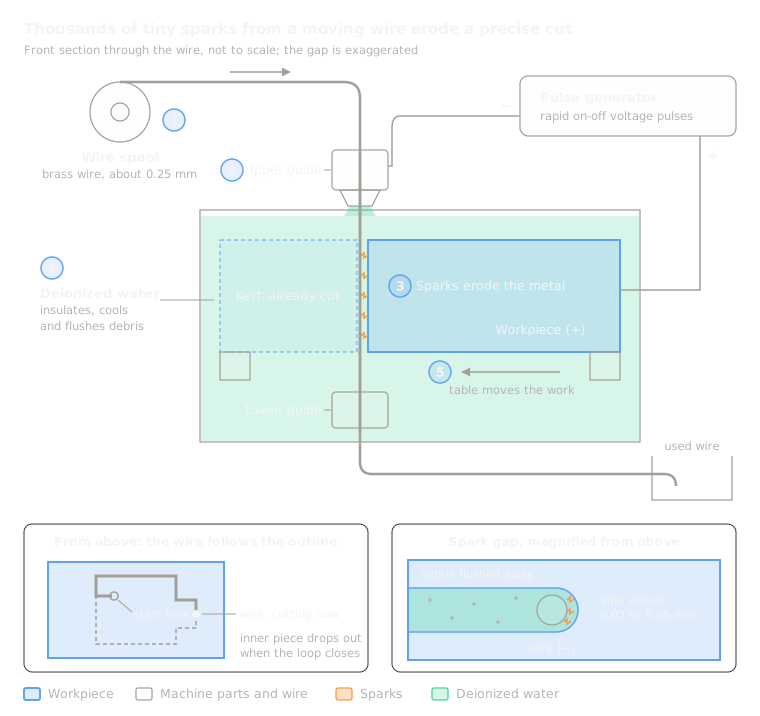 6.5Wire EDMSparks from a thin moving wire cut through-profilesOpen the lesson
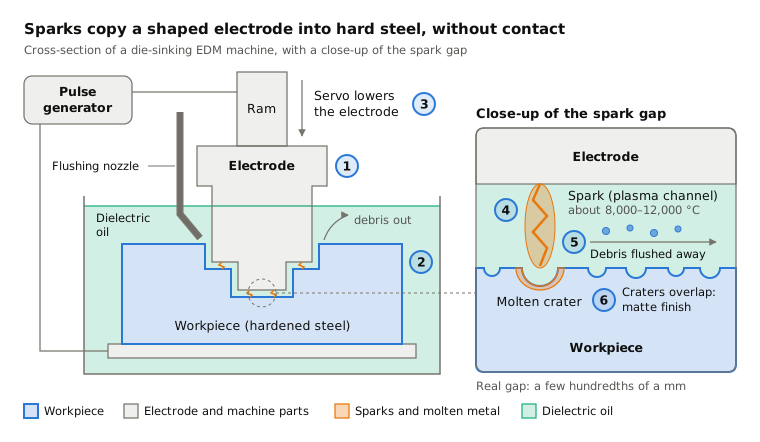
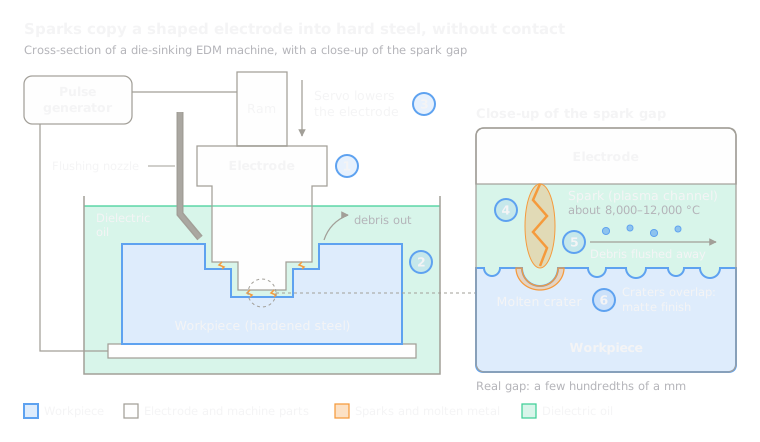 6.6Sinker EDMSparks copy a shaped electrode into a blind cavityOpen the lesson
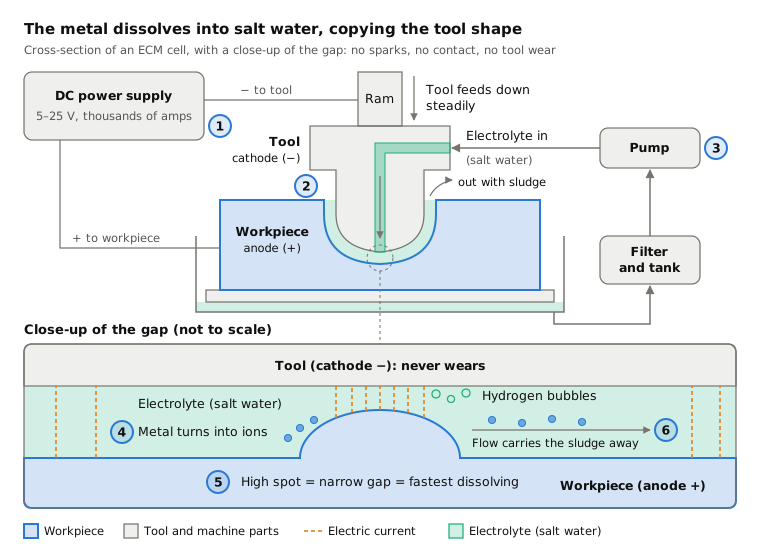
 6.7Electrochemical machining (ECM)Electrolysis dissolves metal in the shape of the toolOpen the lesson
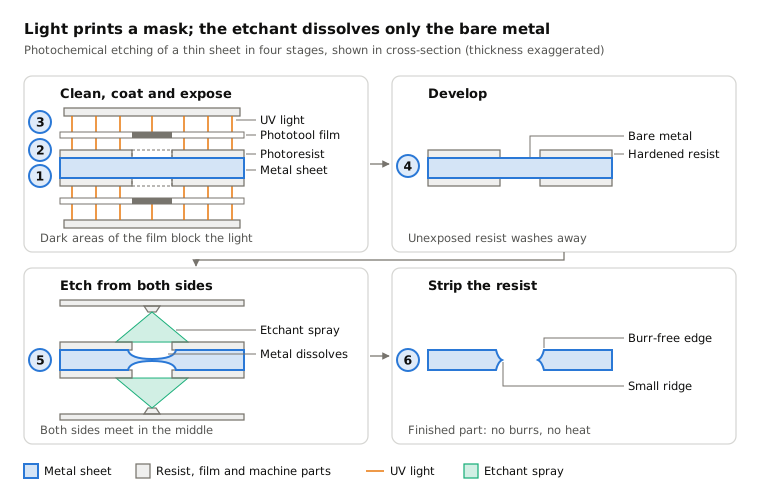
 6.8Chemical machining and photochemical etchingA light-printed mask lets an etchant dissolve only bare metalOpen the lesson
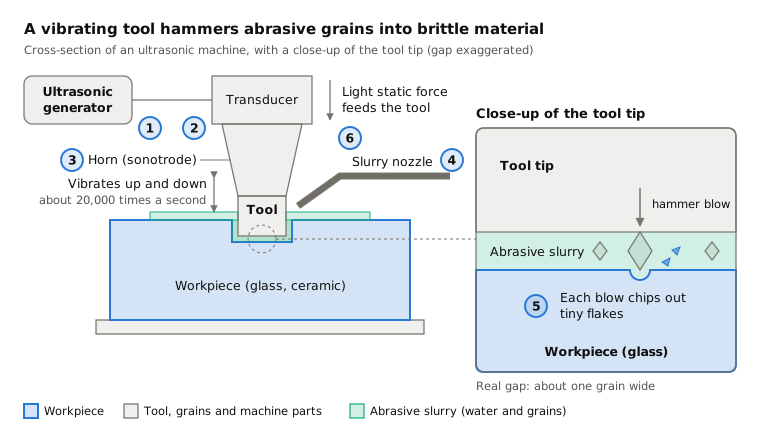
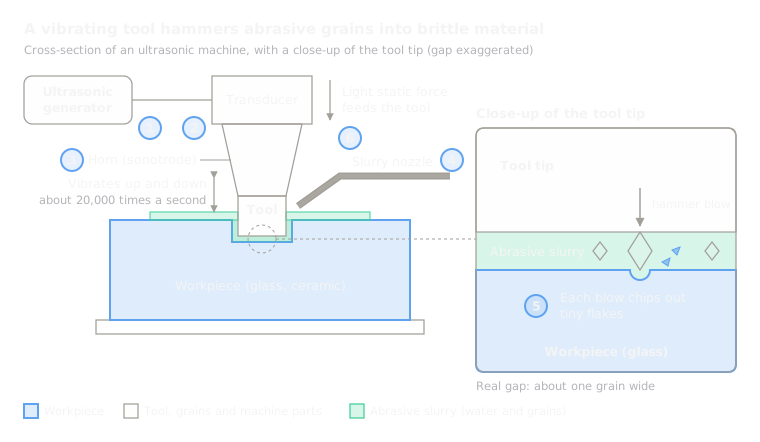 6.9Ultrasonic machiningA vibrating tool hammers abrasive grains into the surfaceOpen the lesson
Side by side
| Process | In one line | Best for | Batch size | Precision |
|---|---|---|---|---|
| 6.1Punching and shearing | A punch shears shapes out of sheet against a die | Holes and blanks in sheet metal | High volume | About ±0.1 mm |
| 6.2Laser cutting | Focused light melts or vaporizes a narrow cut | Detailed profiles in thin to medium sheet | One-offs to high volume | About ±0.1 mm |
| 6.3Plasma cutting | A superheated gas jet melts through conductive plate | Fast, cheap cuts in thick steel plate | One-offs to medium | About ±0.5 mm |
| 6.4Waterjet cutting | Very high-pressure water, usually with abrasive, erodes a cut | Almost any material, with no heat | One-offs to medium | About ±0.1 mm |
| 6.5Wire EDM | Sparks from a thin moving wire cut through-profiles | Precise profiles in hardened metal | One-offs to small series | About ±0.005 mm |
| 6.6Sinker EDM | Sparks copy a shaped electrode into a blind cavity | Mold and die cavities, sharp inside corners | One-offs and tooling | About ±0.01 mm |
| 6.7Electrochemical machining (ECM) | Electrolysis dissolves metal in the shape of the tool | Tough alloys, turbine blades, deburring | Medium to high volume | About ±0.05 mm |
| 6.8Chemical machining and photochemical etching | A light-printed mask lets an etchant dissolve only bare metal | Thin sheet with fine, complex patterns | Prototypes to millions | About ±10% of sheet thickness |
| 6.9Ultrasonic machining | A vibrating tool hammers abrasive grains into the surface | Shaped holes in glass and ceramics | Prototypes to large series | A few hundredths of a mm |
How to choose within this family
- Thin sheet metal, huge volumes and simple holes: punching. Changing designs or detailed profiles: laser cutting.
- Thick steel plate where speed matters more than precision: plasma. Heat-sensitive or non-metallic materials such as stone, glass or composites: waterjet.
- Hardened metal and tight tolerances: wire EDM for through-profiles, sinker EDM for blind cavities, ECM for high volumes of tough-alloy parts with no heat damage.
- Very thin sheet with hundreds or thousands of fine holes: photochemical etching.
- Brittle, non-conductive materials such as glass and ceramics that need shaped holes: ultrasonic machining.
Key words
- Kerf
- the width of material a cut removes.
- Heat-affected zone
- the band next to a thermal cut whose properties the heat has changed.
- Burr
- a sharp ridge of material left on a cut edge.
- Electrode
- the conductive tool that carries current to the workpiece in EDM and ECM.
- Dielectric
- an electrically insulating fluid, such as EDM oil or deionized water.
- Electrolyte
- a liquid that conducts electricity, such as the salt water used in ECM.
- Etchant
- a corrosive solution that dissolves the metal a mask leaves bare.
- Recast layer
- the thin re-solidified skin that melting processes like EDM leave behind.
Try it
Put AI to work in your CAD.
Model parts, generate drawings and automate the repetitive work inside your CAD software.