

Plasma cutting
A superheated gas jet melts through conductive plate
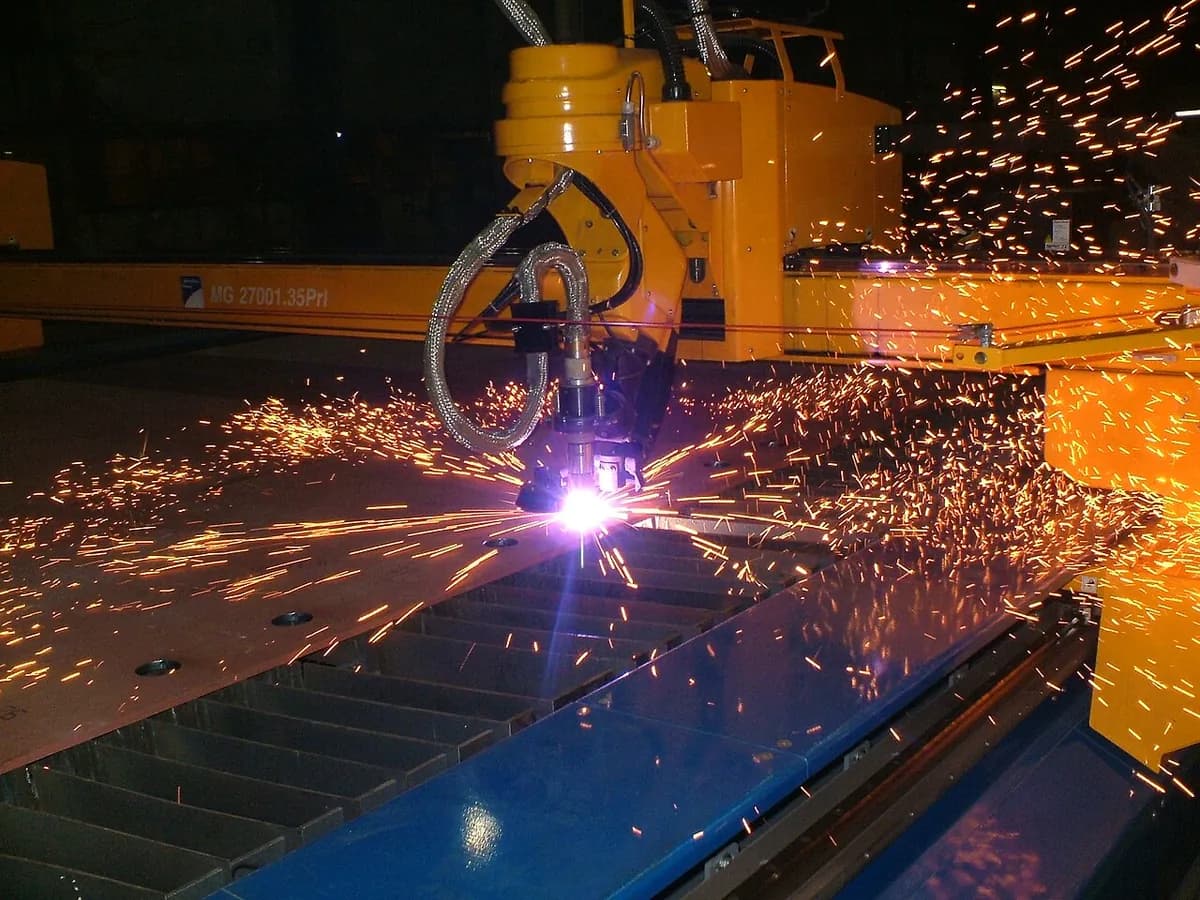
Plasma cutting slices through metal plate with an electric arc squeezed into a thin jet of superheated gas. It is the workhorse for steel plate from about 3 to 50 mm thick: trailer frames, machine bases, brackets and repair work. A handheld unit fits in a car trunk; a CNC plasma table cuts parts from a full sheet of plate.
How it works
Close the circuit. A clamp connects the plate to the positive side of a DC power supply (direct current, like a battery's). The electrode inside the torch is the negative side.
Start with a pilot arc. Compressed air, or another gas, swirls through the torch. A small pilot arc (a starter spark) between the electrode and the nozzle turns some of it into plasma, an electrically conducting gas.
Squeeze the arc. The nozzle's narrow hole squeezes the arc and the gas into a thin, very fast jet, roughly 20,000 °C at its core.
Reach the plate. When the jet touches the plate, the arc jumps to the metal and the full cutting current flows through it, often tens to hundreds of amps. The metal melts through its thickness.
Blow it out. The jet blows the molten metal out of the bottom of the cut as sparks, usually into a water table that also catches fumes. Some metal sticks to the lower edge as dross (re-solidified beads).
Follow the path. A CNC gantry moves the torch along the outline and keeps its height constant; with a handheld torch, a person guides it.
Key facts
- Materials
- Any metal that conducts electricity: mild and stainless steel, aluminum, copper, brass
- Typical parts
- Brackets, base plates, flanges, gussets, frame parts, scrap and demolition cuts
- Part size
- Plate typically 1 to about 50 mm thick; CNC tables often 1.5 × 3 m and much larger
- Precision
- Typically about ±0.5 mm; fine-arc (high-definition) torches do better
- Surface finish
- Rougher than laser, with a slight bevel, dross on the bottom edge and a wider heat-affected zone (a band changed by heat)
- Batch size it suits
- One-off repairs to series of plate parts on CNC tables
- Tooling and machine cost
- No tooling, but the electrode and nozzle wear out; handheld units from a few hundred dollars, CNC tables from tens of thousands
- Speed
- Several meters per minute in 6 to 12 mm steel, faster than laser in thick plate
Strengths and limits
Strengths
- Fast and cheap in medium and thick steel plate
- Low-cost machines, including portable handheld units
- Cuts stainless and aluminum, which an oxy-fuel flame cannot
- Bevel heads cut angled edges ready for welding
Limits
- Only electrically conductive metals
- Wider kerf (1.5 to 4 mm) and less precise than laser or waterjet
- Slightly beveled edges and dross that must be chipped or ground off
- Bright arc, fumes and noise need screens and extraction
Where it's used
- Steel fabricationBase plates, gussets, brackets for buildings and bridges
- Heavy equipment and agricultureChassis plates, buckets, frames for tractors and trailers
- ShipbuildingHull plates and stiffeners, often with bevel heads
- HVAC and ductworkDuct fittings cut from thin galvanized sheet
- Repair, scrap and demolitionHandheld cuts on site, dismantling steel structures
How to recognize it
- A cut edge that is slightly out of square, often squarer on one side of the cut than the other.
- Beads of dross, re-solidified metal, along the bottom edge, or grinder marks where they were removed.
- Curved drag lines on the cut face that lag behind toward the bottom, and a blue or straw-colored band beside the cut.
- Holes slightly tapered or with a small dimple where the cut started (the pierce point).
Compare with
Watch it
Messer Cutting · The arc, the gas and the torch, explained simply
Hypertherm EMEIA · When plasma beats a gas flame, and when it does not
Westermans International · A CNC high-definition cut and its edge quality up close
Bueno's Handyworks · A handheld torch cutting in a small shop
See real photos
- Wikipedia: Plasma cutting — principle, handheld and CNC torches, bevel and tube cutting, history
- Wikimedia Commons photo search
Remember
- An arc squeezed by a small nozzle turns gas into a plasma jet that melts and blows out metal.
- The plate is part of the electric circuit, so plasma cuts only conductive metals.
- Best value in steel plate a few millimeters to a few centimeters thick; rougher than laser.
More in Cutting and non-traditional machining
All 100 processes
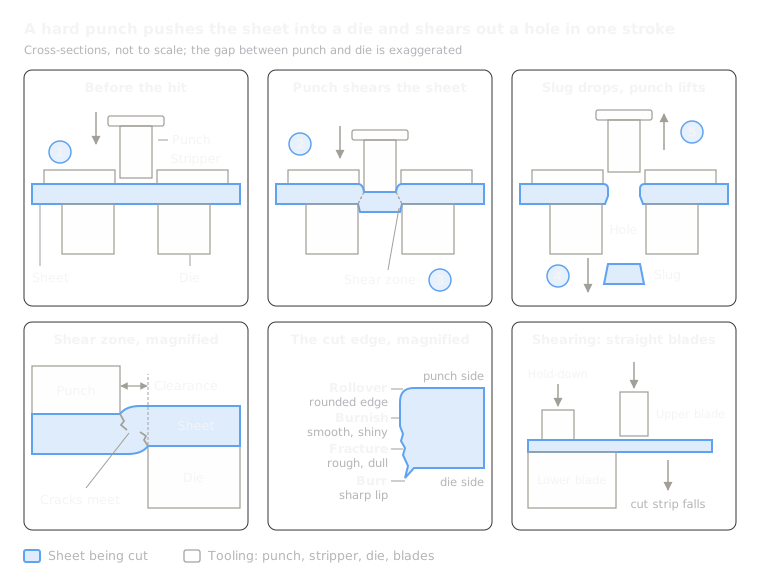 6.1Punching and shearingA punch shears shapes out of sheet against a dieOpen the lesson
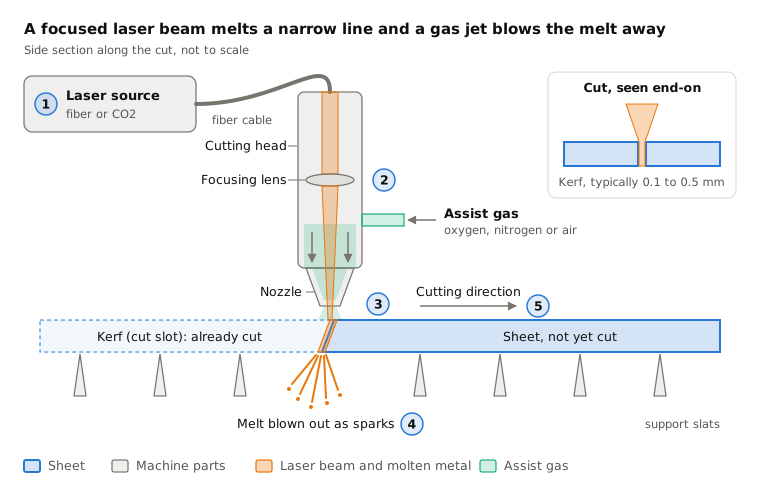
 6.2Laser cuttingFocused light melts or vaporizes a narrow cutOpen the lesson
 6.4Waterjet cuttingVery high-pressure water, usually with abrasive, erodes a cutOpen the lesson
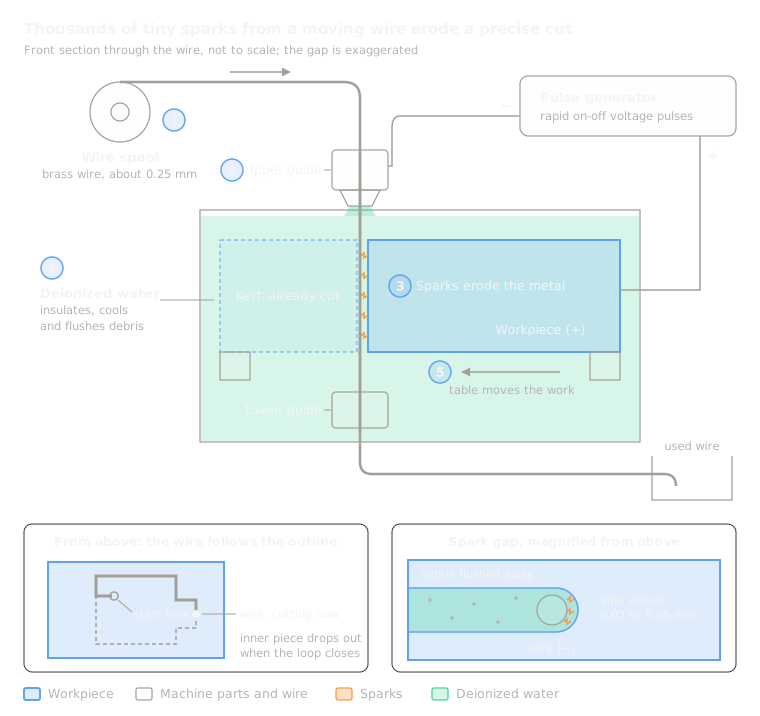 6.5Wire EDMSparks from a thin moving wire cut through-profilesOpen the lesson
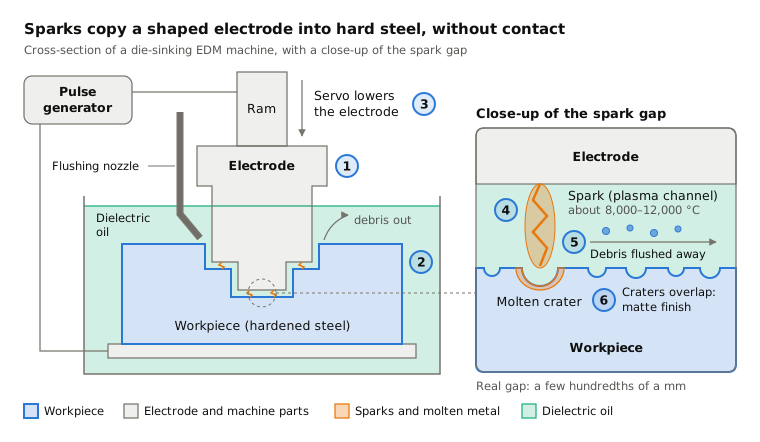
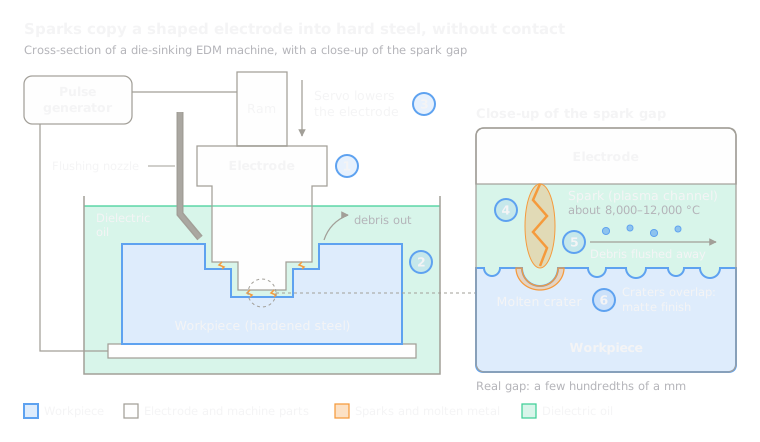 6.6Sinker EDMSparks copy a shaped electrode into a blind cavityOpen the lesson
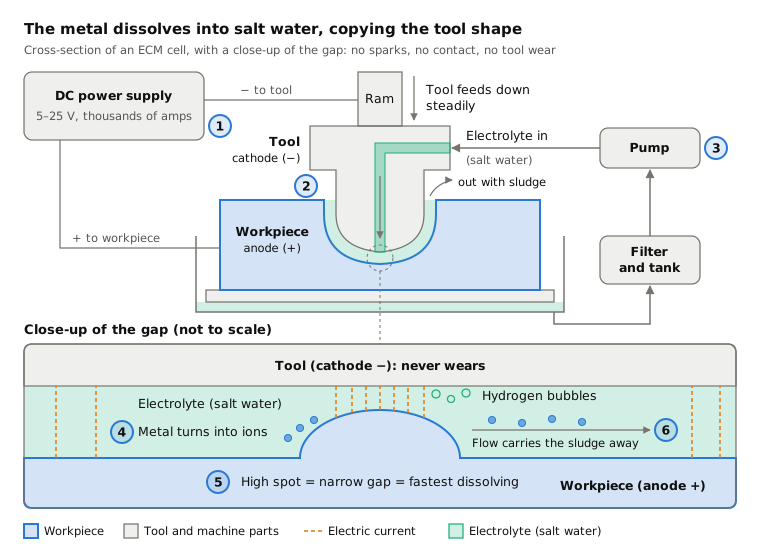
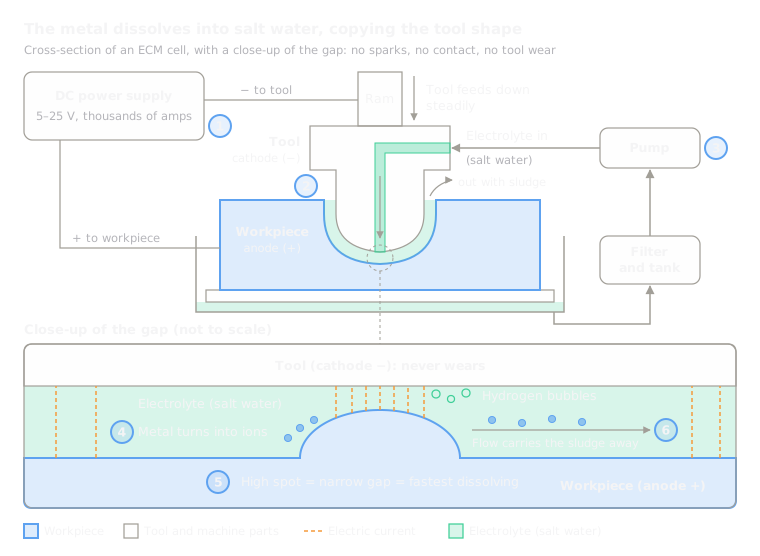 6.7Electrochemical machining (ECM)Electrolysis dissolves metal in the shape of the toolOpen the lesson
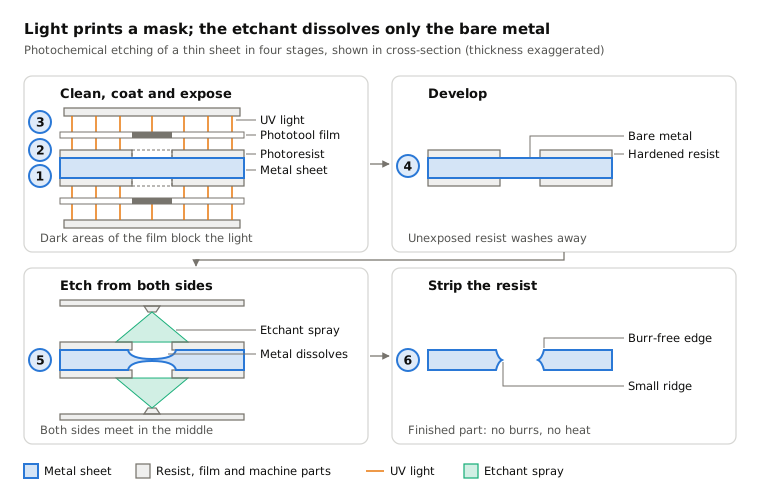
 6.8Chemical machining and photochemical etchingA light-printed mask lets an etchant dissolve only bare metalOpen the lesson
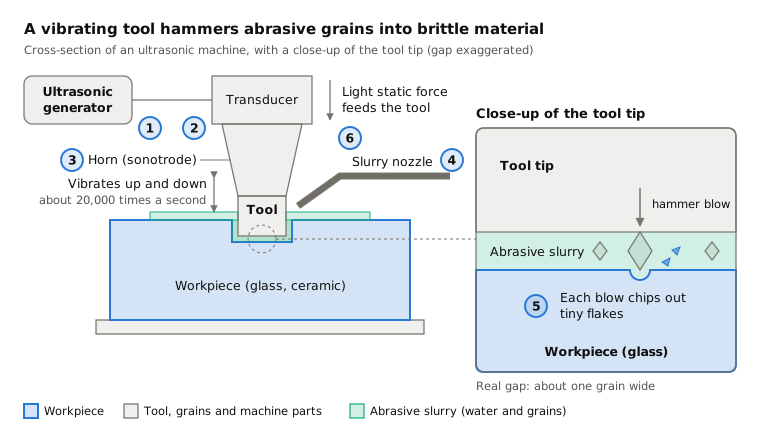
 6.9Ultrasonic machiningA vibrating tool hammers abrasive grains into the surfaceOpen the lesson
Try it
Put AI to work in your CAD.
Model parts, generate drawings and automate the repetitive work inside your CAD software.