

Laser cutting
Focused light melts or vaporizes a narrow cut
Laser cutting traces a shape in flat material with a focused beam of light that melts a narrow line through it. Many metal brackets, enclosure panels and acrylic signs start this way. It needs no tooling: the machine cuts straight from a drawing file, so a single part is as easy to make as a thousand.
How it works
Make the beam. A laser source turns electricity into an intense, invisible infrared beam. Fiber lasers (the beam is generated inside a glass fiber) dominate metal cutting; CO2 lasers (the beam comes from a gas mixture) are common for wood and plastics.
Focus it. A fiber cable (or mirrors, for CO2) carries the beam to the cutting head. A lens concentrates it into a spot a fraction of a millimeter wide.
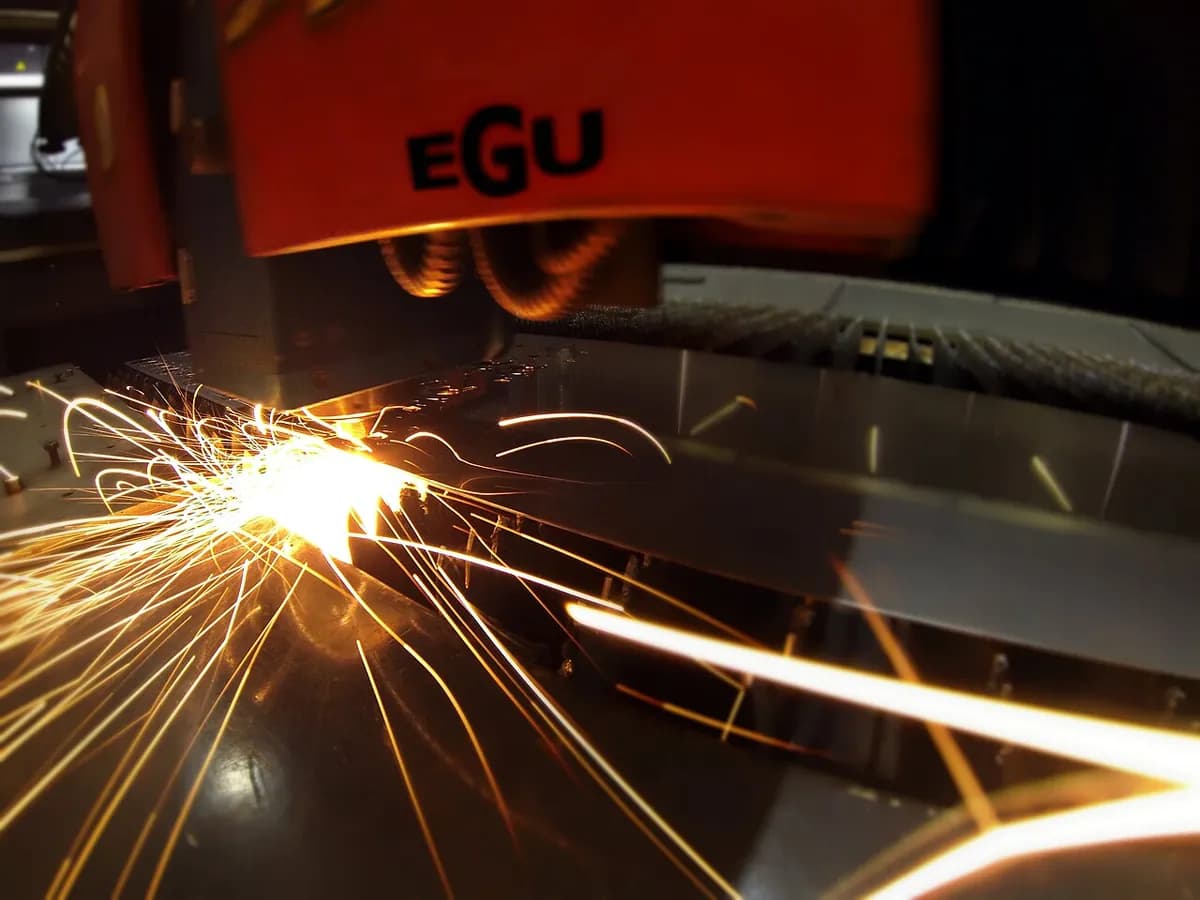
Melt. At that spot the energy is so concentrated that the material melts, or partly vaporizes, through its full thickness.
Blow out. An assist gas flows through the nozzle around the beam and blows the molten metal out of the bottom of the cut as sparks. Oxygen also burns steel and adds heat; nitrogen leaves a clean, bright edge.
Trace the outline. A CNC system (computer numerical control) moves the head along the outline, leaving a narrow kerf (the slot the cut makes). A sensor keeps the nozzle about 1 mm above the sheet.
Most machines cut flat sheet lying on a bed of pointed support slats. Tube lasers rotate a tube under the head to cut holes, slots and angled ends.
Key facts
- Materials
- Mild and stainless steel, aluminum, copper and brass (fiber lasers); wood, acrylic, cardboard, fabric and leather (CO2 lasers)
- Typical parts
- Brackets, enclosure panels, gaskets, signs and lettering, flat parts nested on a sheet
- Part size
- Flat sheets typically up to 1.5 × 3 m or 2 × 4 m; steel up to about 25 mm thick on common machines
- Precision
- Often about ±0.1 mm
- Surface finish
- Smooth cut face with fine vertical lines; a thin heat-affected zone (a band whose structure the heat has changed)
- Batch size it suits
- From one part to large series, with no tooling and automatic sheet loading
- Tooling and machine cost
- No part-specific tooling; hobby CO2 cutters cost a few thousand dollars, industrial fiber machines a few hundred thousand
- Speed
- Tens of meters per minute in thin sheet; around 1 m/min in 20 mm steel
Strengths and limits
Strengths
- No tooling: any 2D outline straight from a drawing file
- Narrow kerf and fine detail, often about ±0.1 mm
- Fast in thin sheet; parts are nested (packed tightly on the sheet) to save material
- One machine handles many metals, or wood and plastics with a CO2 source
Limits
- Mostly flat sheet and tube; thick plate is slow
- Heat leaves a thin altered zone and can warp thin parts
- Shiny copper and brass need fiber lasers and care
- Some plastics, such as PVC, give off toxic gas and must not be laser cut
Where it's used
- Sheet-metal job shopsBrackets, panels, machine guards, one-off parts
- AutomotivePrototype body parts, trimming of formed parts with 5-axis lasers, exhaust parts
- Machinery and agricultureFrames, flanges, gussets, mounting plates
- Architecture and signsDecorative facade screens, lettering, stair parts
- ElectronicsStainless solder-paste stencils, thin shielding parts
- Makers and designAcrylic displays, plywood models, leather goods
How to recognize it
- Very fine, regular vertical lines (striations) on the cut face, and a crisp, square edge.
- Tiny tabs or nicks on the edge: micro-joints, small bridges left to hold parts in the sheet and broken off later.
- A small pierce mark where each cut started, where the beam first burned through, often just off the final outline.
- On wood, a browned, slightly charred edge; on acrylic, a glossy, flame-polished edge.
Compare with
Watch it
Ponoko Laser Cutting · The parts of a laser cutter, explained simply
Small Things · Why focused light can melt steel
TRUMPF Inc. · A fiber laser cutting 25 mm plate, sparks and all
Ray Frith · Everyday shop-floor cutting of 3 mm sheet
See real photos
- Wikipedia: Laser cutting — photos of laser cutting heads and cut parts, with process data
- Wikimedia Commons photo search
Remember
- A lens focuses the beam to a tiny spot that melts a line through the material.
- The assist gas blows the melt out; oxygen adds heat, nitrogen keeps the edge clean.
- No tooling and about ±0.1 mm: the default for flat parts in thin to medium sheet.
More in Cutting and non-traditional machining
All 100 processes
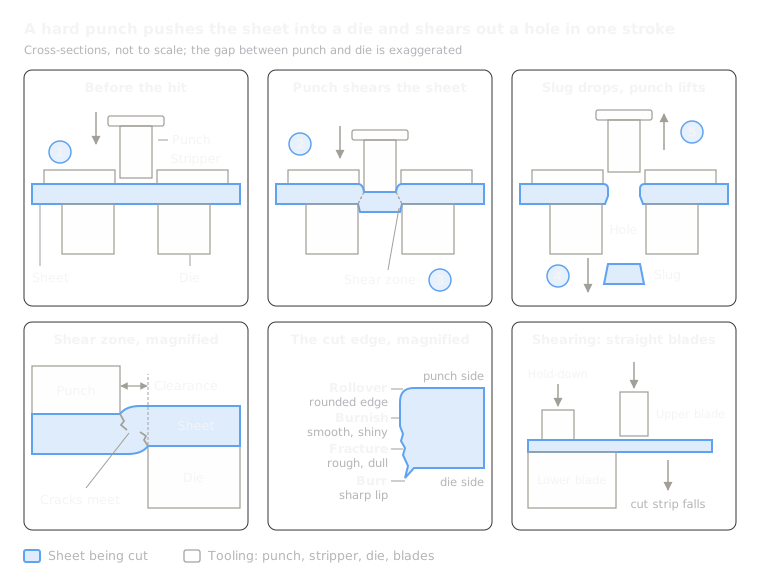 6.1Punching and shearingA punch shears shapes out of sheet against a dieOpen the lesson
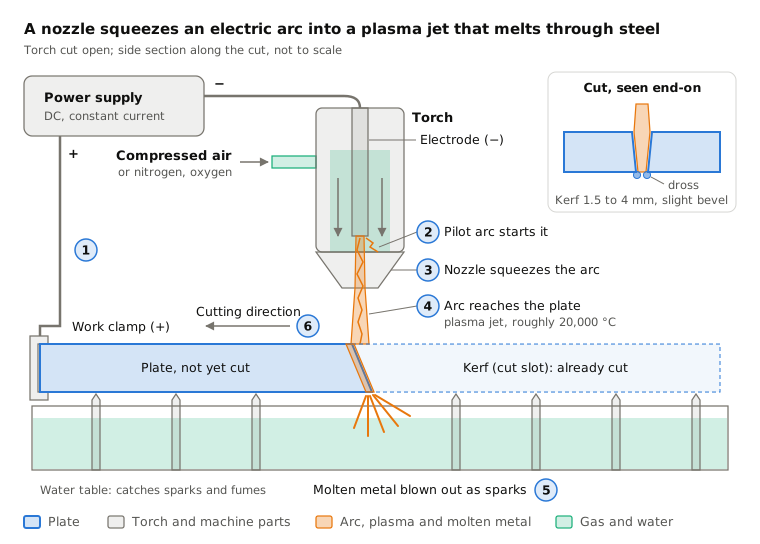
 6.3Plasma cuttingA superheated gas jet melts through conductive plateOpen the lesson
 6.4Waterjet cuttingVery high-pressure water, usually with abrasive, erodes a cutOpen the lesson
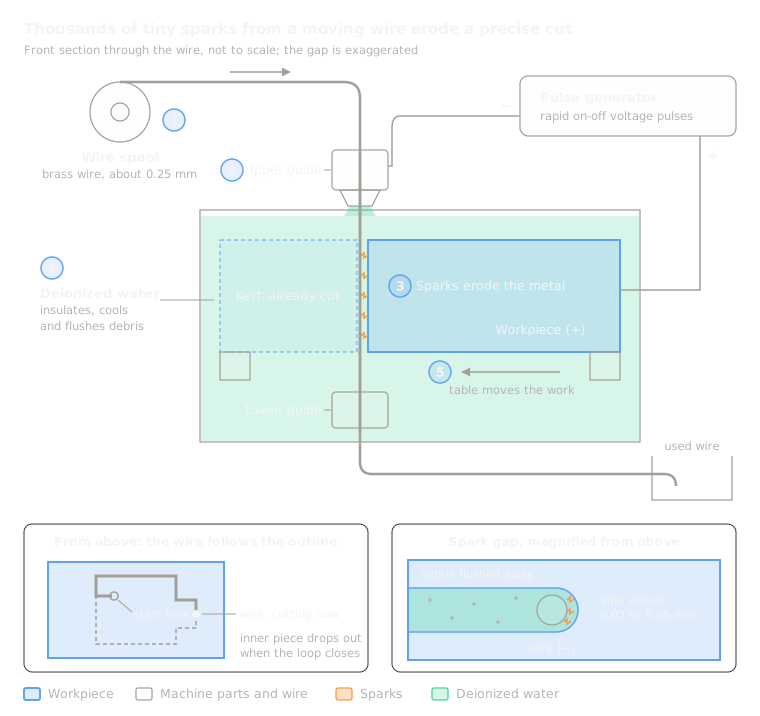 6.5Wire EDMSparks from a thin moving wire cut through-profilesOpen the lesson
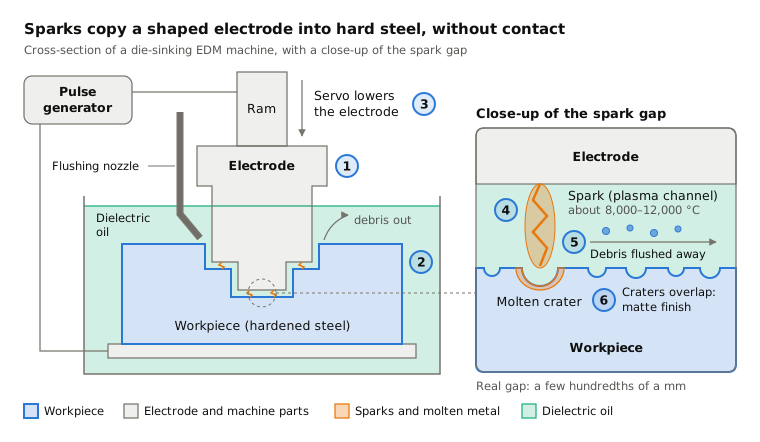
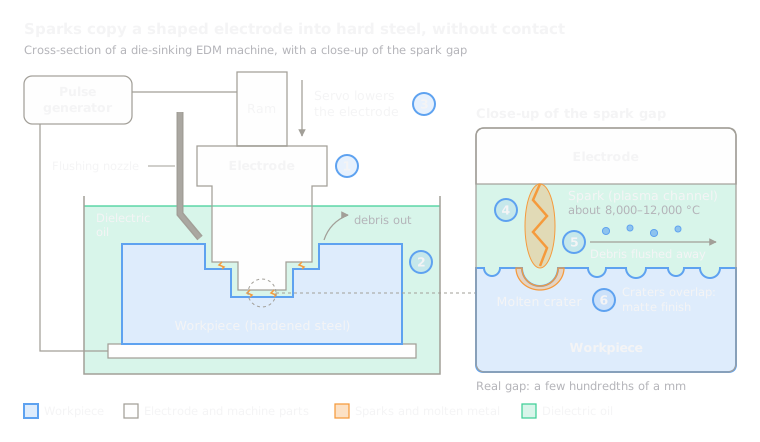 6.6Sinker EDMSparks copy a shaped electrode into a blind cavityOpen the lesson
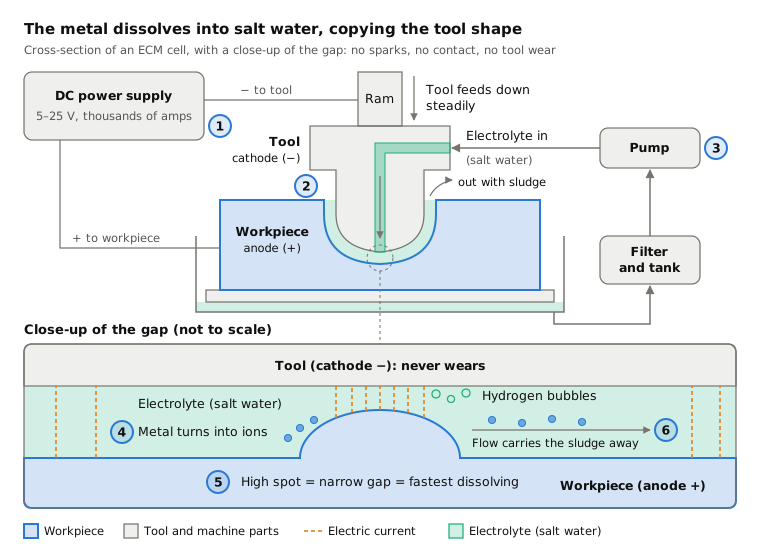
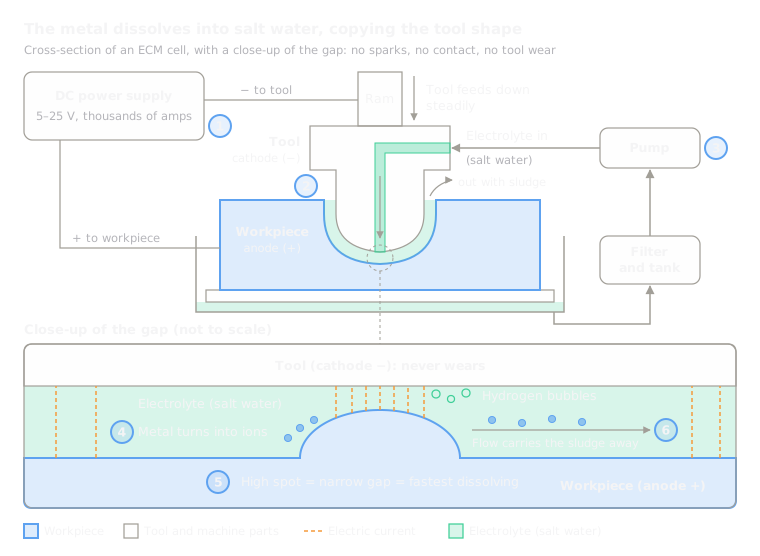 6.7Electrochemical machining (ECM)Electrolysis dissolves metal in the shape of the toolOpen the lesson
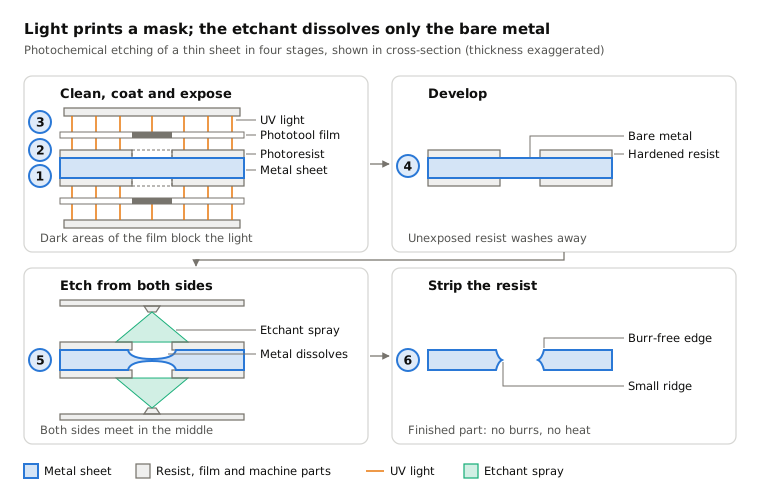
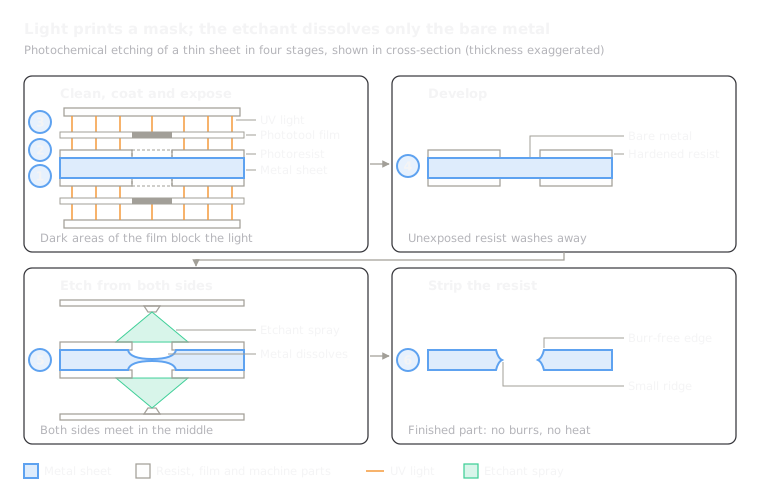 6.8Chemical machining and photochemical etchingA light-printed mask lets an etchant dissolve only bare metalOpen the lesson
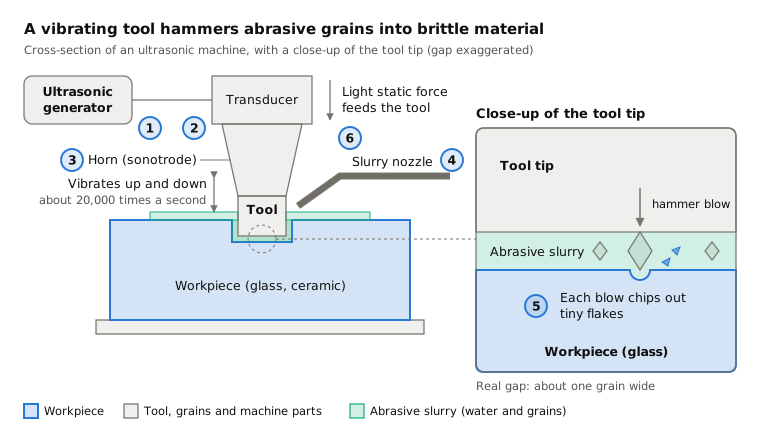
 6.9Ultrasonic machiningA vibrating tool hammers abrasive grains into the surfaceOpen the lesson
Try it
Put AI to work in your CAD.
Model parts, generate drawings and automate the repetitive work inside your CAD software.